Thursday, 18 December 2025

A Parallel Concerto—Mozart, Split Stitch and Zari

16 December 2025


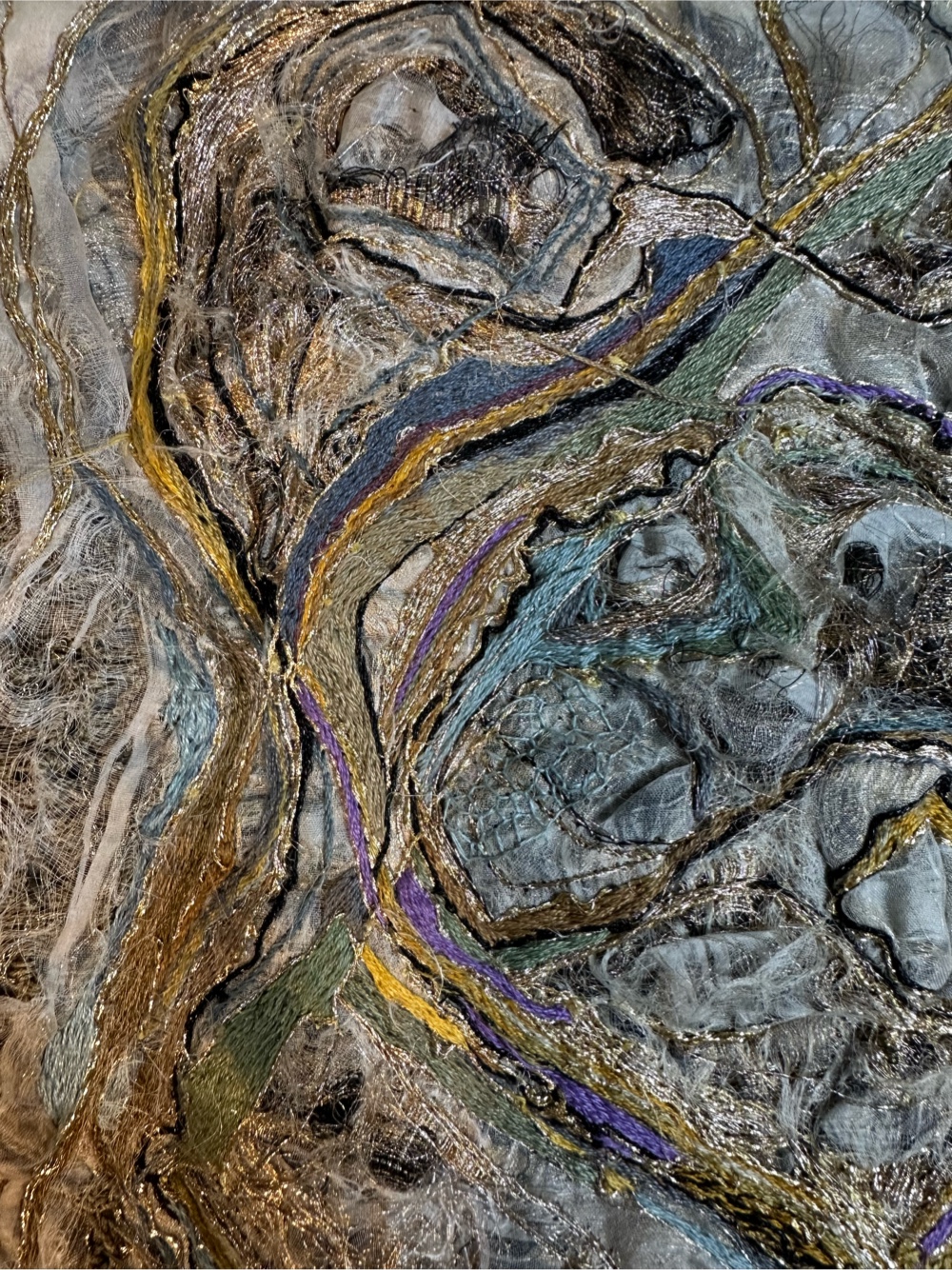
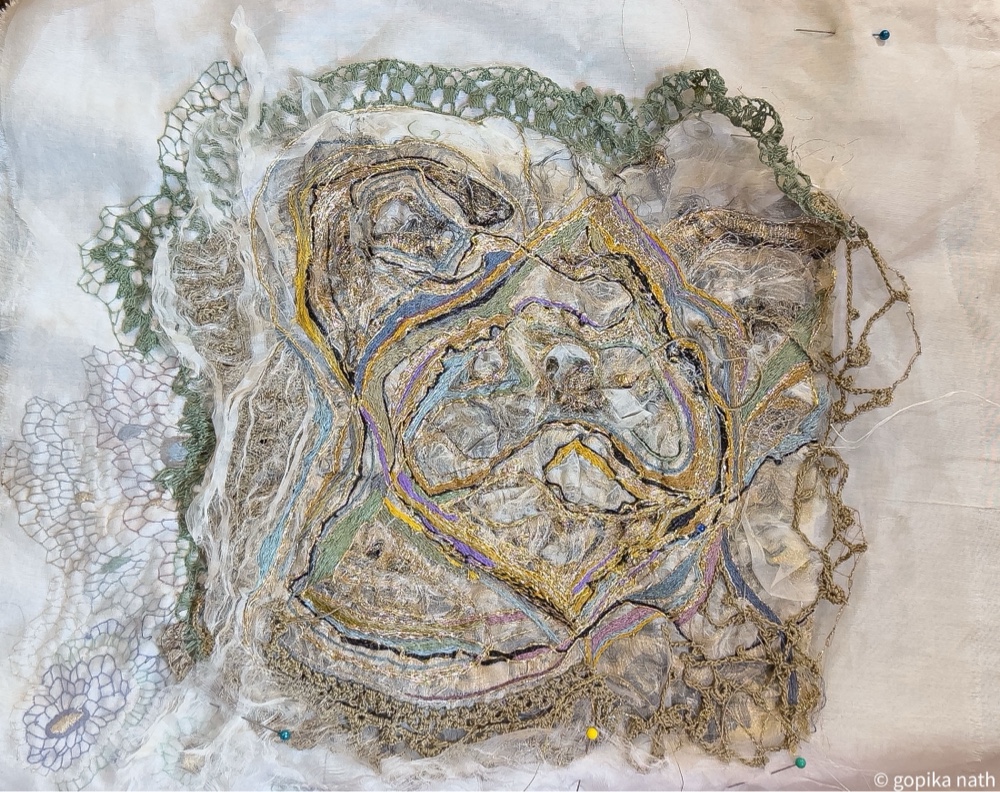
Today I sat with the piece — the third in the Co-creation series — working on it for hours at a stretch. I wanted to fill in the space created by the couched gold thread with a colour that echoed the muddy-coloured crochet I’d  added later. The crochet had made the piece feel bulky, and I wanted the whole to read as a continuum — to draw some of that colour inward, into the inner sanctum, as it were.

I put on some music — an album of Mozart’s violin concertos. I hadn’t really listened to Mozart for a long time. In my thirties I was a devoted listener; I ruined many cassettes playing them endlessly in the car. I was never very fond of his symphonies, but the chamber music, the clarinet concertos, the piano works — those I loved. I even named my black Labrador Mozart.

I wasn’t so familiar with the violin concertos. But as I listened, and by the time I reached the Fourth Concerto in D major, I began to notice a pattern. Mozart would take a melodic line that was  poignant, even melancholic and suddenly, shift it. There was no preamble, no warning. It was as if he was saying: enough. Enough dwelling on pain. Enough dwelling on happiness. Enough dwelling in darkness. This interchange kept occurring, and somehow he even managed to create melancholy within a major key. I don’t know how he did it.

At the same time, I was struggling with my single-strand split stitch. I was working on a fabric base that had been ruptured; the organza threads were everywhere, constantly catching in my needle as I tried to lay the floss against the surface and pick into the twist. I kept struggling to control it.

As I listened to Mozart, it felt almost as if I were stitching with him. There was effort, and then suddenly the stitch would fall into place. I would move forward and it would feel smooth and beautiful. Then the struggle would return. The thread would slip out of the needle. I would lose the needle altogether. It felt like a kind of parallel concerto, if one could call it that. The split stitch became a kind of Mozart stitch — no scope to dwell on any feeling for too long, not an indulgent somatic experience sustained by benign repetition.

At this point I was reminded of a cotton Ikat  weaver I met in Koyyalaguddem in Andhra Pradesh, during one of the projects I did there. Behind his loom was an old black-and-white television. I asked him why it was placed there. He said he liked listening to cricket commentary while he worked. If the television was in front of him, it was distracting. Behind him, he could listen and still weave.

That distinction stayed with me. Many craft processes are repetitive and exacting. The hand already knows what to do. What is required is sustained attention — the ability to remain there long enough for the work to accumulate. Background sound, in such cases, is not inspiration. It is support. It occupies one channel of attention so the rest can remain steady. The stitch proceeds according to its own logic; the listening allows the maker to stay with it. As I did with Mozart—engaged with the music that enabled me to work for 4 hours at a stretch.

As I worked around and within the boundaries created by the couched gold threads, what stirred a deep curiosity in me was my continued use of gold — or rather, zari. Zari comes from a Persian word zar, so it stands to reason that it is not an Indian invention. Historically, it came through Persia and was popularised by the Mughals. Trade moved along the western coast with Surat becoming a centre for Zari production. And,  during periods of instability and invasion in that region,  people migrated— jewellers, metalworkers, weavers — relocated  to regions of greater stability. They were housed and given work by rulers such as the Pallavas, Cholas, and Vijayanagar kingdom.

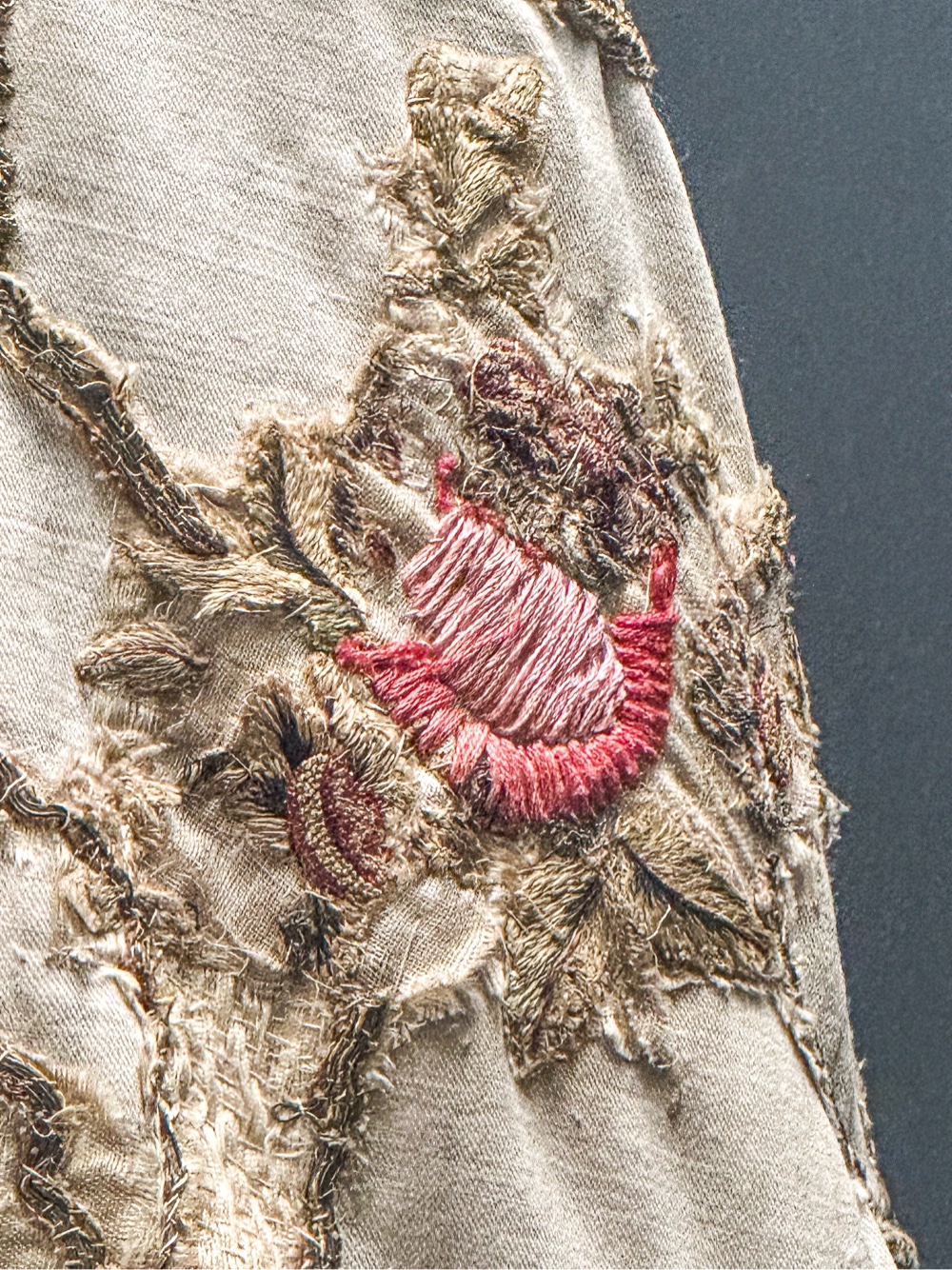
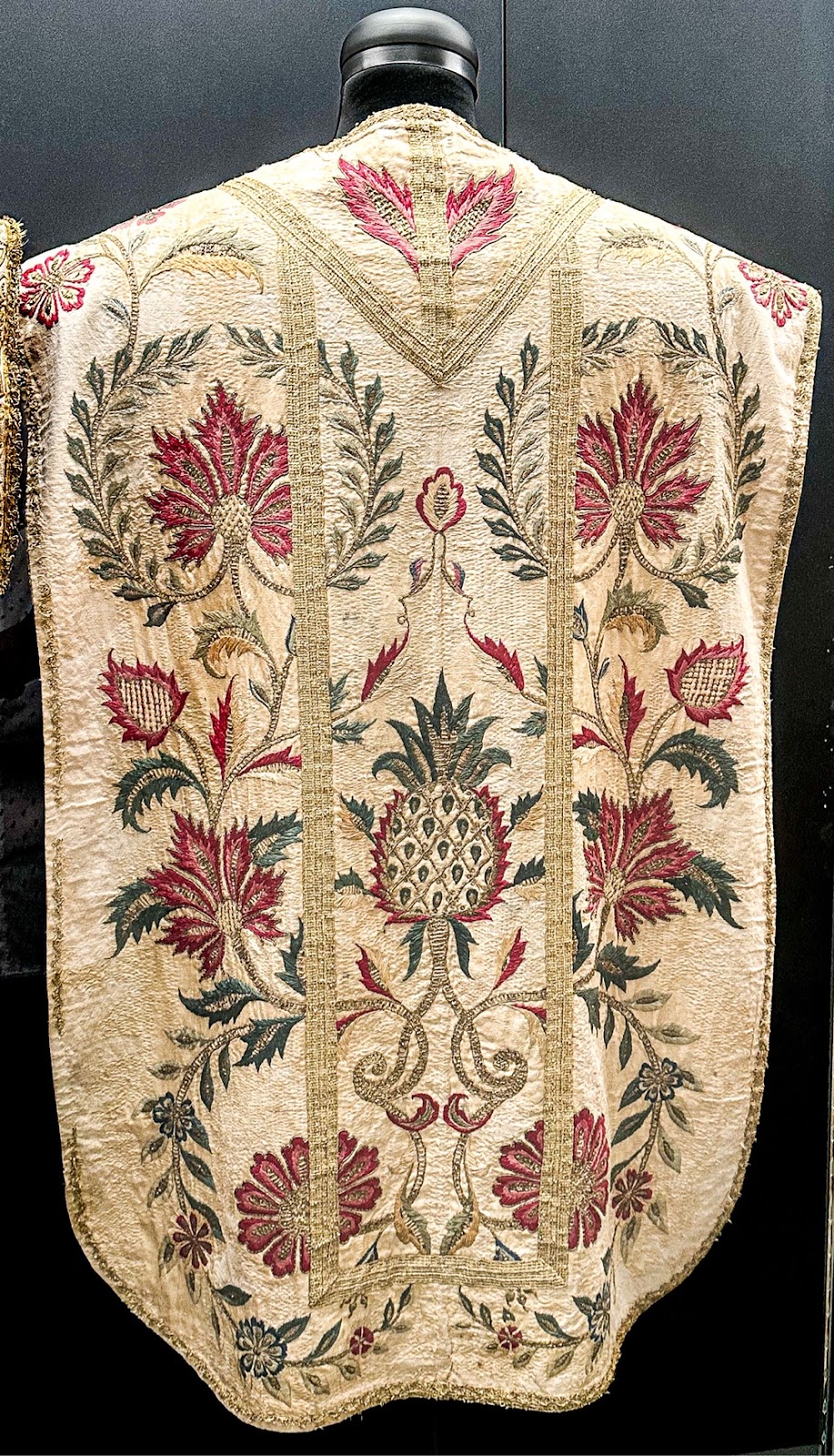
Within these temple economies— the Cholas and Vijayanagar, gold thread acquired ritual and symbolic associations related to divinity, radiance, and auspiciousness, but it never lost its connection to prestige and excess as employed by the Mughals. Where zari was unapologetically lush and ornate, used in court dress, ceremonial textiles, furnishings, and regalia, a logic closely mirrored by the Catholic Church’s use of gold embroidery to signify divine authority through material splendour. 

Textiles in these religious economies functioned as sacred infrastructure. Gold and silk were not about fashion, but ritual necessity. Gold entered cloth not as ornament, but as an expression of divine light and cosmic order, shaped by temple economies and forms of political theology

 As I reflected on this history, I also reflected on myself. I own jewellery, but I rarely wear it. In Delhi, for a significant occasion, yes. But in daily life, nothing. My mother used to lament that girls cannot be without jewellery on their wrists. But bangles interfered with my work, so I chose not to wear them.


I then thought about how gold entered this piece in the first place. It began with sunlight glinting on the waves. That light created a crack in me — an opening that let something in. Not just visual light, but a philosophical one. It was not an intellectual understanding. It struck the gut, spread through the body, and settled as something unshakeable.

Being drawn to gold outside the body, in a controlled, meditative, material way, I realised that I  may be responding to its older function — divine light, cosmic order, such as is evoked in the Vedas where,  Indra is described as ‘golden hued’ Agni as ‘golden haired’ and the source of life is hiranyagarbha or the golden womb — rather than to its modern role as social ornament.

Standing at the tip of the estuary, on what we call Sandbar Island, this is what I perceived: nothing I do exists without a past. That past is formed by people around me, by their pasts, and by the pasts that shaped them. Everything is layered and co-created as were the images I was recording: sun glinting on water, rippling on sand ripples—a confluence of light, water, earth and wind.

It occurred to me then, within the context of living that whatever one feels or thinks—the authorship is divided. It does not belong to a single person— everything is co-created.

That was a moment of realisation — when understanding moved through the body and settled. I think that is what truly holds the key to this piece.

Reflecting that complex layering, the work appears strange — threads removed, delicate and transparent in places, yet dense and impermeable in others. Fabric from layers beneath surfaces through the organza above. Materials at odds with one another, yet organically combined. I am still attempting to create harmony and tonal parity within the composition — a balance that, in life itself, may well be impossible.


Monday, 15 December 2025

Thinking Aloud —


Where the Judgement Comes From


I began this process journal partly in response to reading Glenn Adamson’s Thinking Through Craft. I was hoping to encounter a discussion of craft as lived process, but instead found a great deal of art‑world language aimed at making craft legible to contemporary art discourse.


For me, craft does not need to be translated into theory to be understood. Process is the very core of crafting. Working with textile and stitch, meaning emerges through material negotiation, repetition, resistance, and decision over time. I began recording my process not to analyse myself, but to pay closer attention to how material intelligence operates in the making itself — how fabric, tension, layering, and intuition shape the work as it unfolds.


13 December 2025


Fact is, when I think of tabulating my working process — the process by which I make my art — I realise that so much of it is ingrained in how I look, what I feel, how I approach it all.

Yesterday, I was working on one of the co‑creation–inspired pieces. The third one. I had been more creative with it, introducing blues and a lot of gold. What I noticed was that it looked bare without my usual tendency to create a border.

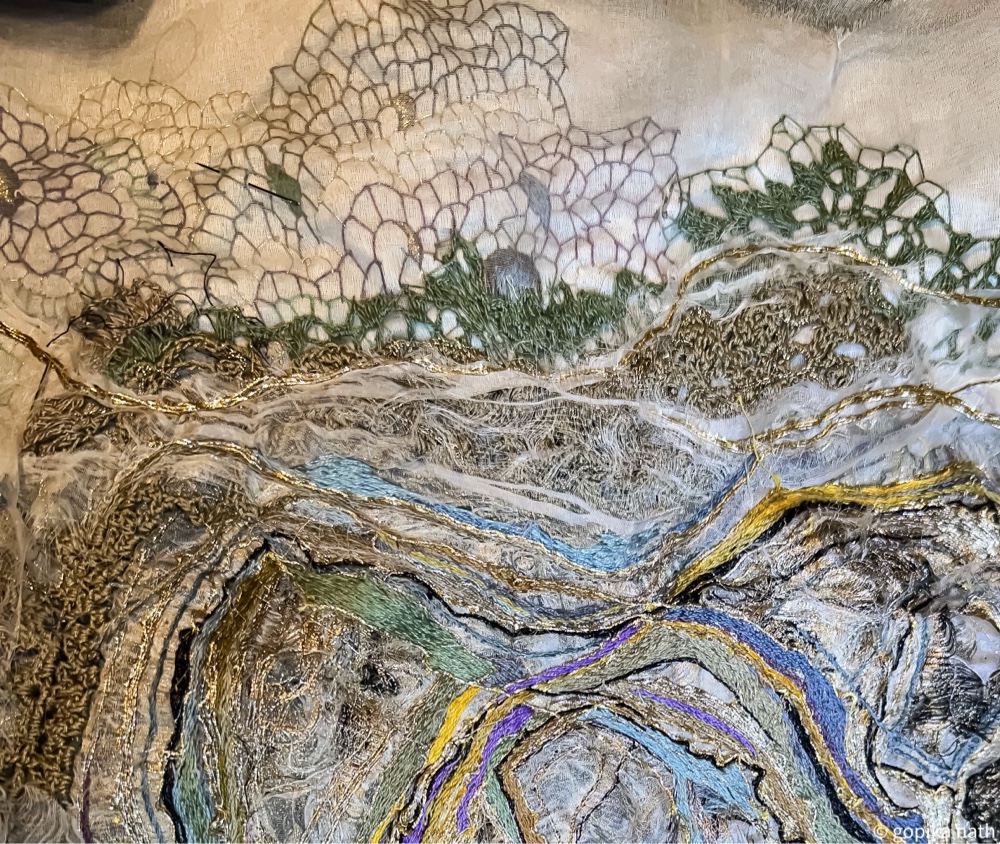
I found the idea of adding crochet around it and then using that to create buttonhole lace interesting. But as I worked on the crochet, I used Doli. thread, which made it feel rather heavy and ungainly. Trying to contain the original within the framework that was evolving seemed clumsy.

But that sense — that it looked clumsy — where did that come from? What was I trying to achieve that made it appear clumsy? What aspect of design composition, visual impact, or my own sense of beauty was being thwarted by this feeling of clumsiness?

What am I trying to arrive at? What idea, ideal, or beauty am I moving towards, and why?

What I mean by ungainly is this: the thread is heavy, and the work itself is on organza. I have layered it with tissue organza and ripped the fabric by taking out threads and exposing different layers. It has a very delicate quality. But the Doli thread is thick. I wanted to create a muddy kind of texture relating to the sandbanks of the river — the ripples that are co‑created by sun, light, and wind. That is one reason why I’ve added so much gold.

I’ve used 6 ply metallic thread or zari, which is couched, and I’ve also stitched with single‑ply zari. When I added the border, that thread was thicker, and it felt clumsy because of the imbalance. Yes, it is a perceived imbalance, and I’m trying to interrogate why this imbalance feels uncomfortable to me.

The reason I give a border to my work — and this is a tendency of mine — is that borders are something most block‑printed textiles have. Every sari pretty much has a border. I have a quilt with block‑printed bootis (motifs) and a four‑sided border. Perhaps it comes from that tradition. Perhaps it comes from the Mughal miniature tradition of the hashiya, where the border is also saying something, in conversation with the piece.

I like the idea of the hashiya because it allows me to have that conversation. The reason I wanted to create something with buttonhole lace was that if I framed it in the usual way, I would have contained it within a mount, and I didn’t like that idea. It would have given the piece no space to breathe. And if I had just left it in the awkward shape it had evolved into, it looked unfinished.

And perhaps that is my discomfort too — that I don’t like to leave things unfinished, or what looks unfinished. How do I decide what is finished? How do I decide what is unfinished?

Perhaps this comes from my training as a designer. Perhaps it comes from an inherent need in my mind to resolve everything. Perhaps it comes from a deep sense of shame that I carry.

A sense of shame that emerges from past experiences that were erroneous — where, in retrospect, I feel naïve, ignorant, and downright stupid—embarrassed to have been that person. I’m still unravelling that sense of shame, but perhaps, within that context, I try to finish everything with a neat border.

Perhaps.