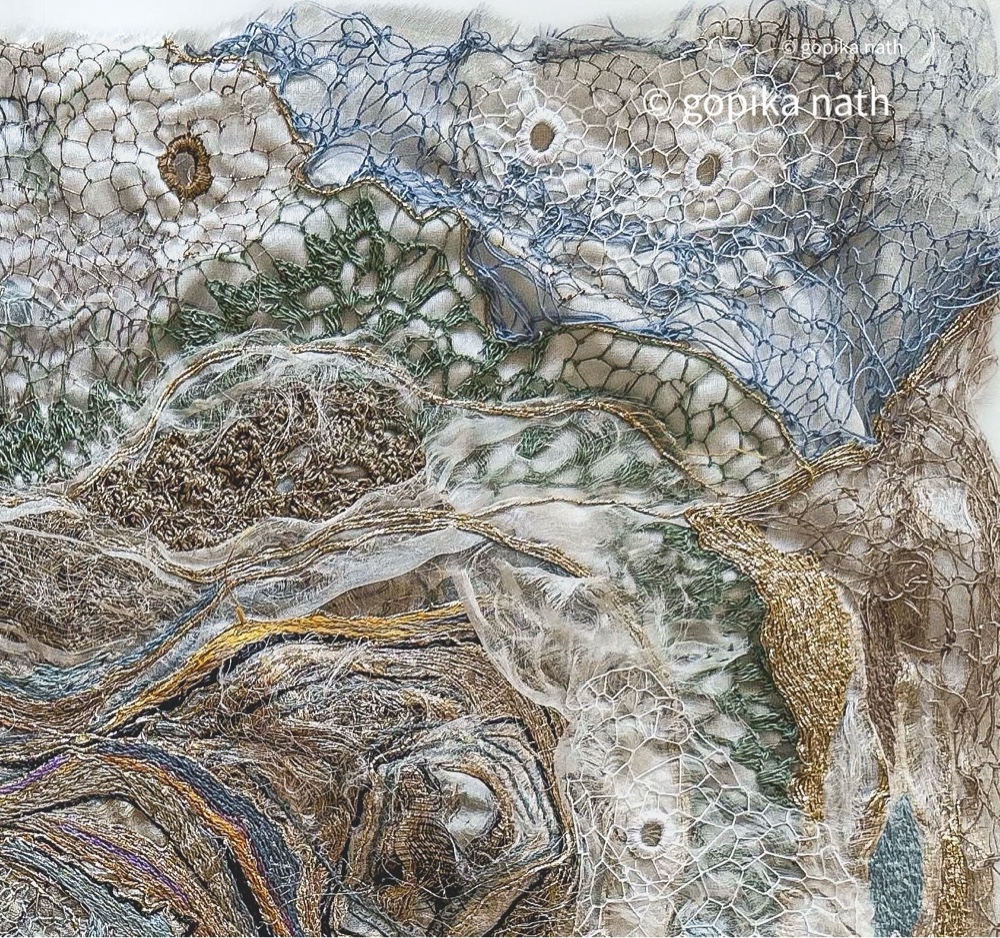
Today, while couching the six ply zari, I found myself moving beyond the original knitted lines. Those lines rose and fell like tidal waves, vertical yet fluid, and I wanted to honour that undulation. At the same time, I had to break it. I couldn’t fill everything. Something had to give.
So the work became a series of decisions. Where to begin. Where to stop. Where the thread should turn. How much of the line to keep. How many lines were enough. I would place the thread, finish one run, put it aside, then stand up and look. Step back. Return. Decide again.
This is where I have arrived through practice. What David Pye named the workmanship of risk describes this precisely: a way of working in which quality is never assured in advance, and where every move carries consequence. Nothing is secured by a plan. The work lives or fails in the moment of making.
When there is a design, you don’t have to do this. You simply follow what has already been decided. But I am not working from a fixed design. I am working from a space I don’t quite have a word for yet, where attention replaces certainty, and where decisions are made in response to what unfolds rather than what is prescribed.
This is often called intuitive, but that feels insufficient. What is actually happening is a conversation. The material pushes back. The line resists or yields. The hand answers. Form emerges through this exchange— what Tim Ingold describes as correspondence: making as an ongoing dialogue rather than an act of control.
The original impulse came from co-creation: the sun on water, water on sand, wind on water, ripples in sand. The glinting light. That moment of recognition that nothing is made alone, that form is always relational. You know this, but sometimes it becomes clear only through the act of looking— being present. And, I’ve chosen to investigate it further through making—stitching.
I am using gold as light. And light, for me, is wisdom. Not ornament, but perception. In that sense, thinking through craft, as suggested by Glenn Adamson, is not an abstract position but something that happens in the work itself, in judgment, hesitation, revision, and care. As I read his book on the subject, I became curious as to its academic stance. Adamson is not a maker, he’s an art historian and scholar, attempting to locate craft within the fine art mileu. I am too, in a sense. But his writing inspired to me to articulate the nuances of my stitch-craft-art making practice from within it, rather than as a academic who observes, their uses and writes.
Working so much with gold has also made me more aware of how this material is received. Zari, sheen, surface, what might easily be dismissed as bling. Even though it comes from a long and specific lineage, the certified art world is uneasy with this kind of material density and materiality. Textiles are of interest to the art world today, but they are expected to transcend themselves, to become something else in order to be taken seriously.
What I am doing does none of that. These are small works. Twelve inches, fourteen, sixteen at most. They stay firmly within the language of stitch, of couching, of repetition and adjustment. I am not trying to dismantle categories or reinvent technique. I am staying inside what these materials already know how to do. In fact, I revel in the materiality — in the infinite possibility that textile, embroidery, crochet, knit and their materials give scope for, in terms of expression—making art. And for me, art is what Ananda Coomaraswamy wrote: that it wasn’t what you did, but how you did it, that made it art—devotion and presence presided rather than the intellectual concept that fine art now revers.
My work is demanding. It asks for sustained attention, judgment, and presence. Much of it is about watching myself work, noticing how decisions are made, how hesitation enters, how form slowly clarifies. I work as an artist, but I do so through material insistence rather than conceptual distance. The thinking is not above the work. It is embedded in the stitch, in the process, in the insistence of the hand.
So each day I am finding my way through it. Slowly. Sometimes reluctantly. There are moments when, despite stitching being somatic and grounding, I resist returning to it. Not because it is difficult, but because it demands decision-making. Presence. Accountability.
This is where risk lives. Not in grand gestures, but in choosing without a script. In staying with uncertainty long enough for the work to reveal what it needs to become.
There is also a question that sits alongside all of this, and I don’t yet have a clear answer to it. While academics may want to analyse what the craftsperson does — how decisions are made, where risk enters, how the hand moves, how the material responds — language always comes later. It describes what has already happened.
What I am more interested in is what this awareness actually does to the making.
At the moment, I find myself watching myself work. Not judging or correcting, just noticing. How a decision forms. Where hesitation enters. When a line feels complete and when it doesn’t. It feels a bit like being a witness to yourself while you are still living, still inside the act.
Perhaps the merit of this awareness is not only for the person making the work. If the making is clearer, if the decisions are more present, then the work itself may carry that clarity. It may also allow the viewer to come closer, to sense how the piece was arrived at, not through explanation but through looking.
This may shift the experience of viewing. Less emphasis on what the work is saying, and more attention to how it came into being. A slower, more intimate relationship with the work.
At the same time, for me, meaning and process are entangled. What the work says emerges through how it is made. The decisions, the risks, the material itself — all of this shapes the work’s voice. I am not interested in choosing between concept and craft. The work holds both.
It is also clear to me that reading Adamson, Pyle, Ingold and others has fed back into the work. I might not have thought of what I am doing in terms of risk, or noticed it so clearly, if I hadn’t read David Pye, or thought about correspondence in the way Tim Ingold describes it, or encountered Glenn Adamson’s writing on thinking through craft. The ideas did not replace the experience, but they gave me a language that sharpened my attention. I began to see what I was already doing.

Wow your writings into your process are almost meditative,immersive and also so tactile one feels one has been part of your artistic journey.It begs a book .
ReplyDeleteThank you Sumira, I’m gratified that my writing can carry you into my process — man’s you s part of my making.
Delete