Showing posts with label stitching. Show all posts

Sunday, 14 June 2026

Mind Replays While Tacking


It's almost four in the afternoon. It's been a strange kind of day. Rain, no rain.

As I awoke to the day, looking out of the window, I noticed how serene it looked. So innocent—as if the cloud and the fronds of the palm leaf were cradled in a baby blue crib.

Then, as the day progressed I had to dress my wound. I'd burnt my hand three days ago while cooking. I wasn't exactly careless, but I didn't pay enough attention to the fact that the lip of the new saucepan is a little tricky— doesn't pour neatly—spills and splashes—most annoying.

Anyway, the long and short of it is that I pouring hot soup into the mixie, I burnt the top of  my left hand. A very, very severe burn. After seeing the skin wither and peel off with pus beginning to rise,  I had to go to  a nearby primary healthcare center. They gave  me an injection for the pain, some antibiotics and painkillers. I was yelping in pain. It was really bad—terrible!

I couldn’t stitch for a few days because any movement of the left hand, disturbed the dressing, which in turn aggravated the wound.

It was uncomfortable and I couldn’t help but think how people can inflict this on anybody else, but more than that, how do people self-immolate? I remembered the protests against the Mandal Commission and those students in Delhi setting themselves on fire. I didn’t witness it myself, but newspaper images of young men flailing—their bodies aflame—aren’t easy to forget. I don’t know why my mind went there, but it did. We read about bride burning and such things and it’s awful, but burning my own hand this way made these images come alive as never before.

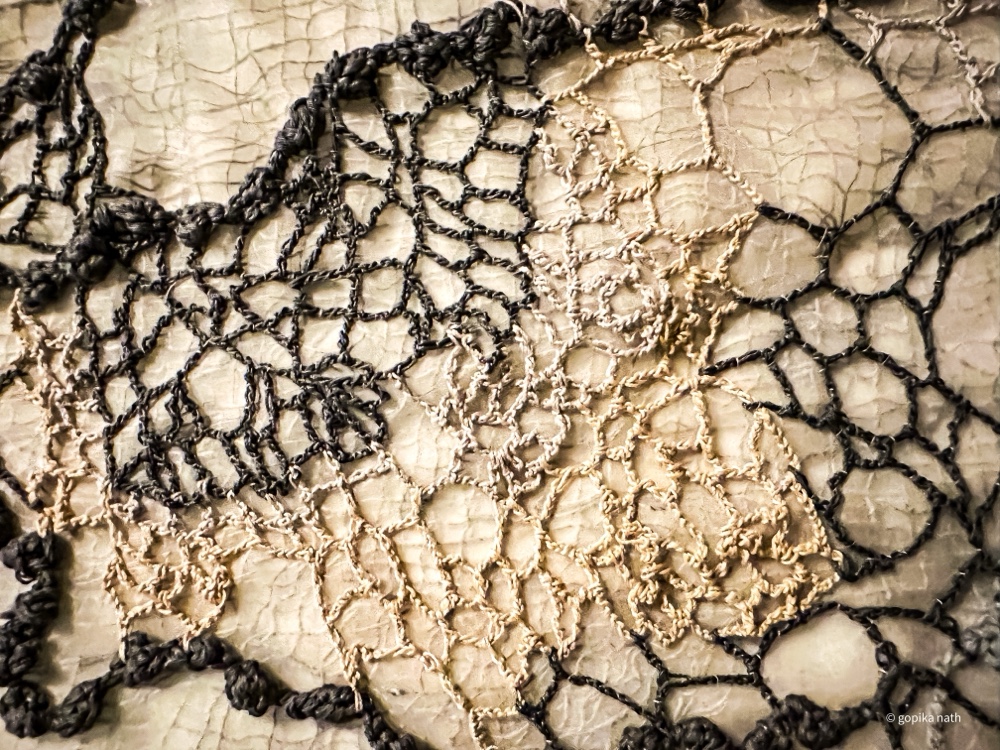
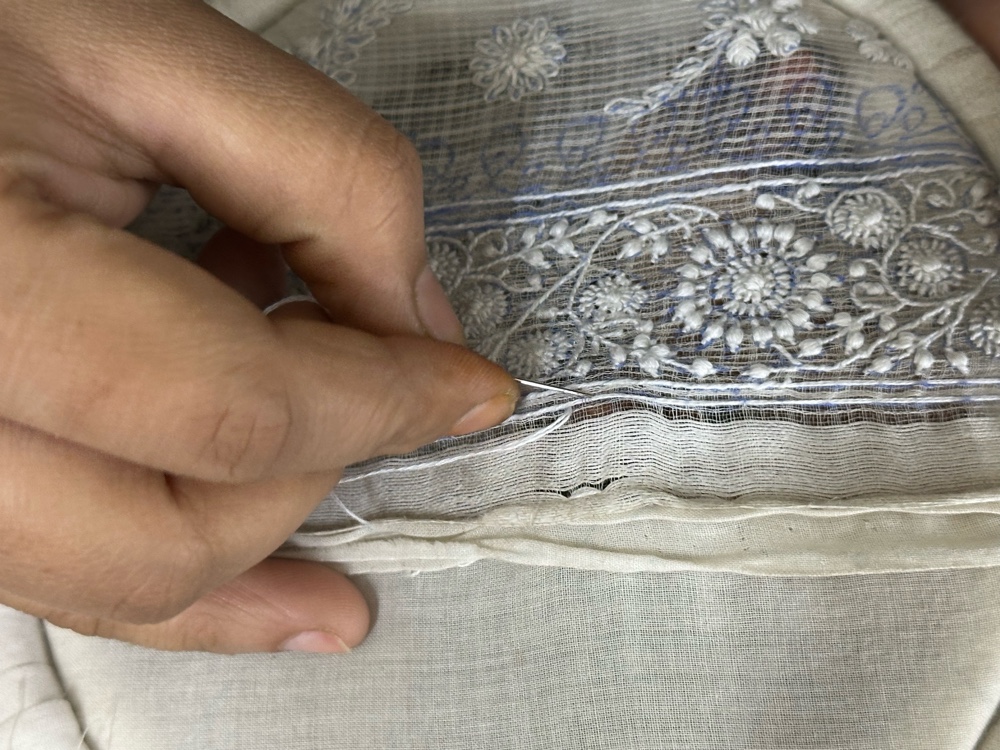
I'm now working on this piece—tentatively called Crab Lace. I've been doing it for a long time and it's taking forever because a lot of tacking work has to be done between the five layers of fabric before I can begin any embroidery. Tacking isn’t something that makes me think too much about what I’m doing. My mind starts replaying all that I have read/heard etc. 

There’s the war in Iran—neither war nor peace, a supposed ceasefire that's not. Glancing at the NYT headlines, disturbed the serenity of the day and what I’d been observing about the weather. Making me think that,  I have the luxury of these gentle moments, even the observations I make about my stitching. Those in war strife zones are striving for basic survival. It seems unfair.

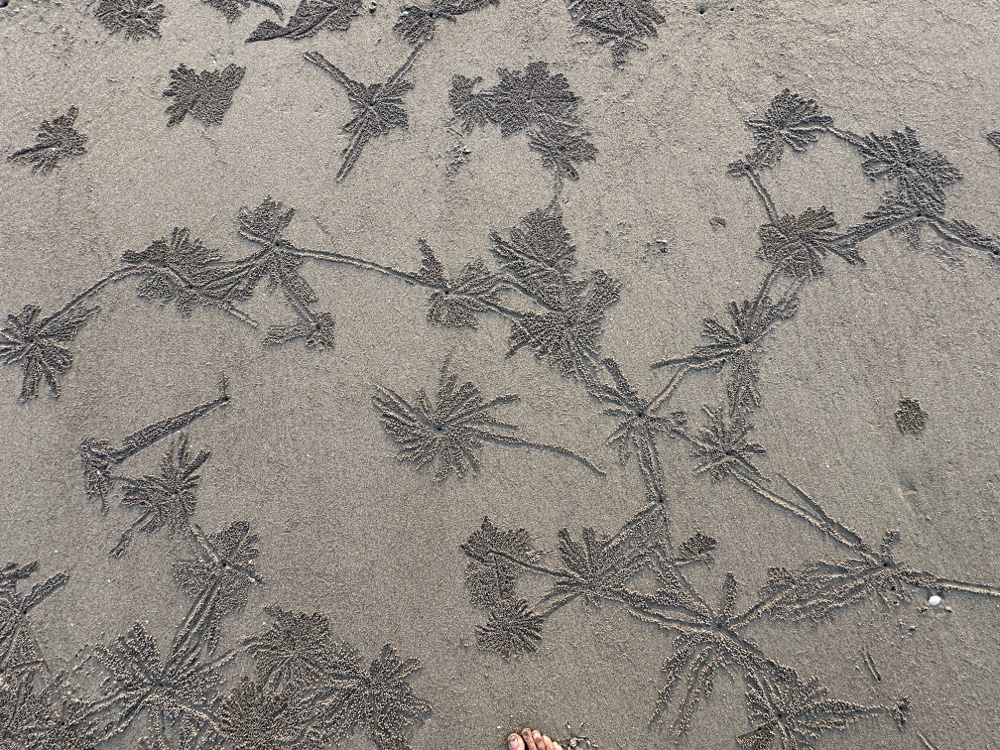
The stitching piece  is inspired by the way the crabs feed off the debris on the beach and in effect clean it for us. Perhaps that’s something we could do for ourselves. Chew on those moments of grief, of pain, of discomfort—digest them.

Now, I have  a knot.  Most uncomfortable. I'm inserting the tip of my needle into the core of the knot, but it is so tight I can't get needle-point into it. If I could, I'd be able to wrestle with it and open it out. It's so tight and so small, I probably need a magnifying glass.

Recently I got news that two of my friends have been diagnosed with cancer. It’s troubling me. My father had cancer and I know what it did to him—to all of us. I know it was decades ago and medicine has made significant advances—but those memories don’t just go away.

I'm holding the thread in my left hand—the burnt hand—it still stings a bit. Between thumb. and index finger, assisted by the second finger, I’ve pulled it taut so that I can try and find the space to inset the needle point to loosen the knot. I'm doing a lot of guesswork because I can’t really see the gap in the threads that have knotted. I have a really fine needle, but maybe I can get a finer one.

Okay, so I've got the finer needle into it. The knot is moving. Now the question is whether I can open it all the way through—unravel the threads to resume stitching.

And I have.
It is so satisfying when you can open a knot.

To me, this  likens  to the wound sitting inside us— things that are knotting in our stomach—the acidity and tension. If you can just release it, it is does indeed lend a sense of satisfaction, doesn’t it?

I like the parallel of the crab digesting its food with us digesting our emotions and cleaning up the environment so that subconscious actions don’t create a stench. Rolling bits of sand in its mouth—then rolling it out into minute balls of sand —moving out of its burrow radially and depositing the feeding residue like sand-lace. It’s a  beautiful image that allows me to think there can be, that there is beauty in dealing with our feelings and emotions. The healer in me wants to believe that we can lessen our body suffering if we pay more attention to what's going on in the mind.

Perhaps I've cultivated that kind of sensitivity. Perhaps that's the kind of person I am. It’s certainly the direction my life has taken. It’s arduous, it tedious—much like the labour of the minuscule sand bubbler crab—especially given its size—its  persistence and ardour are memorable. 

see a lot—both a blessing and a curse. Noticing minute details of life around me. Getting easily stimulated. I can be sitting in my room just drinking water and I will notice the sky. Noting changes in the colour, clouds,  how the shadow travels among the leaves and how delectable that vision is—between filling glasses, between sips. 

And then the mind goes to those who live in war-strife zone. These countries, people living in that region  don't have that luxury. But doesn't that make my capacity  all the more pertinent?

Art is made in all sorts of spaces—in many ways that range from being guttural and spontaneous—responsive in a direct way to subtler visuals. The kind of art that I make is slow and can get quite tedious. The immediacy of expression isn’t possible. Even though the impetus to start something is. But Crab lace—the piece I’m presently working on—it’s more about what the crabs do that inspires me than something I’m feeling aggrieved about.

I’ve been  stitching the layers for months. I’m trying to re-create my own version of the patterns I find on the beach. Evoking the kind of residue that emerges once I’ve been through the emotional vortex—what remains. Sometimes I don't want to come and stitch. It's so tedious. It's not giving me a moment of discovery. It's not challenging me technically. It's not challenging me emotionally. It’s just about tacking and more tacking.

And then I talk myself through it, as I am doing now. I've got the audio on my phone on.  And I'm just talking through the stitching so that the moment is as real as it is.

I am processing like the crabs do.

The zigzag stitches from underneath, which I'm not trying to cover, are a subtle expression of the way the mind does work. So many thoughts, so much that comes up when there is a little space from insta, news, fb and the rest of it. 

I've come to the end of my thread, so I'm cutting the tail after I’ve done  two or three repeated stitches in the same place, and then through those two or three threads, I take the needle and and thread out—hopefully it will not come undone. And quite frankly, the kind of piece I am stitching, if it does come undone, it might very well be more evocative than perfect stitching.

I think of my mother who suffered such a great deal with severe osteoarthritis and Parkinson's. For the last two years of her life, she was fed by a tube. She’d beg us for taste of aam papad, coke, chocolate or tea and mangoes. A lick was all she was allowed. I often wonder if she’d paid greater attention to her emotional wounds that her body wouldn’t have had to take on so much suffering. There’s no scientific proof for this, but I think about it all the time. 

I wake each morning wanting to know what I'm feeling. I journal to understand that feeling. Sometimes I have weird dreams and then I write them out, wondering what my subconscious mind is telling me.  Then I’m distracted by a dark-skinned man climbing up my neighbours coconut tree and I lose the thread. Mind screams overload. Is it because I’ve sensitised myself to the subtler dimensions of being, or is this the way it is with all of us—perhaps not consciously?

The world gets uncomfortable with pain. It wants people to move on. But grief doesn't work like that.

As I sip some elaichi chai, the mug I'm drinking from was painted by my school friend Punchie. She paints these mugs with Hopi style, North American—Indian inspired black-and-white designs. As I savour my tea, I think of her:
She recently lost her mother.

Even though I lost my own mother ten months ago, and we didn't have a particularly close relationship, all kinds of wounds continue to surface. Grieving is something you cannot put a timeline on.

Sometimes the thinking and feelings that come up while stitching gets  so intense that I have to get up after half an hour, or even after ten minutes of stitching. I just need a break from it. From the emotional vortex, from focus on both this and the stitching at hand.

I may put on some TV, but honestly that doesn’t really stop the undertow of thoughts—just helps me keep going. And then later at night, I lie awake with what’s bothering me . 


Friday, 8 May 2026

The Intimacy of Stitch


After returning from travel and two weeks of intense outward engagement, I realised that my resistance to stitching was not simply fatigue or distraction. It was something else.

After days of immersion in other forms of attention: travel, conversations, paperwork, pending tasks, research into Kasuti, observing other methods of making, meeting artisans, studying structure and technique. Engaging with architecture, food, soil and stone — tabulating possible references for the beginnings of Kasuti. Although I remained intellectually engaged with needlework, I was not stitching with my own hands. And when I returned home, it took me another two weeks before I could fully approach the large textile piece waiting for me.

The work itself is ambitious, approximately 1.5 by 1.5 metres, layers of cotton crochet contained and layered between layers of unbleached silk organza. I have written about this evolving “crab lace” process, where crochet fragments and residue become part of a larger stitched surface.

http://gopikanathstitchjournal.blogspot.com/2026/03/crab-lace.html

At this stage I was tacking together five uneven layers of cloth, freehand, without a frame, because the crochet protrusions and shifting surfaces made stretching impossible on a hoop and my ‘adda’ isn’t large enough to accommodate this scale. The work had to be turned repeatedly on the work table — guided by the hand, its proximity to areas that needed to be stitched — maintaining tension and more.

I had chosen a pale grey thread deliberately. Against the black crocheted threads it remained visible, but against the grey and off-white lace it almost disappeared. The stitches moved between visibility and disappearance, holding the structure together — a sense of ease, familiarity and rapport I hadn’t noted before.

As I returned to the act of stitching itself, I became aware of something I may well have felt for years but had never seen nor articulated so clearly: there is an extraordinary intimacy to stitch.

I began my design life as a weaver, and I loved weaving. I still remember the wonder of watching individual strands of thread slowly become cloth. The processes of winding, warping, threading the heddles and reed, passing the shuttle back and forth, all carried their own rhythm and intelligence. But weaving, I now realise, also maintains a certain distance between the body and the cloth. The loom dictates posture, width, tension, movement. Even when one is deeply involved in preparing and constructing the weave, the fabric itself remains stretched within an external structure. The body adjusts itself to the loom — almost always separated from the emerging fabric, by the reed and the frame of the loom.

Stitch and crochet — even knitting, feel fundamentally different.

Here, the cloth engages directly with both hands and the body. It gathers, folds, bunches, softens, and resists according to the movement of  one’s limbs and torso. How I sit is relevant to how I stitch. The work is turned instinctively, held against the lap, cradled and shifted constantly — in search of comfort and control. The material adjusts to you as much as you adjust to it.

While tacking these five layers together, I could feel the organza rubbing against my fingers. Its starchy silkiness — a familiar discourse. I was ruching the fabric to grip it more securely, while managing the uneven tension created by the crochet and layered cloth beneath, as I stitched. At times,  just placing my hand gently under all the transparent layers—palm facing upwards—giving the needle support to pierce. Sometimes no hand under, just the cloth placed on the table—both hands above, helping the needle, pulling it out.  Hands smoothing over the fabric after a few stitches—sometimes holding tension, otherwise gently avoiding bulges. The crochet itself was malleable, constantly shifting shape—I pulled it where I wanted to see more space. It pulled back where there wasn’t enough thread for elasticity.  Every few moments I had to stop, lift the entire piece, rotate it, settle it back onto the table, readjust my body, leaning forward, bringing the fabric closer, ruching and tacking.

The needle held between my thumb and index finger —moved in and out of them. Carving little dents into each. The thread tunnelled through its eye, passing these two fingers. The work was not distant, it was an extension of me — continuously touching, caressing, nudging, coaxing me into a dialogue.

To stitch is to enter a relationship with the fabric, the needle, the thread. The attention it demands takes me inwards. Almost subterranean. One cannot remain outwardly focused while stitching. It brings up thoughts and feelings in an unexpected way. Urging me to sit with them. Creating a rhythm that enables this. It becomes difficult to avoid yourself.

In that sense, stitch resembles an inner conversation. Not performative thought, not social speech, but something quieter and more direct, even if it’s without words. Something changes, shifts — the mood alters.

While working, I found myself relating to my inner life with the same closeness with which I was relating to the fabric: like a journal I write by hand — sensing resistance, recognising fragility, allowing slack where necessary. Stopping when it gets too intense. Pulling gently where continuum was needed, tackling resistance to a deeper excavation of being. I know it’s where my sanity lies. I know it’s how I deal with stress, but sometimes it’s like starting a relationship all over again.

Perhaps this is why returning to stitch after periods of outward immersion can feel difficult. It asks for a different state of being. It asks me to slow down, to be comfortable with repetition, to touch and pay attention to what I am doing, in a very precise and meditative way—to be comfortable in my skin: an intimacy that seems almost alien when outward in the world.

And yet, once inside that space again, there is also familiarity. A recognition. A return to a state of flow. The body remembers the relationship before the mind fully does.


Monday, 2 February 2026

What Remains, What Repairs…


“Craft is healing. It helps people feel grounded, purposeful, and whole.”

— Betsy Greer


I spent most of the day stitching.

Yesterday was a long, social day. I’m feeling unsettled. Words cannot quite express my overstimulated mind: teaching a five-week online course, an enriching talk on Hampi, meeting old friends, recriminations, affection, chiding, eating a delicious but heavy meal. Grocery shopping en route to the meetings. Overspending and then returning home to put everything away. Sleep was elusive, as it often is when I’ve done too much.

I need to stitch. I need its somatic, meditative movements. I need thoughts to form, not be dismissed in the way they might be through yoga nidra or meditation.

As the needle enters the cloth and exits again, as the thread tightens and holds, as one action follows another, my day in the world becomes, briefly, coherent.

It’s often said that stitching is healing. But is it? What do we really mean by healing?

We have all seen ruptures of the flesh, wounds that heal. Yet scars remain. The body remembers. Can one truly heal memory, or the recurrence of pain that arises from it?

I have lived with the idea of healing for decades. I am a three-decade-long Reiki practitioner. I practise various modes of energy healing for myself and for others. It is a deeply misunderstood term, and one I have spent years trying to fathom.

Stitching as healing may create a sense of calm, regulation, relief, and an increased ability to cope. These are not trivial states. They matter. They allow one to function, to endure, to remain present. Regulation, not transformation.

This is where the language around healing, including energy healing, needs clarity. Intention alone does not bring about change. Healing practices can support awareness, soften resistance, and create the conditions in which something might shift. But they cannot replace responsibility. They cannot override lived reality. They cannot act in place of recognition or choice. A healing practice may help one cope with exhaustion, grief, or overwhelm, but it cannot decide for us when something continues to tear, when repeated repair is no longer enough, or when it is time to stop and acknowledge the damage.

Healing operates within possibility, not promise. It unfolds only to the extent that a person is able, willing, or ready to respond. Without this participation, healing becomes maintenance, a way of remaining functional within structures that continue unchanged.

Much of what circulates as healing is essentially about making life bearable without altering its underlying structure.

True healing, when it occurs, is rarely gentle. It does not arrive as comfort. It often dismantles rather than restores. In healing parlance, what is latent often rises to the surface when attention is directed inward. This can feel unsettling, even as though something has gone wrong. Old emotions, exhaustion, sadness, or self-dislike may emerge. Physical symptoms too—falls, colds, bouts of flu—are often understood as signals rather than setbacks, pointing toward what needs rest, recognition, or change.

This distinction matters when speaking about stitch and its potential to heal.

When Betsy Greer writes of craft making people feel grounded, purposeful, and whole, these words describe states of coherence and regulation. They do not promise cure or resolution.

Rozsika Parker, in writing  about middle-and upper-class women in Britain in the late eighteenth and nineteenth centuries, especially the Victorian era, spoke of embroidery as a means of psychic survival. She was studying  women who were excluded from paid work and public life, whose labour was confined to the domestic sphere, and for whom embroidery was not freely chosen but prescribed as part of feminine virtue and value. Parker did not frame this as empowerment, self-expression, healing, or liberation. What she described was far more constrained. For many women living with little agency, embroidery provided structure to time, a way to concentrate attention, and a place to contain anxiety, anger, grief, or frustration that could not be spoken. Often unmarried, or trapped in marriages they could not leave, financially dependent yet intellectually capable, socially silent and expected to appear calm, grateful, and composed, these women could not protest their circumstances or even name their dissatisfaction. Embroidery offered a private, repetitive act, somewhere excess emotion could be placed, a way of enduring without collapsing. Not flourishing. Not transformation. But staying intact. Parker’s insistence was a warning against romanticising needlework: not to mistake endurance for freedom, or survival for repair.

This, reminded me of my visit to Lucknow last April, learning from women engaged in chikankari. Here the context is different, and is not intended as a historical parallel. These were largely Muslim women, many of whom were not permitted to move freely outside the home. They arrived at the atelier covered from head to toe—stepping in wearing burqas, and then, once inside this all-women’s space, unveiled and stitched through the day. The workroom became a contained world — sanctioned, protected, but bounded. Stitch did not alter the structures that governed their lives. It did not offer emancipation. What it offered was time, focus, and a place to speak, share and where attention could rest. Listening to them, and later transcribing those conversations, I was struck by how often stitching appeared not as aspiration or expression, but as continuity — a way of remaining intact within conditions that were unlikely to change.

Repair, in cloth, does not erase damage. It holds a tear. It strengthens an edge. It works with weakness rather than denying it. When I think about repair in this way, it becomes clear that it is not an abstract idea for me, but something I am constantly negotiating through the act of stitching itself. Repair is not something I arrive at conceptually and then apply. It is something that unfolds through attention, constraint, and decision, moment by moment.

I see this most clearly when I think back to how I arrived at the work that day. I was overstimulated, scattered, carrying the residue of too many conversations, obligations, and decisions. Nothing dramatic was wrong, but nothing felt settled either. Stitching did not resolve that state or make it disappear. What it did was hold it. The repetition slowed my breathing. The sequence of actions gave shape to what had been diffuse. The work did not erase the frayed edges of the day, but it strengthened them enough for me to remain present.

I also recognise that the frenzied state was not only about fatigue or overstimulation, but about a lack of clarity. Too many loose threads of thought were creating a sense of chaos. Stitching steadied my breath and slowed the pace enough for those thoughts to come into focus. Once that happened, I could see what needed attention. I made phone calls and  addressed what had been weighing on me instead of carrying it as unnamed anxiety. The stitching did not resolve these issues, but it made it possible to recognise them and act. In that sense, repair was not withdrawal from the world, but a return to it with greater clarity.

Those who have written about craft and making speak of its closeness to lived experience, and of making as a process of correspondence rather than control, where one is in dialogue with material, unspoken perhaps, but real. The material, and how it behaves within the realm of our capacities to interact with it, suggests what we can or cannot do.

As I continue my work on Co-creation III, I am aware of risk at every step. I do not fully control the material. I choose a direction. I commit to a tension, regulate intervals of where the stitch holds the thread, enters the cloth, not always with perfection. Limited by various conditions—eyesight, electric light, glare from shining zari thread and the hued proximity of the thread I couch it with—whatever choices I make within these conditions and my capacity to stitch, skill or lack of it, I live with the consequences. As one does in life.

In this sense, stitch cannot heal the wound. It may effect repairs within the conditions under which the wound can be lived with honestly. Not altering the path, but changing the possibilities of how the path is walked.

And sometimes that is the only kind of healing that is possible.

No miracles. Sometimes not even relief. But an understanding of how the wound, the hurt, even arises.

Within my continued work on Co-creation III, I see this play out repeatedly. A lack of discipline while couching without the fabric stretched on a hoop. The small chaos that emerges when material resists intention. The urge to keep going, to make sense, to hold things together through repetition. Limited by light, eyesight, fatigue, and time, I work within what is possible rather than what is ideal. Each decision holds. Each compromise remains visible.

Stitch does not resolve this.

It asks me to stay with it.

And perhaps that, too, is a form of repair.