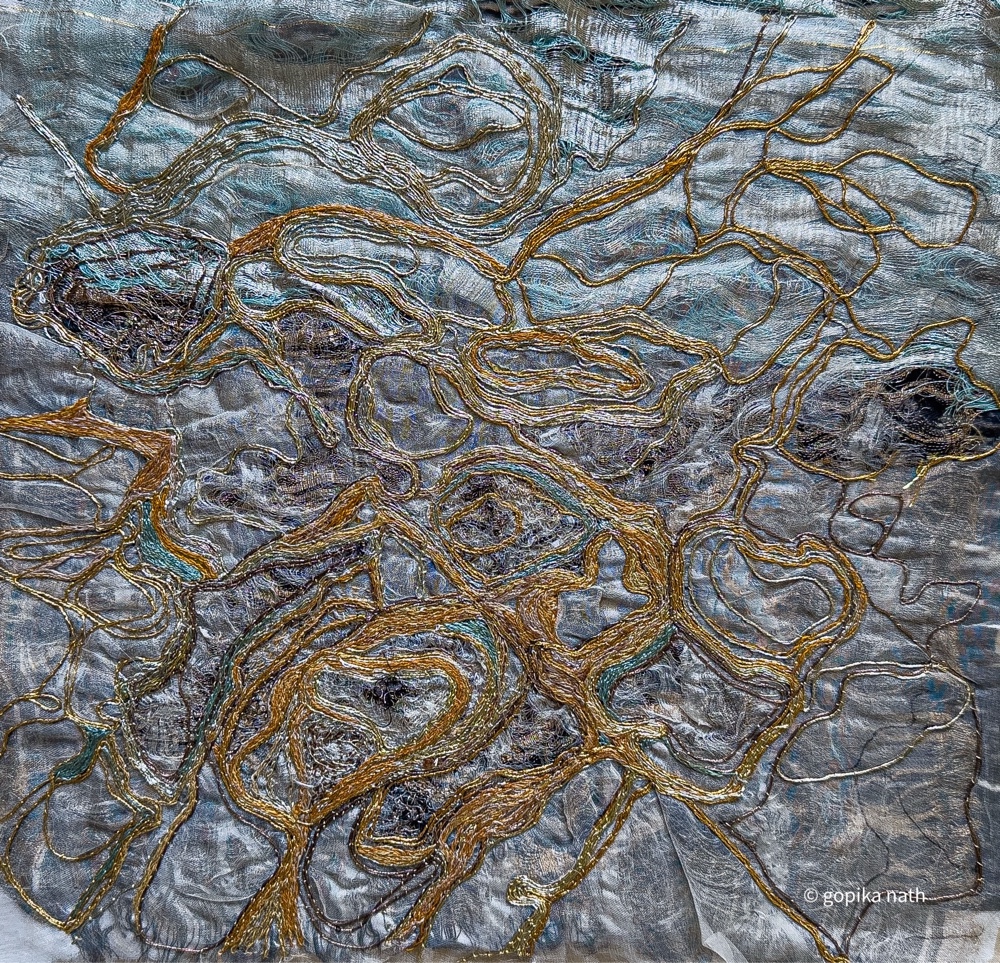
I’ve been working on Co-Creation III for too long. It started out, with me wanting to create a border — a kind of ‘hashiya’, where the border is separate yet conducts an oblique dialogue with the central image/painting. (The ‘hashiya’ comes from Mughal miniature paintings were artists used the border in dialogue with the main subject.) I decided that I had been working long enough and just had to finish. I know myself: I could keep adding more and more. I just had to stop working on this piece. But, there were couched areas that needed to be completed.
I continued with couching the six-ply zari thread. It has a rhythm to it. You hold the thread to be couched, and you keep the fabric taut, holding the laid thread close. Because I’m couching large, uneven spaces I don’t use a hoop. Both hands work in tandem as if dialoguing with each other. Left hand thumb and index finger over the thread to be couched, keeping it in place. Other three fingers below the fabric, keeping it close to the laid thread—light pressure from top and bottom. Right hand, holds the needle between thumb and index finger, little finger and side of hand, over the thread— when it’s slack, keeping the tension-mild but keeping thread straight to avoid the knots. I’ve tried using a hoop but it interrupts the rhythm of long laid threads to be couched. Yes, the laid thread may pucker a bit, but that’s okay because the inspiration, for this piece and others in the series, is sun glinting off ripples of water.
The same week, an incident occurred in my residential complex that left me feeling exposed. It was xenophobic and violent, and made me feel unsafe and threatened in my own home. I was preoccupied and agitated. I missed a day or two of stitching because I simply couldn’t settle. I’d sit with the piece in front of me, but the very idea of more thinking — more decisions to be made, felt too large a task.
And when I returned to the couching, I noticed knots coming up.
Before stitching, knotting was already a way of making textile. Not as embellishment, but as structure. Nets, cords, bindings, even early fabrics and carrying slings. Whole surfaces could be created through knotting, loop after loop. In that sense, knotting isn’t secondary to stitch. It’s older than stitch, and it has its own intelligence and lineage.
When I was learning to weave, one also learnt the weaver’s knot. It’s a really elegant knot: left over right, is the primary instruction I remember—to put the thread in the left hand over the thread in the right hand—and the rest is muscle memory—the hand remembers.
Both threads held between thumb and index finger of left hand. Taking the right hand thread over left hand thumb, holding it down with the 2nd finger of left hand, bringing the right hand thread between left thumb and index finger where the two threads are held. Left hand thread then goes into the loop made by the right hand thread over left thumb, while 2nd finger holds the end of the right hand thread and pull. Voila! The perfect knot.
Quite an instruction to remember—I can’t. I wrote this while observing myself create a weaver’s knot. Stopping frequently to annotate. I’m glad the hand remembers and I don’t have to recount the entire process verbally. I think I’d probably confuse more than guide the hand.
The weaver’s knot was invented as a join that’s flat, allowing the knot to move through the heddles of the loom without encumbrance. Once learnt (1982, for me) it’s hard to forget, but learning it in the first place, is a challenge. My sister is an avid knitter, I’ve tried to teach her, but it still doesn’t form as easily as I can make it. It’s most useful when knitting or crochet and the ball of yarn finishes—to join another seamlessly.
And then there’s the other meaning of knot, the sailing knot, a measure of speed. One nautical mile an hour. Suddenly the word shifts from snag and interruption to movement and distance. Sailors tie knots that must hold in wind and salt and strain. It makes me think that knotting isn’t a mistake at all. Knotting is older than stitching. Rope, nets, rigging, lashings. The forms of making that come before cloth.
But none of this is what I’m meeting here. I’m not doing macramé. I’m not deliberately making a textile through knots, neither am I traversing nautical miles at sea. I’m in the middle of a stitch rhythm, and the thread knots itself anyway. The snag arrives as interruption, not as design.
It is really annoying. You can’t leave the knots, because they won’t sit under the couching thread. They form a little loop and sit there— an uncomfortable bulge. What’s strange is that the knot doesn’t happen where I can see it form. It happens in the slack, in the bit of thread behind and under my right hand, in that length that has its own life. I could swear that I don’t leave it too slack, holding it down carefully, but clearly I am not vigilant enough. It is the only way a knot could form.
I follow the rule of thumb — of keeping the thread no longer than the distance from my index finger to my elbow. Still, even when the thread is quite a bit shorter — quite short in fact, I still get the odd knot. The thread forms a loop into itself. Most of the time I can simply put my needle into the loop and holding the threads that precedes the knot, down with my left hand, pull it upwards with the needle(in my right hand)— and it comes undone with a gentle sound that tells me it’s undone. Something like a ‘khitt’ that’s softly whispered.It’s momentary, a small hesitation, the acknowledging ‘khitt’ and I can keep stitching.
But the other day, I struggled and struggled, and it got worse and worse, until I had to do what I absolutely hate: cut the thread. Cutting the thread feels like admitting defeat. Not because it’s a tragedy, but because I was in rhythm. I was in flow. And now I have to stop, stitch in ends, re-thread, restart. It’s like being pushed out of a trance and get down to the nitty-gritty of mundanity.
And because I’m couching gold thread, there’s a glare with the light. The golden thread reflects light back at me. The glare doesn’t allow me to see my stitches clearly. I try and keep the distance of the stitches within a certain perceived gap, and I’m really focused. The rhythm aids my ability to keep that space— it provides a measure. But when I have to stop for the palaver of cutting the thread, re-threading the needle and finding my place back in the work. It interrupts everything.
The knot has a lineage. The problem is that it arrives uninvited.
Just like the xenophobic assault did: interrupting the rhythm and pace of life. A knot that cannot be undone.

So apt. Have experienced this myself. But you’ve put this so nicely in your essay.
ReplyDeleteThank you Anjali, it’s good to know that it resonates. Thank you for reading and commenting 🙏
DeleteSuch intricate writing, like the stitching itself
ReplyDeleteThank you. It’s the first time my writing has been referred to as intricate like stitching and I love the analogy. 😀
DeleteI get that a lot too, the pesky knot, when the intentional knot is so fiddly to tie! It's the twist in the thread that makes it I think, the double or triple fibres twisted in the spinning tightening and curling a little bit more stitch by stitch. When that tiny loop it forms locks itself on the pull through the knot is going to catch you out. Better you find it at the time, than later in the work when the part you thought stitched firm works loose and floppy behind the unnoticed blighter. Oh fun!
ReplyDeleteYou made me laugh Heidi. Have to confess I miss some or am too lazy to untangle them. The positive side of my work is that it’s so tactile, I doubt anyone would really notice.
DeleteAnd thank you for that observation about the twist. Even though I use a single strand of floss there is a gentle twist. And the reels of thread —alas no longer cotton but polyester are tightly twisted in the spinning which makes them twist as we stitch.
So good to have you read and comment. Thank you.