When artists speak about their practice, they often describe a clear separation between the mind that conceives the work and the hand that carries it out. The idea originates in thought; the hand simply executes it.
Yet when one listens closely to how makers describe their work, something more complex appears. Decisions emerge during the act of making. Adjustments happen through touch, perception, and repetition. Knowledge seems to reside not only in the mind but in the hand itself.
This is what I have come to think of as the thinking hand—not only what the hand does, but what unfolds through the act of making, before it is fully known.
But this way of understanding making is not always shared.
Reading Elaine McBride’s reflections on her embroidery practice raised precisely this tension. Her description of decades of stitching reveals a process shaped by experience and intuition, yet one in which the hand is still described as executing decisions formed in advance.
What follows is an email conversation between Elaine McBride and myself, where this difference in understanding unfolds.
GN
Elaine, when I read your statement, what struck me was the time you have spent with embroidery. Nearly five decades with the needle is a long time—a duration like that changes the relationship between maker and medium. It can no longer be just about stitching.
EM
Gopika, you are right that the relationship to the medium deepens over time, but for me the turning point wasn’t only the years spent stitching – it was realizing in graduate school that embroidery could operate as a form of image making. Although I grew up around utilitarian textile work, I had not considered it an artistic tool until a course with Renie Breskin Adams revealed that stitches could function like painterly marks. That discovery allowed me to merge my background in drawing and painting with textile technique. From that moment, embroidery became my primary language for narrative imagery, not an extension of domestic practice. The hand and the material were part of the learning curve early on, but my focus quickly shifted toward conveying the idea through the medium rather than exploring the medium itself.
For nearly five decades, embroidery has been my chosen medium. Since adopting it in 1978, I have refined a process that is now intuitive and largely subconscious. My work aims to reveal essential information while leaving space for the viewer’s own interpretation. Its small scale reflects both its intimacy and my sense of its preciousness.
Through long practice, I understand how colors blend, how stitch direction can imply movement or shape a sense of space, and how a single stitch can function like a painter’s brushstroke. My early training as a painter informs this sensibility; embroidery allows me to maintain that painterly language while embracing the tactile qualities of textile—surface, sheen, weight, and texture. Technique and process serve the imagery, not the other way around.
GN
You say that your stitching process has become intuitive and largely subconscious. I am curious about what happens in that space where intuition takes over.
What interests me here is the phrase: “through long practice, I understand.”
That kind of understanding must develop through repeated encounters between hand, needle, thread, and cloth. And the hand naturally begins to carry knowledge. You describe knowing how stitch direction can imply movement or shape space. A knowledge that seems to emerge in the doing, through memory stored in both hand and mind.
This is what I call the thinking hand—knowledge that arises through the act of making.
EM
I understand the idea of the “thinking hand,” but in my process the conceptual work happens before I begin stitching. I plan the narrative through drawings and compositional studies, and those decisions determine color, stitch direction, and surface effects. Because I have stitched for so many years, the physical act is automatic – the hand simply follows decisions already made. Intuition plays a role, but it grows out of long practice rather than spontaneous discovery in the moment.
I work from impressions and memories that require contemplation, and stitching has become the subconscious means by which those ideas are realized. My choices of thread color and stitch placement require conscious decision-making, but the physical act of stitching is second nature. The hand simply functions as the tool that carries out these decisions.
GN
Here is where I pause.
You describe the hand as carrying out decisions, yet elsewhere you speak about stepping back from the work, evaluating the emotional tone, and adjusting the palette. That suggests a more fluid exchange where progress on the work influences what the next move would be—in terms of stitch, direction of stitch, colour choice, modulation etc.
So I wonder whether the hand is only executing decisions, or whether in the act of making the hand is also shaping them.
EM
Stepping back is essential for me as well, especially given the small scale and close working distance of embroidery. Viewing the work at a distance helps me confirm whether the stitching is supporting the narrative and emotional intention. The hand executes the decisions, but those decisions continue to evolve as I evaluate the image during the process. My eye, not the material, ultimately guides each adjustment.
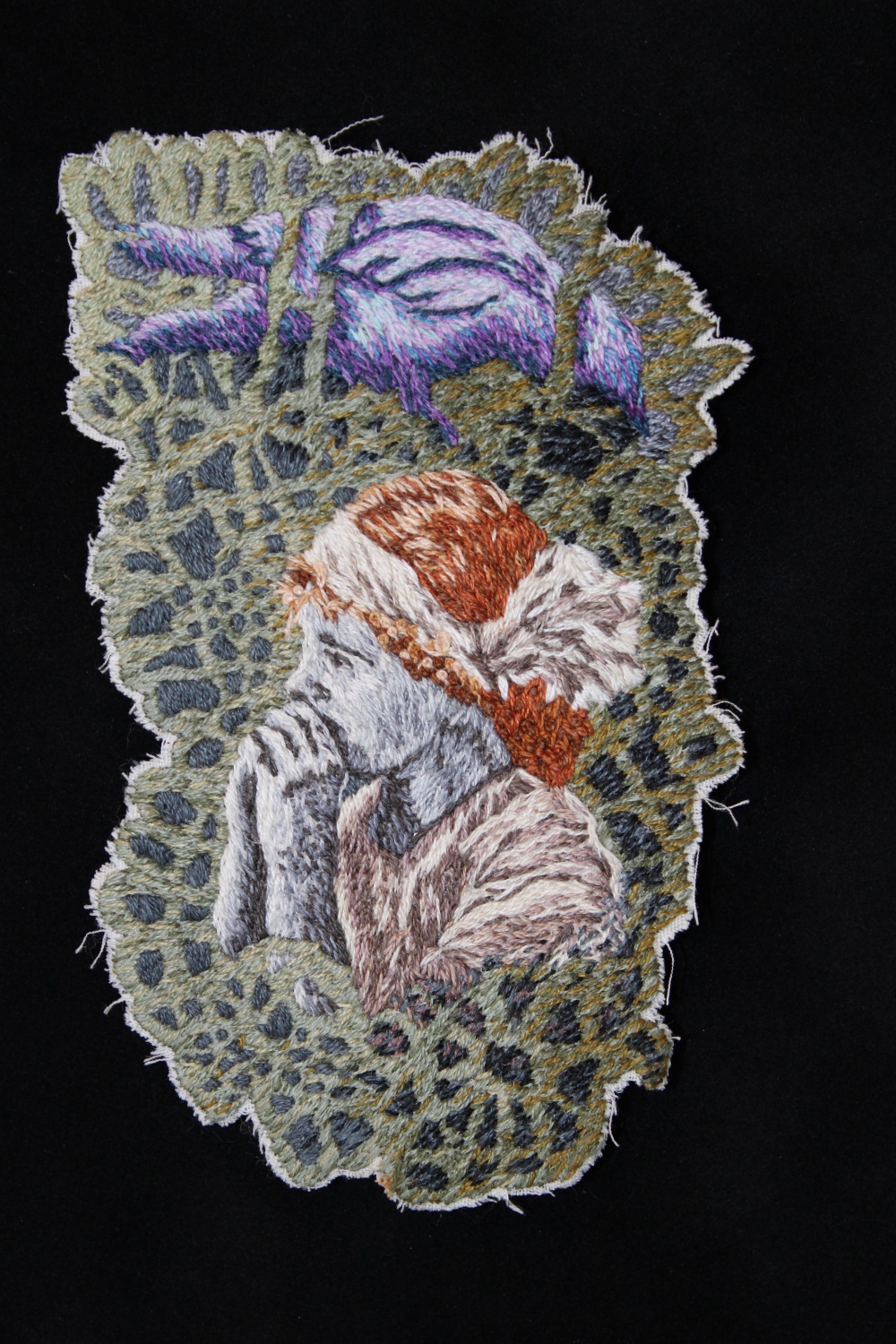
In recent work, I’ve used muted grays and browns to evoke dreamlike spaces softened by memory. Old family photographs often serve as starting points; I gather fragments of the subject and reconstruct them in thread as recollections rather than portraits.
In Incredulous (2024), for example, I repeatedly stepped back from the piece to evaluate its emotional tone. That process led me to mute the background palette so the figure appeared enveloped in quiet ambiguity. Her skin, stitched in grays, browns, and creams, evokes statuary and timelessness.
GN
That moment of stepping back is something I need to do frequently. I don’t work with a drawn image, so here, it’s fundamental for me to keep gauging the next step. But you work with a predetermined narrative and drawing, yet you too stop to look again and again. The image as it emerges suggests the next move.
In that moment, as a maker you seem to be responding, as I do, to what the work itself reveals. The cloth and thread are participating in the decision. In the risks you may take, and in the texture and materiality of the finished piece, where the material’s intelligence is also factored in.
EM
I see how your process invites the work to guide the next step, but my approach is more like painting. I begin with a drawn structure, and the embroidery develops within that framework. I aim to fully cover the fabric so the surface becomes analogous to a painted panel, often drawing inspiration from illuminated manuscripts and early miniatures. Although I make adjustments as the work develops, the driving force remains the narrative image rather than the material asserting its own needs.
Constructing each piece is slow and deliberate. I begin with a drawing that establishes the narrative, then refine color and compositional choices while stitching. Embroidery is a low‑tech practice, and my decisions evolve from my reflections on the emerging image: warm or cool palette? Depth through contrast or subtle modulation?
My lived experience informs each piece, as does knowledge carried over from prior work. In Chill (2019), a cool palette in the foreground created a harsh, cold environment, contrasted with a vivid, fiery sunset on the horizon. Those visual strategies later informed Flashbulb (2023), where a warm interior contrasts with the cold night sky and ruins beyond the window.
GN
So the work evolves through the act of making. The drawing may establish the narrative, but the embroidery continues the thinking. Experience accumulates in the hand, and each work carries traces of earlier decisions.
EM
Yes, the work continues to evolve as I stitch – just as most artworks change from their initial conception. My experience with color and composition shapes every decision, and the pleasure of working this way lies in discovering how color can define form, space, and mood. Even when I have a plan, the piece still reveals surprising possibilities. That ongoing dialogue is part of what keeps the medium engaging after so many years.
In all of this, the hand remains the tool that executes the idea. It holds the needle, draws the thread, untangles knots, and allows muscle memory to support the process. The narrative and visual decisions come from decades of drawing, painting, and studying color.
GN
Muscle memory is an interesting phrase. Repetition stores patterns of movement in the body. After many years, the hand moves without calculation, yet those movements carry decades of experience. So, is the hand merely a tool?
EM
You are right that muscle memory plays an important role. It allows the hand to place stitches precisely and consistently, which is essential in such detailed work. But I still see the hand as carrying out decisions shaped by years of drawing, painting, and stitching experience. Like a potter on the wheel or a practiced golf swing, the body remembers what it has learned – but the intention and design come first.
GN
I’ve been inspired by many writers in craft, such as Richard Sennett to look deeper into my process. Especially Glenn Adamson observation that “craft is process” has also influenced me. It’s made me become a witness to how I hold the needle, what I do with thread; becoming aware of every decision I once made intuitively through muscle memory. Are there any writers on craft who inspire you or whom you relate to?
EM
The writing that resonates most strongly with me is Ben Mitchell’s The Jewelry of Ken Cory – Play Disguised. Cory’s miniature sculptures elevate the everyday through wit and close observation. His narrative approach mirrors my own interests. Mitchell notes that Cory’s works “tell a story… composed pictorially, as if the pieces had first been drawings and then were rendered in metal and enamel.”
Cory himself said, “My primary concern is the idea behind the piece. Design follows idea.” His prioritization of narrative and concept reflects how I think about my work; technique is essential, but always in service to the story.
GN
Your reference to Cory is revealing. You place narrative and idea at the center of the work, yet acknowledge how technique itself shapes the stitched narrative. The direction of a stitch, the blending of thread, and the modulation of tone influence how your stories are embroidered on cloth.
EM
After more than forty‑eight years with needle and muslin, stitching feels as natural as breathing. I often stitch in the evenings, as my grandmothers did when I watched them quilt, mend, and embroider.
Though my studio supports the planning stages, the act of stitching has become a familiar daily rhythm. Each piece still feels like a discovery, and each new work quickly becomes my favorite until the next one emerges.
At 74, embroidery is inseparable from who I am. It is not merely what I do—it is how I know, remember, and translate experience. I want the intelligence of muscle memory and the quiet accumulation of years to register on cloth and to let memory and material meet through the simplest of stitches.
GN
When you say embroidery is how you know and remember, that brings us close to what I would call the thinking hand. Not the hand as a passive instrument of thought, but the hand as an active participant through which knowledge unfolds within the act of making—where the conversation between hand, mind, needle, cloth, and thread continues to evolve.
In my own work, I often begin without a fixed image. A stitch is placed, and only then does the next decision become visible. The direction of thread, the density of the surface, the way colour settles into the cloth—these are not predetermined. They emerge in response to what is already there. In that moment, the hand is not executing a plan; it is discovering the work as it unfolds.
EM
Your perspective has given me a new way of considering how the hand participates in making. Earlier in my career I may have been more aware of that connection, but now my attention is centered on constructing the narrative image. Still, I appreciate the idea that the hand holds its own form of knowledge. Continuing to stitch keeps me engaged and grounded, and I am grateful for the chance to reflect on these ideas through our conversation.

Very very interesting between two well known people about embroidery and each one’s perspective. Bless you both.
ReplyDeleteThank you.
Delete