Where the Judgement Comes From
I began this process journal partly in response to reading Glenn Adamson’s Thinking Through Craft. I was hoping to encounter a discussion of craft as lived process, but instead found a great deal of art‑world language aimed at making craft legible to contemporary art discourse.
For me, craft does not need to be translated into theory to be understood. Process is the very core of crafting. Working with textile and stitch, meaning emerges through material negotiation, repetition, resistance, and decision over time. I began recording my process not to analyse myself, but to pay closer attention to how material intelligence operates in the making itself — how fabric, tension, layering, and intuition shape the work as it unfolds.
13 December 2025
Fact is, when I think of tabulating my working process — the process by which I make my art — I realise that so much of it is ingrained in how I look, what I feel, how I approach it all.
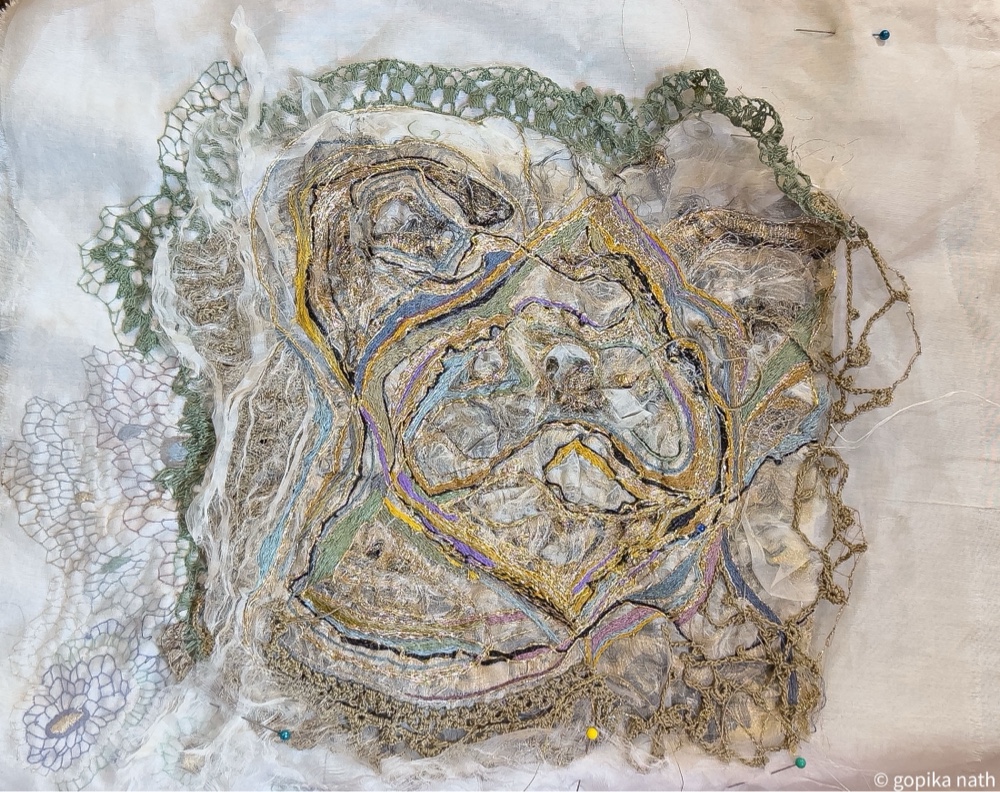
Yesterday, I was working on one of the co‑creation–inspired pieces. The third one. I had been more creative with it, introducing blues and a lot of gold. What I noticed was that it looked bare without my usual tendency to create a border.
I found the idea of adding crochet around it and then using that to create buttonhole lace interesting. But as I worked on the crochet, I used Doli. thread, which made it feel rather heavy and ungainly. Trying to contain the original within the framework that was evolving seemed clumsy.
But that sense — that it looked clumsy — where did that come from? What was I trying to achieve that made it appear clumsy? What aspect of design composition, visual impact, or my own sense of beauty was being thwarted by this feeling of clumsiness?
What am I trying to arrive at? What idea, ideal, or beauty am I moving towards, and why?
What I mean by ungainly is this: the thread is heavy, and the work itself is on organza. I have layered it with tissue organza and ripped the fabric by taking out threads and exposing different layers. It has a very delicate quality. But the Doli thread is thick. I wanted to create a muddy kind of texture relating to the sandbanks of the river — the ripples that are co‑created by sun, light, and wind. That is one reason why I’ve added so much gold.
I’ve used 6 ply metallic thread or zari, which is couched, and I’ve also stitched with single‑ply zari. When I added the border, that thread was thicker, and it felt clumsy because of the imbalance. Yes, it is a perceived imbalance, and I’m trying to interrogate why this imbalance feels uncomfortable to me.
The reason I give a border to my work — and this is a tendency of mine — is that borders are something most block‑printed textiles have. Every sari pretty much has a border. I have a quilt with block‑printed bootis (motifs) and a four‑sided border. Perhaps it comes from that tradition. Perhaps it comes from the Mughal miniature tradition of the hashiya, where the border is also saying something, in conversation with the piece.
I like the idea of the hashiya because it allows me to have that conversation. The reason I wanted to create something with buttonhole lace was that if I framed it in the usual way, I would have contained it within a mount, and I didn’t like that idea. It would have given the piece no space to breathe. And if I had just left it in the awkward shape it had evolved into, it looked unfinished.
And perhaps that is my discomfort too — that I don’t like to leave things unfinished, or what looks unfinished. How do I decide what is finished? How do I decide what is unfinished?
Perhaps this comes from my training as a designer. Perhaps it comes from an inherent need in my mind to resolve everything. Perhaps it comes from a deep sense of shame that I carry.
A sense of shame that emerges from past experiences that were erroneous — where, in retrospect, I feel naïve, ignorant, and downright stupid—embarrassed to have been that person. I’m still unravelling that sense of shame, but perhaps, within that context, I try to finish everything with a neat border.
Perhaps.

Thanks for making your design process visible. I am opening up to how all my go to ideas are also coming from some listening from my past and how it frames me today.
ReplyDeleteListening, is the key. As I’m working, I’m paying attention to what I’m making and what it’s reflecting back to me. The process is what craft is all about—more than technique, it’s about a process of thinking as one makes. Thinking that is framed by the past, by the way the world thinks, by that frames our judgements of self and more. A slow reflective process naturally brings all this to the fore. Thank you for reading and writing in. Appreciate it.
DeleteThe complexity of our multilayered mind, the randomness in the flow of our thinking process is beautifully manifested in your work.
ReplyDeleteThank you
DeleteFascinating how your past,your craft and your design sense wrestle and eventually co-exist in your art - Sumira
ReplyDeleteI’ve always felt that I’m not separate from my art. What I express is what I feel, think, experience.
Deletemore power to you ❤️
DeleteYour work is the physical embodiment of who you are, what you have experienced, lived through, and how the twists and turns have shaped you. Few artists are as fiercely brave, or as honest, to open their hearts and souls in their work like you do. You should be incredibly proud of yourself.
ReplyDeleteDear Poots, thank you for your supportive and encouraging comment.
DeleteThank you for sharing about your beautiful work! I hope you can grow to love your past self. I appreciate her, because she got you to where you are today 😉. All love to you.
ReplyDeleteUnfortunately google has made everyone anonymous so I don’t know who to thank for this comment. Yes, one is trying to come to terms with what the past created. 🙏
DeleteI appreciate the detailed explanation.
ReplyDelete