Showing posts with label glen adamson. Show all posts

Saturday, 28 February 2026

Where Stitching Meets Their Words


Looking at my work—how I stitch, think while I stitch, through the lens of writers and scholars like Glenn Adamson, Tim Ingold, and David Pye, I have begun to understand more clearly what it means for me to take risks while working, and to notice the decisions I make as I go. This awareness doesn’t give me control in any fixed sense, but it keeps me engaged. It keeps me focused on what I am doing. I may not fully know yet what this attentiveness does for me as an artist, but I do know that it sustains my capacity to stay with the work. Knowledge is power, after all, and knowing what I am doing as I do it seems to strengthen my ability to trust, hold, and remain with my decisions.

Yesterday, while I was stitching, I realised a few things about how I make decisions.

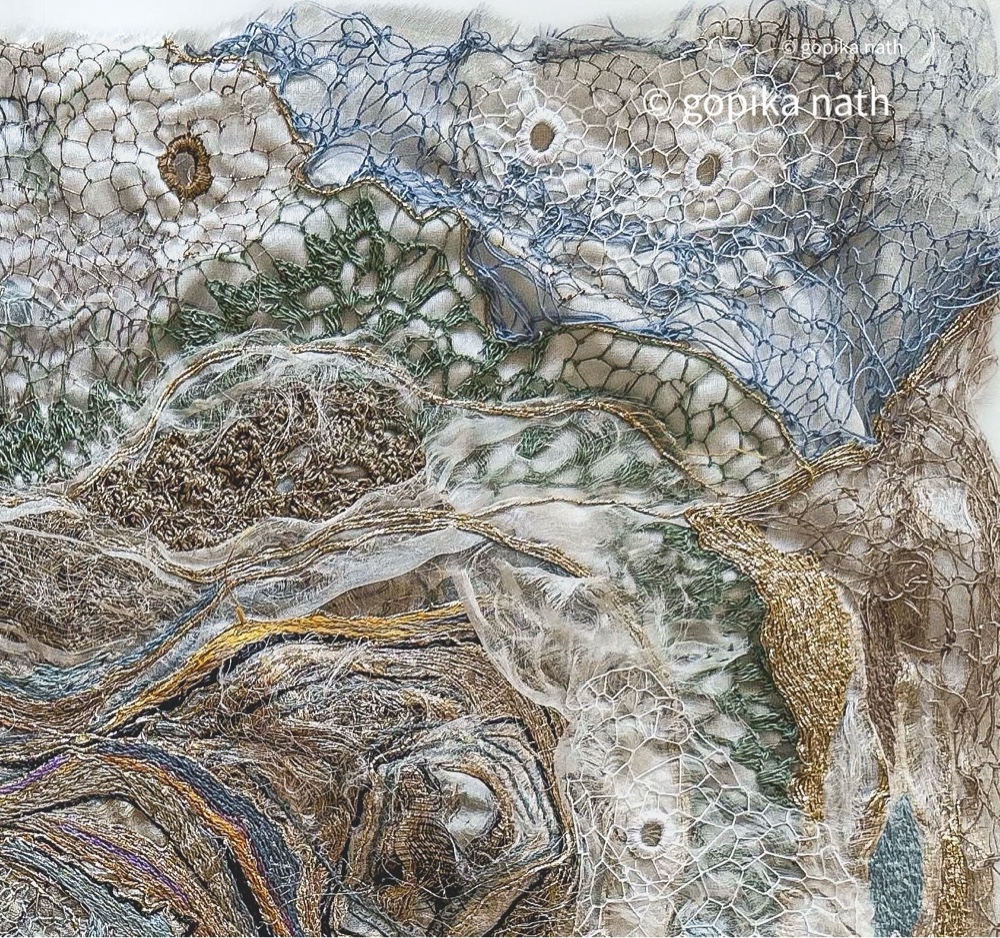
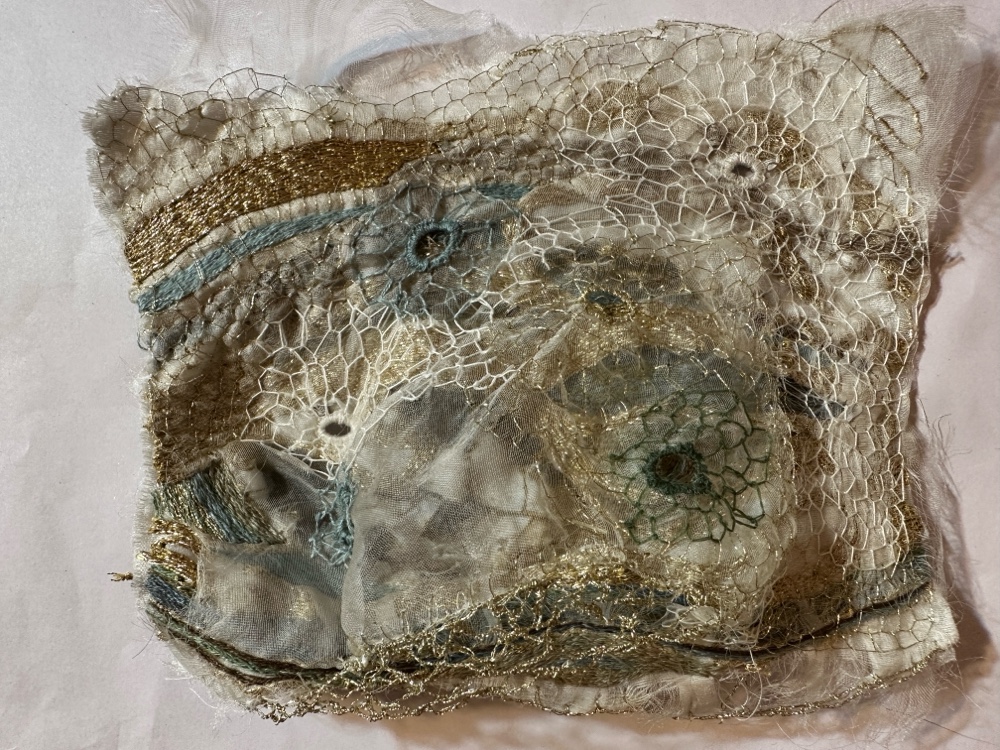
What I put on the fabric to begin with determines the kind of line the stitch will take. In this particular piece, I was working with a fallen, dried leaf that had many, many holes in it. It wasn’t brittle to start with, but as I began manipulating the fabric to stitch around the leaf, it started to crumple. I didn’t want to lose that quality. At the same time, I knew I was already taking a risk by working with something so fragile.

I first tried tacking it down with small bits of Fevicol below and above, hoping that would stabilise it without flattening it completely. That didn’t quite work. Eventually, I realised I had to cover the leaf with fabric while stitching around it. That was another decision, and another risk. Once covered, the leaf would be protected for use, exhibition, and time, but it would also be partially obscured.

When I did that, I saw that the fabric softened the intensity of the leaf that I had initially been drawn to. It pushed it down slightly. I had to accept that loss. And I found myself thinking that this was not really a loss at all. When you look at water flowing over sand ripples, with sunlight glinting on the surface and a leaf lying underneath, nothing is fully visible anyway. The leaf is dried and has no reflective power, so this softening felt appropriate. There is gold all around it, reflecting light, and the translucency of the organza fabric helped tone down the intensity of the gold, even though I quite enjoy it, as it is.

On top of the sheer fabric covering the leaf, I worked a lot of buttonhole stitch. It created a lace-like quality while also holding the fabric down. This wasn’t planned in advance. It came from a previous work where I had liked the effect, and I chose to return to that result here. I had been somewhere before. I remembered what this stitch could do, the kind of structure and openness it creates. At the same time, I have done oodles of this kind of buttonhole stitch, building hexagonal, lace-like forms, so there is also familiarity in the hand. As David Pye puts it, “the workmanship of risk is that in which the quality of the result is not predetermined, but depends on the judgement, dexterity and care which the maker exercises as the work proceeds.” That feels exactly right here. Present decisions are never innocent. They are shaped by past outcomes. The risk I take is always taken with precedent — something I have done before, learned from, and enjoyed the result of.

I have worked with buttonhole stitch in different ways. Sometimes I create a hole right through the fabric, which I’ve done twice in this small piece. At other times, I only create a hole on the surface fabric and then work an intense buttonhole stitch around it to strengthen that opening. From there, I extend it into a kind of hexagonal, lacy structure. I learned this approach in a workshop with the Stitch Club, with Mirjam Gielen.

I also noticed that I was doing split stitch on one side of the leaf, on the organza overlapping it. The fabric doesn’t cover the leaf completely, and it isn’t stitched flat onto it either. It has a slight three-dimensional quality. Because of the buttonhole stitch along the edge, it curls. I can curl it whichever way I want. Sometimes you can see through it, sometimes you can’t. It depends on how you look. When work is exhibited, it’s usually seen straight on, at eye level, and these shifts might not be immediately visible unless you look closely or from underneath. That too is a risk I’m willing to take.

Sometimes, one loses a lot of the stitch quality during exhibition viewing. Particularly the subtle dimensions of stitch which give so much pleasure. In fact, when stitched work or textiles that are exhibited dramatise to stand alongside more visceral media, eclipsing the otherwise delicacy of the medium and its making methodologies, I often cringe. One aspect of working with textiles, for me, is how the meditative dimension of making absorbs the visceral emotive dimensions of the maker, sublimating rather than screaming. I know that stitching for hours together calms the mind, softens the heartbeat, so I do wonder at this.

While stitching this section, I had started with a very light green thread, but I couldn’t find it again later. I didn’t want to open my entire thread stash just to locate that colour. I chose to continue with what was lying nearby. The next green I picked up was much brighter, and I didn’t want it to dominate. So I worked split stitch in lines, leaving spaces in between. Later, I added a very light blue.

Only after doing this did I realise that if I had filled the area with a single green, it wouldn’t have looked as alive as it does now. This decision came partly from laziness, but it turned out to be the right one. I do this often. When a thread runs out, I don’t stop the work. I respond to what is available. The work changes because of that choice.

Louis Pasteur, the French chemist had observed that “Chance only favours the prepared mind,” enabling one to  correctly interpret, or integrate unexpected results, with one’s prior knowledge. To my mind, chance is also about taking risks, where as David Pye suggests that the “workmanship of risk” depends on the discretion and dexterity that arise from knowing, enabling the maker to use the risk to their advantage, or not. In relation to this piece, the element of ‘chance’ is working with a dried leaf that might tear or collapse. The chance is covering it with fabric and accepting that something of its intensity will be lost. The chance is running out of a thread and choosing not to stop, but to continue with what is at hand. These are real risks. They only work because the hand is prepared, because it already knows how stitch, colour, and material behave. Without that preparation, the same choices would simply be random and possibly unsuccessful—visually gawky.

I also tend not to work with long lengths of thread. This is something I learned from Tom Lundberg during my Fulbright in 2000, when he was my mentor. Short threads force change. Colours shift more often. There is modulation rather than control. That variation keeps me attentive. It keeps the hand thinking.

I finished this section of the piece with a very fine gold thread that I bought online. It’s good-quality thread. I can’t really do split stitch with it, but I can do stem stitch, which is very close, and that worked well.

What’s amazing me at this point is how looking attentively at how I make, even in a small section as this —which is not quite two inches, I’ve learnt so much — something that reading the craft stalwarts and scholars alone, didn’t do. Quite frankly, the writing confused me, but now, I’m discovering it anew.



Monday, 2 February 2026

What Remains, What Repairs…


“Craft is healing. It helps people feel grounded, purposeful, and whole.”

— Betsy Greer


I spent most of the day stitching.

Yesterday was a long, social day. I’m feeling unsettled. Words cannot quite express my overstimulated mind: teaching a five-week online course, an enriching talk on Hampi, meeting old friends, recriminations, affection, chiding, eating a delicious but heavy meal. Grocery shopping en route to the meetings. Overspending and then returning home to put everything away. Sleep was elusive, as it often is when I’ve done too much.

I need to stitch. I need its somatic, meditative movements. I need thoughts to form, not be dismissed in the way they might be through yoga nidra or meditation.

As the needle enters the cloth and exits again, as the thread tightens and holds, as one action follows another, my day in the world becomes, briefly, coherent.

It’s often said that stitching is healing. But is it? What do we really mean by healing?

We have all seen ruptures of the flesh, wounds that heal. Yet scars remain. The body remembers. Can one truly heal memory, or the recurrence of pain that arises from it?

I have lived with the idea of healing for decades. I am a three-decade-long Reiki practitioner. I practise various modes of energy healing for myself and for others. It is a deeply misunderstood term, and one I have spent years trying to fathom.

Stitching as healing may create a sense of calm, regulation, relief, and an increased ability to cope. These are not trivial states. They matter. They allow one to function, to endure, to remain present. Regulation, not transformation.

This is where the language around healing, including energy healing, needs clarity. Intention alone does not bring about change. Healing practices can support awareness, soften resistance, and create the conditions in which something might shift. But they cannot replace responsibility. They cannot override lived reality. They cannot act in place of recognition or choice. A healing practice may help one cope with exhaustion, grief, or overwhelm, but it cannot decide for us when something continues to tear, when repeated repair is no longer enough, or when it is time to stop and acknowledge the damage.

Healing operates within possibility, not promise. It unfolds only to the extent that a person is able, willing, or ready to respond. Without this participation, healing becomes maintenance, a way of remaining functional within structures that continue unchanged.

Much of what circulates as healing is essentially about making life bearable without altering its underlying structure.

True healing, when it occurs, is rarely gentle. It does not arrive as comfort. It often dismantles rather than restores. In healing parlance, what is latent often rises to the surface when attention is directed inward. This can feel unsettling, even as though something has gone wrong. Old emotions, exhaustion, sadness, or self-dislike may emerge. Physical symptoms too—falls, colds, bouts of flu—are often understood as signals rather than setbacks, pointing toward what needs rest, recognition, or change.

This distinction matters when speaking about stitch and its potential to heal.

When Betsy Greer writes of craft making people feel grounded, purposeful, and whole, these words describe states of coherence and regulation. They do not promise cure or resolution.

Rozsika Parker, in writing  about middle-and upper-class women in Britain in the late eighteenth and nineteenth centuries, especially the Victorian era, spoke of embroidery as a means of psychic survival. She was studying  women who were excluded from paid work and public life, whose labour was confined to the domestic sphere, and for whom embroidery was not freely chosen but prescribed as part of feminine virtue and value. Parker did not frame this as empowerment, self-expression, healing, or liberation. What she described was far more constrained. For many women living with little agency, embroidery provided structure to time, a way to concentrate attention, and a place to contain anxiety, anger, grief, or frustration that could not be spoken. Often unmarried, or trapped in marriages they could not leave, financially dependent yet intellectually capable, socially silent and expected to appear calm, grateful, and composed, these women could not protest their circumstances or even name their dissatisfaction. Embroidery offered a private, repetitive act, somewhere excess emotion could be placed, a way of enduring without collapsing. Not flourishing. Not transformation. But staying intact. Parker’s insistence was a warning against romanticising needlework: not to mistake endurance for freedom, or survival for repair.

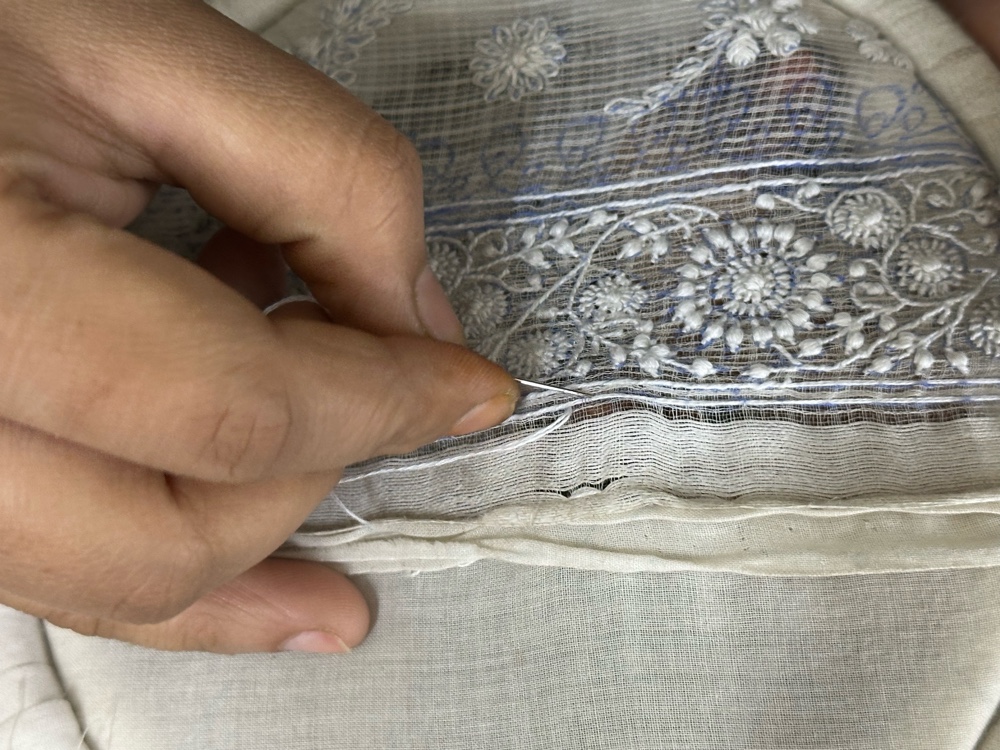
This, reminded me of my visit to Lucknow last April, learning from women engaged in chikankari. Here the context is different, and is not intended as a historical parallel. These were largely Muslim women, many of whom were not permitted to move freely outside the home. They arrived at the atelier covered from head to toe—stepping in wearing burqas, and then, once inside this all-women’s space, unveiled and stitched through the day. The workroom became a contained world — sanctioned, protected, but bounded. Stitch did not alter the structures that governed their lives. It did not offer emancipation. What it offered was time, focus, and a place to speak, share and where attention could rest. Listening to them, and later transcribing those conversations, I was struck by how often stitching appeared not as aspiration or expression, but as continuity — a way of remaining intact within conditions that were unlikely to change.

Repair, in cloth, does not erase damage. It holds a tear. It strengthens an edge. It works with weakness rather than denying it. When I think about repair in this way, it becomes clear that it is not an abstract idea for me, but something I am constantly negotiating through the act of stitching itself. Repair is not something I arrive at conceptually and then apply. It is something that unfolds through attention, constraint, and decision, moment by moment.

I see this most clearly when I think back to how I arrived at the work that day. I was overstimulated, scattered, carrying the residue of too many conversations, obligations, and decisions. Nothing dramatic was wrong, but nothing felt settled either. Stitching did not resolve that state or make it disappear. What it did was hold it. The repetition slowed my breathing. The sequence of actions gave shape to what had been diffuse. The work did not erase the frayed edges of the day, but it strengthened them enough for me to remain present.

I also recognise that the frenzied state was not only about fatigue or overstimulation, but about a lack of clarity. Too many loose threads of thought were creating a sense of chaos. Stitching steadied my breath and slowed the pace enough for those thoughts to come into focus. Once that happened, I could see what needed attention. I made phone calls and  addressed what had been weighing on me instead of carrying it as unnamed anxiety. The stitching did not resolve these issues, but it made it possible to recognise them and act. In that sense, repair was not withdrawal from the world, but a return to it with greater clarity.

Those who have written about craft and making speak of its closeness to lived experience, and of making as a process of correspondence rather than control, where one is in dialogue with material, unspoken perhaps, but real. The material, and how it behaves within the realm of our capacities to interact with it, suggests what we can or cannot do.

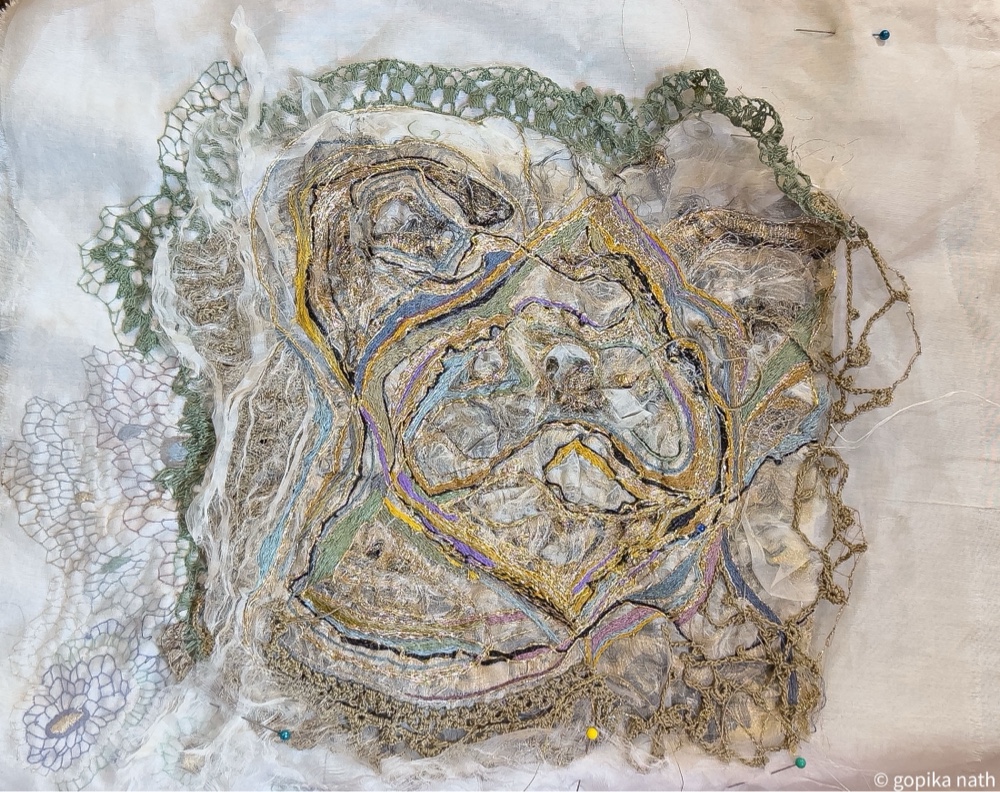
As I continue my work on Co-creation III, I am aware of risk at every step. I do not fully control the material. I choose a direction. I commit to a tension, regulate intervals of where the stitch holds the thread, enters the cloth, not always with perfection. Limited by various conditions—eyesight, electric light, glare from shining zari thread and the hued proximity of the thread I couch it with—whatever choices I make within these conditions and my capacity to stitch, skill or lack of it, I live with the consequences. As one does in life.

In this sense, stitch cannot heal the wound. It may effect repairs within the conditions under which the wound can be lived with honestly. Not altering the path, but changing the possibilities of how the path is walked.

And sometimes that is the only kind of healing that is possible.

No miracles. Sometimes not even relief. But an understanding of how the wound, the hurt, even arises.

Within my continued work on Co-creation III, I see this play out repeatedly. A lack of discipline while couching without the fabric stretched on a hoop. The small chaos that emerges when material resists intention. The urge to keep going, to make sense, to hold things together through repetition. Limited by light, eyesight, fatigue, and time, I work within what is possible rather than what is ideal. Each decision holds. Each compromise remains visible.

Stitch does not resolve this.

It asks me to stay with it.

And perhaps that, too, is a form of repair.


Thursday, 22 January 2026

Observations of Stitching Without A Script


Today, while couching the six ply zari, I found myself moving beyond the original knitted lines. Those lines rose and fell like tidal waves, vertical yet fluid, and I wanted to honour that undulation. At the same time, I had to break it. I couldn’t fill everything. Something had to give.

So the work became a series of decisions. Where to begin. Where to stop. Where the thread should turn. How much of the line to keep. How many lines were enough. I would place the thread, finish one run, put it aside, then stand up and look. Step back. Return. Decide again.

This is where I have arrived through practice. What David Pye named the workmanship of risk describes this precisely: a way of working in which quality is never assured in advance, and where every move carries consequence. Nothing is secured by a plan. The work lives or fails in the moment of making.

When there is a design, you don’t have to do this. You simply follow what has already been decided. But I am not working from a fixed design. I am working from a space I don’t quite have a word for yet, where attention replaces certainty, and where decisions are made in response to what unfolds rather than what is prescribed.

This is often called intuitive, but that feels insufficient. What is actually happening is a conversation. The material pushes back. The line resists or yields. The hand answers. Form emerges through this exchange— what Tim Ingold describes as correspondence: making as an ongoing dialogue rather than an act of control.

The original impulse came from co-creation: the sun on water, water on sand, wind on water, ripples in sand. The glinting light. That moment of recognition that nothing is made alone, that form is always relational. You know this, but sometimes it becomes clear only through the act of looking— being present. And, I’ve chosen to investigate it further through making—stitching.

I am using gold as light. And light, for me, is wisdom. Not ornament, but perception. In that sense, thinking through craft, as suggested by Glenn Adamson, is not an abstract position but something that happens in the work itself, in judgment, hesitation, revision, and care. As I read his book on the subject, I became curious as to its academic stance. Adamson is not a maker, he’s an art historian and scholar, attempting to locate craft within the fine art mileu. I am too, in a sense. But his writing inspired to me to articulate the nuances of my stitch-craft-art making practice from within it, rather than as a academic who observes, their uses and writes.

Working so much with gold has also made me more aware of how this material is received. Zari, sheen, surface, what might easily be dismissed as bling. Even though it comes from a long and specific lineage, the certified art world is uneasy with this kind of material density and materiality. Textiles are of interest to the art world today, but they are expected to transcend themselves, to become something else in order to be taken seriously.

What I am doing does none of that. These are small works. Twelve inches, fourteen, sixteen at most. They stay firmly within the language of stitch, of couching, of repetition and adjustment. I am not trying to dismantle categories or reinvent technique. I am staying inside what these materials already know how to do. In fact, I revel in the materiality — in the infinite possibility that textile, embroidery, crochet, knit and their materials give scope for, in terms of expression—making art. And for me, art is what Ananda Coomaraswamy wrote: that it wasn’t what you did, but how you did it, that made it art—devotion and  presence presided rather than  the intellectual concept that fine art now revers.

My work is demanding. It asks for sustained attention, judgment, and presence. Much of it is about watching myself work, noticing how decisions are made, how hesitation enters, how form slowly clarifies. I work as an artist, but I do so through material insistence rather than conceptual distance. The thinking is not above the work. It is embedded in the stitch, in the process, in the insistence of the hand.

So each day I am finding my way through it. Slowly. Sometimes reluctantly. There are moments when, despite stitching being somatic and grounding, I resist returning to it. Not because it is difficult, but because it demands decision-making. Presence. Accountability.

This is where risk lives. Not in grand gestures, but in choosing without a script. In staying with uncertainty long enough for the work to reveal what it needs to become.

There is also a question that sits alongside all of this, and I don’t yet have a clear answer to it. While academics may want to analyse what the craftsperson does — how decisions are made, where risk enters, how the hand moves, how the material responds — language always comes later. It describes what has already happened.

What I am more interested in is what this awareness actually does to the making.

At the moment, I find myself watching myself work. Not judging or correcting, just noticing. How a decision forms. Where hesitation enters. When a line feels complete and when it doesn’t. It feels a bit like being a witness to yourself while you are still living, still inside the act.

Perhaps the merit of this awareness is not only for the person making the work. If the making is clearer, if the decisions are more present, then the work itself may carry that clarity. It may also allow the viewer to come closer, to sense how the piece was arrived at, not through explanation but through looking.

This may shift the experience of viewing. Less emphasis on what the work is saying, and more attention to how it came into being. A slower, more intimate relationship with the work.

At the same time, for me, meaning  and process are entangled. What the work says emerges through how it is made. The decisions, the risks, the material itself — all of this shapes the work’s voice. I am not interested in choosing between concept and craft. The work holds both.

It is also clear to me that  reading Adamson, Pyle, Ingold and others has fed back into the work. I might not have thought of what I am doing in terms of risk, or noticed it so clearly, if I hadn’t read David Pye, or thought about correspondence in the way Tim Ingold describes it, or encountered Glenn Adamson’s writing on thinking through craft. The ideas did not replace the experience, but they gave me a language that sharpened my attention. I began to see what I was already doing.


Monday, 15 December 2025

Thinking Aloud —


Where the Judgement Comes From


I began this process journal partly in response to reading Glenn Adamson’s Thinking Through Craft. I was hoping to encounter a discussion of craft as lived process, but instead found a great deal of art‑world language aimed at making craft legible to contemporary art discourse.


For me, craft does not need to be translated into theory to be understood. Process is the very core of crafting. Working with textile and stitch, meaning emerges through material negotiation, repetition, resistance, and decision over time. I began recording my process not to analyse myself, but to pay closer attention to how material intelligence operates in the making itself — how fabric, tension, layering, and intuition shape the work as it unfolds.


13 December 2025


Fact is, when I think of tabulating my working process — the process by which I make my art — I realise that so much of it is ingrained in how I look, what I feel, how I approach it all.

Yesterday, I was working on one of the co‑creation–inspired pieces. The third one. I had been more creative with it, introducing blues and a lot of gold. What I noticed was that it looked bare without my usual tendency to create a border.

I found the idea of adding crochet around it and then using that to create buttonhole lace interesting. But as I worked on the crochet, I used Doli. thread, which made it feel rather heavy and ungainly. Trying to contain the original within the framework that was evolving seemed clumsy.

But that sense — that it looked clumsy — where did that come from? What was I trying to achieve that made it appear clumsy? What aspect of design composition, visual impact, or my own sense of beauty was being thwarted by this feeling of clumsiness?

What am I trying to arrive at? What idea, ideal, or beauty am I moving towards, and why?

What I mean by ungainly is this: the thread is heavy, and the work itself is on organza. I have layered it with tissue organza and ripped the fabric by taking out threads and exposing different layers. It has a very delicate quality. But the Doli thread is thick. I wanted to create a muddy kind of texture relating to the sandbanks of the river — the ripples that are co‑created by sun, light, and wind. That is one reason why I’ve added so much gold.

I’ve used 6 ply metallic thread or zari, which is couched, and I’ve also stitched with single‑ply zari. When I added the border, that thread was thicker, and it felt clumsy because of the imbalance. Yes, it is a perceived imbalance, and I’m trying to interrogate why this imbalance feels uncomfortable to me.

The reason I give a border to my work — and this is a tendency of mine — is that borders are something most block‑printed textiles have. Every sari pretty much has a border. I have a quilt with block‑printed bootis (motifs) and a four‑sided border. Perhaps it comes from that tradition. Perhaps it comes from the Mughal miniature tradition of the hashiya, where the border is also saying something, in conversation with the piece.

I like the idea of the hashiya because it allows me to have that conversation. The reason I wanted to create something with buttonhole lace was that if I framed it in the usual way, I would have contained it within a mount, and I didn’t like that idea. It would have given the piece no space to breathe. And if I had just left it in the awkward shape it had evolved into, it looked unfinished.

And perhaps that is my discomfort too — that I don’t like to leave things unfinished, or what looks unfinished. How do I decide what is finished? How do I decide what is unfinished?

Perhaps this comes from my training as a designer. Perhaps it comes from an inherent need in my mind to resolve everything. Perhaps it comes from a deep sense of shame that I carry.

A sense of shame that emerges from past experiences that were erroneous — where, in retrospect, I feel naïve, ignorant, and downright stupid—embarrassed to have been that person. I’m still unravelling that sense of shame, but perhaps, within that context, I try to finish everything with a neat border.

Perhaps.