“Stewart Kelly’s work is one that revolves around the observation of the human form. He produces work that gives insight as to who we really are as an organic entity, stripping away the layers of pretence. These are not portraits of obvious personality, there are no faces, no identifiable poses, no costumes, no props.”
– John Hopper (Inspirational 8)
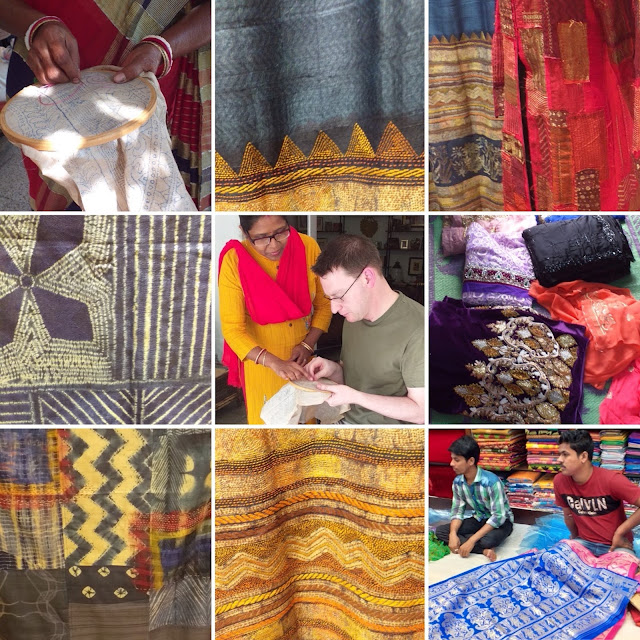 |
| Studying Kantha Embroidery, West Bengal, 2019. |
My current practice lies at the intersection of art, health and wellbeing. Through practice-based research, I am interested in reflecting on how the ritual of hand stitching can document emotional experiences.
During 2019, I travelled to West Bengal and visited artists, often in remote villages, working in their studios. My interest was in researching Indian textiles, specifically Kantha embroidery, which is synonymous with this region.
Experiencing the sights, sounds, colours and people of India was a revelation in many ways. Through speaking to artisans, I became increasingly aware how tradition and beliefs are integral to the nation’s cultural identity.
West Bengal
 |
| Map of West Bengal, India. |
West Bengal is a state in the eastern region of India along the Bay of Bengal. With over 91 million inhabitants, it is the fourth-most populous state and the fourteenth-largest state by area in India.
Part of the Bengal region of the Indian subcontinent, it borders Bangladesh in the east, Nepal and Bhutan in the north. It also borders the Indian states of Odisha, Jharkhand, Bihar, Sikkim and Assam.
The state capital is Kolkata, the third-largest metropolis, and seventh largest city by population in India.
Kantha Embroidery
 |
Kantha
Embroidery, Kolkata, 2019. |
In Sanskrit, the word 'kontha' means rags. Kantha is the most popular form of embroidery in West Bengal, and has been around for more than 500 years. Initially, Kantha was used on cotton or silk, however, it is now used on other fabrics as well like Georgette, crepe and chiffon.
Originally made from old, recycled fabrics, the traditional kantha cloth is an example of flat, or un-wadded quilting, worked on multiple layers of fabric. Bangladeshi or Bengali kantha cloths were made by women for use in their own homes as bedcovers, mats and all-purpose wrappers.
The stitching consists of embroidered patterns, ranging from simple floral motifs to elaborate scenes, combined with running-stitch quilting in a colour matching the background fabric.
Portraits without Faces
Although there is a wealth of traditional textiles produced in India, my thoughts focused on the lives of the artists. Many of whom work long hours, tirelessly investing their skills, for little financial reward.
On my return from India, I revisited drawings I had created prior to my trip, consisting of multiple figure studies. I began to embellish the surface, emulating labour and repetition through intensive periods of stitching.
Baptism of Fire and Wake Up
The first two pieces I created for this project were called 'Baptism of Fire and Wake Up'
 |
Baptism
of Fire, Ink & Machine Embroidery on Paper, 80 X 60cm, 2020. |
However, through intensive periods of stitching, the pieces began to transform dramatically.
I frequently stitched on the reverse side of the work, unaware of the image evolving on the front. The image almost became irrelevant, and the process of repetitive stitching, became the focus of the work.
 |
Baptism
of Fire (Detail), Ink & Machine Embroidery on Paper, 80 X 60cm, 2020. |
As the pieces evolved, the paper began to break away in places, caused by the perforations made by the machine needle. At this point it was necessary to add additional support to the work in order to progress.
This process of working became an interesting metaphor in the work, especially as my practice is informed by themes surrounding the human condition.
 |
Wake
Up, Ink & Machine Embroidery on Paper, 80cm X 60cm, 2020. |
Through the process of creating the work, the work became fragile and began to degenerate.
Out of the Blue and Spectrum
 |
Out of the Blue
(Detail), Hand & Machine Embroidery on Digital Print 65 X 50cm, 2020. |
The following two pieces in this series were called 'Out of the Blue and Spectrum'. These pieces also evolved in several stages over many months.
Initially, I photographed a series of drawings before digitally manipulating the images to add colour and definition. Following this, I collaborated with the Centre for Advanced Textiles at Glasgow School of Art in order to digitally print the images on to cloth.
In the studio, I began to hand and machine embroider onto the surface of the printed cloth. However, these pieces began to evolve in a different way to the earlier works on paper. Through intensive periods of stitching, the cloth began to gather and sculpt in unpredictable ways. Through this process of working, the pieces were transformed, and formed a new identity.
 |
Out of the Blue (Detail), Hand & Machine Embroidery on Digital Print, 65 X 50cm, 2020.
|
My creative process can vary depending on a specific project, however, many of my pieces evolve over a period of time. I find this approach enables me to explore the full potential of working in a particular way.
I frequently work on more than one piece of work at any one time. I find this process of working valuable in being able to reflect and assess the progression of a particular project. I normally work on one piece for a while, put it away, try to forget about it, and start to work on a different piece.
After a period of time, I will return to the first piece, and for a short time, I can be the viewer of my own work. I can assess what is going well, and what is not working. At that point I am often able to make bold decisions about how to move the piece forward.
 |
Spectrum,
Hand & Machine Embroidery on Digital Print, 65 X 50cm, 2020. |
Slow Motion and Daydreamer
The final two pieces in this series were called 'Slow Motion and Daydreamer'.
The basis of these pieces were drawings digitally printed on to cloth. However, hand stitching and the inclusion of kantha embroidery is more predominant in these pieces.
 |
Slow
Motion, Hand & Machine Embroidery on Digital Print, 75 X 55cm, 2020. |
On reflection, I began to consider how the drawn line is immediate, whilst stitching is slower and more reflective. Through a complex network of drawn gestures and stitched lines, I attempted to establish order amongst the chaotic background of lines and colours.
What lies beneath the surface? How can hand embroidery enable communication between the conscious and subconscious, and serve as a subliminal connection to the world? In addition, how can the hand drawn qualities of stitching, create a narrative to intertwine the fabric of this inner and outer connection?
 |
Slow
Motion (Detail), Hand & Machine Embroidery on Digital Print, 75 X 55cm,
2020. |
I also considered how my practice seeks to explore reasons for using stitch to express male identity, and how embodied textile practice encourages well-being in men. The significance of stitch as a feminist-based practice is well documented. However, the use of stitch as a reparative tool, and craft as a method of embodied textile practice for men, has rarely been assessed.
 |
Daydreamer,
Hand & Machine Embroidery on Digital Print, 75 X 55cm, 2020. |
How can engaging with material processes report, reflect and discover the spiritual act of stitching through contemplation, meditation, resilience, transition, physical and emotional healing? In addition, how does the intimacy of repetitive touch leave a trace of the artist’s presence?
Craft is immortalised by the hands, and draws an association with the processes it is engaged with. The artist initiates a dialogue with the material, and the act of the hand. However, is there a relationship between craftsmanship and sensitivity in a conversation of the hands?
 |
Daydreamer,(detail) Hand & Machine Embroidery on Digital Print, 75 X 55cm, 2020. |
Conclusion
Through the development of this project, I reflected on how the ritual of hand stitching can document emotional experiences. The intimacy of the medium itself, with the suggestion of repetitive touch, lends a poignancy to bodily associations, providing an intimate and ambiguous trace of the artist’s presence.
 |
Out
of the Blue (Detail), Hand & Machine Embroidery on Digital Print 65 X 50cm,
2020. |
Making hand stitched textiles can be therapeutic, a crucial tool for reflection and developing self-awareness. Working on slow, reflective projects has allowed a better understanding of the connection between the self and my desire to make art.
The work marks time, and chronicles emotional changes through the physical and reflective act of stitch. In addition, the work aims to convey the concept of transformation in life, the importance of reflection, and the exploration of creativity as part of artistic identity.
 Stewart
Kelly MA, BA (Hons), PGCE, is an award winning, internationally recognised
artist based in Manchester, United Kingdom. In addition to working with Indigo
Salon at Premiere Vision in Paris, Donna Karan, Ralph Lauren, Lauren Vidal, Sahco Hesslein and Ralph
Lauren Home Collection, His work has been exhibited across the United
Kingdom, Europe, USA, Canada and China. Stewart is also a member of the European Textile Network and the Surface Design Association.
Stewart
Kelly MA, BA (Hons), PGCE, is an award winning, internationally recognised
artist based in Manchester, United Kingdom. In addition to working with Indigo
Salon at Premiere Vision in Paris, Donna Karan, Ralph Lauren, Lauren Vidal, Sahco Hesslein and Ralph
Lauren Home Collection, His work has been exhibited across the United
Kingdom, Europe, USA, Canada and China. Stewart is also a member of the European Textile Network and the Surface Design Association.
Links
www.stewartkellyartist.com
www.axisweb.org/p/stewartkelly
www.bankley.org.uk/artist-stewart-kelly
www.facebook.com/stewartkellyartist
www.twitter.com/SKellyArtist
www.instagram.com/stewartkellyartist
www.linkedin.com/in/stewartkellyartist
www.pinterest.com/stewartkellyartist