Showing posts with label embroidery. Show all posts

Friday, 8 May 2026

The Intimacy of Stitch


After returning from travel and two weeks of intense outward engagement, I realised that my resistance to stitching was not simply fatigue or distraction. It was something else.

After days of immersion in other forms of attention: travel, conversations, paperwork, pending tasks, research into Kasuti, observing other methods of making, meeting artisans, studying structure and technique. Engaging with architecture, food, soil and stone — tabulating possible references for the beginnings of Kasuti. Although I remained intellectually engaged with needlework, I was not stitching with my own hands. And when I returned home, it took me another two weeks before I could fully approach the large textile piece waiting for me.

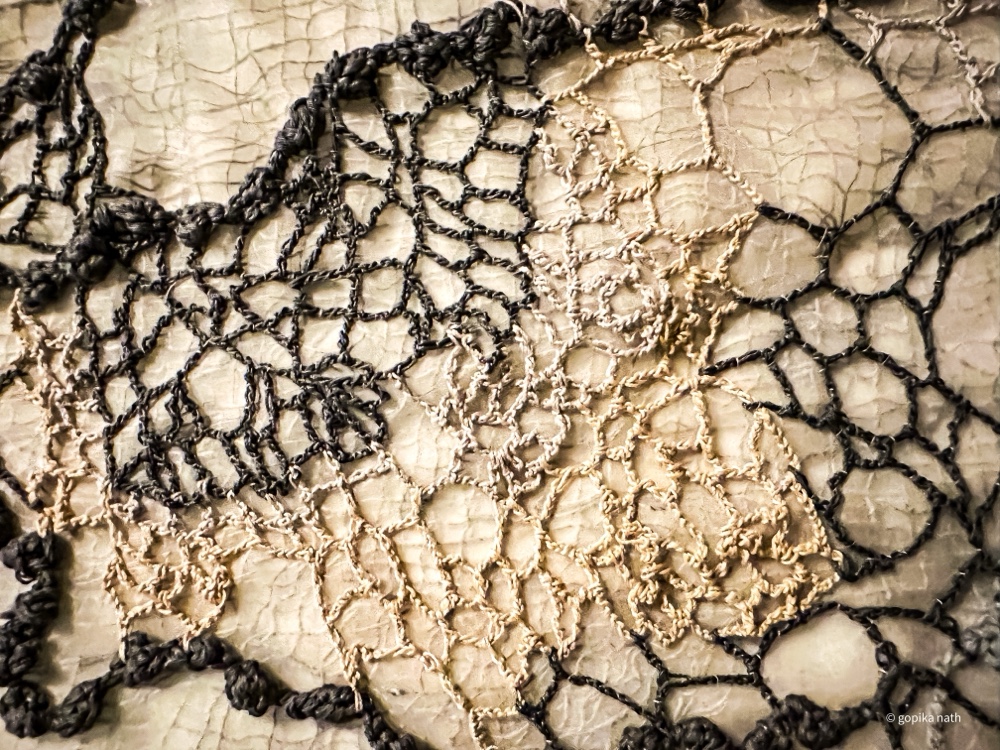
The work itself is ambitious, approximately 1.5 by 1.5 metres, layers of cotton crochet contained and layered between layers of unbleached silk organza. I have written about this evolving “crab lace” process, where crochet fragments and residue become part of a larger stitched surface.

http://gopikanathstitchjournal.blogspot.com/2026/03/crab-lace.html

At this stage I was tacking together five uneven layers of cloth, freehand, without a frame, because the crochet protrusions and shifting surfaces made stretching impossible on a hoop and my ‘adda’ isn’t large enough to accommodate this scale. The work had to be turned repeatedly on the work table — guided by the hand, its proximity to areas that needed to be stitched — maintaining tension and more.

I had chosen a pale grey thread deliberately. Against the black crocheted threads it remained visible, but against the grey and off-white lace it almost disappeared. The stitches moved between visibility and disappearance, holding the structure together — a sense of ease, familiarity and rapport I hadn’t noted before.

As I returned to the act of stitching itself, I became aware of something I may well have felt for years but had never seen nor articulated so clearly: there is an extraordinary intimacy to stitch.

I began my design life as a weaver, and I loved weaving. I still remember the wonder of watching individual strands of thread slowly become cloth. The processes of winding, warping, threading the heddles and reed, passing the shuttle back and forth, all carried their own rhythm and intelligence. But weaving, I now realise, also maintains a certain distance between the body and the cloth. The loom dictates posture, width, tension, movement. Even when one is deeply involved in preparing and constructing the weave, the fabric itself remains stretched within an external structure. The body adjusts itself to the loom — almost always separated from the emerging fabric, by the reed and the frame of the loom.

Stitch and crochet — even knitting, feel fundamentally different.

Here, the cloth engages directly with both hands and the body. It gathers, folds, bunches, softens, and resists according to the movement of  one’s limbs and torso. How I sit is relevant to how I stitch. The work is turned instinctively, held against the lap, cradled and shifted constantly — in search of comfort and control. The material adjusts to you as much as you adjust to it.

While tacking these five layers together, I could feel the organza rubbing against my fingers. Its starchy silkiness — a familiar discourse. I was ruching the fabric to grip it more securely, while managing the uneven tension created by the crochet and layered cloth beneath, as I stitched. At times,  just placing my hand gently under all the transparent layers—palm facing upwards—giving the needle support to pierce. Sometimes no hand under, just the cloth placed on the table—both hands above, helping the needle, pulling it out.  Hands smoothing over the fabric after a few stitches—sometimes holding tension, otherwise gently avoiding bulges. The crochet itself was malleable, constantly shifting shape—I pulled it where I wanted to see more space. It pulled back where there wasn’t enough thread for elasticity.  Every few moments I had to stop, lift the entire piece, rotate it, settle it back onto the table, readjust my body, leaning forward, bringing the fabric closer, ruching and tacking.

The needle held between my thumb and index finger —moved in and out of them. Carving little dents into each. The thread tunnelled through its eye, passing these two fingers. The work was not distant, it was an extension of me — continuously touching, caressing, nudging, coaxing me into a dialogue.

To stitch is to enter a relationship with the fabric, the needle, the thread. The attention it demands takes me inwards. Almost subterranean. One cannot remain outwardly focused while stitching. It brings up thoughts and feelings in an unexpected way. Urging me to sit with them. Creating a rhythm that enables this. It becomes difficult to avoid yourself.

In that sense, stitch resembles an inner conversation. Not performative thought, not social speech, but something quieter and more direct, even if it’s without words. Something changes, shifts — the mood alters.

While working, I found myself relating to my inner life with the same closeness with which I was relating to the fabric: like a journal I write by hand — sensing resistance, recognising fragility, allowing slack where necessary. Stopping when it gets too intense. Pulling gently where continuum was needed, tackling resistance to a deeper excavation of being. I know it’s where my sanity lies. I know it’s how I deal with stress, but sometimes it’s like starting a relationship all over again.

Perhaps this is why returning to stitch after periods of outward immersion can feel difficult. It asks for a different state of being. It asks me to slow down, to be comfortable with repetition, to touch and pay attention to what I am doing, in a very precise and meditative way—to be comfortable in my skin: an intimacy that seems almost alien when outward in the world.

And yet, once inside that space again, there is also familiarity. A recognition. A return to a state of flow. The body remembers the relationship before the mind fully does.


Monday, 30 March 2026

In Conversation With Elaine Mc Bride


When artists speak about their practice, they often describe a clear separation between the mind that conceives the work and the hand that carries it out. The idea originates in thought; the hand simply executes it.

Yet when one listens closely to how makers describe their work, something more complex appears. Decisions emerge during the act of making. Adjustments happen through touch, perception, and repetition. Knowledge seems to reside not only in the mind but in the hand itself.

This is what I have come to think of as the thinking hand—not only what the hand does, but what unfolds through the act of making, before it is fully known.

But this way of understanding making is not always shared.

Reading Elaine McBride’s reflections on her embroidery practice raised precisely this tension. Her description of decades of stitching reveals a process shaped by experience and intuition, yet one in which the hand is still described as executing decisions formed in advance.

What follows is an email conversation between Elaine McBride and myself, where this difference in understanding unfolds.


GN

Elaine, when I read your statement, what struck me was the time you have spent with embroidery. Nearly five decades with the needle is a long time—a duration like that changes the relationship between maker and medium. It can no longer be just about stitching.


EM

Gopika, you are right that the relationship to the medium deepens over time, but for me the turning point wasn’t only the years spent stitching – it was realizing in graduate school that embroidery could operate as a form of image making. Although I grew up around utilitarian textile work, I had not considered it an artistic tool until a course with Renie Breskin Adams revealed that stitches could function like painterly marks. That discovery allowed me to merge my background in drawing and painting with textile technique. From that moment, embroidery became my primary language for narrative imagery, not an extension of domestic practice. The hand and the material were part of the learning curve early on, but my focus quickly shifted toward conveying the idea through the medium rather than exploring the medium itself.

 For nearly five decades, embroidery has been my chosen medium. Since adopting it in 1978, I have refined a process that is now intuitive and largely subconscious. My work aims to reveal essential information while leaving space for the viewer’s own interpretation. Its small scale reflects both its intimacy and my sense of its preciousness.

Through long practice, I understand how colors blend, how stitch direction can imply movement or shape a sense of space, and how a single stitch can function like a painter’s brushstroke. My early training as a painter informs this sensibility; embroidery allows me to maintain that painterly language while embracing the tactile qualities of textile—surface, sheen, weight, and texture. Technique and process serve the imagery, not the other way around.


GN

You say that your stitching process has become intuitive and largely subconscious. I am curious about what happens in that space where intuition takes over.

What interests me here is the phrase: “through long practice, I understand.”

That kind of understanding must develop through repeated encounters between hand, needle, thread, and cloth. And the hand naturally begins to carry knowledge. You describe knowing how stitch direction can imply movement or shape space. A knowledge that seems to emerge in the doing, through memory stored in both hand and mind.

This is what I call the thinking hand—knowledge that arises through the act of making.


EM

I understand the idea of the “thinking hand,” but in my process the conceptual work happens before I begin stitching. I plan the narrative through drawings and compositional studies, and those decisions determine color, stitch direction, and surface effects. Because I have stitched for so many years, the physical act is automatic – the hand simply follows decisions already made. Intuition plays a role, but it grows out of long practice rather than spontaneous discovery in the moment.

I work from impressions and memories that require contemplation, and stitching has become the subconscious means by which those ideas are realized. My choices of thread color and stitch placement require conscious decision-making, but the physical act of stitching is second nature. The hand simply functions as the tool that carries out these decisions.


GN

Here is where I pause.

You describe the hand as carrying out decisions, yet elsewhere you speak about stepping back from the work, evaluating the emotional tone, and adjusting the palette. That suggests a more fluid exchange where progress on the work influences what the next move would be—in terms of stitch, direction of stitch, colour choice, modulation etc.

So I wonder whether the hand is only executing decisions, or whether in the act of making the hand is also shaping them.


EM

Stepping back is essential for me as well, especially given the small scale and close working distance of embroidery. Viewing the work at a distance helps me confirm whether the stitching is supporting the narrative and emotional intention. The hand executes the decisions, but those decisions continue to evolve as I evaluate the image during the process. My eye, not the material, ultimately guides each adjustment.  

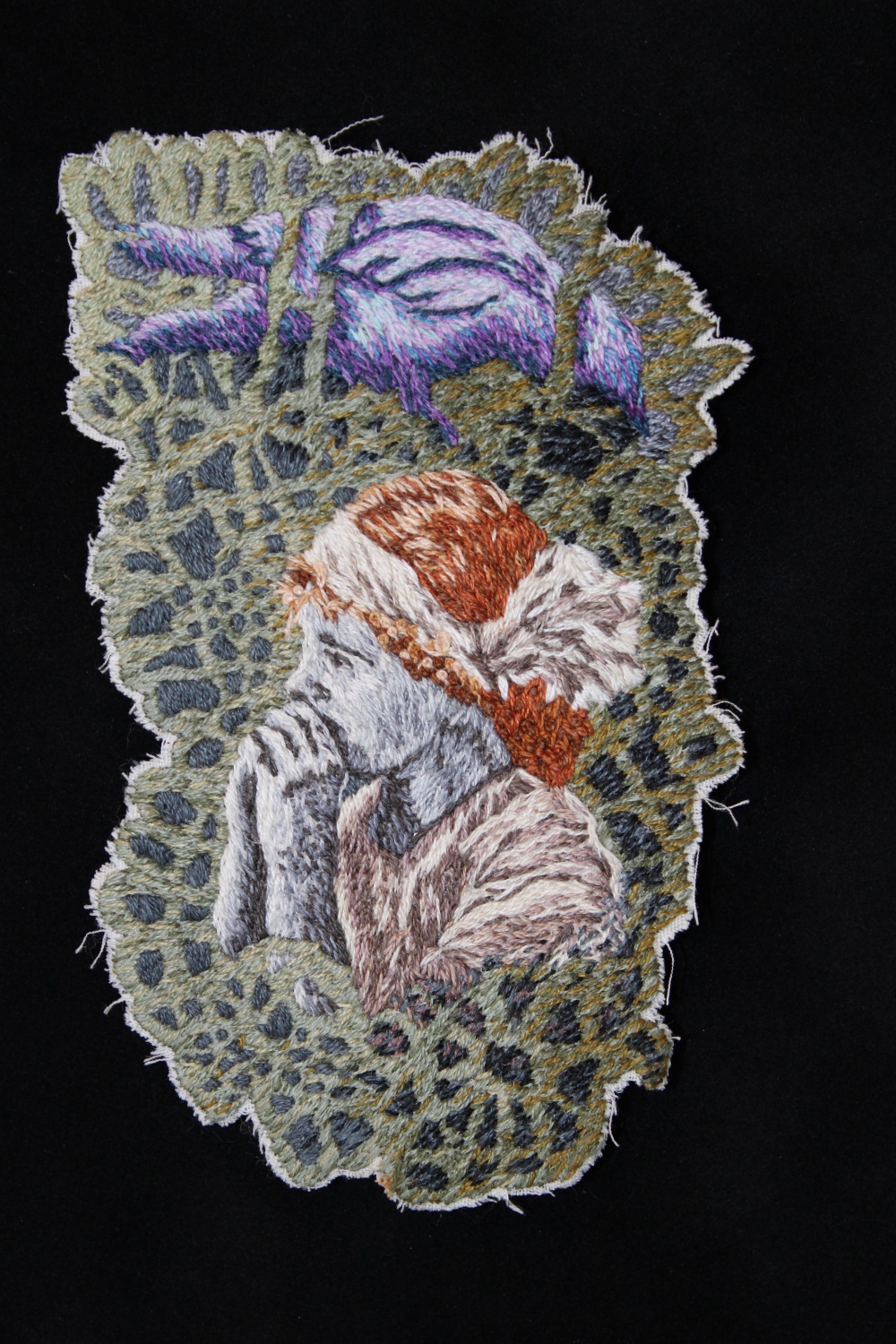
In recent work, I’ve used muted grays and browns to evoke dreamlike spaces softened by memory. Old family photographs often serve as starting points; I gather fragments of the subject and reconstruct them in thread as recollections rather than portraits.

In Incredulous (2024), for example, I repeatedly stepped back from the piece to evaluate its emotional tone. That process led me to mute the background palette so the figure appeared enveloped in quiet ambiguity. Her skin, stitched in grays, browns, and creams, evokes statuary and timelessness.


GN

That moment of stepping back is something I need to do frequently. I don’t work with a drawn image, so here, it’s fundamental for me to keep gauging the next step. But you work with a predetermined narrative and drawing, yet you too stop  to look again and again. The image as it emerges suggests the next move.

In that moment, as a maker you seem to be responding, as I do,  to what the work itself reveals. The cloth and thread are participating in the decision. In the risks you may take, and in the texture and materiality of the finished piece, where the material’s intelligence is also factored in.


EM

I see how your process invites the work to guide the next step, but my approach is more like painting. I begin with a drawn structure, and the embroidery develops within that framework. I aim to fully cover the fabric so the surface becomes analogous to a painted panel, often drawing inspiration from illuminated manuscripts and early miniatures. Although I make adjustments as the work develops, the driving force remains the narrative image rather than the material asserting its own needs.


Constructing each piece is slow and deliberate. I begin with a drawing that establishes the narrative, then refine color and compositional choices while stitching. Embroidery is a low‑tech practice, and my decisions evolve from my reflections on the emerging image: warm or cool palette? Depth through contrast or subtle modulation?


My lived experience informs each piece, as does knowledge carried over from prior work. In Chill (2019), a cool palette in the foreground created a harsh, cold environment, contrasted with a vivid, fiery sunset on the horizon. Those visual strategies later informed Flashbulb (2023), where a warm interior contrasts with the cold night sky and ruins beyond the window.


GN

So the work evolves through the act of making. The drawing may establish the narrative, but the embroidery continues the thinking. Experience accumulates in the hand, and each work carries traces of earlier decisions.


EM

Yes, the work continues to evolve as I stitch – just as most artworks change from their initial conception. My experience with color and composition shapes every decision, and the pleasure of working this way lies in discovering how color can define form, space, and mood. Even when I have a plan, the piece still reveals surprising possibilities. That ongoing dialogue is part of what keeps the medium engaging after so many years.

In all of this, the hand remains the tool that executes the idea. It holds the needle, draws the thread, untangles knots, and allows muscle memory to support the process. The narrative and visual decisions come from decades of drawing, painting, and studying color.


GN

Muscle memory is an interesting phrase. Repetition stores patterns of movement in the body. After many years, the hand moves without calculation, yet those movements carry decades of experience. So, is the hand merely a tool?


EM

You are right that muscle memory plays an important role. It allows the hand to place stitches precisely and consistently, which is essential in such detailed work. But I still see the hand as carrying out decisions shaped by years of drawing, painting, and stitching experience. Like a potter on the wheel or a practiced golf swing, the body remembers what it has learned – but the intention and design come first.


GN

I’ve been inspired by many writers in craft, such as Richard Sennett to look deeper into my process. Especially Glenn Adamson observation that “craft is process” has also influenced me. It’s made me become a witness to how I hold the needle, what I do with thread; becoming aware of every decision I once made intuitively through muscle memory. Are there any writers on craft who inspire you or whom you relate to?


EM

The writing that resonates most strongly with me is Ben Mitchell’s The Jewelry of Ken Cory – Play Disguised. Cory’s miniature sculptures elevate the everyday through wit and close observation. His narrative approach mirrors my own interests. Mitchell notes that Cory’s works “tell a story… composed pictorially, as if the pieces had first been drawings and then were rendered in metal and enamel.”

Cory himself said, “My primary concern is the idea behind the piece. Design follows idea.” His prioritization of narrative and concept reflects how I think about my work; technique is essential, but always in service to the story.


GN

Your reference to Cory is revealing. You place narrative and idea at the center of the work, yet acknowledge how technique itself shapes the stitched narrative.  The direction of a stitch, the blending of thread, and the modulation of tone influence how your stories are embroidered on cloth.


EM

After more than forty‑eight years with needle and muslin, stitching feels as natural as breathing. I often stitch in the evenings, as my grandmothers did when I watched them quilt, mend, and embroider.

Though my studio supports the planning stages, the act of stitching has become a familiar daily rhythm. Each piece still feels like a discovery, and each new work quickly becomes my favorite until the next one emerges.

At 74, embroidery is inseparable from who I am. It is not merely what I do—it is how I know, remember, and translate experience. I want the intelligence of muscle memory and the quiet accumulation of years to register on cloth and to let memory and material meet through the simplest of stitches.


GN

When you say embroidery is how you know and remember, that brings us close to what I would call the thinking hand. Not the hand as a passive instrument of thought, but the hand as an active participant through which knowledge unfolds within the act of making—where the conversation between hand, mind, needle, cloth, and thread continues to evolve.

In my own work, I often begin without a fixed image. A stitch is placed, and only then does the next decision become visible. The direction of thread, the density of the surface, the way colour settles into the cloth—these are not predetermined. They emerge in response to what is already there. In that moment, the hand is not executing a plan; it is discovering the work as it unfolds.


EM

Your perspective has given me a new way of considering how the hand participates in making. Earlier in my career I may have been more aware of that connection, but now my attention is centered on constructing the narrative image. Still, I appreciate the idea that the hand holds its own form of knowledge. Continuing to stitch keeps me engaged and grounded, and I am grateful for the chance to reflect on these ideas through our conversation.



Thursday, 8 January 2026

Material Memory


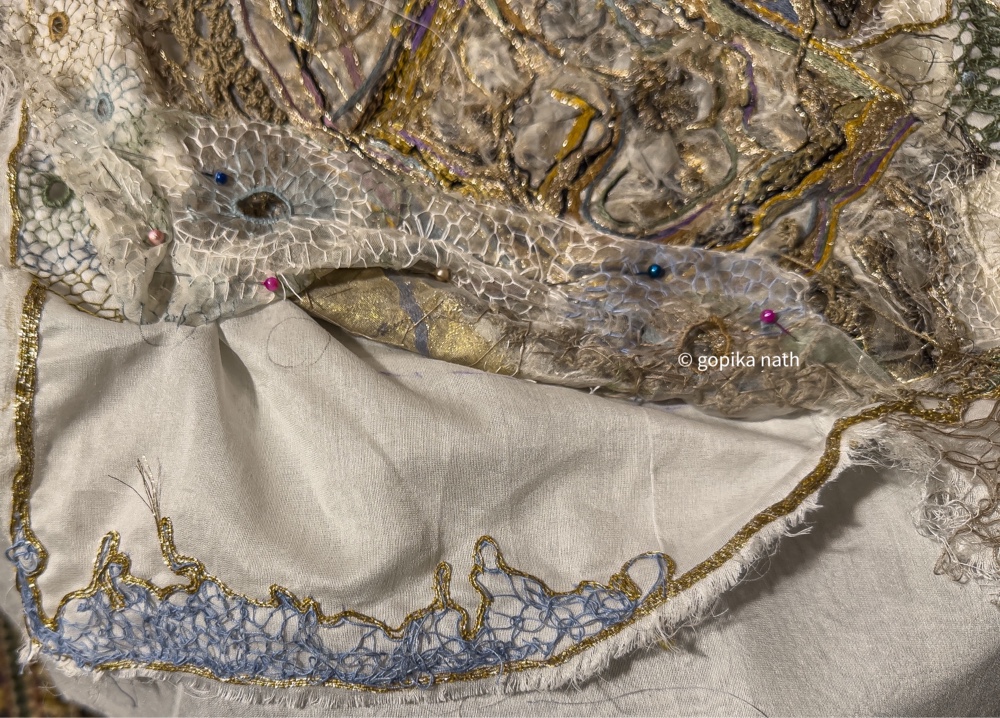
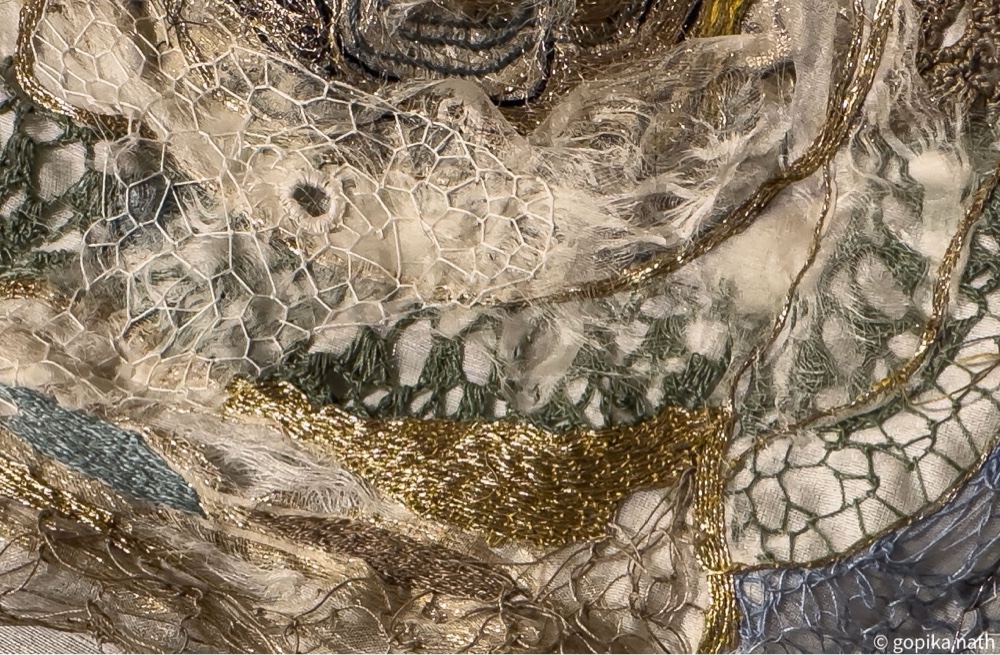
The work on my third co-creation piece continues. I have been doing a great deal of couching with 6ply gold thread or Zari. As I was couching around a particularly unregulated space, the process became uncomfortable. Moving along the uneven threads of a knitted piece that I had cut and placed into the work— threads I had earlier couched, or tacked— the surface was uneven. The lines moved up and down, curved inward, then rose again, at one point I was couching a strand of 6ply zari around a single strand of 2/30’s cotton. Needless to say, it was a taxing stitching experience

The intense presence required of me to focus so completely on the thread I was couching with and the six-ply Zari itself—brought several thoughts to mind.

One was how much we take for granted the work we see around us. Zardozi work does not refer to couching at all. It is simply called sui ka kaam. The work is intricate, often impossibly complex, and yet one cannot truly understand what it entails unless engaged in doing it oneself. Even when I am couching the 6ply gold thread in straight lines, a seemingly simple task, I find that my couching stitches are not at regular intervals.

Part of the difficulty is visual. I work with a lot of electric light focussed on the work. The gold of the sari shines back at me. The couching thread itself is dyed yellow. Between the two, visibility is compromised. I am also not bent over an adda like the craftsmen are. I sit back on my sofa, sometimes working at a table, and at this point with the fabric resting on my lap, supported by a cutting mat underneath for stability.

I am acutely aware that I do not work the way traditional craftsmen do. They sit on the floor, cross-legged, bent forward over an adda, the body trained into a posture that brings eye, hand, and cloth into a fixed and intimate relationship. I cannot sit like that. My body does not allow it. I work seated on a couch or a chair, adapting the surface to my lap or a table, stabilising the fabric as best I can. This difference in posture is not incidental. It affects visibility, control, rhythm, and endurance. What the craftsman achieves through a lifelong bodily discipline, I mediate through adjustment and compensation.

What is at work here is physical negotiation. The hand is constantly adjusting to uneven tension, to the glare of gold against yellow thread, to limited visibility. It compensates for posture, and it stabilises the work with whatever is at hand. These are not conceptual decisions. They are moment-to-moment bodily responses. The intelligence involved is motor, accumulated through doing, refined through repetition and resistance.

Much of what happens in this work is decided before it can be named. The hand adjusts, compensates, responds. Thought follows action, not the other way around. The hand carries its own intelligence, shaped by repetition, resistance, and material encounter.

All of this made me acutely aware of the importance of skill, and of how skill is acquired across generations. The level of perfection achieved by traditional craftsmen comes from beginning very young, often at the age of fourteen or even earlier, with nimble fingers trained through repetition. This led me to think about the histories that precede and influence us. How did this gold thread come into being? Who invented it? Who first thought of turning metal into thread?

Historically, gold thread is believed to have originated in China, where thin sheets of gold were beaten into leaf, cut into fine strips, and wrapped around a core of silk. In Chinese practice, paper too was transformed into textile material. What was known as zhi bu—literally paper cloth—referred to paper that was strengthened, coated, sometimes laminated with metal leaf, and then cut into narrow strips to function like thread.

I remember visiting the artisanal district of Nishijin in Kyoto, where I saw this process continued in Japan as Shifu, which uses the same characters and means the same thing: paper cloth. Gold leaf was meticulously laid onto paper, then hung vertically beneath the boards of the atelier to dry so that no dust could settle on it. Once dry, it was cut into extremely fine strips. By the 1980’s, Japan had computerized looms producing elaborate designs for obis and kimonos, yet the gold thread itself—the Shifu—was still inserted by hand. As techniques travelled from China to Japan, pronunciation may have shifted, but the material logic endured: paper becoming textile, metal becoming thread.

Although gold thread is used extensively in India today, it did not originate here. The word Zari itself is Persian, derived from zar, meaning gold. From China, this material knowledge travelled westward along trade routes into Central Asia and Persia, carried not only as finished textiles but as technique. In these regions, where metalworking traditions were already highly developed, gold thread gained technical refinement and symbolic importance, becoming integral to court dress, ceremonial garments, and religious textiles. 

India has always worn gold—often heavily, abundantly, and with deep ritual meaning. Gold jewellery has been central to bodily adornment, temple wealth, marriage, fertility, and lineage. Necklaces, bangles, anklets, waist belts, nose rings—gold sits directly on the body in Indian culture, in intimate contact with skin. In ancient times, there was no cultural hesitation about wearing gold as metal.

What did not emerge in India, however, was the widespread transformation of gold into thread as a dominant textile material. This distinction has less to do with aesthetic preference and more to do with climate, clothing structure, and where status was displayed.

In the Indian subcontinent, the hot and humid climate favoured minimal, draped, breathable garments—saris, dhotis, and uncut lengths of cloth. The body remained the primary site of ornamentation. Gold worn as metal remained visible and effective. Heavy surface embroidery with metal thread would have weighed cloth down and interfered with fluidity and drape. Decoration therefore emerged through weaving, borders, pallavs, dye, and pattern rather than through dense metal-thread embroidery. Today, these factors are overridden by things like air-conditioning and heating of our lived spaces. 

In contrast, in West and Central Asia and the Middle East, layered garments evolved out of environmental and social necessity. Desert regions are marked by extremes of heat and cold, abrasive winds, and dust, and many societies were nomadic or semi-nomadic, constantly moving across terrain. Clothing functioned as protection and portable shelter. Over time, layered robes, coats, and structured garments also became associated with dignity, authority, and public modesty. As the body became increasingly covered, jewellery worn directly on the skin lost its visibility and practical relevance. Status therefore migrated onto the garment itself. For wealth and power to remain legible, gold had to enter cloth. It is in this context that gold thread gained both technical importance and symbolic force, becoming integral to courtly, ceremonial, and religious textiles.

These regions also possessed long-standing metalworking traditions—wire drawing, filigree, armour making—which made the transition from metal to wire to wrapped thread technically continuous. Through trade, migration, and court patronage, this material intelligence travelled into the Indian subcontinent, where gold thread was absorbed, adapted, and eventually refined within local practices, gaining extraordinary prominence in ceremonial embroidery.

What is interesting is that contemporary Zari behaves very differently from older forms. Today, Zari can pierce fabric, allowing it to be used for stitches such as stem stitch or satin stitch, not only for couching. This is not a very recent development. I have seen ecclesiastical embroideries in the Museum of Christian Art in Goa where Zari is used in satin stitch rather than laid on the surface.

We also have Dabka, the purled gold wire, which is a different material altogether. Today, Dabka is made from copper or aluminium wire coated with a gold-coloured finish. Modern Zari itself is produced through a fascinating industrial process, where a microscopically thin layer of metal is vacuum-deposited onto a polyester film called Mylar. This metallised film is then cut into fine strips and wrapped around a core thread, creating the illusion of metal while remaining light enough to pass through fabric—an extraordinary convergence of ancient visual language and modern material science.

The other moment that struck me came when I turned the fabric over to secure the thread at the back. Looking at the reverse—the unregulated, overlapping stitches in dyed yellow thread that allows me to couch the zari onto the surface without being overtly visible,  something shifted. What surfaced in that moment was the memory of my wedding lehenga—the weight of it, the labour embedded in it, the unseen back of the work. I cannot fathom why the back and not the zari itself brought to mind the peach-saffron lehenga—perhaps the underside was evocative of traditional Zardozi work more than my contemporary rendition. 

It made me think about how history and memory move together, how they converge into what we are doing today, who we are today. And it brought me back, very clearly, to the essence of this piece—what I call co-creation.

Nothing arises in us without history, conditioning, precedent and our own sense of being human.