Showing posts with label guest post. Show all posts

Sunday, 31 December 2023

Personal Threads: Perfection of Imperfection, Guest Post by Stephanie Fujii

I cannot look at fabrics without touching. The way they move by crumpling, folding, tearing, shrinking, fraying. They never stay the same and working with them is intensely personal.  


My approach to my current creative practise is meditative and intuitive but this was not always so. 

I was born and brought up in Manchester, UK in the 1960s and 70s. Manchester’s rich history of cotton textiles was unknown to me for most of that time even though I went through school showing a skill for ‘art’. In my school, this was what you studied – art. I had an excellent art teacher who made all my lessons stimulating and interesting, but the art exams we took were only drawing and painting, so that is all I did. I did this instead of studying other subjects, much to my parent’s chagrin, and I love drawing and painting to this day.   

My father was an architect, and he loved the architecture in Manchester. He had a passion for the watercolours of Russell Flint. Both my sisters are creative and skilled in drawing and one of my sisters and my mother are exceptional seamstresses. So, there was a definite creative streak running through my family. However, my parents loved history so, as a family, we visited museums rather than art galleries.  

I went to Manchester Polytechnic (now Manchester Metropolitan University) to complete my art foundation course and then I studied Graphic Design and Illustration at Kingston Polytechnic (now Kingston University). These were formative years when I discovered the joy of going to art galleries, which I still love to do, looking at other forms of art and creativity and learning about the influences of well-known artists as well as those of my peers. 

I was very lucky to gain a place to study Illustration at the Royal College of Art in the 1980’s in London where I had the privilege of learning from well-known illustrators at the time including Quentin Blake. I was able to experiment and develop my way of working, preferring to make layers of collage using acrylic paint, paper and fabric. I think my tutors were concerned that my style was a little too abstract and they supported me and my work. After leaving, I embarked on a career as a commercial artist for about ten years during which time I worked for design companies and magazines. At the same time, I was also developing my personal work as paintings following my own themes such as interpreting space and spatial freedom which I identified with much more. These themes continue to occupy my current work. I found the constraints of making commercial work and answering other people’s creative questions increasingly physically, emotionally, and creatively difficult to do. 

Also at the same time, I began to travel a great deal more to countries with wonderful, rich, cultural heritages such as China, Vietnam, India and Russia. This inspired me to become a teacher so that I could explore more of the world while working and creating at the same time. This was the masterplan – teach, create, move onto to another country. Travelling and teaching excited me very much and opened up new horizons. However, paradoxically, my creative work went into hibernation as my first teaching job took me to Japan where I met my husband and where our daughter was born. My life went into a delightful, sensory overload, taken up with looking after my family, learning Japanese and learning about the Japanese culture and way of life. My husband is from Kyoto, once the capital of Japan, steeped in history and traditions, full of gardens, the bamboo forest, palaces and shrines and the home of Kabuki theatre.  

Altogether, I spent five years living just outside Tokyo in the late 1990’s. My experience of Japanese culture and way of life was mostly of precision, order, and efficiency. A train arrives reassuringly on time at the exact spot marked on the platform without fail. A little more stressful is making your child’s packed lunch which must be done in a specific way. It took a lot of time for me to get to know, understand and adapt to all the details present in a different culture that I took for granted in my own culture. 

My discovery of the aesthetic of wabi sabi in a variety of forms was extremely gradual throughout my time in Japan. I did not understand for some time that what I was seeing had a name. Wabi sabi has been described as ‘flawed beauty’ and ‘the beauty of the imperfect, the impermanent, the incomplete’. As art forms, it can be seen or experienced in different ways for example, in Ikebana (flower arranging), Japanese Zen gardens and Kintsugi (broken ceramics mended with lacquer mixed with gold) to name a few. It also includes Boro, or ‘rags’ or ‘something tattered or repaired’. This is repairing textiles by patching and stitching, and it was practised by poor workers and farmers in Japan who could not afford new clothes or bedding. They needed to repair them over and over again. I have seen many isolated examples over the years. However, more recently here in London, I saw a large collection of authentic Japanese Boro textiles including bedding, clothes, bags and shoes for the first time. 

The rawness of Boro, its simplicity and the organic way items are mended and assembled using this technique resonates with me. There are no rules. Yet, it was not until many years later back in my home country with my family when this began to permeate my creative thinking. I reached a point where my life experiences urged me to re-generate my creative voice and answer my own creative questions. To begin with, I think I was looking for ‘a place to go’ that was just mine to think, to heal, to cope, to make decisions and so on. There was and still is a great deal of happiness and fun, but it is the dark times in life such as death and illness that require an escape route. I had never stitched before, so this is how I started - I collected together different bits of fabric that I already had, created a simple composition, and began to stitch.               

I quickly understood that my intention was to use stitching as a mark making tool. I started by using a double thickness of thread but soon realised that a single thread was a base – it makes a sensitive mark on its own but it can also be built upon. Double and overstitch, couch, back stitch, blanket stitch can all be added to a single thread. Stitches are a language and when I see them emerge on the fabric, they have a very clear definition even when I am not sure what I am trying to make. 

In my mind, my first series of ‘stitchings’ was entitled ‘Somewhere to Go’ because these beginnings became my new place to go to find my peace and my freedom to create. Only a few of these pieces of work as I first made them still exist. Over time, I have re-examined them, deconstructed them, stitched over them, painted on them, added parts of them to later works …..and also hidden them away not to be found again.


‘Another Country’


I believe my work took on a more sustained meaning for me during the COVID lockdown when I made a collection of six hangings entitled ‘Another Country’. In the UK, we were allowed to go outside for exercise breaks and these hangings are tactile responses to the spaces I found myself in not so far from my home. Like most people, I had to think about the term ‘self-isolation’ which became an integral part of our pandemic vocabulary.  There is a solitude about each hanging, but they also have a connection to each other, and they can be placed in any order. I liked to imagine I was walking through each terrain alone with my own thoughts and wondering if I can cross this boundary or venture through these contours. In many of the hangings, I asked myself ‘yes I am allowed here but how will I get over to that side?’ This was also when I began to think about my work as physical and emotional maps. This is quite natural to me as, having spent most of my life living in big cities, I am interested in interpreting space and spatial freedom. As physical maps, I zoom out to show satellite-like images of spaces and zoom in to show close ups of details of stones or pavements. As emotional maps, I attempt to represent thoughts, worries and musings. At the time, I was certainly contemplating where we are going to find ourselves. 


‘Our Paths Don’t Cross’   


In this vein, I made ‘Our Paths Don’t Cross’ where I continued to look closely at my immediate urban environment and how we were now being asked to behave to protect ourselves. It is a space to walk and pass through, an open territory with hidden and defined boundaries but it also resembles a shroud - a very uncertain time for everyone. While I was making this piece, I was developing the freedom of printing and painting on fabric with acrylic paints, adding applique in the form of fabric tapes, offcuts and edges cut from other pieces of fabric and working with new textures such as the stiffness of the paint together with the soft fabric. My stitching responded accordingly. 


‘There is Beauty in the World’  


A further series of work entitled ‘There is Beauty in the World’ focused on the chaos and the order in my urban environment, such as broken tiles, cracked pavements, weathered wood, crumbling walls. I think the imperfections, accidents and mistakes that manifest around us show a frailty in life which is transient as well as a strength. I have favourite walls and pavements close to where I live that I like to look at. Case in point, spilt paint by a bus stop near my home which I have photographed many times. This paint spillage has inspired a wealth of pieces I have made using parts of shopping bags, remnants and my old clothes. For these works, I prepared many pieces of fabrics by painting, printing and staining. Then I spent a great deal of time placing them together before hand stitching. I am comfortable unpicking, cutting up and tearing off parts that do not quite work. The commercial artist in me has a need to create a composition.     


‘The Discarded’


Similarly, I often photograph discarded objects such as card, boxes, wrappers and cord just as they have been left on the road, in gardens and on pavements. ‘The Discarded’ is a series of work I made based on all the ‘accidental compositions’ I discovered by chance. I can see shapes, tones and textures that inspire me to make something, and I am attentive to the beauty of their impermanence. I always have the hope they will not be there the next day and that I have managed to capture them in while it lasted. 


Stripes and lines


Almost all my work features some kind of attempt to make stripes in different ways, with tape, string, thread or print and I sometimes use cloth that is already striped. There are also many overlapping, tangled lines and contours in all of my pieces. When I am stitching, I think about breaking these lines, strengthening or weakening them, changing their direction and crossing the boundaries that lines create. When a line is broken, a new space opens up. 


‘Meeting Place’   


I use my sketchbook as a place to collect, store and process images and ideas I have found. I try things out, make compositions and write. What I do in my sketchbook is a starting point which triggers other things. I made ‘Meeting Place’ after looking at prints I had made using sponge prints washed over with inks on paper in my sketchbook. I usually like to cut organically and intuitively to make new shapes – but somehow, I found myself cutting up the paper into equal(ish) squares then made 4 rows of 3 squares each. When I adapted this idea to fabric, there were a lot of parts I did not like but I kept printing and staining and cutting until I made the composition I wanted. There are bold white streaks that are sometimes linked together by stitched clusters or couched lines. I have attempted to make some symmetry, but this has been intentionally interrupted by the patches and lines. The concentration of red and cream stitched thread and string in the middle is where we can meet but it is not contained. We can move about, and we can leave the space if we want to. 


‘I can wear what I want’   


I often use my own old clothes and clothes from thrift shops as a base for a composition. I am guided by the defined edges of seams, hems, cuffs and collars to begin with which I can contrast with the raw, frayed, cut up edges. The outline is always irregular. While I am making these pieces, I am acutely aware I have deconstructed a highly technical piece of work and I have wondered if I am reacting to the fact that I cannot make clothes myself. I enjoy looking at sewing patterns because they resemble maps, but they are also instructions which I am unable to follow. 


‘Tiles’    


I was inspired by the design of the tiles in the British Museum, London – a place I have been a member of and have visited for many years. I became interested in an arrangement of dark central tiles surrounded by larger pale tiles. But I noticed that, within this arrangement, no two dark tiles are the same, so I set about making my own versions using off cuts of stained and printed fabric. There are six pieces in all – I wanted to propose a deviation or a possibility of changing direction so, while four of the tiles are similar, two break away from this - one is in reverse and one suggests a corner.  I still have not decided whether they should be shown separately or together and, if together, which order? And should they be on the wall or on the floor?


I am developing my own personal love of exploring fabrics to answer my own creative questions. A pattern is emerging. I choose and collect fabrics, mostly remnants, old clothes and found fabrics. I paint and stain them. Then I spend time piecing them together, constantly cutting up and positioning them until I have a composition I like. Finally, I begin to hand stitch. My stitching responds directly to the surfaces I have made, a relationship forms between them and, as time goes by, each part of a piece I work on begins to connect with another part of the piece. I often start to make many pieces at the same time, keeping them ‘on the go’ until I am ready to concentrate completely on finishing.

I do not have a large repertoire of stitches – only really using running stitch, back stitch, blanket stitch and couching. I often stitch clusters by using thick thread or cord as a base and a chaotic over-stitch with finer threads. I have recently enjoyed the effects of painting ink directly onto the compositions I make to watch the leakage emerge. There is an unpredictability in this approach which provides another dimension to how my stitching will respond. The possibilities are endless.

I have often read that textile work tells stories and there are many wonderful examples, old and recent, that I admire greatly. Currently, I think my work is narrating a story of sorts that might only be clear to me. I have yet to show my work in any kind of professional arena, so my plan is to continue to strive for the perfection of imperfection. 


Stephanie Fujii MA (RCA) is a textile artist and teacher based in London UK. After working as an illustrator in the1990’s, travelling, teaching, living in Japan for five years and having a family, she has embarked on developing new personal work using fabric, paint, thread and inks drawing inspiration from Japanese Boro, her urban surroundings and love of textures and surfaces.


Thursday, 10 March 2022

Personal Threads: Portraits Without Faces, Guest Post by Stewart Kelly


“Stewart Kelly’s work is one that revolves around the observation of the human form. He produces work that gives insight as to who we really are as an organic entity, stripping away the layers of pretence. These are not portraits of obvious personality, there are no faces, no identifiable poses, no costumes, no props.”

– John Hopper (Inspirational 8)

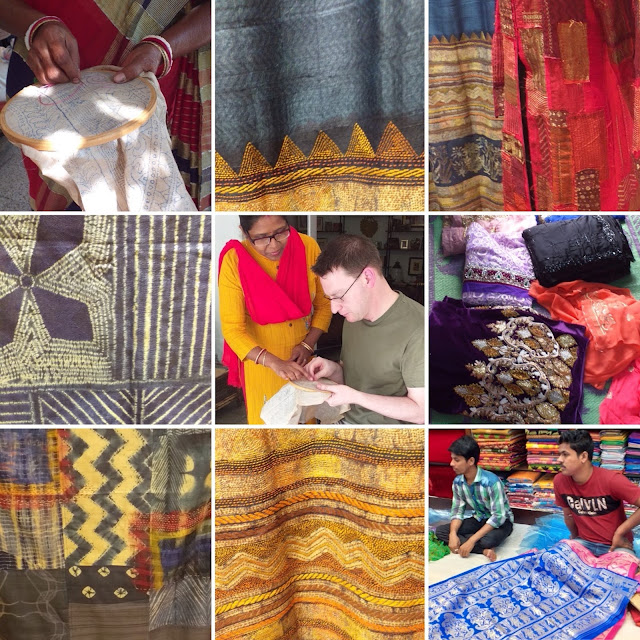
Studying Kantha Embroidery, West Bengal, 2019.

 
My current practice lies at the intersection of art, health and wellbeing. Through practice-based research, I am interested in reflecting on how the ritual of hand stitching can document emotional experiences. 

During 2019, I travelled to West Bengal and visited artists, often in remote villages, working in their studios. My interest was in researching Indian textiles, specifically Kantha embroidery, which is synonymous with this region. Experiencing the sights, sounds, colours and people of India was a revelation in many ways. Through speaking to artisans, I became increasingly aware how tradition and beliefs are integral to the nation’s cultural identity. 

 West Bengal 

Map of West Bengal, India.


West Bengal is a state in the eastern region of India along the Bay of Bengal. With over 91 million inhabitants, it is the fourth-most populous state and the fourteenth-largest state by area in India. Part of the Bengal region of the Indian subcontinent, it borders Bangladesh in the east, Nepal and Bhutan in the north. It also borders the Indian states of Odisha, Jharkhand, Bihar, Sikkim and Assam. The state capital is Kolkata, the third-largest metropolis, and seventh largest city by population in India. 

 Kantha Embroidery 


 Kantha Embroidery, Kolkata, 2019.


In Sanskrit, the word 'kontha' means rags. Kantha is the most popular form of embroidery in West Bengal, and has been around for more than 500 years. Initially, Kantha was used on cotton or silk, however, it is now used on other fabrics as well like Georgette, crepe and chiffon. 

Originally made from old, recycled fabrics, the traditional kantha cloth is an example of flat, or un-wadded quilting, worked on multiple layers of fabric. Bangladeshi or Bengali kantha cloths were made by women for use in their own homes as bedcovers, mats and all-purpose wrappers. The stitching consists of embroidered patterns, ranging from simple floral motifs to elaborate scenes, combined with running-stitch quilting in a colour matching the background fabric. 

Portraits without Faces 

 Although there is a wealth of traditional textiles produced in India, my thoughts focused on the lives of the artists. Many of whom work long hours, tirelessly investing their skills, for little financial reward. On my return from India, I revisited drawings I had created prior to my trip, consisting of multiple figure studies. I began to embellish the surface, emulating labour and repetition through intensive periods of stitching. 

Baptism of Fire and Wake Up 

The first two pieces I created for this project were called 'Baptism of Fire and Wake Up'

Baptism of Fire, Ink & Machine Embroidery on Paper, 

80 X 60cm, 2020.


The pieces evolved in several stages, over many months. The basis of each piece was an ink drawing on paper. The drawings consist of multiple figure studies, made from observation, overlaid over a period of time. In the studio, I began to machine stitch over the surface of the drawings, initially to enhance certain lines and fill in spaces. 

However, through intensive periods of stitching, the pieces began to transform dramatically. I frequently stitched on the reverse side of the work, unaware of the image evolving on the front. The image almost became irrelevant, and the process of repetitive stitching, became the focus of the work. 

Baptism of Fire (Detail), Ink & Machine Embroidery

 on Paper, 80 X 60cm, 2020.


As the pieces evolved, the paper began to break away in places, caused by the perforations made by the machine needle. At this point it was necessary to add additional support to the work in order to progress. This process of working became an interesting metaphor in the work, especially as my practice is informed by themes surrounding the human condition. 

Wake Up, Ink & Machine Embroidery on Paper, 

80cm X 60cm, 2020.


Through the process of creating the work, the work became fragile and began to degenerate. 

Out of the Blue and Spectrum 

 Out of the Blue (Detail), 

Hand & Machine Embroidery on Digital Print 65 X 50cm, 2020.


The following two pieces in this series were called 'Out of the Blue and Spectrum'. These pieces also evolved in several stages over many months. Initially, I photographed a series of drawings before digitally manipulating the images to add colour and definition. Following this, I collaborated with the Centre for Advanced Textiles at Glasgow School of Art in order to digitally print the images on to cloth.

In the studio, I began to hand and machine embroider onto the surface of the printed cloth. However, these pieces began to evolve in a different way to the earlier works on paper. Through intensive periods of stitching, the cloth began to gather and sculpt in unpredictable ways. Through this process of working, the pieces were transformed, and formed a new identity. 

Out of the Blue (Detail), 

Hand & Machine Embroidery on Digital Print, 65 X 50cm, 2020.


My creative process can vary depending on a specific project, however, many of my pieces evolve over a period of time. I find this approach enables me to explore the full potential of working in a particular way. I frequently work on more than one piece of work at any one time. I find this process of working valuable in being able to reflect and assess the progression of a particular project. I normally work on one piece for a while, put it away, try to forget about it, and start to work on a different piece. After a period of time, I will return to the first piece, and for a short time, I can be the viewer of my own work. I can assess what is going well, and what is not working. At that point I am often able to make bold decisions about how to move the piece forward. 

Spectrum, Hand & Machine Embroidery on Digital Print, 

65 X 50cm, 2020.


Slow Motion and Daydreamer 

The final two pieces in this series were called 'Slow Motion and Daydreamer'. The basis of these pieces were drawings digitally printed on to cloth. However, hand stitching and the inclusion of kantha embroidery is more predominant in these pieces. 

 Slow Motion, Hand & Machine Embroidery on Digital Print, 

75 X 55cm, 2020.


On reflection, I began to consider how the drawn line is immediate, whilst stitching is slower and more reflective. Through a complex network of drawn gestures and stitched lines, I attempted to establish order amongst the chaotic background of lines and colours. 

What lies beneath the surface? How can hand embroidery enable communication between the conscious and subconscious, and serve as a subliminal connection to the world? In addition, how can the hand drawn qualities of stitching, create a narrative to intertwine the fabric of this inner and outer connection?

Slow Motion (Detail), Hand & Machine Embroidery on Digital Print, 75 X 55cm, 2020.


I also considered how my practice seeks to explore reasons for using stitch to express male identity, and how embodied textile practice encourages well-being in men. The significance of stitch as a feminist-based practice is well documented. However, the use of stitch as a reparative tool, and craft as a method of embodied textile practice for men, has rarely been assessed. 

Daydreamer, Hand & Machine Embroidery on Digital Print, 

75 X 55cm, 2020.


How can engaging with material processes report, reflect and discover the spiritual act of stitching through contemplation, meditation, resilience, transition, physical and emotional healing? In addition, how does the intimacy of repetitive touch leave a trace of the artist’s presence? 

Craft is immortalised by the hands, and draws an association with the processes it is engaged with. The artist initiates a dialogue with the material, and the act of the hand. However, is there a relationship between craftsmanship and sensitivity in a conversation of the hands? 

Daydreamer,(detail) Hand & Machine Embroidery on Digital Print, 75 X 55cm, 2020.


Conclusion 

Through the development of this project, I reflected on how the ritual of hand stitching can document emotional experiences. The intimacy of the medium itself, with the suggestion of repetitive touch, lends a poignancy to bodily associations, providing an intimate and ambiguous trace of the artist’s presence.

Out of the Blue (Detail), Hand & Machine 

Embroidery on Digital Print 65 X 50cm, 2020.


Making hand stitched textiles can be therapeutic, a crucial tool for reflection and developing self-awareness. Working on slow, reflective projects has allowed a better understanding of the connection between the self and my desire to make art. 

 The work marks time, and chronicles emotional changes through the physical and reflective act of stitch. In addition, the work aims to convey the concept of transformation in life, the importance of reflection, and the exploration of creativity as part of artistic identity.


Friday, 6 September 2019

Personal Threads : Blessings From a Grandmother, Guest Post by Ina Puri


My dearest Samaira,
 
Long before you read about the fabled Pokkhiraaj - the winged horse that is believed to have magical powers to fight evil, you will own an exquisitely embroidered kantha that will narrate many a story. Tales of valour, romance and enchantment. When your great-grandmother, your father’s Nani Konchi, started stitching the kantha, it was for her grandson Arjun, your father. We were in Baharampur, Murshidabad, where my grandparents lived in a rambling house filled with books and memories.
 
Ina with her son Arjun

It is hardly mentioned now, but the British East India Company started its journey from Murshidabad which was the capital of pre-British Bengal, and Bankim Chandra  Chatterjee who composed the famed ‘Vande Mataram’, wrote his epic ‘Anandamath’ sitting on the banks of the Bhagirathi that flows through our very own Baharampur. In fact, Kashida, the exquisite silk embroidery on cotton was at one time exported exclusively from Bengal, its main centres around Dhaka and Murshidabad.
 
A Balaposh
Those days, I was looking for a Balaposh – a yearning for that subtly fragrant, soft and comforting quilt. Although it is a quilt, the only quilting stitches are on the edges. It was a speciality of the artisans of Murshidabad, made by craftspeople known to our family. The Balaposh is traditionally layered, with ‘attar scented’ cotton, infolded between two fabrics of silk cloth, and sewn at the edges. It was first made in the Mughal era on request by Nawab Shujauddin Muhammad Khan who commissioned a quilt  “soft like wool, warm like a lap, and gentle like a flower.” 
 
Flowering Bakul Tree (Indian Medlar)
On days that I stepped out, in search of a one, my mother (your great-grandmother) would sit in the garden, under the fragrant flowering Bakul tree (Indian Medlar or Bulletwood tree), stitching away. The evenings stretched long and as we, on my mother's side of the  family shared stories and anecdotes amongst ourselves, to while away the hours, Ma would spread out the silk cloth -a  smallish, baby-sized quilt length, and fill in the imaginary squares which she had, probably, already marked out in her mind. The box with different coloured silk threads and needles by her side, she would carry on stitching even when the lanterns and candles were brought out, during the daily power cuts.

Konchi's Kantha, Hand sewn for her grandson Arjun

It was a time I recollect with fondness, when our family, spanning generations - my maternal grandparents, mashis (aunts) and cousins, all gathered at our ancestral  home in  Murshidabad,  just to be together. It had been an uncharacteristically cold February that particular year, some thirty years ago, but the room was warm and alive with conversations and laughter. We begged Boro Mashi (Mahasweta Devi) to tell us one of her famous ghost stories and huddled close, as she obliged. Outside, the night was full of mysterious shadows, lit occasionally, by the dancing fireflies.
 
Ina with her cousin, mother and aunt Mahashweta Devi,
who is doing the alpana
 
Do you know, as long as I can remember, kanthas have always been a part of our household. A light blanket which was ideal for summer or monsoon nights, was usually made by the women who specialized in the art and turned discarded and worn-out sarees into a beautifully embroidered quilt. It was worked with the myriad stitches of kantha needlework. The main distinguishing feature of a kantha was the pattern created by the concurrent lines of running stitch, sewn in white thread securing together the layers of cloth, which gave the surface a textured, rippled feel. If the designate purpose was to use the cloth as a regular covering, this puckering quilted surface was left unadorned but, if it was designed as a wall hanging or stole, then the kantha-maker would embroider it with motifs that were artistic and imaginative.
 

Detail of Konchi's Kantha

 
My grandmother (your great-great-grandmother) told us that the earliest reference to kantha in Bengali literature date back to the verses in Charyapadas (8th to the 11th centuries CE) They are a collection of mystical poems, in the Vajrayana tradition of Buddhism, derived from the tantric tradition during the Pala Empire in Ancient Assam, Bengal, Bihar, Orissa. It was written in an ‘Abahatta’ (evolving language) that was the ancestor of Bengali and other Eastern Indo-Aryan languages, and is said to be the oldest collection of verses written in those languages.
 
 
The family celebrating Bhai PhoNta
or Bhai Dooj
 
A fleeting hush would descend when Didima spoke about the history of Bengal, its textiles or customs. The younger people in the room would find it  especially fascinating to know that Baharampur had such a rich heritage. We had all visited the historic ‘Hazarduari’ or a ‘palace with a thousand doors’ with our grandparents, built on the lands of the demolished fort Kila Nizamat which stood on  the banks of  the  Bhagirathi River, in Murshidabad.  And, with the pride of true Bengali’s  our hearts had thrilled to hear about the bravery and courage of Siraj ud-Daullah, the last independent Nawab of Bengal, who, deceived by his own men, faced the British cavalry fiercely, armed with a mere sword, in the decisive ‘Battle of Plassey’. The end of his reign marked the start of British East India Company rule over Bengal and subsequently the Indian Subcontinent.
 
Fort Bahrampur, on the banks of the River Bhagirathi
 
While the conversations flowed through the evening, Ma worked on her kantha completely lost to the world. Who can tell, what was going on in her mind.  I would ask myself, if she was imagining a conversation with her yet to be born grandson. In front of her, the Kantha she was embroidering was getting more and more elaborate every day, a magical fairyland inhabited with serpents, dancing peacocks, flowers and fruits, alphabets, nursery rhymes and board games with knots and crosses. In one corner, there were even the fabled birds familiar to us from our favourite bedtime storybook ‘ ‘Thakurmar Jhuli’, the Byangoma and Byangomi.
 
Another detail from Konchi's Kantha
 
 Samaira, wait till you are a little older, we will read these stories together and look at the pictures of all these enchanted creatures.
 
Baby Arjun
 
When I look at this kantha today, those soft folds that once swathed my infant son, following the layout with more focussed attention, I realize that what makes it so original is that Ma followed her own instincts when it came to the design. Creating a composition that was intimate yet visually appealing. We were aware that most conventional kanthas have a basic pattern that is common to them - a lotus at the centre embellished by vines of plants and motifs taken from old and worn sari borders. The four corners usually have the tree of life patterns that lead to the centre, with the ornamentations drawn from nature or mythologies. Images of goddesses are popular and Lakshmi is the one deity who remains a perennial favourite - her footprints  symbolically  represented through patterns of alpana. Newly married wives were known to show off their embroidery skills by making elaborate kanthas for their husbands, interspersed with lines of romantic poetry. In contrast, Ma’s creativity was uniquely her own personal language.
 
Manish Ghatak with his wife Dharitri Devi,
Ina's maternal grandparents
You would have enjoyed her company, Samaira. Ma was born to an illustrious family; her mother was Dharitri Devi and her father, the distinguished litterateur Manish Ghatak. He was a poet and novelist of the Kallol era (one of the most influential literary movements in Bengali literature), who used to write under the pen name ‘Jubanashwa’. Her eldest sister was the brilliant writer and activist Mahasweta Devi who studied in Shantiniketan. But, she was a strict disciplinarian when she came home for the holidays, keeping the large brood of younger siblings under a stringent regime. While the rest behaved, Ma was hauled up constantly. She was said to be extremely mischievous and was always getting into trouble. In her youth, she was a striking beauty with a fiercely independent mind, who stood up for what she believed was just and right. While her siblings went about their lives establishing themselves in diverse ways, Ma concentrated on her music.  And as she grew older, she developed  her other skills, like stitching, cooking and making alpana. She had just about started enjoying her life away from Baharampur, at her maternal uncle, the renowned sculptor, Sankho Chowdhury’s home in Baroda, where she was learning music, when her parents decided to marry her off to an eminent suitor, they considered suitable for her.

Ina's mother Konchi

No matter how tough life turned out to be, in later years, she never submitted to defeat and remained her indomitable self, full of spunk and laughter. Had she continued her studies in music, who knows, she might even have been a musician of distinction today. Yet, destiny had other plans for her, a life she lived with her entire being. Remaining till the end, unvanquished.
 
Another detail of Konchi's Kantha
Samaira, this embroidered cloth is a repository of song and words of poetry that came alive as she embroidered the squares, almost a delicate memoir of her recollections and desires. While she continued to stitch even after making this one for Arjun, she never made another quite so intricate or exquisite. Someday, when you are older, read this story  when you look at the kantha. Imagine the life that was, imagine the hands that held the fabric and fingers that lovingly sewed, carrying forth a tradition of our native Bengal
 
Ina with her mother
 If Ma were around, I know she would want to add just another frame, of a little girl with shiny eyes and curly hair, laughing hard. Of you.
 
 
With all my love,
Your fond Dadi, Ina


Ina Puri is a writer, biographer, art curator and collector. She is the author of several books, including In Black & White (a biography of Manjit Bawa), Faces of Indian Art (iconic artists seen through the lens of Nemai Ghosh) and Journey with a Hundred Strings (on the music and life of Pandit Shiv Kumar Sharma). She produced Meeting Manjit, a film on Bawa, her friend and collaborator, which won the National Award. She currently occupies the position of Editor at Art Varta and has recently published a pictorial memoir on Pt. Shiv Kumar Sharma entitled, The Man and His Music.  Ina’s three-decade-long engagement with the arts embraces everything from tribal art and folk theatre to contemporary performing arts, visual arts and literature. She lives in Gurgaon with her husband, Ravi, and canine soulmate, Leyla.