After returning from travel and two weeks of intense outward engagement, I realised that my resistance to stitching was not simply fatigue or distraction. It was something else.
After days of immersion in other forms of attention: travel, conversations, paperwork, pending tasks, research into Kasuti, observing other methods of making, meeting artisans, studying structure and technique. Engaging with architecture, food, soil and stone — tabulating possible references for the beginnings of Kasuti. Although I remained intellectually engaged with needlework, I was not stitching with my own hands. And when I returned home, it took me another two weeks before I could fully approach the large textile piece waiting for me.
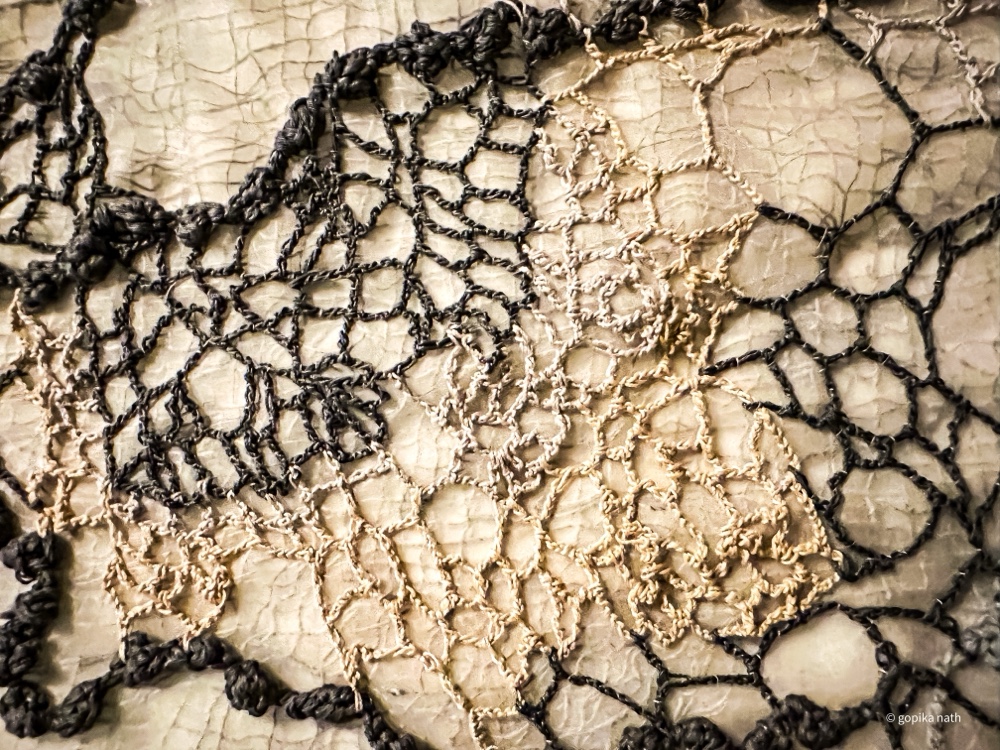
The work itself is ambitious, approximately 1.5 by 1.5 metres, layers of cotton crochet contained and layered between layers of unbleached silk organza. I have written about this evolving “crab lace” process, where crochet fragments and residue become part of a larger stitched surface.
http://gopikanathstitchjournal.blogspot.com/2026/03/crab-lace.html
At this stage I was tacking together five uneven layers of cloth, freehand, without a frame, because the crochet protrusions and shifting surfaces made stretching impossible on a hoop and my ‘adda’ isn’t large enough to accommodate this scale. The work had to be turned repeatedly on the work table — guided by the hand, its proximity to areas that needed to be stitched — maintaining tension and more.
I had chosen a pale grey thread deliberately. Against the black crocheted threads it remained visible, but against the grey and off-white lace it almost disappeared. The stitches moved between visibility and disappearance, holding the structure together — a sense of ease, familiarity and rapport I hadn’t noted before.
As I returned to the act of stitching itself, I became aware of something I may well have felt for years but had never seen nor articulated so clearly: there is an extraordinary intimacy to stitch.
I began my design life as a weaver, and I loved weaving. I still remember the wonder of watching individual strands of thread slowly become cloth. The processes of winding, warping, threading the heddles and reed, passing the shuttle back and forth, all carried their own rhythm and intelligence. But weaving, I now realise, also maintains a certain distance between the body and the cloth. The loom dictates posture, width, tension, movement. Even when one is deeply involved in preparing and constructing the weave, the fabric itself remains stretched within an external structure. The body adjusts itself to the loom — almost always separated from the emerging fabric, by the reed and the frame of the loom.
Stitch and crochet — even knitting, feel fundamentally different.
Here, the cloth engages directly with both hands and the body. It gathers, folds, bunches, softens, and resists according to the movement of one’s limbs and torso. How I sit is relevant to how I stitch. The work is turned instinctively, held against the lap, cradled and shifted constantly — in search of comfort and control. The material adjusts to you as much as you adjust to it.
While tacking these five layers together, I could feel the organza rubbing against my fingers. Its starchy silkiness — a familiar discourse. I was ruching the fabric to grip it more securely, while managing the uneven tension created by the crochet and layered cloth beneath, as I stitched. At times, just placing my hand gently under all the transparent layers—palm facing upwards—giving the needle support to pierce. Sometimes no hand under, just the cloth placed on the table—both hands above, helping the needle, pulling it out. Hands smoothing over the fabric after a few stitches—sometimes holding tension, otherwise gently avoiding bulges. The crochet itself was malleable, constantly shifting shape—I pulled it where I wanted to see more space. It pulled back where there wasn’t enough thread for elasticity. Every few moments I had to stop, lift the entire piece, rotate it, settle it back onto the table, readjust my body, leaning forward, bringing the fabric closer, ruching and tacking.
The needle held between my thumb and index finger —moved in and out of them. Carving little dents into each. The thread tunnelled through its eye, passing these two fingers. The work was not distant, it was an extension of me — continuously touching, caressing, nudging, coaxing me into a dialogue.
To stitch is to enter a relationship with the fabric, the needle, the thread. The attention it demands takes me inwards. Almost subterranean. One cannot remain outwardly focused while stitching. It brings up thoughts and feelings in an unexpected way. Urging me to sit with them. Creating a rhythm that enables this. It becomes difficult to avoid yourself.
In that sense, stitch resembles an inner conversation. Not performative thought, not social speech, but something quieter and more direct, even if it’s without words. Something changes, shifts — the mood alters.
While working, I found myself relating to my inner life with the same closeness with which I was relating to the fabric: like a journal I write by hand — sensing resistance, recognising fragility, allowing slack where necessary. Stopping when it gets too intense. Pulling gently where continuum was needed, tackling resistance to a deeper excavation of being. I know it’s where my sanity lies. I know it’s how I deal with stress, but sometimes it’s like starting a relationship all over again.
Perhaps this is why returning to stitch after periods of outward immersion can feel difficult. It asks for a different state of being. It asks me to slow down, to be comfortable with repetition, to touch and pay attention to what I am doing, in a very precise and meditative way—to be comfortable in my skin: an intimacy that seems almost alien when outward in the world.
And yet, once inside that space again, there is also familiarity. A recognition. A return to a state of flow. The body remembers the relationship before the mind fully does.

Love the way you articulate thoughts
ReplyDeleteThank you so much Savia.
DeleteBeautiful articulation of the synergy between thought and stitch
ReplyDeleteThank you dear Banhi
DeleteI love the comparison between stitching and your inner state of mind
ReplyDeleteIt’s something that has been integral to my art making and stitching. The two go hand in hand….
DeleteA lovely intimate depiction of your relationship with the process and materials ~ Boisali
ReplyDeleteThank you Boisali. As a weaver, id love to learn how your process unfolds for you-your relationship with the cloth you weave.
DeleteLove the connection and awareness you have ,to your thoughts and actions. Its like experiencing what goes in the head in a slow motion.
ReplyDeleteThank you. I like the idea of the reader experiencing what goes on in the head in slow motion. Stitching slows the pace-often to tedium when I’m working at this point. Plenty of scope for rogue thoughts to surface - slowly. Thanks for reading
DeleteLove the writeup. It resonates with me so much 👏👍
ReplyDeleteHow lovely! Thank you for sharing this.
Delete