It all began with a singular question.
After listening to a talk by Savia Veigas at Arthashila Goa, I found myself wondering about her use of stitch in relation to narrative. She emphasised that the visual carried the work — that the stitch itself was not something she thought about in depth. And yet, looking at her work, I could see stitch doing things she hadn’t named.
This left me with a more fundamental question: what does stitch actually do? Is it only a line, like charcoal or ink, or does it carry something else entirely — can it elucidate a narrative, shape it in ways not immediately visible?
When an artist chooses charcoal, watercolour, or oil, the medium shapes the expression. Charcoal smudges and resists precision. Watercolour bleeds and disperses. Oil holds and saturates. The material is not neutral.
From my perspective, stitch is even less neutral. And I find myself seeing it in narrative visual embroideries too.
A split stitch gives a clear, controlled line. It holds a curve, allows detail, builds density, and can modulate colour with great subtlety — as medieval church embroideries in Europe demonstrate. I am drawn to its flatness, especially when contrasted with other textures.
A satin stitch smooths a surface into colour, though never entirely flat. A cross stitch breaks the surface into a grid, allowing colour to mix in the eye rather than in the thread. I often work with a freer version — what I call a ‘crazy cross stitch’ — where the grid loosens and layering becomes possible, building intricate shading through accumulated color and stitches.
A buttonhole stitch can close a form or open it into lace, depending on how it is worked. I like opening it out into a permeable hexagonal lace, allowing one layer to be seen through another — particularly on transparent fabrics like silk organza, where fine zari thread lends an ethereal quality.
Crochet shifts the surface altogether. It introduces relief — a whole new dimension within the ambit of stitch. Even in fine thread, it sits on the surface, creating another fabric rather than merging into the base.
Each stitch carries its own behavioural tendency. It is this that shapes what can be said through it.
In my own work, which has gradually moved towards an abstract narrative, I choose stitches for what they do to the surface.
In my work, texture is not an addition. It is the story.
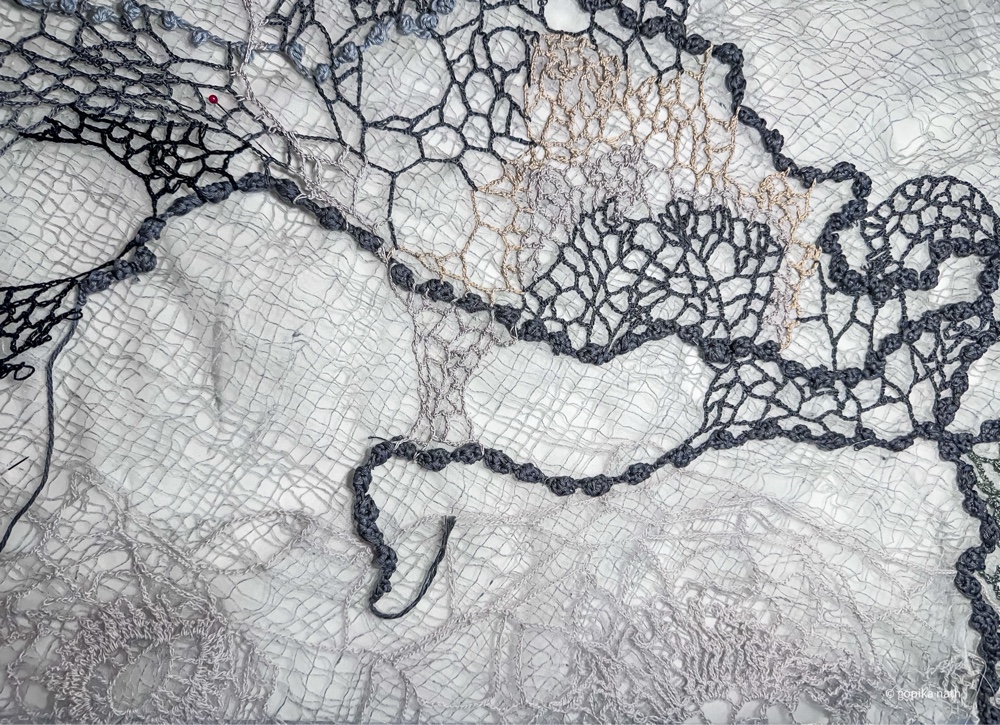
At present, I am working with what I call crab lace. Crocheted nets are layered, joined, and stitched through. The top layer is made of varied yarns — tightly spun mercerised cotton, slubby threads, tencel — held together using an Irish crochet netting technique and placed over undyed silk organza.
Beneath it lies another crocheted net in pale grey, resting on a mid-grey open weave cotton fabric with its selvedge cut and threads unevenly drawn apart. Below this sits another layer of organza. The piece currently holds multiple layers, though not consistently across its full surface of 1.5 x 1 metres.
The grey open weave is not tacked. It adheres lightly to the organza. The pale crochet is only loosely held. As I stitch the upper layer, the thread passes through all layers, binding them into a single body.
Earlier, I tried to keep the stitching invisible, slipping the thread beneath the crochet lines. Then I stopped. Why should this disappear?
The movement of the thread across layers, its irregular path, its appearance and disappearance — all of this is part of the texture. So I let it remain.
A pale grey (polyester cotton) thread moves across whites and off-whites, soft greys, green-grey, dark grey and black — the surface of the crocheted net. Sometimes it shows, sometimes it recedes. That fluctuation matters. It begins to map an inner terrain, the texture of emotional work.
The form itself comes from watching sand bubbler crabs. Not by imitation, but through observation. Their lace-like formations on the beach are delicate in appearance, yet formed through repetitive labour. The crab takes in sand, processes it, releases it. Again and again. A repetitive, arduous labour of feeding and cleansing.
For me, the parallel is: a thought, a feeling returns. You examine it. You turn it. You release it. Then it returns again, slightly altered. There is a back and forth until something clears — a moment of knowing, of clarity.
The work attempts not just to hold that process, but to create a tactile evocation of it.
The layering, the density, the interruptions, the small fragments of crochet and open fabric inserted between layers — all of it builds a surface that is not smooth, not resolved. It holds effort. It holds time.
The piece has not been easy to work on. It is large. It requires patience. There have been days of only looking, without the courage to stitch.
After tacking the top layer down, I find it is beginning to reveal its layered texture. I have been thinking about the spaces between — large areas of open ground that I want to work with subtle textures.
I have thought of circular running stitch, as in Kantha. The stitch has a distinctive texture of its own, and when the thread is pulled, the ripple effect is exaggerated — particularly on layered cotton.
The repetition is meditative, its circularity perhaps mirroring the circularity of emotional processing. But I hesitate. It works well on layered cotton; on organza, the ripple flattens. And the surface must not be crowded.
I am also considering buttonhole stitch — beginning from a central opening and building outward into a radial lace, following the patterning of the sand bubbler’s residual pellets. Perhaps in conversation with the running stitch, though I remain unsure.
This uncertainty is part of the process.
On the surface, the day moves normally. Cooking, laundry, conversations. But underneath, something continues — a sorting, a returning, a clearing. The texture is that underside, always present, clarity emerging when the day is done or in early morning quiet.
It is the texture — the gnawing in the gut, the pull at the back of the throat, the stiffness in muscles—paying attention to them allows clarity to emerge. It is what makes it possible to read, to research, to teach, to be present.
The work of clearing the mind is not separate from the work of making art.

What type of fabric did you use for the base layer? The very loose net fabric I mean.
ReplyDeleteI found it. Kept it. Was a long time ago. Tried looking for it. No luck. It’s one of those finds. It’s cotton, possibly used for hobby crafts. Can’t say.
DeletePoetic.
ReplyDeleteI think most stitches render a definite character to a stitched piece, most of the time. Your work and writing is truly poetic, Gopika!! ~ Boisali
ReplyDeleteThank you Boishali
DeleteBeautiful wprds
ReplyDeleteThank you
DeleteVery meditative piece loved it Gopika
ReplyDeleteThank you
Delete