Showing posts with label textile art. Show all posts

Monday, 14 September 2026

Thinking While Making— slowness, and making art in a frantic age


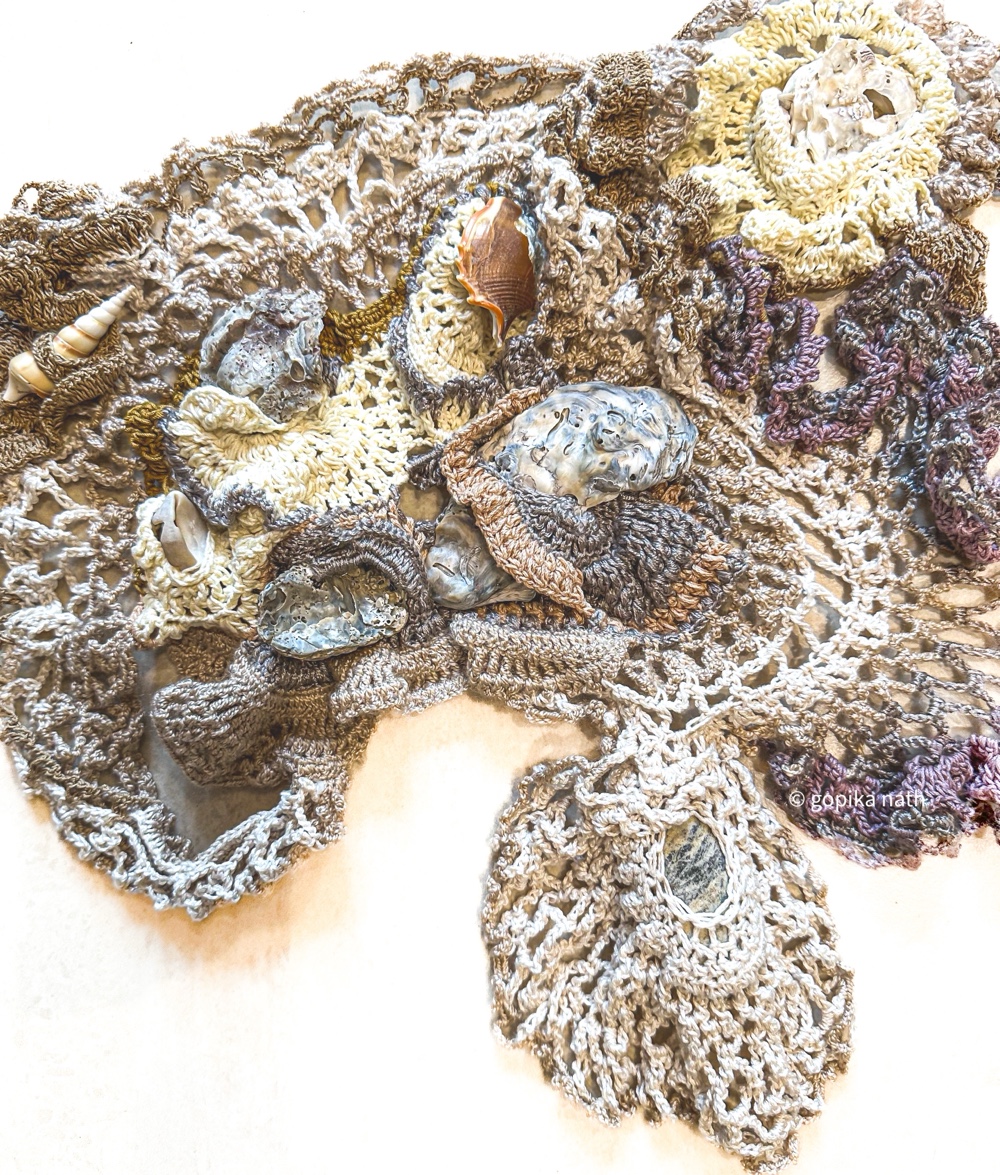
I've been working on a series of shells, going back to how I started with the Washed Ashore project. Sometimes I don't know why I do things — I'm just inspired to — and this was one such thing. I was making a piece called Tread Carefully, built up of numerous shells and stones. As I kept attaching more, it grew ungainly, so I began making pieces independently instead, thinking I'd connect them later — I'd even bought a canvas to stretch them onto, to  join them using Irish crochet — my style. But after two or three pieces, I realised working them independently was creating pieces in their own right.

So today I've picked up a rather large oyster shell — subtle shades of white and off-white, with little bits of pale yellow and grey. I'm using a metal crochet needle, three millimetres to start, though I've now moved to 0.7 millimetres. The thread isn't finely twisted, so it's not a stiff material to work with. I took the finer needle because the thicker one kept bumping against the shell and was difficult to negotiate. I began by crocheting five lines across the base, connecting th through natural holes in the shell. The intention is to work in layers emerging independently from these lines. The first line I started with double crochet, going straight rather than round, to keep this piece independent of the others.

The shell itself is about six inches by three, and it's a landscape in itself — undulating, full of hollows and holes I find useful for pulling my thread through. Multiple smaller shells are glued to it, and I'm fascinated by whatever glue lets shells adhere to each other this way. I love the oyster's texture — these tiny holes that aren't quite holes; I don't know if they're the radula of some other creature trying to get at the flesh inside.

I've gone back to the three-millimetre needle. After two rows of double crochet I'd moved further from the shell than I wanted, and the fine needle was catching on the plies, looking messy. It’s a steel hook with a fine point that had started chipping away bits of the calcium carbonate structure.  I like creative stitching, but I still want it neat. I'm not sure what comes next — I want the crochet to rise and clasp the shell, which means reducing stitches or holding steady. So I'm trying half crochet to tighten and shorten it, then maybe single crochet to help it hug the shell.

I work very intuitively with these pieces — it's hard to plan around a shell. I need holes to hook into, and I need to let the shell dictate the direction. I like this randomness, especially after a month-long, still-unfinished phase of disciplined cross-stitch. Maybe I'm restless and indisciplined, or maybe that's just how the mind works — only so much discipline before it needs release. It's also been a busy couple of weeks, preparing lectures for my mentoring Thursdays, which have been fascinating for me and my students — tracing how different genres of art evolved through social, environmental, and political conditions.

Making me think about the art we make today, in an age of short attention spans, saturated with images, where information is at our fingertips but there's no time to absorb the finer details of anything. That's part of why I write about my process — so that it isn't lost. How is a thing made? What does the making do to the maker?

I notice that textile art is increasingly becoming larger than life, grants and competition briefs also stress pushing boundaries of making, as though its acceptance into the art world requires it to leave behind the domestic, the craft, everything it was once associated with.

I'm not sure I agree, even though I understand the impulse. I appreciate that the machine-made has its place — we live in a post-machine, digital era. Community projects, farming work out to craftsmen — I see the value in this too. But for me, it's always been about being the craftsperson myself.

I first ran into this question when working as a designer, painting saris — literally running around five and a half meters of fabric so the paint wouldn't dry or drip more than I wanted. It was a different kind of skill than fine lines and delicate shading, but skill nonetheless. I once asked a client to raise the price for a sari, and he said, "But why? It can't have taken you more than half an hour." That was a moment of reckoning. I told him: maybe half an hour, but that half hour rests on almost three decades of drawing — since I was five or six — plus a whole studio helping lift the frame, tilt it, mix the dyes. Where does that money go? It doesn't just land in my pocket.

Around the same time, I was working on projects in Bastar, Chhattisgarh, Kashmir, and Andhra Pradesh, with weavers, rug makers, embroiderers, printers, and ikat weavers. I saw their conditions, and I saw the resentment toward designers who walked in and told them what to do — it was intimidating to play God. You had greater value if you could give them business. Since these were government sponsored projects, there were bureaucratic wrangles over who represented the work at Heimtextil, and some projects simply went unpaid. A lot of mismanagement.

The one thing I felt I could do was bring value to handcrafting by becoming a craftsperson myself — an artist bringing this work into the gallery. That was the initial impulse, which has led to much more.

I recognise that the artists working large are, in effect, drawing attention to textiles, and that different approaches are necessary. But that approach runs contrary to what I want my work to say. I want it to speak to the detail: why change the hook, why change the needle, how is the shell responding to my touch, how does it feel against my skin. The shell is uncomfortable to hold, and I hold the hook in an odd way — not the ladylike way that’s established tradition.

I've made another line at the back to pull the fabric in, and I'm struggling again with the three-millimetre green aluminium hook — prising each chain apart, literally jabbing the hook through — thumb and middle finger of my left hand steadying the thread, the hook itself held between thumb, middle, and index finger of my right. Getting the hook into a single crochet is proving difficult, my fingers rub  against the shell's rough, brittle, fragile-but-hard surface. One stitch through — the next equally hard, piercing against my middle finger before it pulls through. I'm skipping a few chains at the back where perfection doesn't matter, just enough to join it legitimately to the last row. Fewer stitches here has tightened the join so it won't show.

I'm now working behind the rows I've already done — three rows of double crochet, two more of double crochet, one of half double crochet — using the small gaps between them to add another line of half double crochet underneath, hoping it will tighten the crochet against the shell at the front. What I'd done before hadn't worked; the crochet had risen past the height of the shell itself.

I'm not really a crochet expert. I learned about ten years ago, when I first moved to Goa. Before that I only embroidered — running stitch, cross stitch, occasionally stem stitch. But Goa shifted my whole landscape, and I didn't know what to do until I started picking up stones and shells from the beach. Then the question became: what do I do with them?

A friend —Venetia, a Goan who owns a restaurant on Candolim-SinquerimBeach — kept handing me plastic bags of shells every time I visited. I'd protest that I'd collected enough; she'd say, "I know you. You'll pick up more." I tried embroidering with the shells first, but it looked strange and unfamiliar — I'd never worked with found objects this way. Crochet was her suggestion.

I taught myself off YouTube, and within a week could make a perfect chain. From there I just experimented — going around the shells, hearing about fractals from someone who'd tried something similar, and the research kept unfolding on its own.

I became curious about crochet's history in Goa — who brought it here, how it arrived. The best answer I've found is that it came through the Jesuits and the nuns who taught it to people here. Crochet's broader history is well documented, so I won't go into that, but for me, crochet has come to mean Goa specifically, and I'm still trying to trace exactly how — though maybe that's a small, futile pursuit given how little time there is and how many things pull at my attention. Not just that, these domestic crafts have never received much attention from academics and a lot of history is lost.

This piece has created something — not quite what I intended. So I have to reinvent what I was doing — another chain row underneath, to grasp the ridges of the shell below. With these pieces, it never goes the way I expect. It's almost as if the shell, needle, and thread are dictating their own story. It is my story, but it feels like they're helping me tell it.

The external world has always been my starting point. Partly through this piece, working these multiple, difficult lines, I asked myself: why make it so hard? And I laughed, thinking — maybe making this difficult gives me some companionship in the difficulty of life itself. Maybe overcoming it gives a sense of triumph, a way of creatively transcending difficulty to make something beautiful. Isn't that what art does?

Which brings me back to the idea of art in the age of Instagram, AI, and digital technology — I'd genuinely like to know what you think it should say. For me, quiet contemplation, with occasional writing, is a space to reflect, to make decisions, to organise my mind around everything I'm doing — including thinking through my lectures, my students, what more I can show them, how else I can help bring out their artist voice etc.

I'm not the kind of teacher who just says "carry on." I push my students — not everyone likes it, but I had teachers who pushed me, and I benefited enormously from what pinched the ego.  That's probably where it comes from, along with the fact that I push myself the same way.

So I'd genuinely like to know: what do you think about art in the digital age? I believe this could be an era where working with the hands gains more ground than ever. I have found that can't really relax without doing something with my hands — maybe it's habit, but I think there's a real neurological link between hand and brain. I remember reading that infants move their hands while suckling, and researchers have found a neurological  connection between mouth and hand that soothes the baby as it suckles.  I suspect there's a similar connection between hand and mind.

I feel that connection acutely doing this kind of crochet — concentrating hard to get the three-millimetre needle into tight single-crochet lines, trying to reach back to where I'd drifted from the shell. My face, contorts with every difficulty — not pretty faces, I’m sure though I have no mirror to confirm it.

I'd thought to work along the top line of the piece, but halfway through realised it had flattened things. So I'm trying the line between the back holes instead, to see if it does something different — working  a single chain.

I'm holding the hook the "ladylike" way now. My friend Venetia once watched me crochet at her restaurant and remarked at how awkwardly I was holding the needle — I told her it was just how I managed the difficult parts. But held between thumb and middle finger, the tension is better, the stitch cleaner. It takes me time to find my way back there.

Some people hold it in an almost fist — all four fingers and thumb wrapped around it — which is what I reach for when I need a surer grip, especially when the needle keeps slipping against the shell's calcium-carbonate surface.

This section hasn't produced anything spectacular, so I'm cutting the thread and moving to another portion, possibly with a colour change. I have a tencel yarn, not quite tightly twisted either, but with a nice sheen. The thread I've used here is a dirty ecru, close to the shell's own colour — the shell itself carries so many hues, it's almost magical. I've finished this end; the loops and edges can wait. Two knots done. Now, cream, beige, or grey for the next stretch — there's a blue-grey somewhere too, if I can find it.

When I think about social media now, I remember being fairly active on it once, enjoying the exchange. But about twenty months ago my mother passed away, at ninety-three, after a long illness. What followed shattered something between my siblings and me, and I went into deep mourning — not just for her, but for the fragmentation of our family, which hadn't started with her death at all, but had been building for years. I withdrew from social media entirely. A few people checked in when they hadn't seen me for a while. I found the distance such a relief that I never really returned, beyond the occasional blog post. I feel that engagement on social media is largely superficial — an economy of image rather than word.

That's part of what makes me think about what art can do instead: bring us back to something more authentic in ourselves. Do we need to scroll a thousand images a day, watch every reel, comment on every story? I don't think so. I think the quality of relationships and of life matters more, and that requires spending time with ourselves — asking who we actually are. I've been reading James Hollis, What Matters Most and An Examined Life, alongside each other — his idea that in the second half of life (where I clearly am now), our task shifts. In the first half, we're largely following what we've been told, taught, shown. At some point the question becomes: is any of this actually me? Does it relate to who I am? Why did my life bring me to this pass? Is this what I want, does it fulfil me?  And that means sitting with the decisions and choices that got you here — why, and what they became.

For me, the way to meet this furiously racing world is to step back and give it time. Embroidery and crochet let me do that — let me feel the needle scrape against shell, hear that faint screech, and connect it to something that lives in my own throat: a screech of non-belonging, of restlessness and insecurity.

Stepping back from a racing world isn’t easy. And when I do step back to think about art itself, I find myself wondering whether spectacle can sustain us indefinitely. I see a great deal of work being made collaboratively and communally now, and while I understand what that makes possible — many voices, participation, exchange — I sometimes find myself missing the intimacy of one person’s sustained engagement with material, and the particular quality that comes from skill developed over time.

I understand what conceptual art opened up for us — Duchamp fundamentally altered the question of where art resides, shifting attention away from the handmade object and towards the idea. That shift was necessary and enormously generative. But I find myself asking a different question now. If an artist conceives something and someone else executes it, what happens to the knowledge that comes through making? What happens to all those decisions that are made only because the material resists, surprises, refuses, or suggests another direction?

And perhaps AI makes that question even more interesting. If machines can increasingly generate images, texts, forms and possibilities for us, perhaps the value of working with our own hands changes rather than diminishes. Perhaps the awkwardness matters. The time matters. The resistance matters. The fact that I have to struggle to get a three-millimetre hook through a tight chain while holding an uncomfortable shell in my hand matters.

I don’t think this means that everyone must make everything themselves, or that one kind of art is more legitimate than another. But for me, the making is inseparable from the thinking. If I hand that part over entirely, I lose something I am actually trying to understand.

And perhaps that is what I keep returning to: in an age when so much can be done for us, what remains particular to the human hand, the human mind, and the encounter between them?

What do you think?


Friday, 14 August 2026

I Didn’t Know What I Was Doing, Until I Was Doing It


I had been working on the crab lace piece for months. I reached a point where I no longer knew whether it was finished, and when that happens, I put the piece away.

I turned to something else I’d been meaning to start — perhaps another piece for the co-creation series, which now has four. While looking for fabrics, I came across some digitally printed cotton panels of shell photographs I’d taken years ago — enlarged fragments in which the shells’ patterns become almost abstract.

I don’t know why they caught my eye, or what I meant to do with them. There was just an internal nudge, and I followed it.

What has always interested me about shells is that their pattern isn’t decoration applied to a finished surface. The shell is built incrementally, by the mollusc’s mantle, which secretes new material and pigment at the growing edge. Research suggests this growth is under neurosecretory control — neural activity shaping the secretory cells as each increment is laid down. The pattern accumulates over the animal’s life, recording a history in the shell itself, and it can keep changing as the animal grows or as conditions around it shift. Pigmentation is inherited, but its expression is shaped by environment.

This is what first made the shell compelling to me as an analogue for psychological patterning: something built over time through an interaction of what is inherited and what is lived, leaving a visible record. In a person, that record isn’t visible on the body. The shell gave me a way to imagine what it might look like if it were.

When I have fabric printed, I usually order two or three copies, so I can layer and play with them. I began by placing two identical prints together over two layers of cotton markeen, the fabric usually used for lining furnishings. I stitched through all four layers with running stitch, pulling the thread so the surface puckered and became tactile, following the ridges of the shell to deepen their indentation.

When I stopped to look at what I’d done, I thought: what am I doing? What is the stitch adding to what the shell is already saying? It didn’t sit right. The pattern felt too bold, too blunt, too exposed.

This became one of those pieces where I didn’t know what I was doing. I wasn’t illustrating an idea — I was working intuitively, letting something pull me along and following it anyway.

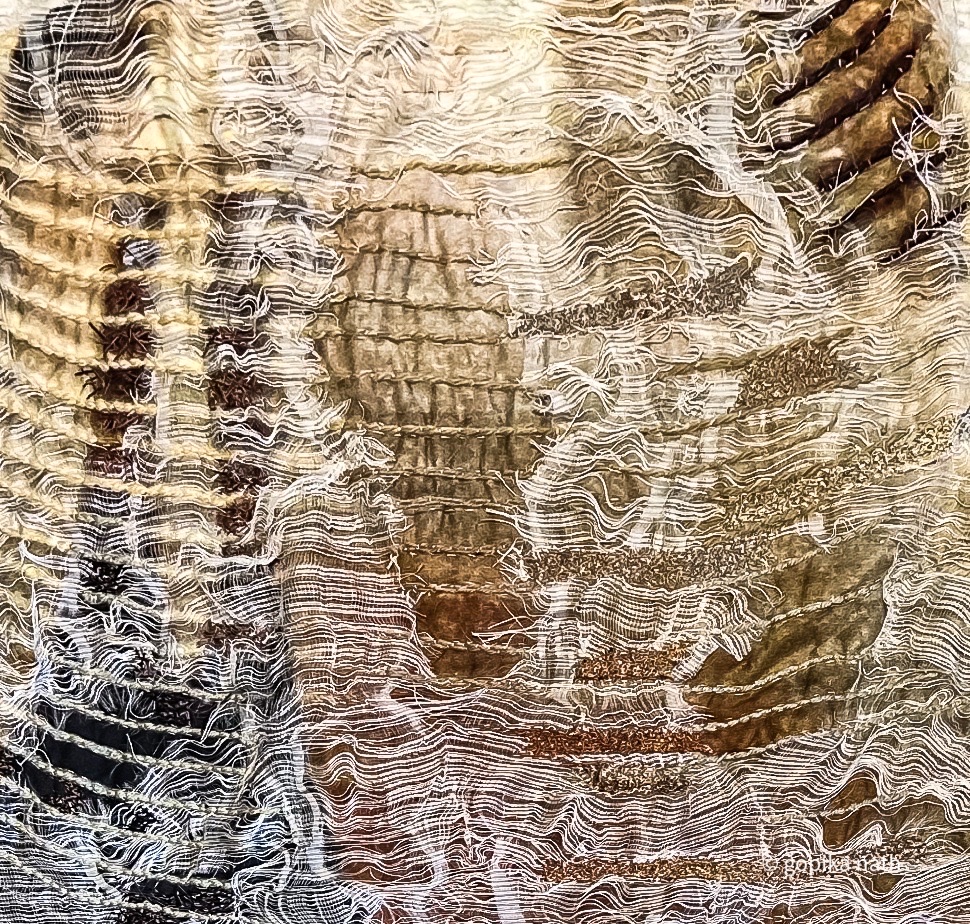
I took a piece of silk organza — not plain, but woven with self-checks, which let me pull out warp and weft threads. I began disturbing the fabric, pulling threads loose, tearing it, and laid it over the shell. I liked the effect, but now the organza was eclipsing the shell entirely. Again: what am I doing? I went with it anyway.

I cut away parts of the organza so some areas of the shell were fully exposed and others stayed veiled. Then I took thicker threads — crochet cotton, wool, whatever I had in the right gauge, in colours drawn from the shell — and couched them along the ridges still visible.

This was layered over the running stitch I had already spent a day doing. For a while I wondered whether that work had simply disappeared beneath the organza. But the quilted texture underneath remained perceptible. Something I could no longer fully see was still affecting the surface, giving it a depth no flat print could have.

I began working over the exposed areas with a crazy cross-stitch — straight stitches placed in an ad hoc way, the thread used almost like paint, building colour in layers. A black area, looked at closely, is never simply black: there’s maroon in it, violet, dark brown, rust, a daub of grey. It took me back to my college days in Delhi, learning watercolour, learning to see the many hues folded into a single colour — a blue inside a green, a pink inside a green. That way of seeing has stayed with me.

But working the cross-stitch over what was already exposed felt redundant — why stitch what I could already see?

So I moved to the areas where the shell was only partly visible through the organza, drawing out fragments of colour and pattern I could barely make out beneath it. I wasn’t reproducing the shell. I was choosing: intensifying some areas, leaving others alone, letting the stitches start large and taper down to something close to seed stitch.

I photographed the piece as it changed. At one point I looked at it and thought: this is like a frame grab from a video. I had somehow grabbed a state of mind.

I had begun with the shell’s pattern already in mind as an analogue for our own psychological patterning — the inherited and learned responses that shape how we react to others, mostly invisible to us until we look. But something else was happening now. The pattern was still there, but no longer whole. A veil had fallen over it, and the veil itself had been torn — some parts of what lay beneath fully visible, some partly, some almost entirely hidden.

I began to see the piece differently: less an illustration of psychological pattern, more a rendering of what it feels like to look at oneself.

The usual explanation — that we repeat our early family dynamics in later relationships — never fully convinced me. It felt too tidy, a category. Life and living are more complex than that —— with many more shades of grey than that suggested framework allows for.

What emerged instead, through the stitching rather than through thinking it out in advance, was something more specific: less about who I was drawn to, more about how I behaved once a relationship had taken hold — the adapting, the allowances, the doubting of my own read on things. That recognition arrived through the making, not before it.

This matters to me because of what it says about how I work. I don’t always begin with an idea and give it form. Sometimes the making does the thinking — shifting the question, showing me a distinction I hadn’t had words for, or revealing that the pattern I’d been taught to look for wasn’t the one actually operating.

We excavate our patterns through experience, often through pain, and come to recognise certain tendencies and where they might have come from. But that awareness doesn’t hand us a complete picture. The veils don’t lift and vanish — they stay, shattered, along with the sense of self we carried before we saw them at all. There is a loss in that seeing too: perhaps of innocence, perhaps that sense of self we were accustomed to. A knowing that was challenged.

Some things become clear. Some we only glimpse. Some we choose to look at directly; others we leave alone.

What I’d made, perhaps, was an image of that: the pattern underneath, the shattered and provisional self, what pain and experience bring into view, and what stays concealed — all present at once, none of it resolved — if it ever can be!

Understanding a pattern doesn’t free you from it. Awareness doesn’t guarantee you’ll recognise it in the moment, or choose differently the next time. We live with what we’ve discovered about ourselves, and with what stays hidden, and with the shattered veils through which we see both.

The piece is still evolving. So, probably, is my understanding of it.

Because I’d started thinking of it as a frame grab, a captured moment, it seemed to need an edge — something to hold it. I began a cross-stitch border on 14 count Aida matte that I’d attached to the original fabric. I haven’t decided how it will end up — even on all four sides or not. But as I worked it, the idea of a border opened out further than simply extending the colours of the shell into the border area.

Borders have been part of my visual vocabulary for years, particularly through designing sarees, where a border is never an afterthought — it has a fundamental relationship with the field it contains.

 I’ve also been drawn to the hashiya in Mughal painting, the margin surrounding the central image, which could carry its own imagery, ornament, calligraphy, or poetry. It didn’t just frame the painting. It ran alongside it, sometimes echoing the centre, or opening a separate layer of meaning entirely — a parallel dialogue. This in particular appealed to me for this piece.

I thought that if the central field holds the visible and obscured pattern, the torn veil, the excavation and the partial seeing, then perhaps the border could carry something else.

I began thinking about words.  They may not describe the image directly, but would  belong  to the same psychological terrain. Repeated around the edge, I visualised them as a pattern with their own meanings. I envisaged them almost disguised and hidden within colours — the pigmentation of the shell fragment that I was extending into the border. 

A border that would no longer simply contain the work. It would carry a parallel dialogue with what the work had revealed to me.


Friday, 8 May 2026

The Intimacy of Stitch


After returning from travel and two weeks of intense outward engagement, I realised that my resistance to stitching was not simply fatigue or distraction. It was something else.

After days of immersion in other forms of attention: travel, conversations, paperwork, pending tasks, research into Kasuti, observing other methods of making, meeting artisans, studying structure and technique. Engaging with architecture, food, soil and stone — tabulating possible references for the beginnings of Kasuti. Although I remained intellectually engaged with needlework, I was not stitching with my own hands. And when I returned home, it took me another two weeks before I could fully approach the large textile piece waiting for me.

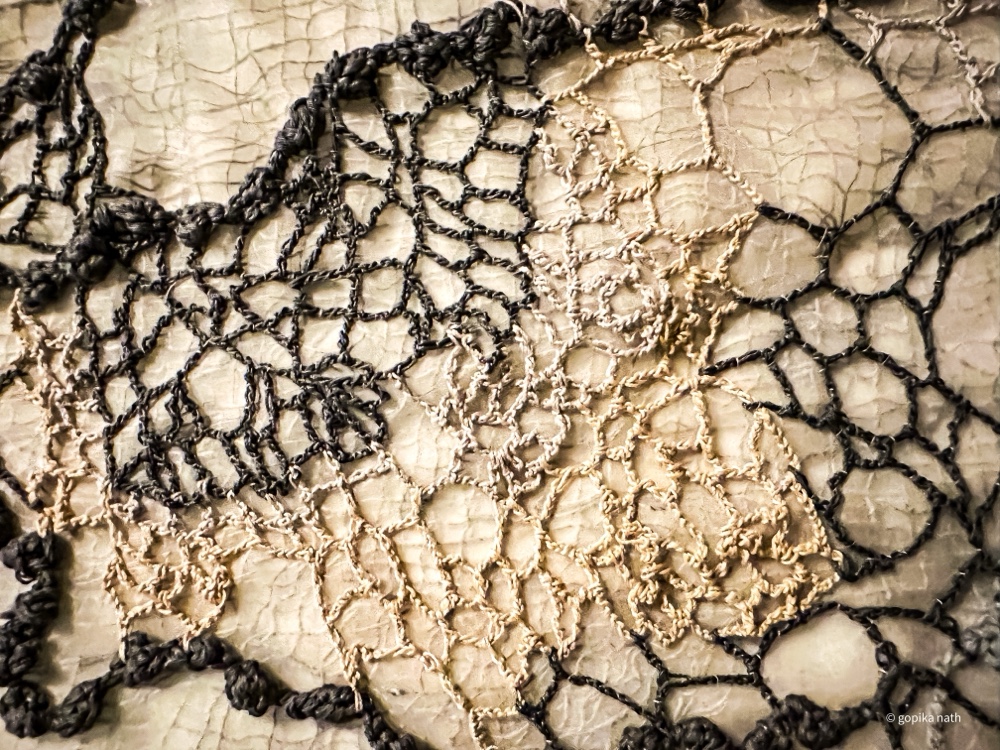
The work itself is ambitious, approximately 1.5 by 1.5 metres, layers of cotton crochet contained and layered between layers of unbleached silk organza. I have written about this evolving “crab lace” process, where crochet fragments and residue become part of a larger stitched surface.

http://gopikanathstitchjournal.blogspot.com/2026/03/crab-lace.html

At this stage I was tacking together five uneven layers of cloth, freehand, without a frame, because the crochet protrusions and shifting surfaces made stretching impossible on a hoop and my ‘adda’ isn’t large enough to accommodate this scale. The work had to be turned repeatedly on the work table — guided by the hand, its proximity to areas that needed to be stitched — maintaining tension and more.

I had chosen a pale grey thread deliberately. Against the black crocheted threads it remained visible, but against the grey and off-white lace it almost disappeared. The stitches moved between visibility and disappearance, holding the structure together — a sense of ease, familiarity and rapport I hadn’t noted before.

As I returned to the act of stitching itself, I became aware of something I may well have felt for years but had never seen nor articulated so clearly: there is an extraordinary intimacy to stitch.

I began my design life as a weaver, and I loved weaving. I still remember the wonder of watching individual strands of thread slowly become cloth. The processes of winding, warping, threading the heddles and reed, passing the shuttle back and forth, all carried their own rhythm and intelligence. But weaving, I now realise, also maintains a certain distance between the body and the cloth. The loom dictates posture, width, tension, movement. Even when one is deeply involved in preparing and constructing the weave, the fabric itself remains stretched within an external structure. The body adjusts itself to the loom — almost always separated from the emerging fabric, by the reed and the frame of the loom.

Stitch and crochet — even knitting, feel fundamentally different.

Here, the cloth engages directly with both hands and the body. It gathers, folds, bunches, softens, and resists according to the movement of  one’s limbs and torso. How I sit is relevant to how I stitch. The work is turned instinctively, held against the lap, cradled and shifted constantly — in search of comfort and control. The material adjusts to you as much as you adjust to it.

While tacking these five layers together, I could feel the organza rubbing against my fingers. Its starchy silkiness — a familiar discourse. I was ruching the fabric to grip it more securely, while managing the uneven tension created by the crochet and layered cloth beneath, as I stitched. At times,  just placing my hand gently under all the transparent layers—palm facing upwards—giving the needle support to pierce. Sometimes no hand under, just the cloth placed on the table—both hands above, helping the needle, pulling it out.  Hands smoothing over the fabric after a few stitches—sometimes holding tension, otherwise gently avoiding bulges. The crochet itself was malleable, constantly shifting shape—I pulled it where I wanted to see more space. It pulled back where there wasn’t enough thread for elasticity.  Every few moments I had to stop, lift the entire piece, rotate it, settle it back onto the table, readjust my body, leaning forward, bringing the fabric closer, ruching and tacking.

The needle held between my thumb and index finger —moved in and out of them. Carving little dents into each. The thread tunnelled through its eye, passing these two fingers. The work was not distant, it was an extension of me — continuously touching, caressing, nudging, coaxing me into a dialogue.

To stitch is to enter a relationship with the fabric, the needle, the thread. The attention it demands takes me inwards. Almost subterranean. One cannot remain outwardly focused while stitching. It brings up thoughts and feelings in an unexpected way. Urging me to sit with them. Creating a rhythm that enables this. It becomes difficult to avoid yourself.

In that sense, stitch resembles an inner conversation. Not performative thought, not social speech, but something quieter and more direct, even if it’s without words. Something changes, shifts — the mood alters.

While working, I found myself relating to my inner life with the same closeness with which I was relating to the fabric: like a journal I write by hand — sensing resistance, recognising fragility, allowing slack where necessary. Stopping when it gets too intense. Pulling gently where continuum was needed, tackling resistance to a deeper excavation of being. I know it’s where my sanity lies. I know it’s how I deal with stress, but sometimes it’s like starting a relationship all over again.

Perhaps this is why returning to stitch after periods of outward immersion can feel difficult. It asks for a different state of being. It asks me to slow down, to be comfortable with repetition, to touch and pay attention to what I am doing, in a very precise and meditative way—to be comfortable in my skin: an intimacy that seems almost alien when outward in the world.

And yet, once inside that space again, there is also familiarity. A recognition. A return to a state of flow. The body remembers the relationship before the mind fully does.


Monday, 10 June 2024

Stitch Meditations on Being - The Patterns and Hues


“They fuck you up, your mum and dad.

They may not mean to, but they do.
They fill you with the faults they had

And add some extra, just for you.
But they were fucked up in their turn

By fools in old-style hats and coats,
Who half the time were soppy-stern

And half at one another’s throats.
Man hands on misery to man.

It deepens like a coastal shelf…….”
                                                                                                                                                    - Philip Larkin


These words say it all, without revealing the gory details or gruesomeness of the wounds we all carry within us. Largely disguised in various ways but played out subconsciously. Most of the time we are unaware of why we do what we do and of the influences of the “soppy-stern…….at one another’s throats” that created who we are, beyond just the physical mating, but the why and how of our psychological make up.

When Larkin says “Man hands on misery to man. It deepens like a coastal shelf” he evokes the patterns we form and re-create (subconsciously for the most part). Habits make it easier for us to negotiate life - such as driving a car or bike and even drawing, crochet, knitting and that ilk. But, it’s the emotional and psychological patterns that create the problems, where human misery “deepens like a coastal shelf”


Yet, as Larkin put it, it’s inevitable that we inherit dysfunctional ways/patterns and also play them out, passing them on generation to generation. Unravelling these patterns may or may not create the potential for change, but it’s interesting to do so for the purposes of understanding your own psyche/self. Beyond that, what can we do?


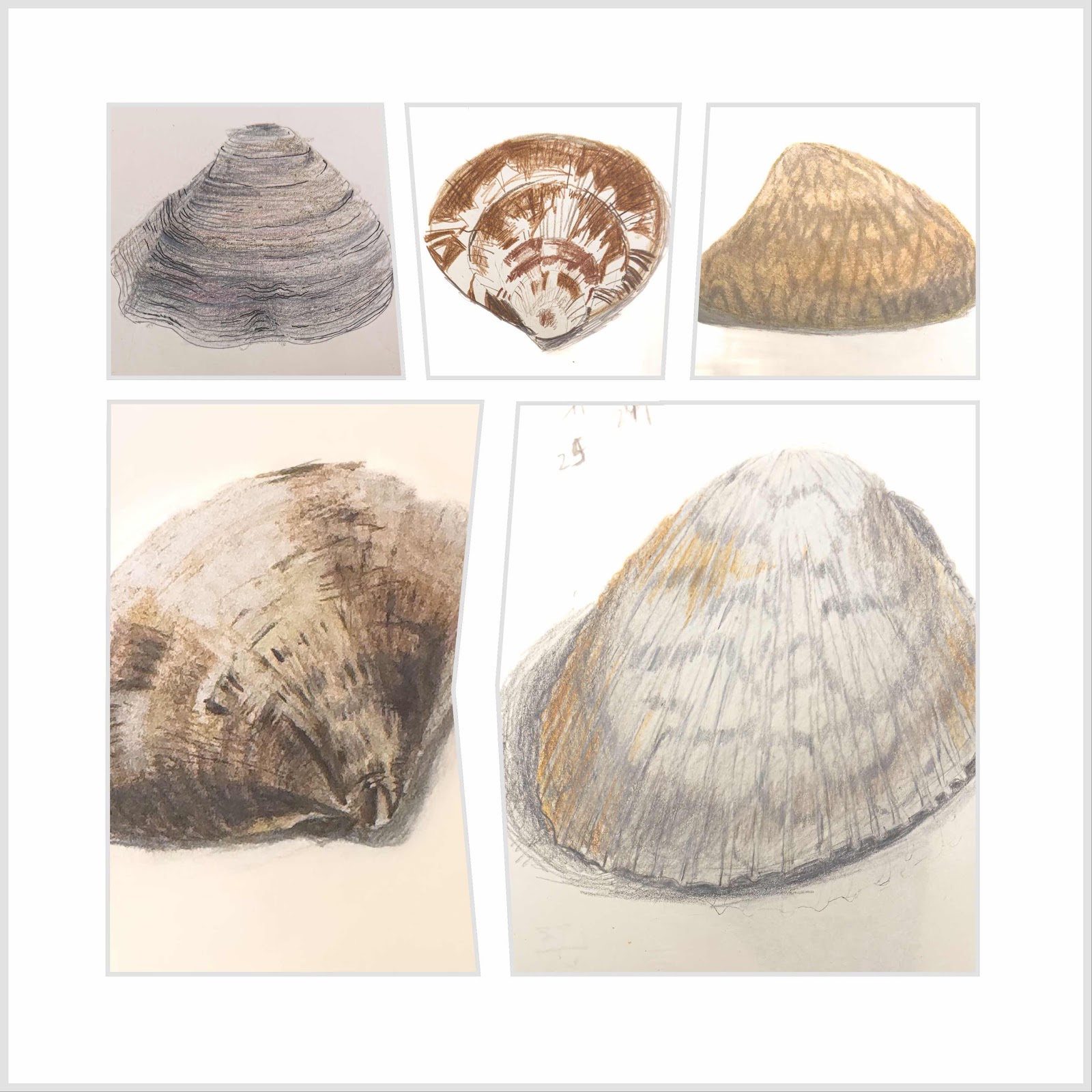
This was a dilemma that I faced and struggled with until I started studying the patterns on the molluscs along the Goan coastline. These patterns were unique, as inimitable as our finger prints. It was virtually impossible to find two clams with identical colours and patterns.


What was even more interesting was to learn that these patterns are created by virtue of genetic and environmental conditions. A neurological response for camouflage and survival. Even so, the radula of other species did manage to drill through and suck the animal out, and if not, it wasn’t for lack of trying. Wherein the holes they drilled, became another level of embellishment to the strokes of colour that decorated the exoskeletons.

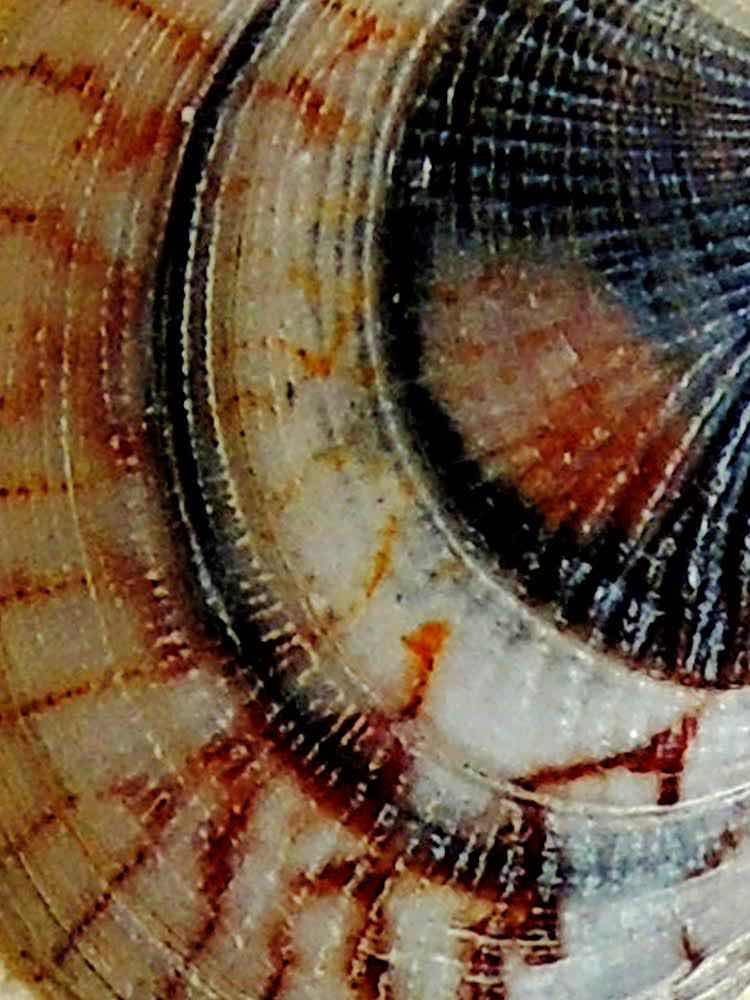
I studied these patterns in various ways: through the camera, by drawing and eventually by zooming into the photos I took of each. This was fascinating because in pixelating the images, I found the patterns were a configuration of colours.


Colour, as we have seen through the ages, carries symbolic meaning that varies from culture to culture. Lisa Feldman Barrett, social scientist and author of the book ‘How Emotions are made’ asserts that our emotions also vary from culture to culture. Colour and emotions, have long been linked:  green with envy, yellow for happiness and joy, red for love and anger and more in that vein.

But, Feldman Barrett says there is no singular way to describe any of the human emotions. Each culture and person within it, experiences a variety of sensations within anger, joy, love and despair. The subtle gradations and differences between fury, rage, anger, frustration, being irked etc are just that - subtle variations.

In this zoomed in and pixelated photo of a clam shell, that’s what I see, subtle gradations of colour - so subtle that it’s driving me insane trying to reproduce them in thread.


I have two versions of the thread adaptations. The first was a cross-stitched replica where I mixed the threads - two to three different colours from over 400, colours of cotton floss, collected from various thread makers including Anchor and DMC. It took me a long time to complete one piece and the second is in progress. A slow process which I often abandon to tackle something else and return to until it is done. The first one took me a year.


However, the piece that I’m currently working on, isn’t just about getting the colour right, it’s also about patterns and how the same hue can alter with the pattern. The idea is to make a large crocheted and knitted piece instead of embroidery. The reason the colours are taxing both mind and pocket is that unlike embroidery threads, the colour range is extremely limited for knitting and crochet. At least in any one count of yarn to enable some symmetry in scale to join the 5  inch squares.

I had started the pattern blanket (for want of another term)with some vague idea, with regard to how I wanted to put theknitted and crochet squares together. It evolved over two to three years and I made the squares from all the colours I could muster but I just couldn’t figure out how to really work them together to create any visual that appealed to me. This resulted in my abandoning the project and the 300 odd squares I’d already made, not to forget the hours of painstaking knitting and crochet – often at the end of the day. It didn’t make me happy but I didn’t know how to move forward. I thought it was a failed project and hadn’t looked at it for over a year.


Then a couple of weeks, I discovered wood borers had inhabited my rather extensive book shelf which stretches across about half my apartment. I had to empty all the shelves and cabinets below that housed stationery, fabric and my stash of embroidery threads as also hundreds of books amassed over the last four decades and some inherited from my parents’ collection. Art magazines, old issues of Selvedge, Piecework, Surface Design, Embroidery and the now extinct Fiber Arts, Marg Magazines, India magazines (also extinct),BBC music magazine, piano scores and about 100 art magazines - a series I collected in my student days about artists - one issue on each artist (sadly none about Indian artists but focussed on western art history). And of course a collection of books - fiction, non-fiction, poetry, textiles, art, spirituality and more. Basically it was a lot to place around the apartment and at the end of it all, the only free space was my bed.

My knitting and crochet stash is housed in my bedroom, in various draws – usually by colour. This was not disturbed by the pest control requirement. So I decided to revisit the abandoned pattern blanket and changed tack by using the template I had already embroidered in cross-stitch. The 1/4 inch embroidered squares took me about ten minutes each to execute, with seven of those minutes to get the colours to match. In the knitted and crochet version, I am facing similar issues with the subtle gradations of hue, but more so because I’m not working with just cotton floss, but yarns ranging from wool, acrylic, rayon, nylon, cotton, wool and cotton blends, and also the counts are all different from very fine crochet yarn at a 40’s count to chunky 4-6 ply. Often, I have to work  differing counts together to try and approximate the colours.


It was a challenging week both with the rather smelly pest control, putting things back into place and this creative project. But I now have a template that gives me the direction I need. What I’m grappling with, in addition to the technical issues, is what I hope to achieve by engaging in this rather esoteric idea of replicating the colour boxes in both hue and pattern.

While working on the cross-stitch version, I marvelled at the numerous shades there were and recreating them helped me understand that there are so many hues to each emotion. It’s impossible to understand what another person is feeling because what they feel is unique to them - culturally, socially, experientially, genetically, environmentally and more. That was a great insight because one does tend to think we know how others are experiencing emotion or what they may be feeling, but Feldman Barrett also suggests that it’s not possible - at best we can imagine within the range of our experience, based on our own emotional shade card. Our emotions and the hue gradation of the occurrence is uniquely personal.


Most of our thinking comes from conditioning. And is the result of social constructs geared to create a sense of order with the existence of so many of us who inhabit this planet. However, through centuries of the existence of mankind, the ideas have evolved in a rather unthinking and dysfunctional way. In many ways much of our thinking could be deemed be distorted by ideas that most likely germinated through limited knowing and were handed down with incompleteunderstanding by those before us, who didn’t know better.  Quite like Larkin says in his poem. “They fuck you up, …..They may not mean to, but they do.”


Patterns are prevalent throughout nature and also in our emotions and thinking. My professional training has been in textile design and patterns are now firmly etched in my DNA. We were taught to create designs for fabric by dissecting vegetables like okra – a cross section with the seeds visible; drawing this and repeating the form in differing ways of  formal repeat patterns for printing motifs on cloth. The challenge was to ensure that the repeat wasn’t visible and also contributed to the visual outcome; trying to disguise the vegetable form through repeating the motif in creative ways. The repetition made almost everything pleasing to the eye because familiarity  is what enables a sense of well-being and makes something agreeable to the senses.


As I evolved into  a fibre artist, examining my own persona – a journey of self-actualization through my art, I started exploring the idea of mind-stains or ideas that cause us to feel less than good, feeling shame and doubt and self-cynosure. Initially I explored this through notions of tea stains on my saucer as I spilled the tea I was drinking. It was a long exploration of seven years, wherein I realised that one could still flower – fulfil the human potential despite these feelings that seem to hold one back. 


When I moved to Goa, I didn’t give up the idea of stains for they were very much a part of my inner explorations relating to  experiences that created these inhibitors. But, living along the coastline of the Arabian Sea, I went beyond human nature to study nature in her full glory and life by the seaside has been fascinating in this sense. Wherein colliding ripples of water, washing over mud adhesion ripples at the River Chapora estuary and further down the beaches of Morjhimand Aswem, with wind adding to the rippling effects and the diffused rays of sunshine at dusk – complimenting and complicating the patterns, I began seeing these patterns of colliding energies as incredibly beautiful. 


It was the complexity that appealed for it related to the intricacy of configurations that become our patterns of behaviour. Of energies inherent in the psyche formulated through generations of conditioning, one’s own experiences – of colliding with other energies, bringing out these patterns. Where we recreate them because energy draws us to others when we recognising something familiar. In re-creating we feel grief and anguish, become aware and the tendency is generally to view ourselves in a negative light. Something that needs to be changed. But the wisdom of the ocean suggests that there is incredible beauty in these engagements and that the tendencies may change through the collisions of energetic fields as we negotiate our lives, but the overlaying effects of these fields are intriguing, dynamic and awe-inspiring. If only one could look at the self as we see the natural world.


Through the study of  clams shells, the sand bubbler crabs and their feeding residue and also the ripples of sand and water, I started seeing that patterns are formed by colour and the collision of energies in the elements. By extension I made the correlation that emotions seen as colour, in the human psyche, form patterns and vice-versa. Therefore adding pattern to the art work, going beyond mere colour became imperative.


However, this further complicated the process of trying to create the sublet hues uneven thread counts and a variety of ornamental thread configurations through crochet and knitting. At this point, I can only envisage a blanket that’s an uncomfortable evocation of how we exist together with our unique experience and understanding of emotion, alongside others who feel and perceive these differently.

But, I’m a long way yet from being able to see this. I have under 100 squares when I need close to 640. I often rip out the squares because they’re either too big or I need to add a row or two if it’s smaller than I need it to be. Some are tight and sit awkward, others are delicately delightful. It’s going to be another task to whip them all together, possibly like one struggles to negotiate this world with the billions of others beside us….