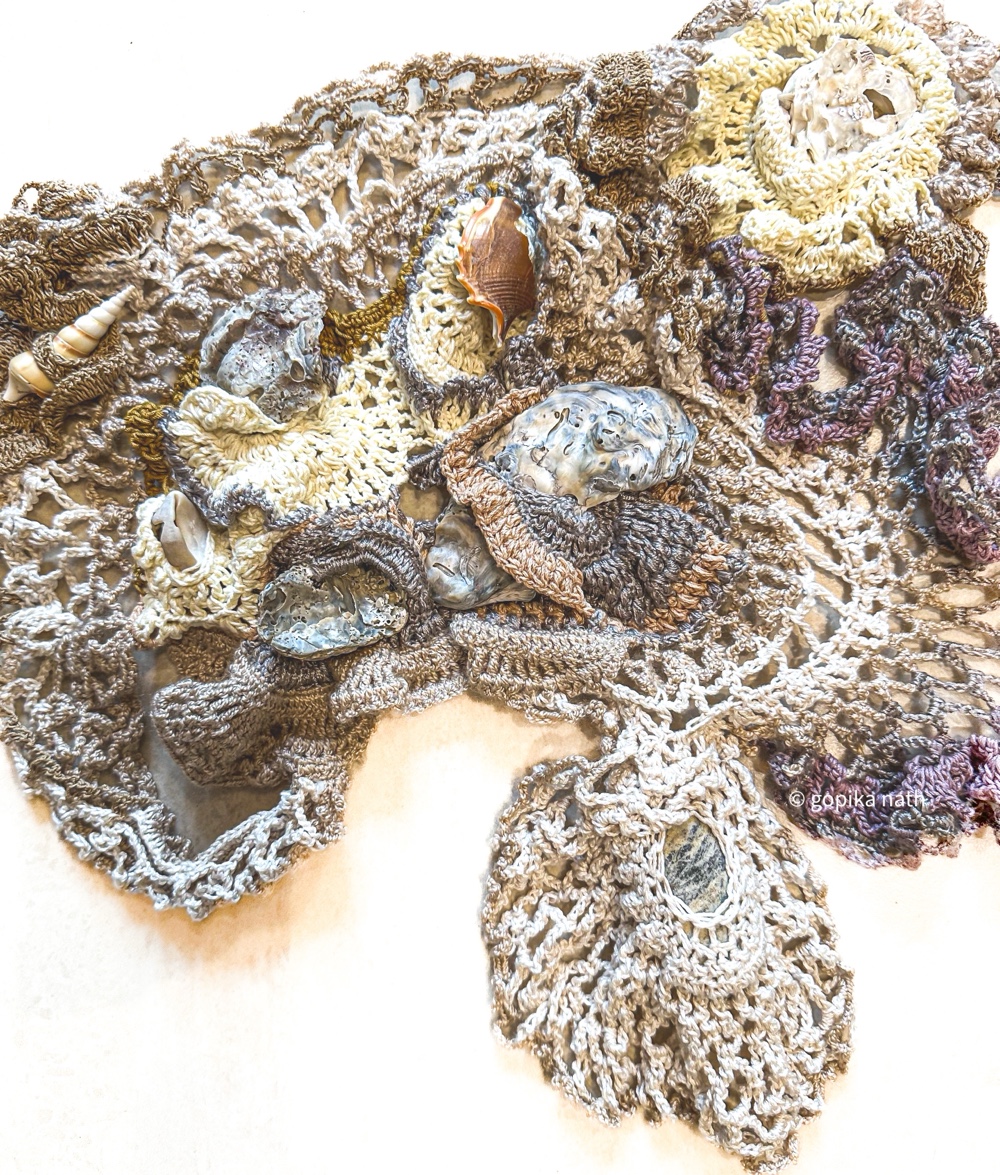
I've been working on a series of shells, going back to how I started with the Washed Ashore project. Sometimes I don't know why I do things — I'm just inspired to — and this was one such thing. I was making a piece called Tread Carefully, built up of numerous shells and stones. As I kept attaching more, it grew ungainly, so I began making pieces independently instead, thinking I'd connect them later — I'd even bought a canvas to stretch them onto, to join them using Irish crochet — my style. But after two or three pieces, I realised working them independently was creating pieces in their own right.
So today I've picked up a rather large oyster shell — subtle shades of white and off-white, with little bits of pale yellow and grey. I'm using a metal crochet needle, three millimetres to start, though I've now moved to 0.7 millimetres. The thread isn't finely twisted, so it's not a stiff material to work with. I took the finer needle because the thicker one kept bumping against the shell and was difficult to negotiate. I began by crocheting five lines across the base, connecting th through natural holes in the shell. The intention is to work in layers emerging independently from these lines. The first line I started with double crochet, going straight rather than round, to keep this piece independent of the others.
The shell itself is about six inches by three, and it's a landscape in itself — undulating, full of hollows and holes I find useful for pulling my thread through. Multiple smaller shells are glued to it, and I'm fascinated by whatever glue lets shells adhere to each other this way. I love the oyster's texture — these tiny holes that aren't quite holes; I don't know if they're the radula of some other creature trying to get at the flesh inside.
I've gone back to the three-millimetre needle. After two rows of double crochet I'd moved further from the shell than I wanted, and the fine needle was catching on the plies, looking messy. It’s a steel hook with a fine point that had started chipping away bits of the calcium carbonate structure. I like creative stitching, but I still want it neat. I'm not sure what comes next — I want the crochet to rise and clasp the shell, which means reducing stitches or holding steady. So I'm trying half crochet to tighten and shorten it, then maybe single crochet to help it hug the shell.
I work very intuitively with these pieces — it's hard to plan around a shell. I need holes to hook into, and I need to let the shell dictate the direction. I like this randomness, especially after a month-long, still-unfinished phase of disciplined cross-stitch. Maybe I'm restless and indisciplined, or maybe that's just how the mind works — only so much discipline before it needs release. It's also been a busy couple of weeks, preparing lectures for my mentoring Thursdays, which have been fascinating for me and my students — tracing how different genres of art evolved through social, environmental, and political conditions.
Making me think about the art we make today, in an age of short attention spans, saturated with images, where information is at our fingertips but there's no time to absorb the finer details of anything. That's part of why I write about my process — so that it isn't lost. How is a thing made? What does the making do to the maker?
I notice that textile art is increasingly becoming larger than life, grants and competition briefs also stress pushing boundaries of making, as though its acceptance into the art world requires it to leave behind the domestic, the craft, everything it was once associated with.
I'm not sure I agree, even though I understand the impulse. I appreciate that the machine-made has its place — we live in a post-machine, digital era. Community projects, farming work out to craftsmen — I see the value in this too. But for me, it's always been about being the craftsperson myself.
I first ran into this question when working as a designer, painting saris — literally running around five and a half meters of fabric so the paint wouldn't dry or drip more than I wanted. It was a different kind of skill than fine lines and delicate shading, but skill nonetheless. I once asked a client to raise the price for a sari, and he said, "But why? It can't have taken you more than half an hour." That was a moment of reckoning. I told him: maybe half an hour, but that half hour rests on almost three decades of drawing — since I was five or six — plus a whole studio helping lift the frame, tilt it, mix the dyes. Where does that money go? It doesn't just land in my pocket.
Around the same time, I was working on projects in Bastar, Chhattisgarh, Kashmir, and Andhra Pradesh, with weavers, rug makers, embroiderers, printers, and ikat weavers. I saw their conditions, and I saw the resentment toward designers who walked in and told them what to do — it was intimidating to play God. You had greater value if you could give them business. Since these were government sponsored projects, there were bureaucratic wrangles over who represented the work at Heimtextil, and some projects simply went unpaid. A lot of mismanagement.
The one thing I felt I could do was bring value to handcrafting by becoming a craftsperson myself — an artist bringing this work into the gallery. That was the initial impulse, which has led to much more.
I recognise that the artists working large are, in effect, drawing attention to textiles, and that different approaches are necessary. But that approach runs contrary to what I want my work to say. I want it to speak to the detail: why change the hook, why change the needle, how is the shell responding to my touch, how does it feel against my skin. The shell is uncomfortable to hold, and I hold the hook in an odd way — not the ladylike way that’s established tradition.
I've made another line at the back to pull the fabric in, and I'm struggling again with the three-millimetre green aluminium hook — prising each chain apart, literally jabbing the hook through — thumb and middle finger of my left hand steadying the thread, the hook itself held between thumb, middle, and index finger of my right. Getting the hook into a single crochet is proving difficult, my fingers rub against the shell's rough, brittle, fragile-but-hard surface. One stitch through — the next equally hard, piercing against my middle finger before it pulls through. I'm skipping a few chains at the back where perfection doesn't matter, just enough to join it legitimately to the last row. Fewer stitches here has tightened the join so it won't show.
I'm now working behind the rows I've already done — three rows of double crochet, two more of double crochet, one of half double crochet — using the small gaps between them to add another line of half double crochet underneath, hoping it will tighten the crochet against the shell at the front. What I'd done before hadn't worked; the crochet had risen past the height of the shell itself.
I'm not really a crochet expert. I learned about ten years ago, when I first moved to Goa. Before that I only embroidered — running stitch, cross stitch, occasionally stem stitch. But Goa shifted my whole landscape, and I didn't know what to do until I started picking up stones and shells from the beach. Then the question became: what do I do with them?
A friend —Venetia, a Goan who owns a restaurant on Candolim-SinquerimBeach — kept handing me plastic bags of shells every time I visited. I'd protest that I'd collected enough; she'd say, "I know you. You'll pick up more." I tried embroidering with the shells first, but it looked strange and unfamiliar — I'd never worked with found objects this way. Crochet was her suggestion.
I taught myself off YouTube, and within a week could make a perfect chain. From there I just experimented — going around the shells, hearing about fractals from someone who'd tried something similar, and the research kept unfolding on its own.
I became curious about crochet's history in Goa — who brought it here, how it arrived. The best answer I've found is that it came through the Jesuits and the nuns who taught it to people here. Crochet's broader history is well documented, so I won't go into that, but for me, crochet has come to mean Goa specifically, and I'm still trying to trace exactly how — though maybe that's a small, futile pursuit given how little time there is and how many things pull at my attention. Not just that, these domestic crafts have never received much attention from academics and a lot of history is lost.
This piece has created something — not quite what I intended. So I have to reinvent what I was doing — another chain row underneath, to grasp the ridges of the shell below. With these pieces, it never goes the way I expect. It's almost as if the shell, needle, and thread are dictating their own story. It is my story, but it feels like they're helping me tell it.
The external world has always been my starting point. Partly through this piece, working these multiple, difficult lines, I asked myself: why make it so hard? And I laughed, thinking — maybe making this difficult gives me some companionship in the difficulty of life itself. Maybe overcoming it gives a sense of triumph, a way of creatively transcending difficulty to make something beautiful. Isn't that what art does?
Which brings me back to the idea of art in the age of Instagram, AI, and digital technology — I'd genuinely like to know what you think it should say. For me, quiet contemplation, with occasional writing, is a space to reflect, to make decisions, to organise my mind around everything I'm doing — including thinking through my lectures, my students, what more I can show them, how else I can help bring out their artist voice etc.
I'm not the kind of teacher who just says "carry on." I push my students — not everyone likes it, but I had teachers who pushed me, and I benefited enormously from what pinched the ego. That's probably where it comes from, along with the fact that I push myself the same way.
So I'd genuinely like to know: what do you think about art in the digital age? I believe this could be an era where working with the hands gains more ground than ever. I have found that can't really relax without doing something with my hands — maybe it's habit, but I think there's a real neurological link between hand and brain. I remember reading that infants move their hands while suckling, and researchers have found a neurological connection between mouth and hand that soothes the baby as it suckles. I suspect there's a similar connection between hand and mind.
I feel that connection acutely doing this kind of crochet — concentrating hard to get the three-millimetre needle into tight single-crochet lines, trying to reach back to where I'd drifted from the shell. My face, contorts with every difficulty — not pretty faces, I’m sure though I have no mirror to confirm it.
I'd thought to work along the top line of the piece, but halfway through realised it had flattened things. So I'm trying the line between the back holes instead, to see if it does something different — working a single chain.
I'm holding the hook the "ladylike" way now. My friend Venetia once watched me crochet at her restaurant and remarked at how awkwardly I was holding the needle — I told her it was just how I managed the difficult parts. But held between thumb and middle finger, the tension is better, the stitch cleaner. It takes me time to find my way back there.
Some people hold it in an almost fist — all four fingers and thumb wrapped around it — which is what I reach for when I need a surer grip, especially when the needle keeps slipping against the shell's calcium-carbonate surface.
This section hasn't produced anything spectacular, so I'm cutting the thread and moving to another portion, possibly with a colour change. I have a tencel yarn, not quite tightly twisted either, but with a nice sheen. The thread I've used here is a dirty ecru, close to the shell's own colour — the shell itself carries so many hues, it's almost magical. I've finished this end; the loops and edges can wait. Two knots done. Now, cream, beige, or grey for the next stretch — there's a blue-grey somewhere too, if I can find it.
When I think about social media now, I remember being fairly active on it once, enjoying the exchange. But about twenty months ago my mother passed away, at ninety-three, after a long illness. What followed shattered something between my siblings and me, and I went into deep mourning — not just for her, but for the fragmentation of our family, which hadn't started with her death at all, but had been building for years. I withdrew from social media entirely. A few people checked in when they hadn't seen me for a while. I found the distance such a relief that I never really returned, beyond the occasional blog post. I feel that engagement on social media is largely superficial — an economy of image rather than word.
That's part of what makes me think about what art can do instead: bring us back to something more authentic in ourselves. Do we need to scroll a thousand images a day, watch every reel, comment on every story? I don't think so. I think the quality of relationships and of life matters more, and that requires spending time with ourselves — asking who we actually are. I've been reading James Hollis, What Matters Most and An Examined Life, alongside each other — his idea that in the second half of life (where I clearly am now), our task shifts. In the first half, we're largely following what we've been told, taught, shown. At some point the question becomes: is any of this actually me? Does it relate to who I am? Why did my life bring me to this pass? Is this what I want, does it fulfil me? And that means sitting with the decisions and choices that got you here — why, and what they became.
For me, the way to meet this furiously racing world is to step back and give it time. Embroidery and crochet let me do that — let me feel the needle scrape against shell, hear that faint screech, and connect it to something that lives in my own throat: a screech of non-belonging, of restlessness and insecurity.
Stepping back from a racing world isn’t easy. And when I do step back to think about art itself, I find myself wondering whether spectacle can sustain us indefinitely. I see a great deal of work being made collaboratively and communally now, and while I understand what that makes possible — many voices, participation, exchange — I sometimes find myself missing the intimacy of one person’s sustained engagement with material, and the particular quality that comes from skill developed over time.
I understand what conceptual art opened up for us — Duchamp fundamentally altered the question of where art resides, shifting attention away from the handmade object and towards the idea. That shift was necessary and enormously generative. But I find myself asking a different question now. If an artist conceives something and someone else executes it, what happens to the knowledge that comes through making? What happens to all those decisions that are made only because the material resists, surprises, refuses, or suggests another direction?
And perhaps AI makes that question even more interesting. If machines can increasingly generate images, texts, forms and possibilities for us, perhaps the value of working with our own hands changes rather than diminishes. Perhaps the awkwardness matters. The time matters. The resistance matters. The fact that I have to struggle to get a three-millimetre hook through a tight chain while holding an uncomfortable shell in my hand matters.
I don’t think this means that everyone must make everything themselves, or that one kind of art is more legitimate than another. But for me, the making is inseparable from the thinking. If I hand that part over entirely, I lose something I am actually trying to understand.
And perhaps that is what I keep returning to: in an age when so much can be done for us, what remains particular to the human hand, the human mind, and the encounter between them?
What do you think?
