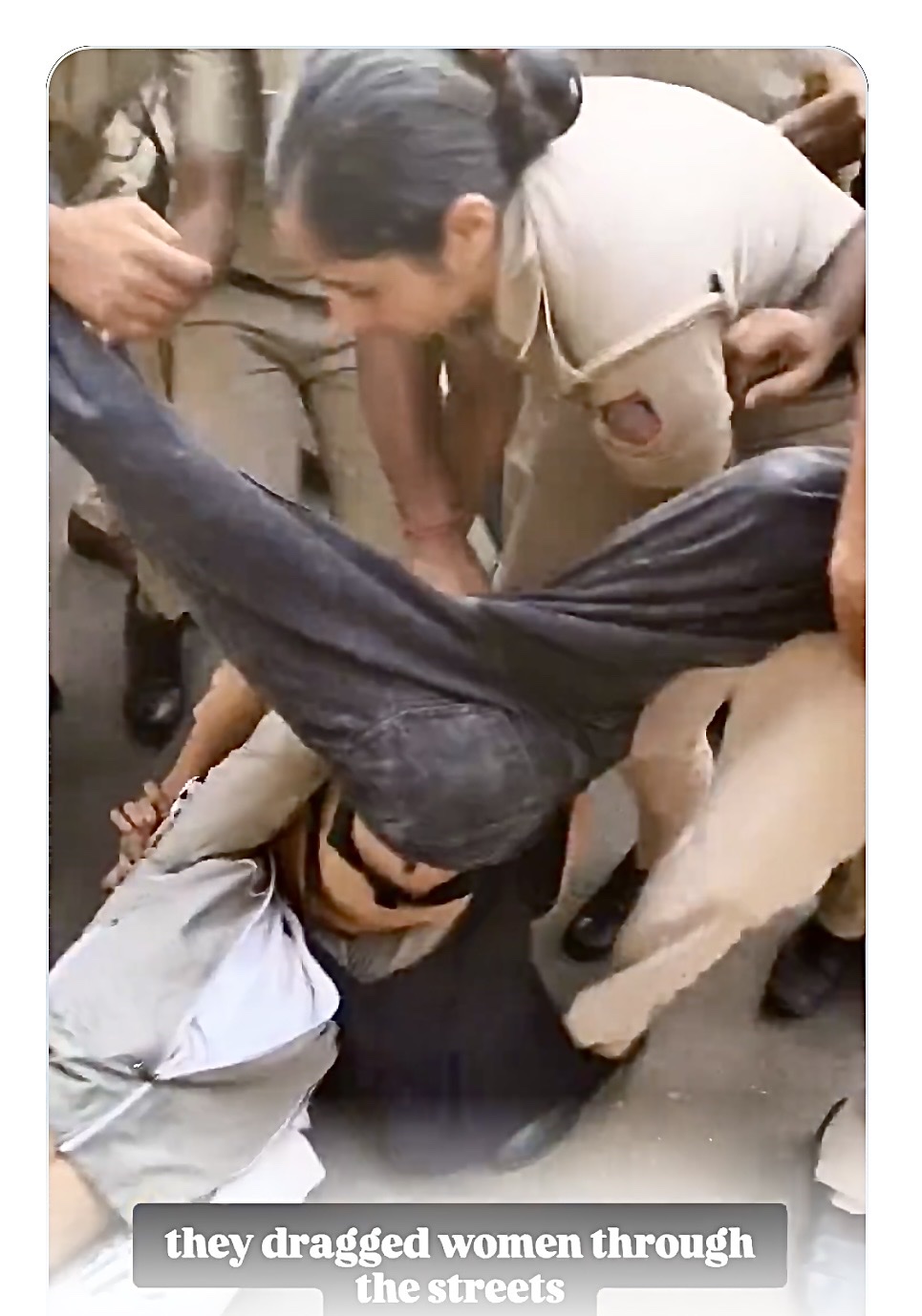
This morning somebody sent me a video from Delhi. A young woman was being forcibly moved by a group of police officers. At one point she was upside down, her legs held up by two people like logs of wood. Her upper body hanging close to the road. Her shirt had ridden up exposing her stomach and navel. Later, one sees her sitting in the road — dazed by what just happened. I was too. She had no control over how her body was being handled, or over what was being exposed. The indignity was crucifying.
The protests in Delhi, led largely by young people and joined by opposition leaders, are centred on the controversy around the Special Intensive Revision of the electoral rolls. Protesters are alleging that legitimate voters have been removed from the rolls and that the revision has compromised electoral fairness — demanding the resignation of the Chief Election Commissioner, Gyanesh Kumar. In its defence, the Election Commission says the exercise is intended to clean up the rolls by removing duplicate and ineligible entries. The dispute has escalated and spilled onto the streets, where hundreds of protesters have been detained, and large parts of central Delhi have been locked down to prevent demonstrations.
There are reports that say people were slapped, kicked, dragged and threatened. One woman said she had been beaten while the police stood by; senior Delhi Police officers said they had rescued her and removed the men. No FIR had been filed against the men at the time of that report. So even the act of looking becomes complicated. Who is doing what? Who is watching? Who is intervening? Who is not?
There is a lot of brutality in the world. In the outer political sphere, certainly, but also much closer to home, within families, marriages, relationships. Brutality seems to have become so integral to life that perhaps we don’t even notice it until something makes us stop.
I remember being a young woman of twenty-two, being brutalised by my husband and not really raising my voice. Today I stand back and I am stunned by that young girl. He tried to kill me and I didn’t go out screaming into the streets. I didn’t lodge a police complaint. I didn’t tell anybody what had happened. I simply locked myself in the other bedroom until he apologised.
Why?
Why were we taught to endure?
This is one of the questions I keep coming back to now, all these years later, sitting in my studio in Goa, looking at what is happening elsewhere and also looking at my own life.
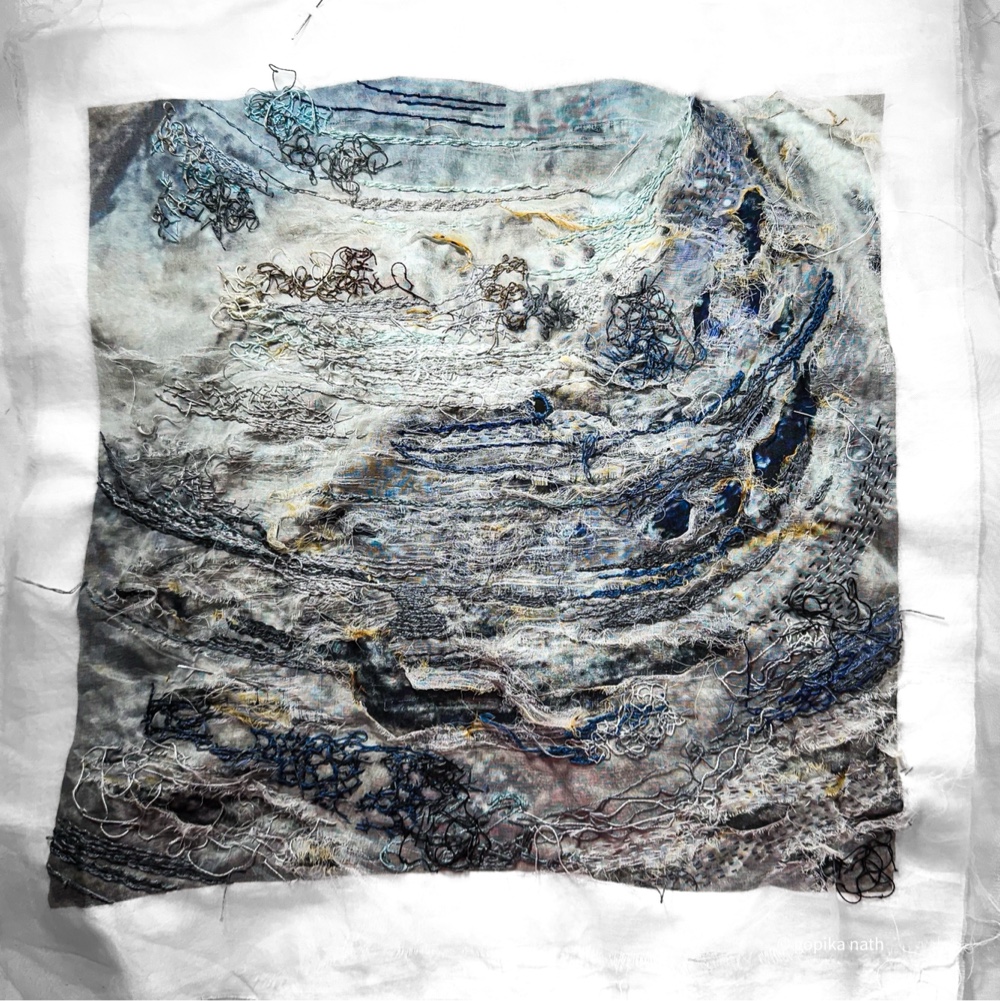
I look at the work I do. The violence that I enact, The violence that I enact is the needle piercing layers of fabric, the tearing and rupturing of cloth — perhaps a way of sublimating some of the violence I have borne.”. Sometimes I tear the cloth in frustration. I rupture the carefully constructed weave because I am trying to understand what goes into it. I am trying to understand the layers beneath it. I am trying to understand myself. My life. My feelings. My anger, frustration and pain.
I go deeply into my craft, into what I do, how I do it, the decisions I make at this very minuscule level. I can spend enormous amounts of time considering a stitch, a thread, the way one layer sits over another, what happens when I cut through something, what is revealed underneath. Or erasing fragments altogether.
And then I wake up on a Sunday morning to read the news and see videos and snippets people are sharing, talking about what is happening on the ground in Delhi. Young people protesting. Women being manhandled. People being carried away like carcasses. And I am deeply, deeply disturbed by what I see.
What should my role be? Where should my attention go? What is my dharma in this?
A few Facebook notifications prompted me to open the app. These days Facebook first gives you a reel to look at, and the one that came up was Anne Carson talking about noticing, and about how noticing alters judgment. She suggested that if we look at people more closely, perhaps we become less judgmental about them. We begin to see the details, the circumstances, the complexities.
In other news the student leader Neha Bora, president of the All India Students’ Association, was dragged along the road and pushed into a waiting bus. In a video statement, she accused policewomen of elbowing protesters, digging their nails into them and pulling at young women’s clothing. Delhi Police say women were treated with dignity. I wasn’t there, and I can’t see what happened on that road.
What does deeper noticing do in such situations?
Do I notice that the policemen may have been given instructions? That they are acting within a larger machinery of power? Does that change my judgment of the individual policeman/woman? It may, but how does it alter the fact that a young woman has been brutalised?
Does noticing make brutality less brutal?
Or does looking closely sometimes make it more difficult to look away?
I remember going to Shaheen Bagh in the winter of 2019-20, when women - many of them Muslim women from the neighbourhood - had begun a continuous sit-in against the Citizenship Amendment Act and the proposed National Register of Citizens. The women sat there through the bitter Delhi winter, day after day, and Shaheen Bagh became a symbol of resistance across India. I went and sat with them in solidarity, also joining a choir to sing for the women. I remember people telling me I was crazy. My family included. I was in Delhi then, I wanted to add my voice of protest and did. But sitting so far away in Goa, I’m unable to do anything other than watch the brutality being enacted. Furious and frustrated.
The friend who’d accompanied me to Shaheen Bagh tells me she wanted to go to a protest at Jantar Mantar but her osteoporosis won’t take it. It is now a fight for the young ones, she says.
I suppose it is.
My age and my body will not allow me to do many of the things I may once have done. And yet sitting on the sidelines feels unbearable too. I asked, in a WhatsApp message, what can one do? One feels so frustrated. “Armchair support” was the response.
And that is precisely what troubles me.
I may tear fabric in frustration. I may rupture the carefully constructed weave. But what does that do?
How can art making of any kind really make a difference?
How does one support these young people who have the courage to get together and do what they do?
Having reached the age I have, occupying the space I do as an artist, a craftsman, craftswoman — whatever word one chooses — I wonder what I can actually do.
I feel frustrated. I feel hemmed in. I feel as though my hands are tied and that I want to jump out of this space and do something at so many levels. But instead I feel glued to this chair, tied down by these threads, as though I am going nowhere. These threads are what I know, but can they mean anything in today’s world?
Looking out at a stoic palm tree moving slightly in the gentle breeze, I think about the monsoon that wasn’t really one. Walking along on the beach yesterday, a fisherman spoke about the wells drying up. There will be no water, he said. Much of Goa’s water is provided by wells — where I live is too.
Is this nature’s brutality?
At some level we are responsible for this too, through what we have done to the planet, through climate change, through all the things we have collectively set in motion.
Yesterday another fisherman from Morjim told me, “I am Morjai.” He said, we were not created by God. Our ancestors created us. And so he was lighting lamps and putting them into the river as homage to his ancestors.
Making note of all that goes on around me, is said or suggested, is confusing. There is so much information.
We have been conditioned in certain ways. We have been taught things socially, culturally, educationally, through our families. We are told where we came from, who created us, what to believe.
But when you think about it, yes, we were created by our parents. But who created our parents? What was the beginning of this universe?
We don’t really know. The more I understand, the less I know anything.
And I wonder whether all this brutality is about a need to control, when there isn’t really any? To determine what is right and what is wrong, what belongs and what does not. Within families. Within nations. Between nations?
People in my neighbourhood don’t like those of us who came from Delhi. I have been told to go back. A woman spat at my feet, called me mental, telling me I know nothing about Goa because I was not born and brought up here.
Again, belonging. Who belongs where? Who decides?
Who has the right to say, this is mine and not yours?
Wars have been fought continually over religion, land, identity, power. Two or three people disagree and it becomes a battle of wits, of right, of power.
And there is brutality at every stage. How does an individual respond to this? How have other artists responded?
Does it make an impact on the powers that be?
There is so much documentation now. So much video footage. We can watch brutality almost as it happens. And yet even seeing it does not necessarily bring change.
So what does witnessing mean? What does noticing mean?
When I was in my thirties, I used to get very upset about people eating in their cars and throwing the orange peel and pips onto the street. I remember being aghast at some people in a brand-new car pulling the plastic coverings off the seats and chucking them out of the window of their moving vehicle, onto the road.
Such lack of civic sense would infuriate me, I’d talk about it. One day I get a call from a well meaning but upset acquaintance, telling me that a journalist had written an article called, “Gopika ko gussa kyun aata hai?” Why does Gopika get angry?
The writer’s advice, as I remember it, was that I should contain my anger and make textile art instead of becoming so frustrated by all these things.
And now I wonder.
Is it because we are taught to contain our anger, sublimate it, that we have arrived where we are today?
Where it is somebody else’s problem. Somebody else’s street. Somebody else’s protest. Somebody else’s child. Somebody else’s water shortage.
Perhaps we have not involved ourselves enough.
But then what does involvement actually mean? Posting something on social media? Going onto the streets?
Making art? Writing? Sitting quietly and noticing?
Another friend complains that the art community is pathetic because nobody wants to post anything on social media. But there is fear too. People are afraid of what happens when they speak. So silence cannot always simply be called apathy.
I don’t really know what I want to say: I am trying to understand myself within these circumstances, within this life. Looking ahead. Looking at something happening far away from me and feeling offended by it. Looking at my own life and what people have done to me and feeling equally offended by that.
I get numerous messages all day long. Today, there’s one from a bookshop saying, bring the book you are reading and let us swap plots and recommendations. Another is a video of Anish Kapoor’s exhibition at The Hayward Gallery in London. Showing entrail-like forms that speak more about the artist’s view of spirituality than about war or gore.
It’s all so removed from what is going on and what I’m trying to respond to. Everyone basically gets on with their individual lives, focussed on whatever. We are seemingly not united in any sense about anything.
I don’t know if that is good or bad.
Perhaps human beings were never united.
Perhaps this is simply what we are.
And yet, I remain deeply disturbed by the images I saw this morning.
Can I contemplate all these facets of life and absolve myself of what is happening elsewhere? Can I simply become absorbed in my own life, my own family, my own pain, my own stitching? Or is there something more being asked of me — that I am asking of myself?
When the Mahabharata was fought, Vyasa documented the war, and within that epic, Krishna speaks to Arjuna about dharma, about what one must do when faced with an impossible moral situation.
I keep wondering whether there is any place for that idea in the world we live in now. What is dharma when you are sitting safely in Goa while someone protesting peacefully about their rights is being dragged away in Delhi?
What is dharma when your own body will not allow you to stand on the street in solidarity? What is dharma when what you know how to do is thread a needle and look very closely at how you stitch?
What is the meaning of this life? What have we come here to do?
Perhaps I am asking too many questions. Perhaps this is all I can do today.
I look closely at the fabric. I rupture it. I look beneath the surface. I am trying to understand how it is constructed — what holds it together and what makes it fall apart.
Doing exactly the same thing with the life, within and around me.