Showing posts with label block-printing. Show all posts

Monday, 28 June 2021

Personal Threads: Stitching Up the Wounds - Guest Post by Sunaina Bhalla

Rhythm # 1


Growing up I was told I would never be an artist because my drawing was deemed terrible! Both my sisters were creative and I would get yelled at by my chemistry teacher for being unable to draw even a beaker. Who knew then, that I would end up being an artist, and that too working with textiles.

After school, I had no idea what course I wanted to enroll for. My closest friend was applying to the Polytechnic for a Fashion design course, so I decided to follow her there. With a total lack of understanding I sat for the entrance exam for Textile Design assuming it had the least drawing requirements, but I got in and the rest is history. I loved the course turned out to be a fairly student. I found working with patterns, repeats and creating motifs to be relaxing and meditative and it was these facets that later transformed my practice from mere art making to healing.

After graduating with a Diploma, I was employed by Satya Paul as part of the small team of designers who drew and painted each pattern for their printed sarees. It was quite a laboured task, taking up to a month to finish an intricate ‘pallu’ design. Subsequently, I got married and moved to Bangalore. Here, I did some freelancing work where I found a lot of opportunities for printing and hand painting on running fabric for salwar suits as well as sarees, which allowed me to experimented pattern making and printing.


Rejuvenation

Another shift occurred when my husband was given a project in Tokyo. I had never been outside of India and the prospect of going to Japan filled me with dread. Even though I accompanied him with trepidation, the minute I stepped into Tokyo’s Narita airport I fell in love with the country and felt welcome. We were supposed to have been there just three months, which was extended to a year and then longer. At this point I decided to find some work. However my Diploma in Textile Design from India and no knowledge of the Japanese language, made it impossible. However I found a textile teacher at a university who spoke a smattering of English and I started learning fabric dyeing and printing with a technique called ‘Tsutsugaki’, using rice paste as a resist-dyeing patterns on fabric. The names of the materials and dyes are lost to me since I only knew the Japanese names. At the same time I also got pregnant and once my son was born, time for any creative work became limited. 

About a year into my apprenticeship, my teacher retired and once again I was left with no idea what to do. As luck would have it,  a friend introduced me to  a fantastic class on ‘Nihonga’ Painting - a traditional form of Japanese painting using ink and gouache on silk boards. These classes were pivotal in the direction my art practice would take. The rules of Nihonga are very strict in respect of colour palettes and subject of the painting etc. To gain knowledge of the technique, the first couple of years were spent creating replicas of work by Grand Master works.  Our sensei Suiko Ohta organized several group shows which gave me the confidence to venture into India for my first solo show of these paintings. 

In we left Japan in 2003, moving to Singapore. It was here that my art became truly independent of any external influences,  creating my own  ideas of colour, form and subject. For me the hardest part was to change my mindset from that of a designer to being an artist. A designer works within parameters of printing techniques and is looking for solutions. However, as an artist I needed to allow  ideas and visuals  to flow freely – away from the security of repeating patterns, borders et al. 


Block-printing and Embroidery on Gauze bandage

In those days, Singapore had few galleries, where most focused on  showing Chinese art, which meant that there weren’t many opportunities to exhibit my work. This made me look towards India to connect with galleries and curators. Aided by Singapore’s geographical proximity to India as also the opening up of  the internet and email becoming standard practice.

In 2005 I gave birth to my second child, a daughter. Domestic  chores took precedence over art,  but I started feeling restless and wasn’t content  just being a mother and wife. I created a small makeshift studio  in our guest bedroom. For years I struggled to create a dedicated space to work in and only in he last seven years, that I have a studio at home – an actual workspace.  


Devotion

However, as is often with life, it threw me a curveball. In 2010 my daughter was diagnosed with Type 1 Diabetes. Type 1 is an autoimmune disease, completely different from Type 2 diabetes which is more common and arises from high sugar content in the blood. The impact on all our lives was devastating. Adjusting to a new life based on keeping my three year old daughter alive by regulating insulin injections and controlling her food intake, was mentally and physically exhausting. But I never stopped making art. This became an outlet for the angst I felt and, though few and far in between, I continued having exhibitions in India.

Two years later, in 2005, I was diagnosed with  Breast Cancer and given just one week to decide whether to keep my breast or lose it. I kept it. Fearing that I may not have much time left I also went into overdrive and got all the medical check-ups needed for my daughter. It turned out that she had developed two more auto immune conditions-Celiac disease and Hashimoto’s syndrome. At that point I laughed  hysterically, and then became hysterical to think that the universe really was testing me in such an unbelievably cruel way.  To cut a long and agonizing story short I survived it all  and during that bizarre year decided to further my art education.


Pain, Prayer, Peace...


Something was missing in my art practice but I couldn’t put my finger on it. I took several online courses on art history, and an online course with Gopika Nath, an established textile artist in India. She helped me break through some of the rigid mindsets and ideas I was working with,  but I needed more. I enrolled into the MFA programme at Lasalle College in Singapore; graduating with a dual degree from Lasalle and its affiliate - Goldsmiths College in U.K.

I was exposed to art theory and learned how to question and critique my own work. It was ground breaking and the materiality of my work changed completely. I could now view material from the standpoint of their inherent characteristics, textures and visual and tactile language – expanding my visual vocabulary.
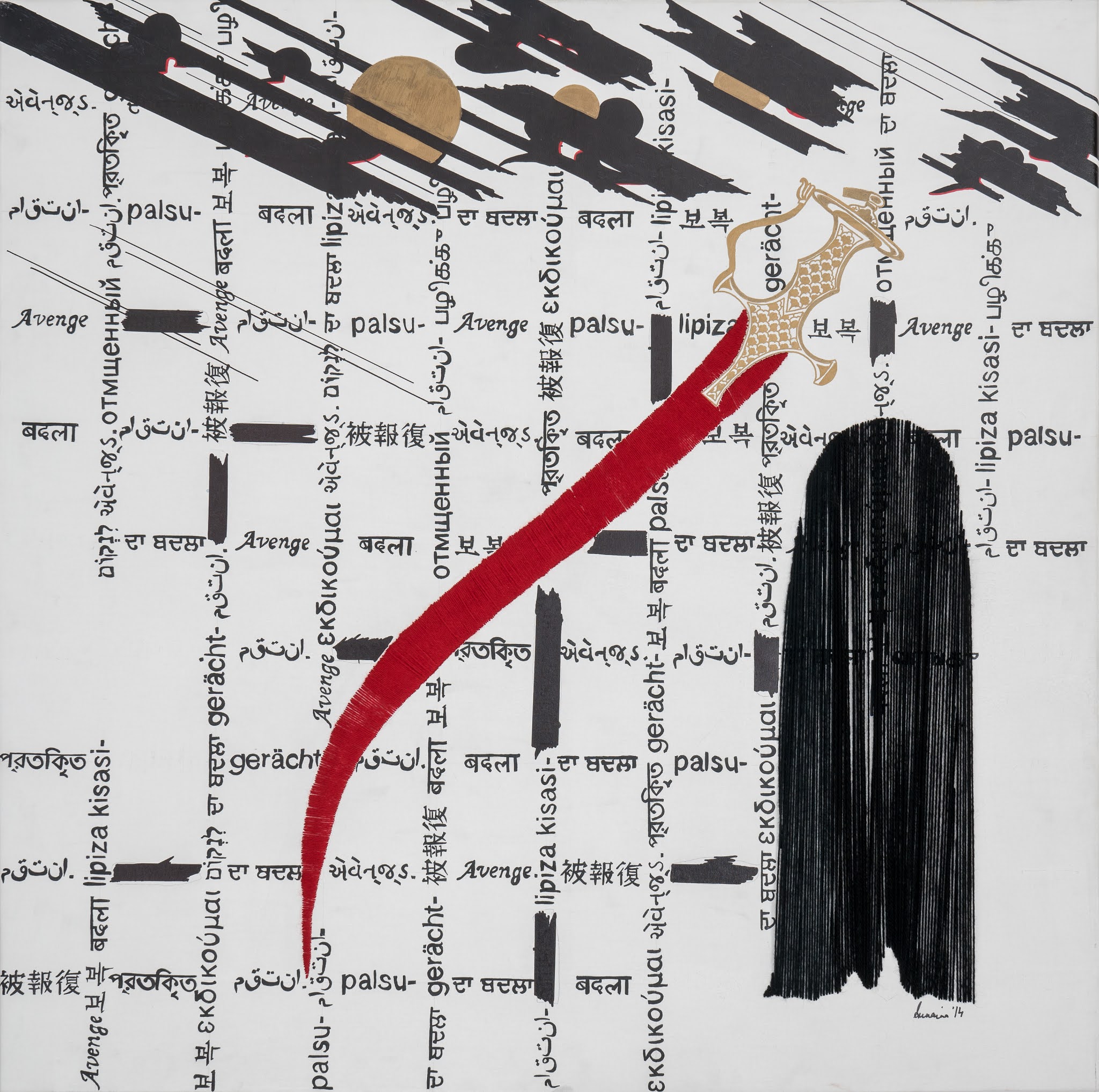

Avenge


Throughout this time,  I was in constant touch with my textile print making. I conducted, and continue to do block printing workshops in Singapore, South East Asia and the US . Recently commencing the first workshop at the National Gallery in Singapore. In addition, I have been working with a block carver in India, who belongs to a family of block makers. His grandfather had an atelier during the East India Company over a 100 years ago, and his father is the recipient of four National Awards. In my endeavour to  support his craft, I offer these hand carved blocks for sale at each workshop, the proceeds of which go to  him and his family. He also carves block that I have designed for use in my own art practice. In total, I  have amassed a collection of over two hundred blocks.

In the past couple of years there has been a renewed focus of working with fabric, where I have added usage of medical detritus and embroidery. I was never trained in it but I find the basic stitch very powerful, visually and metaphorically. A lot of stories can be mapped out with the simple stitch.

I am now focusing on the body and exploring traditions in healing, mapping the physical and mental shifts in perception, behavior and reaction to pain and chronic health conditions.

I am a proud survivor of a number of interactions with disease and health conditions and I hope I will be just as positive for the next phases in my life as I grow older.  Working with the hand and especially with embroidery is an important  part of my practice and I hope to continue evolving as an artist through this medium .


Survivors


Sunaina Bhalla has an MFA from Lassalle College Singapore. A conceptual artist, art educator, printmaker and a mother, Sunaina is a textile artist who has experimented with various art forms but returns to work with textiles. More of her work can be seen on her website: www.sunainabhalla.com and her instagram handle: bhalla.sunaina


Sunday, 10 September 2017

Personal Threads: Structure Me Not by Maggie Baxter, Australia, Guest Post


Maggie aged 7years,
wearing handknit
done by her mother
and or aunts
Quilting. Now there is a word that terrifies me, one I want to run away from. It is loaded like a gun to shoot me away from all pretensions of being a ‘serious’ artist into the murky lower depths of the craft circle with all its connotations of women’s work and the amateur.

slippage 2 - detail, Resist block printing
over dyed with organic natural dye on hand woven cotton
When Gopika suggested the concept of a narrative quilt, I thought ‘fabulous, great idea’ but quickly chickened out of the quilt and headed straight to the narrative. In a backward glance this meandering memoir, piecing together this and that, will investigate a little of why that is.
 
 
Cover of the book ’The Quilts of Gee’s Bend’
 
I am a fraud, that much you should know. Like all good feminist artists who work with textiles I have read The Subversive Stitch by Rozsika Parker, so I know that in Western countries, embroidery and all things stitched lost status from the middle ages when men and women worked together in guild workshops, until they were fully deemed women’s work in the 18th century. This fall from grace has never been restored. I have tut-tutted, shaken my head at this and probably had a little rant or two.
 
Quilt - detail  from the book, Irene Williams, c 1975
 
I check out art books all the time for inspiration. One I turn to, at least as much as if not more than any about painting or sculpture, is The Quilts of Gee’s Bend. If those quilts were painted they would be regarded as masterpieces of modernist abstraction - “geometric permutations of pure colour and form-bars and bands of colour offered up in bold confidence, intricate triangles playing visual eye games” . That they were born out of the repression of slavery using whatever their authors could lay their hands on makes their brilliance shine all the more. There is an unconscious immediacy about this work, and although the result is quite different the same can be said of traditional kantha quilts where soft, worn, aged saris are recycled into a new incarnation, the composition entirely at the behest of the maker.
 

'Slippage 1',
2.5 x 1 m, Direct block printing
 using organic natural dye on
hand woven cotton
But in the West, notwithstanding the small number of professional quilt artists who bravely set out to extend the parameters of the medium, most of my sisters in stitch spend hours and months patiently and carefully making quilts of pre-determined patterns from cheap cotton often pre-sorted into colour or themes (Christmas, landscape, Australiana etc etc). Yes, yes, I know it isn’t my business to comment, or wonder why, let alone pass judgement, especially if it gives them pleasure, but still I find it slightly depressing - like paint by numbers or embroidery kits. It seems that if the work is born of necessity and has to be the composition of the person doing it, there is a spirit so lacking in that which is pre-determined by others.
 
 
'Whole' - Maggie Baxter, Knitted
 
I can’t quite cross the line. See above, I have not called myself a textile artist but an artist who works with textiles. What a nit-pick! If I had stuck to my original intentions of sculpture, performance art and photography instead of being drawn by an irresistible, irrevocable, invisible karmic thread to Indian textiles, I wouldn’t have this dilemma. I am sure my friends in India, surrounded as they are by the ongoing splendour of their simultaneously ancient and modern - woven, printed, stitched and embroidered material culture, are just thinking ‘Whatever, but really, what is your problem?’
 
Teenage rebellion
 
'Slippage 2', 2.5 x 1m.
Detail, Resist block printing
 over dyed with
organic natural dye
on hand woven cotton
There was no quilting in our family or much sewing of any kind. I do have a small number of tray and tablecloths that my mother embroidered early in her marriage, but she didn’t maintain the enthusiasm. It was knitting that was the centre of our craft world. The hand knitted sweater and cardigan was epidemic in 1950’s and 1960’s England – the time and place of my childhood and adolescence. Someone could write a thesis on mid-20th century hand knitting just by going through our family photo albums. My mother and all my aunts knitted non-stop and with great skill. They could do complex cabling and multi-coloured patterns without even looking at the needles, watch television while they counted rows and stitches. Who, WHO, WHO would want to spend their life sitting at home knitting when there was a big wide world out there to explore my sixteen-year-old self, asked no one in particular - not ME I ungratefully muttered while putting in an order for whatever caught my fashion fancy on the knitting books that regularly arrived by post. And anyway, why bother to learn when someone else could already do it – and here I must digress for one moment to apologise to my mother on behalf of my teenage self.
 
Four elderly Scottish Aunts wearing hand knit sweaters and cardigans, cira 1960's
 
But did they all do it just for the love of knitting? To begin with, probably not but later probably yes.  I can only speculate because, taking it for granted, I never asked the question. They were very good at it, took pride in their skill but in the child rearing decades of post-World War II England it was an economic necessity. It was much cheaper to buy wool on the skein and knit than to buy a completed sweater. This hasn’t been the case for a long time and except for occasional brief revivals as ‘the new meditation’, hand knitting is well and truly in decline superseded by the ongoing barrage of quickly disposable machine made.
 
Sweater my mother, Phyl Baxter, knitted for me circa 1980
 
And when they weren’t knitting my female elders were neatly, carefully darning socks and old hand made sweaters. The throw-away society was on the horizon but in the mean time it was mend and make do. Not quite rafoogari but neat and functional nonetheless.
 
Sweater my mother, Phyl Baxter, knitted for me circa 1980, detail view
 
Then there was school – not that sewing or domestic science were major subjects, more a quick overview and then an option.  Retrospective note to long since deceased teachers (just in case you reincarnate into the same profession): if you want to engage the imagination of teenage girls do not start sewing lessons with three different ways to patch sheets. What you will end up is grubby bits of lacklustre tat that look like a dog chewed them. I am sure I am not alone from that class in saying I have never patched a sheet since.
 
'Uncurled 1',
Resist block printing overdid with organic natural dye
 on hand woven cotton. Pakko hand embroidery
 
I went to art school almost a decade later, chronologically somewhere between Punk and when the amputated asymmetry of Rei Kawakubo’s anti-aesthetic hit the catwalks of Paris and thereafter the world. Oh rip, tear and deconstruction, we were made for each other. I thought my lack of craft skills base had found its true calling without realising until I tried it just how skilful the apparent nihilist approach to cloth really was.


'Whole' - Maggie Baxter, Knitted
 
But disconcertingly I reverted to my origins. I knitted. First big soft sculptures Claes Oldenburg style before moving on to knitting plastic tubes, strips of fake fur, and even garden mesh. Then just as suddenly as the knitting fervour came upon me it went back into hibernation emerging once more in the 21st century as irregular lace-like textures achieved by dropping stitches, knitting into two or three stitches at a time and then randomly increasing them. Abstract knitting. I’m all over the place, just where I like to be.
 
'Drip', Maggie Baxter, Knitted
 
If I were going to consolidate the primary statement of my artwork – it would be line. My drawings (and therefore block printing, and use of stitch) are linear, calligraphic, scribbled. And strangely knitting is linear: It is the act of making a more solid cloth or garment by wrapping and knotting very long threads of fibre over two sticks. In my knitting, the thread never becomes solid, it loops and drapes into random circuitous lines. Some of these I have drawn again and turned into blocks ready for more randomness in the way they are placed on cloth.
 
'Drip', Maggie Baxter, Knitted, a detailed view
 
So, maybe there is another problem with quilting for me? It isn’t random. It is all about structure and building blocks. That is not say there can’t be randomness in the choice of colour or the way the blocks are built up, but still there does have to be some kind of geometry, forethought or plan in the layout. In quilting serendipity is pre-ordained no matter the oxymoron of that statement.
 
 
'Drift', Maggie Baxter, Knitted
 
I am having a personal, quiet little rebellion against structure. No more of in my life thank-you very much, I already have way too much. City Australia, which is here most of us live, is not the wild frontier of our myths and legends but an over regulated nanny state where we can’t even bicycle on a footpath to the local shop without a crash helmet. My working life coordinating public art in new buildings and public open spaces is a barrage of deadlines, timetables, minutes and reports even before we can get to the literal building blocks of the architecture into which the art is assimilating. So outside of that, in my own artwork allow me to indulge in the free form, be unprepared, totally intuitive, and let it roll out how it chooses to. I am just not sure I can do that with quilting.
 
'Drift', Maggie Baxter, Knitted


Maggie Baxter is an Australian artist, writer, curator, and public art coordinator.

References:
1. Parker, Rozsika. The Subversive Stitch: Embroidery and the Making of the Feminine. London, The Women’s Press. First published 1984, reprinted 1996.
2. William Arnett (Editor), The Quilts of Gee’s Bend.  John Bearldsley, Shelly Zegart, and Maude Southwell Wahlman (contributing editors), published by Tinwood Books, Atlanta, Georgia in assoc. with the Museum of Fine Arts, Houston, 2002.
3. Ibid. P.14


‘Personal Threads’ is about creating a narrative quilt, in an endeavour to read our histories as not something unconnected with each other or the past, which is personal and political, but to read our histories as the interconnected pieces of a quilt, assembled like bricolage. We may claim different nationalities and religions but the DNA of our lives is complex and far from unconnected. While the past has tremendous bearing,  the intention isn't to harp on it as a wail or dissent or blame, but to narrate this as a means to locate ourselves and who we are within its folds.
If you’d like to contribute to this project, drop me a line.