Showing posts with label hand knitting. Show all posts

Wednesday, 14 August 2024

What’s In A Mess


My studio has overtaken my home. It’s a mess. I usually hate the messiness, but something shifted in these last few weeks. Making me realise it was actually useful.


It looked messy on the outside, but I felt really comfortable within it - sitting on the sofa, with all my threads around me in clear plastic bags, allowing me to see them. The threads did entangle and at times, around me too. Catching in my toes, around my ankles and legs. Trying to get up in a hurry to answer the doorbell or go to the loo was often a rather strangulating process. Sometimes a sneaky ball of yarn would roll under the sofa and once I realised that, I’d pull and pull the thread until I caught sight of the ball, pick it up and place it somewhere it couldn’t create more of a mess. But yarns when unravelled and snuggled together in close confines, will tangle and twist when handled and it does become problematic. 


I had crochet hooks and knitting needles close at hand so I could decide to do either, depending upon the threads I had in my hand - based on the number of strands that made up, or came close to the colour I needed to make into my 5” square pattern. 


Laid out open, even though they were carefully placed in holders, the knitting and crochet needles took up considerable space and the crochet hooks would often disappear under a cushion or into a thread bag. I had similar issues with the thread cutter and scissors. Many times, I’d be sitting on them. Always a mystery how they got there! 


It was a mess. But, it was a functional mess. Having everything at hand, despite the periodic disappearing acts, served expediency and efficiency. And as I worked with my hands, enacting various mudras to create the fabricated patterns, order was emerging from the chaos. The squares piled up. I blocked them each night and felt satisfied that so was making progress. Each day, I just slipped into that messy space, almost comforted by it, to continue making the squares - adding to the pattern melange. 


These mudras may or may not or have the  beneficial effects of yogic or dance mudras. But, something happens to the mind and heart, when the hand works in repetitive patterns. Stitching slows the mind down, it allows one to think. Rather, hear oneself think. It also helps me feel what’s going on. Sometimes feelings are intense, they’re hard to fathom and slowing down helps unravel them. The fact that we make something, aids the contemplation. I don’t feel quite so useless, just connecting with myself for most of the day. 


In our overly connected world, where there’s just too much out there to assimilate and make sense of, stitching for hours at a stretch helps one feel more grounded in your being. And, I tend to do it for most of the day in silence. No music, no Netflix or Apple TV. It’s when the mind starts going around in circles and I can’t continue to confuse myself, that I switch channels and create some noise in the background. Ostensibly I’m  watching TV and do grasp some of what’s going on, but mostly I’m concentrating on what I’m making. And having slept it off, as I journal the next morning having, I begin to make sense of whatever I was ruminating on or feeling. And it goes on and on like so. 


It’s rained so hard for the past two months. It was beginning to seem as if the sun had forsaken us altogether. I’ve also been unwell for the last three weeks. It’s been hard. But, I found comfort in my messy studio, where I could work once the fever wore off. Yes, it’s drained me. Yes, the paracetamols have caused havoc with acidity, but I’m recovering. 


The pattern melange is also coming along. I’ve crossed the half-way mark, but there’s still a long way to go. However,  I have to pack this stuff up to prepare for a multitude of things, a trip to Delhi for care-giving included. 


Before I cleared up this mess, I wanted to share how it suddenly dawned on me, that this mess, isn’t unlike the mess I see myself as. The shame and disdain I feel for what I’ve done or not done, for the ignorance, the arrogance and more that fuelled the trajectory of my life this far. Those so-called dysfunctional patterns that subconsciously emerged and determined the course of action I took. But, I’m beginning to realise that they may well be ‘functional’ after all. Like my messy studio creates efficiency and expediency in making the over-sized pattern mélange. There may well be some function to the psychological mess that discomfits my sense of self. 


It’s really making me re-think the idea of messiness. It’s helping me feel less of a need to tidy up, to clean up around me or cringe at all the fallen leaves that carpet the lawn, totally eclipsing the grass. And Im also trying not feel so bad about the bamboo trees they thoughtlessly pruned last year because they’re growing back in clumsy clumps. The balletic fronds fluttering  elegantly in my window frame, just isn’t the same these days. Their dance is gawky and amateurish and I have been cussing the guys who ordered them cut, ruining my vista of graceful green


The tall coconut palm that stands a stoic witness to life within and without my window, advises that one must flutter whichever way the wind blows. 


Even if it means diving right into the messiness of it all. As Carl Gustav Jung observed “design emerges from amidst the chaos of form” so, there’s hope yet! 


Monday, 10 June 2024

Stitch Meditations on Being - The Patterns and Hues


“They fuck you up, your mum and dad.

They may not mean to, but they do.
They fill you with the faults they had

And add some extra, just for you.
But they were fucked up in their turn

By fools in old-style hats and coats,
Who half the time were soppy-stern

And half at one another’s throats.
Man hands on misery to man.

It deepens like a coastal shelf…….
                                                                                                                                                    - Philip Larkin


These words say it all, without revealing the gory details or gruesomeness of the wounds we all carry within us. Largely disguised in various ways but played out subconsciously. Most of the time we are unaware of why we do what we do and of the influences of the “soppy-stern…….at one another’s throats” that created who we are, beyond just the physical mating, but the why and how of our psychological make up.

When Larkin says “Man hands on misery to man. It deepens like a coastal shelf” he evokes the patterns we form and re-create (subconsciously for the most part). Habits make it easier for us to negotiate life - such as driving a car or bike and even drawing, crochet, knitting and that ilk. But, it’s the emotional and psychological patterns that create the problems, where human misery “deepens like a coastal shelf”


Yet, as Larkin put it, it’s inevitable that we inherit dysfunctional ways/patterns and also play them out, passing them on generation to generation. Unravelling these patterns may or may not create the potential for change, but it’s interesting to do so for the purposes of understanding your own psyche/self. Beyond that, what can we do?


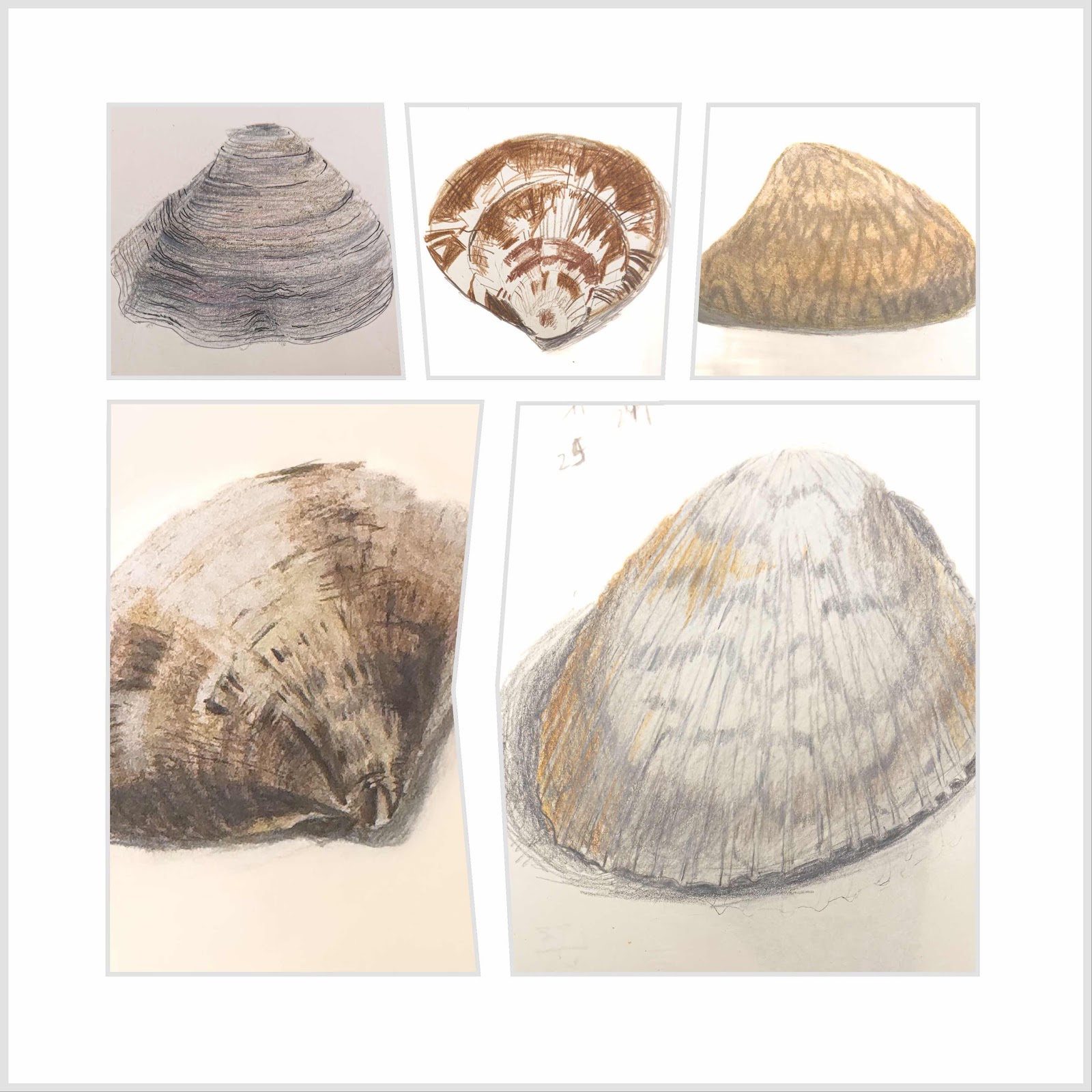
This was a dilemma that I faced and struggled with until I started studying the patterns on the molluscs along the Goan coastline. These patterns were unique, as inimitable as our finger prints. It was virtually impossible to find two clams with identical colours and patterns.


What was even more interesting was to learn that these patterns are created by virtue of genetic and environmental conditions. A neurological response for camouflage and survival. Even so, the radula of other species did manage to drill through and suck the animal out, and if not, it wasn’t for lack of trying. Wherein the holes they drilled, became another level of embellishment to the strokes of colour that decorated the exoskeletons.

I studied these patterns in various ways: through the camera, by drawing and eventually by zooming into the photos I took of each. This was fascinating because in pixelating the images, I found the patterns were a configuration of colours.


Colour, as we have seen through the ages, carries symbolic meaning that varies from culture to culture. Lisa Feldman Barrett, social scientist and author of the book ‘How Emotions are made’ asserts that our emotions also vary from culture to culture. Colour and emotions, have long been linked:  green with envy, yellow for happiness and joy, red for love and anger and more in that vein.

But, Feldman Barrett says there is no singular way to describe any of the human emotions. Each culture and person within it, experiences a variety of sensations within anger, joy, love and despair. The subtle gradations and differences between fury, rage, anger, frustration, being irked etc are just that - subtle variations.

In this zoomed in and pixelated photo of a clam shell, that’s what I see, subtle gradations of colour - so subtle that it’s driving me insane trying to reproduce them in thread.


I have two versions of the thread adaptations. The first was a cross-stitched replica where I mixed the threads - two to three different colours from over 400, colours of cotton floss, collected from various thread makers including Anchor and DMC. It took me a long time to complete one piece and the second is in progress. A slow process which I often abandon to tackle something else and return to until it is done. The first one took me a year.


However, the piece that I’m currently working on, isn’t just about getting the colour right, it’s also about patterns and how the same hue can alter with the pattern. The idea is to make a large crocheted and knitted piece instead of embroidery. The reason the colours are taxing both mind and pocket is that unlike embroidery threads, the colour range is extremely limited for knitting and crochet. At least in any one count of yarn to enable some symmetry in scale to join the 5  inch squares.

I had started the pattern blanket (for want of another term)with some vague idea, with regard to how I wanted to put theknitted and crochet squares together. It evolved over two to three years and I made the squares from all the colours I could muster but I just couldn’t figure out how to really work them together to create any visual that appealed to me. This resulted in my abandoning the project and the 300 odd squares I’d already made, not to forget the hours of painstaking knitting and crochet – often at the end of the day. It didn’t make me happy but I didn’t know how to move forward. I thought it was a failed project and hadn’t looked at it for over a year.


Then a couple of weeksdiscovered wood borers had inhabited my rather extensive book shelf which stretches across about half my apartment. I had to empty all the shelves and cabinets below that housed stationery, fabric and my stash of embroidery threads as also hundreds of books amassed over the last four decades and some inherited from my parents’ collection. Art magazines, old issues of Selvedge, Piecework, Surface Design, Embroidery and the now extinct Fiber Arts, Marg Magazines, India magazines (also extinct),BBC music magazine, piano scores and about 100 art magazines - a series I collected in my student days about artists - one issue on each artist (sadly none about Indian artists but focussed on western art history). And of course a collection of books - fiction, non-fiction, poetry, textiles, art, spirituality and more. Basically it was a lot to place around the apartment and at the end of it all, the only free space was my bed.

My knitting and crochet stash is housed in my bedroom, in various draws  usually by colour. This was not disturbed by the pest control requirement. So I decided to revisit the abandoned pattern blanket and changed tack by using the template I had already embroidered in cross-stitch. The 1/4 inch embroidered squares took me about ten minutes each to execute, with seven of those minutes to get the colours to match. In the knitted and crochet version, I am facing similar issues with the subtle gradations of hue, but more so because I’m not working with just cotton floss, but yarns ranging from wool, acrylic, rayon, nylon, cotton, wool and cotton blends, and also the counts are all different from very fine crochet yarn at a 40’s count to chunky 4-6 ply. Often, I have to work  differing counts together to try and approximate the colours.


It was a challenging week both with the rather smelly pest control, putting things back into place and this creative project. But I now have a template that gives me the direction I need. What I’m grappling with, in addition to the technical issues, is what I hope to achieve by engaging in this rather esoteric idea of replicating the colour boxes in both hue and pattern.

While working on the cross-stitch version, I marvelled at the numerous shades there were and recreating them helped me understand that there are so many hues to each emotion. It’s impossible to understand what another person is feeling because what they feel is unique to them - culturally, socially, experientially, genetically, environmentally and more. That was a great insight because one does tend to think we know how others are experiencing emotion or what they may be feeling, but Feldman Barrett also suggests that it’s not possible - at best we can imagine within the range of our experience, based on our own emotional shade card. Our emotions and the hue gradation of the occurrence is uniquely personal.


Most of our thinking comes from conditioning. And is the result of social constructs geared to create a sense of order with the existence of so many of us who inhabit this planet. However, through centuries of the existence of mankind, the ideas have evolved in a rather unthinking and dysfunctional way. In many ways much of our thinking could be deemed be distorted by ideas that most likely germinated through limited knowing and were handed down with incompleteunderstanding by those before us, who didn’t know better.  Quite like Larkin says in his poem. They fuck you up, …..They may not mean to, but they do.”


Patterns are prevalent throughout nature and also in our emotions and thinking. My professional training has been in textile design and patterns are nofirmly etched in my DNA. We were taught to create designs for fabric by dissecting vegetables like okra – a cross section with the seeds visible; drawing this and repeating the form in differing ways of  formal repeat patterns for printing motifs on cloth. The challenge was to ensure that the repeat wasn’t visible and also contributed to the visual outcome; trying to disguise the vegetable form through repeating the motif in creative ways. The repetition made almost everything pleasing to the eye because familiarity  is what enables a sense of well-being and makes something agreeable to the senses.


As I evolved into  a fibre artist, examining my own persona – a journey of self-actualization through my art, I started exploring the idea of mind-stains or ideas that cause us to feel less than good, feeling shame and doubt and self-cynosure. Initially I explored this through notions of tea stains on my saucer as I spilled the tea I was drinking. It was a long exploration of seven years, wherein I realised that one could still flower – fulfil the human potential despite these feelings that seem to hold one back. 


When I moved to Goa, I didn’t give up the idea of stains for they were very much a part of my inner explorations relating to  experiences that created these inhibitors. But, living along the coastline of the Arabian Sea, I went beyond human nature to study nature in her full glory and life by the seaside has been fascinating in this sense. Wherein colliding ripples of water, washing over mud adhesion ripples at the River Chapora estuary and further down the beaches of Morjhimand Aswem, with wind adding to the rippling effects and the diffused rays of sunshine at dusk – complimenting and complicating the patterns, I began seeing these patterns of colliding energies as incredibly beautiful. 


It was the complexity that appealed for it related to the intricacy of configurations that become our patterns of behaviour. Of energies inherent in the psyche formulated through generations of conditioning, one’s own experiences – of colliding with other energies, bringing out these patterns. Where we recreate them because energy draws us to others when we recognising something familiar. In re-creating we feel grief and anguish, become aware and the tendency is generally to view ourselves in a negative light. Something that needs to be changed. But the wisdom of the ocean suggests that there is incredible beauty in these engagements and that the tendencies may change through the collisions of energetic fields as we negotiate our lives, but the overlaying effects of these fields are intriguing, dynamic and awe-inspiring. If only one could look at the self as we see the natural world.


Through the study of  clams shells, the sand bubbler crabs and their feeding residue and also the ripples of sand and water, I started seeing that patterns are formed by colour and the collision of energies in the elements. By extension I made the correlation that emotions seen as colour, in the human psyche, form patterns and vice-versa. Therefore adding pattern to the art work, going beyond mere colour became imperative.


However, this further complicated the process of trying to create the sublet hues uneven thread counts and a variety of ornamental thread configurations through crochet and knitting. At this point, can only envisage a blanket that’s an uncomfortable evocation of how we exist together with our unique experience and understanding of emotion, alongside others who feel and perceive these differently.

But, I’m a long way yet from being able to see this. I have under 100 squares when I need close to 640. I often rip out the squares because they’re either too big or I need to add a row or two if it’s smaller than I need it to be. Some are tight and sit awkward, others are delicately delightful. It’s going to be another task to whip them all together, possibly like one struggles to negotiate this world with the billions of others beside us….


Wednesday, 24 March 2021

Kya Soch Rahe Ho........(What are you Thinking)


Sometimes, I don’t know what I’m thinking. Especially when engaged in doing household chores, cooking and such stuff that I try and get over with as fast as I can, I’m rarely focused on what’s going on the mind screen. Thoughts come and go but I am too busy with the job in hand that I can rarely recollect what they were.

Often, when I’m knitting and crocheting my ‘thought-nets’, I’m also not really focusing on thoughts either. It’s not that I don’t want to, it’s not always easy to understand one’s own disposition. And the essence of issues that plague the mind - the deeper and untiring dialogue with self, is usually buried under the busyness of the day. If I want to look at myself think I do, but otherwise I watch something on nextflix, listen to a talk on YouTube or a book on Audible, to switch off from the superficial chatter of the daily rubble.


Sometimes, when the rant spills over, I can’t watch or listen to anything. My head is just screaming to be heard. If I can, I write in my journal or if it’s too chaotic to form sentences and if there too much emotion, I may speak to a friend. If I don’t feel comfortable talking to anyone, I babble into my phone and record the tirade. When I hear it back - the emotion, irritation and anxiety of what’s been said -that is if I can bear to go over the whole thing again, I do get a clearer picture of the problem at hand. Of why I’m feeling stressed. If I can’t hear that stuff again, I’m relieved that my mind is lighter for off-loading it. Usually it’s stuff that’s deemed unnecessary, pertaining to a whole host of mundane things that are detracting from the essence of what some part of me wants to think about, but the mind is exhausted with itself and cannot muster the discipline to do so. Sometimes feelings overwhelm and they cannot easily be put into thoughts and words – at best disjointed ones.


I’m a reflective sort of person, so I usually begin my day, writing in my journal. I start with reading the previous entry to get a sense of where I left off, because unresolved things have a habit of playing like elevator music, that’s heard but not really listened to - not enough to recognise the melody, not unless it’s a familiar tune, when we do sing along effortlessly – if we like the tune. In trying to get through the processes of living, which requires focus on the mundane, on driving, cooking, folding clothes and other tasks - the screaming is actually this underlying background dialogue that’s unfinished and unresolved, which is demanding it’s time and share of attention.


When I start this morning dialogue with myself, if I’m in a self-reflective mood, I can write for hours. If not, I leave off where I cannot go farther with the thought. Either I’ve said enough or I just can’t quite get to any point of understanding. Often I have to leave things for the thoughts to emerge. Where a movie, a talk or something else - even the rhythm of knitting sheds light.


And, more often than not, it is conversations or interactions with someone else that really helps shed light on what’s going on in one’s own mind - a reflective surface kind of mirroring dialogue. If it doesn’t automatically occur to me, I put my attention on what about the conversation struck me, moved me, or the advice I may have given . And it’s almost always what I need to think about for myself, albeit in a varying degree or context. This then requires deeper reflection which takes me into those areas that eons of exploration leave me tired and unfulfilled, but ideas that I need to resolve to whatever extent possible, because unless I do so I’ll never be free of the distressing inner rant.


A net by its very nature is something to catch things. Fishermen use it to catch fish, which is food for the human body. In Goa, many outdoor restaurants and cafes suspend nets under over-arching trees to catch the falling leaves so that the foliage debris doesn’t hamper happily chomping guests.


So what does a ‘thought-net’ do? What does it catch, or prevent from imposing or entering a protected space or field of vision?


If I put the larger and more cumbersome nets that I’ve created over my head, as an extension of my mind - an evocation of what’s going on inside my head, then it’s a kind of trap. A net that binds me within its threads. And not unlike repeating thoughts which bind us to people, situations and circumstance. But, the irony is that ranting and venting - going over the same ideas - creating this ‘thought-net’, is also a way out of this bind.


When we vent or rant - go on and on about a situation, most of us want sympathy because we see ourselves as victims of an unfair circumstance or relationship. Or we don’t have the courage to do or say what we really feel. Or perhaps we don’t have clarity and have conflicting feelings that need detailed analysis. In some sense, the situation challenges us.


I’ve often noticed this about myself that, if I’m on top of things, or matters are going well, there is no need for a dialogue. It’s only when I’m not able to get a grip on what’s going on that, the why’s and why-not’s circle around endlessly. And depending upon the intensity of the situation and emotion it evokes, I may lie awake at night, wondering why I can’t sleep despite vigorous exercise and feeling pretty darn sleepy too.


I was speaking quite recently to a friend, about the paradoxical beauty of our thoughts. This had occurred to me when I was looking at an embroidery pattern I had created within a series of ‘thought-nets’. The resultant ‘thought-net’ was visually attractive and led me rethink the very idea of ‘thoughts’ as being a burden. Of our ‘thought-patterns’ being something destructive. Such that new age philosophy underlines, telling us to get let go the past, to change our thoughts etc. Enticing us with absolutely miraculously solutions that almost never work quite as effectively and definitely not in the long term. Not unless we are on the brink of taking that leap by having done plenty of the work already.


Our thinking patterns, the template of our moral, ideas and ideals arise from societal norms, familial dictates, cultural morals and more that have evolved through individual, social, cultural, national and world events. All of which have collectively framed the psyche of our elders and educators, their ancestors and theirs: going as far back as time itself. Therefore, inherited ‘patterns’ are really not something we can get past easily enough. And, they are the real reason that the thread of ‘thought-nets’ catch us, binding the imaginative mind, curtailing the freedom of our spirits - keeping us from transforming our human destinies and exploring the potential of our human selves, even going beyond this.


My friend’s response was that negative thinking cannot be seen as beautiful, despite what the ‘thought-net’ I was showing her was proof of. She appreciated the artwork, but couldn’t correlate it with what she herself experienced when her mind is gripped with dismaying thoughts - negative thoughts in common parlance.


At one level, I agree with her. When you’re going on and on in a non-empowering way it’s enervating - for both you and the person listening to you. Fact is that negative gives power, when it’s changed through its charge into positive, and the two together is what generates energy. Negative thinking disembowels, but it is also creating an unacknowledged impetus within us, to rise above. If we were happy in that state, there really wouldn’t be any need to rant, complain or drag us and everyone around us, down the dingy steps of despair. We do that because we want a way out, but can’t see it. But lightening the load, getting consolation from friends, seeing that we are not alone in these things, lends confidence to delve within. That’s what we really want. Not necessarily advice, but solace. Not solutions that someone else gives but a means to reduce the thought load and find a way to the subtler voice of our own wise being. At times advice is sought, solution providers can be useful too but essentially the two charges of negative leading to positive - self-affirmation and feeling good, is what brings forth the energy. And in an instant the binds of the ‘thought-net’ are torn asunder. And we taste that enviable taste of freedom. Of being unstoppable.


I think that makes the process quite beautiful, don’t you?


Monday, 5 February 2018

Personal Threads: Pink Cashmilon by Suzy Singh, Guest Post


There were no baby showers in those days. Certainly not in the seventies and eighties, in the Phulkari (embroidery technique unique to Punjab) obsessed town of Patiala in Punjab, where I spent most of my summer and winter holidays, basking in my grandparent’s love. But there was a ritual that made the pregnant waiting for the arrival of any baby in the family, deeply symbolic. It was the way my Nani-ma (maternal grandmother) invested endless hours knitting her magic into bewildering patterns, using pastel coloured Cashmilon (acrylic yarn) balls that she transformed into adorable pieces of infant attire. It was this unconditional act of love that made the arrival of every child in the family a great honour.
 
I was two years old when I first arrived at my grandparent’s house in Punjab. My family had recently met with a car crash and mum was struggling to deal with its aftermath while also attending to two young children. I’m not exactly sure why as the younger of two siblings, I was chosen to be sent away to Nani-ma’s house, but I guess in hindsight, I’m really grateful for it. I lived with my grandparent’s for the next couple of years till I was old enough to start schooling.
 
Unsettling as that displacement was for the little ‘me’, it gave me the opportunity to forge a deep and meaningful bond with my grandparents. As I observed my Nani-ma go about her daily routine, knitting, cooking and indulging us, I learnt about the incredible power of love and compassion. Back then, I wasn’t aware that the separation from my mother would create an unconscious program of abandonment in me. This limiting program may never have healed, had it not been for Nani-ma’s endless lessons in love.
 
Nani-ma was always so peaceful
 
There were times when she would chant hymns from the Rehras Sahib, (the evening prayer of Sikhs), under her breath while she knitted away, and the day turned quietly from daylight to dusk. At other times, she'd regale me with her stories and teachings while her fingers kept busy despite our conversations. Even as we sat immersed in the cinematic drama of movies, in pitch darkness, at dilapidated cinema halls in Sangrur, Rajpura and Patiala, her knitting needles didn’t rest for a moment. They seemed to be racing against time, weaving a legacy for every ‘expected child’ in her family. And thus she  kept on knitting, even as the seasons changed and the generations of her family grew up. In time, her shoulders froze with arthritis, but still her love knew no bounds. All she cared about was that enough sets of sweaters, matching caps and booties had to be made ready in time to welcome the new arrivals. 
 
Sometimes Nani-ma would stare emptily into the distance ahead, while her hands worked furiously on. I never knew what went on in her mind during those moments. She always seemed to have such a peaceful demeanour.  And yet, there were times when her needles made a peculiar sound, different from the usual clicking, that suggested her peace of mind may have been compromised. Her tranquillity, as I comprehend it now, was a carefully crafted mask which she wore with tremendous dignity and grace. Regardless of whatever anyone said to her, Nani-ma always stayed calm. But if those needles could have spoken, they may have revealed a  deeper truth. As I recollect that peculiarly frantic clicking in my mind now, I sense her inner turmoil and I wonder; did she ever feel as loved, in ways that she loved us all?
 
I guess you don't ask such questions from a reservoir of love. And so it was that the question never arose between us. But I wish it had. I wish it had tamed my selfishness, made me a tad more empathic to her needs, made me hold her hands in mine and treasure them in a way I always wanted to, but never really did. Alas, why wasn't I more conscious of her suffering? Instead, all I ever did was to greedily ask her for more freshly churned white butter on my paranthas (flatbreads), more Gajar-Shalgam-Gobi ka achaar (vegetable pickle), more Panjiri (traditional Punjabi sweet) that she made especially for the pregnant ladies of the family to nourish the fetus and facilitate an easy delivery for the mother, more haldi ki barfi (Tumeric sweatmeat) that I so relished, and more sweaters every winter. All of which she made exquisitely, with a joyful willingness, like no one ever could.
 
 
How I wish I had talked to her knitting needles, when she lay them down after a long day’s work, listening to the stories they had to tell. Surely they must have been privy to the secrets of one who had worked with them so deftly. But wisdom usually arrives late in life, filling one's heart with remorse. All one can do then is to gather those memories woven with love, and hold them close to one’s heart, wishing for another chance to love in a more conscious and wholesome way.  But since I cannot turn the clock back now, the only thing I can hope to do is to become a weaver of love, by training my hands and heart to knit her magic, by pouring my love generously and selflessly into all. That perhaps is the greatest tribute I can pay her, by simply becoming who she was.
 
I remember so vividly how all the grandchildren fought over who would sleep with Nani-ma during our vacations, or who had received more sweaters from her each winter.  As the styles changed, so did the shapes and designs of her hand-crafted garments. Twin sets, long dresses with belts, half sleeved jackets, caps, scarves, mufflers - anything we children demanded, was magically knit, sometimes even overnight. But it was the warm vests that remained the same through all times. Pure white, sleeveless, round-neck embraces of double-knit compassion, that were designed to keep her beloved family warm, through the coldest winter months.
 
Long cable dress with belt knit by Grandma in 1978
 
 
I often wonder if anyone ever asked my Nani ma if she felt loved. Or was everyone else, like me, simply content with just receiving from her, without ever sparing a thought about her needs? Whether it was the comfort of her cosy lap that we snuggled in, the nourishment of the hot Elaichi (cardamom) milk she prepared for us at bedtime, or the gentle thapki (tender patting) that made us drift into blissful sleep, all of us grandchildren were cherished and indulged beyond imagination.
 
Nani-ma was like the sun, giving off her warmth, every single day for as long as she lived, yet never asking anyone for anything. Except on those two days, when she must have begged for mercy from God. But her prayers were not answered. Not when she lost her younger son, so unexpectedly to heart failure, while his wife was pregnant with child. Not even when she lost her elder one, to a terrible car accident.
 
Nani ma


And yet, her face continued to wear a brave mask, but her body began to give way. Her shoulders became frozen with pain and her heart lost its fervour to knit. There were days when I stood outside her bathroom door and heard her suppressed wails as she desperately lifted an arm to put on her shirt or when she tried to placate her grieving heart. But Nani-ma never spoke about her pain, nor did she ever complain. She just went on with life, like drudgery. The only difference was that she prayed more fervently, through the rest of her days, as though begging God to take care of her sons. Or perhaps, requesting Him, to take her away. 
 
Slowly, the sweaters became fewer and rarer. Life snatched away her two grown sons prematurely, and with it the rhythm of her knitting lost its colour, design and purpose. The new-borns kept arriving and she did knit for them all, even for some of her great grand-children, but her magic had begun to fade. I saw it in her eyes, that dead stony gaze which told the story of her loss and her slackening will to live. Much as I wanted to, I could do nothing to soothe her pain.
 
Instead, I began knitting sweaters for my loved ones, just like Nani-ma did. I knit for my husband and for my new-borns. They were nothing compared to grandma’s knits, but I felt reassured when my husband repeatedly chose to wear his camel coloured, double knit, cabled sweater, that I made for him. On many a cold winter night, he warmed my heart by casually mentioning that this was indeed the warmest sweater of all.
 
Ribbed sweater I knit for my husband in 1992
 
Time passed and the sun rose one morning to announce that Nani-ma had passed on, quietly in her sleep. She left as gently as she had lived, without asking for help or burdening anyone. How I wish I had held my Nani-ma’s hands in reverence, and placed mine on her hurting heart, to comfort it. How I wish, I could somehow have healed the loss of her sons, and disentangled the traumatic knots that silently choked her grieving heart. How I wish, I had held her tightly when she ached for them, like she had held me, when I was fearful and forlorn. How I wish, I could have promised her that she would surely meet her lost sons again, on the other side, in the higher realms. How, oh how I wish, I had woven the same love into her life that she had knit into every child’s life that was ever born to her family.
 
And because I didn’t do any of those things for her back then, and now I know I never can, surely not on this earthly realm, I give my love to other people, hoping to heal their pain and unshackle their hearts and minds. And I weave this tale with deepest admiration and love, with the pink Cashmilon threads of my heart, to honour her life, to share her legacy with all, and to celebrate the extraordinary woman that my Nani ma was.


Suzy Singh learnt to live life, to sew, stitch, knit, cook, bake and most importantly, to love, from her grandma. After eighteen years in advertising, She relinquished a successful corporate career to pursue her soul’s purpose of healing, loving and giving. She is now a Healer, Spiritual Teacher and Author of the book, ‘7 Karma Codes - Heal the Storm Within’, available online: https://www.amazon.in/7-Karma-Codes-Suzy-Singh/dp/938423821X
 
Her website is www.suzyheals.com
 
She can be reached on
suzyhealsme@gmail.com

 
‘Personal Threads’ is an endeavour to read our histories (both political and personal) as the interconnected pieces of a quilt – each one’s individual threads sewn together to form a larger picture. Telling our stories is a means to locate ourselves and who we are within the folds of their narrative. And often, who we are and what we do, emerges from the people, things and places that played some role in our past. We may claim different nationalities and religions but the DNA of our lives is complex and far from unconnected.
 
If you’d like to contribute to this project, drop me a line.