Showing posts with label creative expression. Show all posts

Sunday, 7 July 2024

Stitch Meditations , 7th July 2024


Music has been an integral part of my life, be it playing the piano or singing. I gave up the piano when the instrument I had was too old to be tuned and the piano tuner also died.  At this point I was past 50. 


And returned to singing (after some 30 years) which I had given up to pursue the piano. While I’m doing crochet - working on the ‘Patterns in Being’ project, I try and do some riyaaz. With the tanpura to keep sur now an app, I can do this quite easily, though not as often as my teacher would like me to. This is a ghazal she suggested I learn. I recorded it to share with her as my last class was missed. It’s far from perfect. I start off, off-key and the high notes are still a challenge, but it’s a WIP, just like my crochet project. 

https://youtu.be/Lvq6Ii6a6iA?si=ot_ibSpoHtwWJuck


As I sang, pondered on the lyrics and popularity of this ghazal, a 6mm aluminium crochet hook weaving the fabric - of a pattern I used to make a lovely silk scarf from my younger sister’s recent birthday. Having constructed a 7ft long one the pattern should have been second nature, but using two threads instead of one didn’t permit the usual flow. This too added to my reflections on stitch and the song.


The lyrics of which were written by Fayaz Hashmi, a 20th century Pakistani poet and songwriter who also worked in the Indian film industry.  The music was composed by Sohail Rana and the song was popularized by classical vocalist, Habib Wali Mohmmad who also sang it as playback singer for a Pakistani film ‘Badal aur Bijli, in 1973. 


The profoundly romantic and soul piercing lyrics expressing the pain of unrequited love and longing for a beloved, combined with a heart stirring melody creates an emotional listening experience, and has inspired many artistes to add it to their repertoire. My favourite rendition is by Farida  Khanum  (1993) whose vocals evoke the intensity of yearning that’s real and palpable.  I remember hearing it for the first time and feeling a familiar tug of the longing the poetics evoke. 


And don’t we all? I mean isn’t that why the lyrics appeal to so many?


Making me wonder if somewhere our idea of love and romance has become associated with longing, that which we cannot have. The unattainable, the challenge which brings us to a state of pathos. Pushing us into the depths of being, rising up like the phoenix from the ashes of disappointment. Like moth to flame, unrequited love can become an addictive pattern that challenges the being, its growth. 


Often, when I think of the verses that Swami Parmahansa wrote and sang during satsangs and which have become part of the Sadhna of his devotees, I find this same sense of longing for the idea of God, for what is attainable but ever so briefly or through rigour and intense discipline. Or always just beyond one’s reach. Saint poets like Lala, Andal and Mahadeviakka also spoke of pain, rigour and strife, as the ways into the soul of our being.


Yet, the world judges those that seek but do not find. That strive but fail. Often shaming each other. Even as our most romantics hero’s are Heer and Ranjha, Romeo and Juliet and even Rumi’s profound poetry comes from his separation from Shams. A pattern of social acceptance seems to be to reject the idea of longing even as it’s what’s embedded in our psyche. 


The old Hindi film songs, which I so love. That era of poetry in film that made the songs so memorable and singable, are also more about longing, more than love itself. The bitter-sweetness of parting, waiting to be re-united and that ilk. It’s almost as if we are programmed to fail to achieve the desired, because the journey is probably more exciting, hopeful, poignant than the destination. Which in the context of human love is inevitably a huge disappointment. 


And we cope with heartbreak to realise we were never really broken, but being opened up to explore horizons of being, beyond our imagination. And, these songs remind us of that journey, that longing, the hope - that romance of being which is never quite fulfilled through another, if at all. 


With these words 

“Waqt ke qaid mein, zindagi hai magar 

Chand ghadiyaan yehi hai jo aazad hai 

Inko khokar mere jaan-e-jaana, umr bhar 

na taraste raho. Aaj jaane ki zid na karo” the poet almost suggests that the beloved leave, for otherwise who would yearn so sweetly for him/or her…..


This post is in continuum of the previous one 

http://gopikanathstitchjournal.blogspot.com/2024/05/stitch-meditations-on-being-patterns.html

Wednesday, 21 February 2024

Golden Sands


I started this embroidery some weeks ago. An Instagram post with haphazardly laid slubby yarn inspired me to scour the Delhi market for some ghicha (tasar silk) which has a wonderful multi-hued (from dull gold to dark brown) texture that’s rough but soft to touch. 


Ghicha is traditionally made from wild tasar silkworms and produced in a variety of ways, one of which is by allowing the worm to emerge from the silk naturally, (without boiling them alive - now called ahimsa or non-violent silk) . The cocoons which are single-shelled and oval-shaped  are collected from the forest or rearing fields and dried naturally in the sun. The empty cocoon is then boiled to soften it for easier extraction of the thread. Ghicha silk fibres are short and coarser hence the silk is not reeled in a continuous thread like mulberry (bombyxymori) and other silks. 


There are several species of Tasar silk moths (family Saturniidae) in China, India, Japan, Africa and North America. The moths are large and have a prominent eye marking on their wings. The caterpillars are bright green, as wide as a man’s finger and they feed on a wide range of plants like Asan (a common herb also called Bijaka) Arjun - a large deciduous herbal plant (tree) and Sal. Valued for its natural golden to brown hues - said to be derived from the tannin in the leaves that the moth feeds on, the main producers of Tasar silk are the Jharkhand and Bihar regions in India.


Why did I find myself drawn to the slubby ghicha, is something that I have been preoccupied with ever since I embarked on this work. For so many years, I have worked with cotton fabrics, not really caring much for the quality of cloth and usually veering towards markeen or mulmul- not the fine muslin of yore, but mill-made cotton voile. I did use silk organza some decades ago, and that too has returned to my repertoire, but Tasar wasn’t ever on my radar. 


Anyhow, this Instagram post - I’ve never been able to find it again, set me on a purposeful journey to find ghicha fabric. The idea was to remove the yarn - ghicha is usually used in the weft, with finely spun Tasar or cotton for the warp and it’s easy to unravel.


I spent way too much money on this, buying all manner of silk - mulberry and organza included, adding muga tussar blends and silk cotton blends. Good quality tussar can cost upto ₹3,500/- per metre, organza around ₹850/- and gold tissue about ₹1,500/- per metre. Sometimes I bought a metre but usually only half a metre. Even so I ended up spending over ₹20,000/- on a single trip and there were more sprees.  Given that all I had were cut pieces that I was going to shred it really does seem like extravagance but when it comes to work, I never stint. 


As soon as I returned from my shopping spree I got down to work by taking out the thread. Some fabrics weren’t so easy to unravel so I got just the yarn length of the fabric width and kept them neatly together for use later. One of the fabrics was a dream: I could actually reel the thread off the fabric and create small balls of it. I use this for embroidery. I’ve been trying to get a spool or two of the finer Katia thread to work with, but as yet haven’t had much luck as the yarn isn’t made locally and suppliers are wholesalers. 


I then used some of these fabrics that I had drawn the threads from and rendered fragile, by layering them upon each other and trying to tack the loosened threads. The end result was a mishmash of fabrics quite large and unwieldy.  I liked some of the textures that stitching had created, and wanted to pursue that - make the work smaller and focus on the detail. 


So, I cut the whole into bits - just random bits. I then divided the organza and gold tissue fabrics into equal parts and got 8 rectangles from each measuring 9.5 x 11 inches each. Hence the series of 8. 


I tried tacking the randomly cut bits of tasar onto the organza overlaid on the gold tissue by hand but it was treacherous. I indulged in getting one of those mini sewing machines I’ve been eyeing for sometime now. I have a good enough sewing machine at home in Goa and didn’t need to add clutter to an already overflowing studio, so it didn’t make sense then. But I’ve been in Delhi since early November, with another two months (when I started the work) to go before I returned home, so I knew I had to get it. It’s reasonably priced and did the basics. Just about that too. The stitches were too large on the lighter end of the  fabrics (you cannot modulate the length) which ended up being a boon in the long run because I just ripped out the stitching once the embroidery had started and the loosened ghicha threads were more manageable. 


I’ve been in n Delhi, taking care of mum who’s ailing. She’ll be 92 in June this year, has Parkinson’s which has affected her swallowing mechanism. This means that she cannot eat. Beginning with a Riles tube, we had to put in a PEG tube in the stomach to feed her every two hours. This site got infected and the doctors  inserted an NJ (nasal jejunum - it goes deeper into the stomach than a RT). She’s pretty much bedridden with her severe osteoporosis and limited mobility plus has had a UTI almost constantly for the last 5-6 years. She’s alert, misses eating her favourites and once in a while asks for coke or chocolate or tea and we feed her licks or by teaspoon. It’s hard and she’s miserable. And, there’s a sense of gloom that pervades the whole place. Her home has been neglected or rather left to the staff to run, so almost nothing works and despite continuous repairs, it’s hardship living for us. 


Knowing the situation and that I was to be here for 4 months this time around, I decided to post most of my stuff and set up a temporary but workable studio on the large oval dining table that seats eight (half of it). I’ve been working regularly and it’s been my salvation. I had brought pieces that I had been working on and there were a lot of samples to be made for a 4 module workshop that I conducted at the Kiran Nadar Museum of Art in Saket. But, sometimes, things can’t be worked to order and one needs some expression that’s more in tune with situation and circumstance of the present. In fact, I find that the chaos of life actually lends itself well to authentic expression. 


My exploration of life along the seashore in Goa, as a mirror to self has been a seven year journey thus far. I have explored and studied the shells and their markings - zoomed in on what scientists have said are neurological responses to the environment - with genetic traces too, to realise that it’s pure colour that make up these patterns. Subtle gradations of colour. I have a series of cross-stitch pieces that replicate my photographic recording and pixilation of these patterns that are fascinating in their hues. I’d been working on one of them, (they take a year to do each) when the Instagram post sent me on another track. 


But, it really wasn’t another track just another way of looking at neurological responses.  And, in studying the colour of these responses as I tried to match each hue - and it’s the most demanding thing I’ve ever tried for each square of 16 crosses takes me approximately ten minutes to complete: 2 minutes to stitch and the rest to match the right colour and tone, I’ve explored emotions in the human context and how we use them to respond to situation and circumstance. 


This led to the understanding that there is a geography of emotion. A terrain that isn’t linear but layered. Like patterns are formed in our subconscious behaviour, emotions also have patterns. How we respond to people is based on these patterns and hence they are referred to as the geography of emotion. 


In mapping this geography, initially I referred to my album of images from my weekly walks on the beach, when I’m resident in Goa. And I found the correlation quite fascinating. But, then my sister came to share the caregiving and running of house responsibilities and all hell broke loose. 


The cook who pretty much runs the house was going on leave and the two of us were to do this along with mother’s care. Our personalities are like chalk and cheese. While she externalises, I internalise. And, we haven’t lived together our entire adult lives - not since we were in our teens. Not only that, we have a troubled past too - I guess most families have their issues and we do as well. It was an ambitious plan that within days became nothing short of a nightmare. My head was screaming overload. I’m used to living alone and barely managed the numerous people involved in mums home and care till sister arrived and then to deal with her entirely different stress coping mechanism  - one that imposed on me, was impossible and that’s how these pieces came into being. But, it’s not just this that created them for I had started the initial work prior to my sister’s arrival. I was under stress and she just became the trigger for something visceral. 


Inspired essentially by the sand bubbler crabs whose radial feeding residue patterns create a lace-like pattern across the sand. These patterns are fascinating in themselves, but the story behind them is equally so - actually more so and lends meaning to what I’m attempting to do with this series of embroideries. 


The sand bubbler crabs are tiny, shy creatures that run into their burrows at the sight of me. They dig these burrows and live in them until the tide brings forth the stuff they feed on. Then, they scuttle out of their hiding places and roll bits of wet sand in their mouths, digesting organic waste and detritus of animals, discarding the rest as little globules that dot the beaches. They work radially outwards from the burrow. And in leaving these globules they inform their tribe that this sand has been sifted and there’s nothing left to feed on. But, the part that I find most interesting is that in consuming the waste and detritus these sand bubblers actually clean the beaches. without which, there would be a stench. 


In these pieces, I’m using this concept of dealing with the detritus of one’s emotions to clean the environment. I started them, despite my beck and shoulders in agony. Finished two aided by a week of daily Physio therapy and then got a whopping cold. First, one side of the nasal tract and then the other with a really lovely chesty bronchial cough. All of which left me no choice but to abandon sewing and sleep it off. 


Not everything can be sorted by mere creative ideas. But, it’s all part of the healing process. If it hadn’t been for the rest, I’d never have cleared my head enough to write this! 


Hope you enjoyed this post. Stay tuned for more on the Golden Sand series - on why silk and gold have become emblematic of this series and other stitching stories.


Resources: 

https://en.m.wikipedia.org/wiki/Tussar_silk

https://asiainch.org/craft/ghicha-silk-weaving-of-bihar/) 

Sunday, 19 December 2021

Personal Threads: The Needlecraft Road, Guest Post by Beth Arnold (assisted by Julia Robinson Shimuzu)

It started with a skid on the low pile carpet at work, then a shaky left foot, then a slow uneven gait, my left arm no longer swinging…it was Parkinson’s.  It does not and will not define me.  My needlework defines me.  My travels define me.  My family defines me.  

Several years ago, on a weekend beach trip in southern California with two women who also have PD, we stopped at a needlework shop in Ventura where I found a kit for a glorious, red-headed counted-cross stitch Mermaid.  She came with beads and required over 40 skeins of colored cotton embroidery floss.  I bought the kit and ordered olive green 30-count linen.  I could not wait to get started.   I love going through my collection of embroidery thread that is organized by number, pulling out the ones I have and making a list of those I don’t.  I also love going to the craft store and pulling the new colors I need.  Over the years I have worked on her and she now stands at about 80% complete. 


Mermaid

When I told a good friend about my predicament with my mermaid she said “your mermaid is beautiful and unfinished, just like you”.  And I thought, she is right, at least about the unfinished part.  She taught me that I have more to give, more art to create where I will be inspired and energized by color and texture and flowers and my travels. 


Wild Flower

My husband was working in the Bay Area for several years while I remained in Los Angeles and I had many nights and weekends alone where my Mermaid kept me company along with other needle crafts like knitting, embroidery and sewing (both hand and machine).  That ended a few years ago and I put my mermaid and other projects aside after my husband and I bought a new home on a hill that we have decked out with interior and exterior entertainment spaces.  My favorite is our rose terrace that has over 30 rose bushes.   Sometimes I joke that I raise roses in lieu of not having children.  We also have a parterre, fruit trees and a Zen garden with topiaries.  We have a lovely view of the glen from our living area bay window.  

About a year ago I started having double vision. My doctor says it’s the PD.  One of the many odd PD symptoms.   There is nothing to be done.  My fine motor skills are also changing, making it harder to thread a needle and sew or knit or write or type when I am “off”.  This “off” period that can vary but in my case is about an hour, refers to the transition time between medication doses which I take at six different times a day.  So we go on and off, up and down, just like in sewing.  

It was startling when I realized I could no longer work on my Mermaid. Thirty count linen was just too small and I have not been able to find a comfortable magnifier stronger than the one I own.  So I started anew with a blank slate thinking of what I could make with my growing collection of tulle, felted wool, beads, fabric and metallic thread.  Starting with my tulle collection I did an internet search and learned you can singe the edge of a round piece of tulle to make flower petals.  I made a few small flowers this way and sewed them on little felt jewelry pouches.

I began thinking about how I could use the tulle in other ways. For years I have been buying up tulle remnants from fabric stores, tucking them in a drawer to my craft table.  Like with the embroidery floss, I adored the colors and the idea that something fancy could be made with them and I needed to own as many as I could find on sale. 

I have always enjoyed close up pictures of flowers, maybe from the influence of Georgia O’Keefe who I discovered in college, and ever since getting my first camera I have taken hundreds of flower close-ups from places I have traveled to such as Red Butte Gardens in Salt Lake City, Utah. It was particularly “fruitful.” On a trip to Denmark in the midd-80’s I fell in love with their brightly colored Danish Flower Thread, cross-stitched linen botanical designs.  


Yellow Embroidered Pillow 

With the grace of God, I was inspired to pull up a few of my flower photos and began piecing together the felted wool and tulle petals in small tapestries.  I needed to hold the tulle and felt in place.  I tried stabbing wool roving into both and the result was really pleasing.  I am able to use the wool roving like oil paint, mixing color, using contrasting colors. It was thrilling to find online retailers selling roving samplers. I now own over 100 colors.  I recently organized my roving using “The Secret Lives of Color” by Kassia St. Clair.    There were names I have never heard of before like “woad” (in the blue family) and “verdigris”.  I spent hours grouping and re-grouping my lovely colors into eight boxes like a rainbow. 

To help use felted wool remnants and add unique detail to my tapestries, I use small dots or beads for tiny [part of flower that looks like dots].  To make this easier I purchased a Japanese punch needle for making small wool dots.  Oh, and I also have lots of beads, purchased at General Bead in San Francisco (can you imagine two floors of colored beads)? I’m also building up my metallic thread collection


Daffodils 

My interest in needle felting goes back to 2005 when I befriended a little neighbor girl who love doing “hands-on” projects with me.   I found a kit for her to make a penguin using wool roving.   That is when I first started working with roving.  Like embroidery floss, it comes in many colors.  A few years later I stumbled on a shop called “The Wool Lady”, now sadly closed, and I got my first taste for felted wool applique. 


Tapestry 1, Daffodils

The colors, textures and designs were endless.  I became interested in Jacobean designs and made several pillow tops with intricate designs.   [photo?] I continued to make counted cross stitch pieces, looking for patterns with lots of color.  [consider photo of partially finished mermaid – cannot see to finis due to PD – caused blurry vision] Parkinson’s can affect fine motor skills so my hand-writing has become a mess unless I go super slow.  This makes embroidery and knitting difficult so I schedule my crafting that requires a steady hand during my “on” times.

Tapestry 2

My mom would be so pleased to see my latest creations. She grew up on a small farm in Buffalo, Kentucky and her mom, my Grandma Mom, moved around the south because my great grandfather was a heavy handed school teacher and kept getting fired.  Both my mom and grandma influenced my interest in crafts.  My grandma crocheted me a colorful doll blanket using remnants.  I think that may have been my first experience with fiber arts and I was certainly captured by the colors in my blanket. The blanket sits safely in my cedar chest. 


Grandma's Colorful Crocheted Blanket


My mom went on to be a homemaker with four of us kids, me being the oldest. My first memory of sewing is with her using her old Singer sewing machine. She made clothes for my Chatty Cathy doll. A favorite is a purple grape print with white rickrack. And my mom made most of my clothes (we wore uniforms to school).  One year my mom made red flannel pajamas (3 girls and 1 boy) for each of us.  Can you imagine all that red flannel?!! Her work was beautifully done and immaculate.


Red Flannel Pyjamas


My mom taught me to sew on her Singer and I made rudimentary attempts at making doll clothes.  As a girl scout I learned about embroidery and our troop leader taught us how to knit using sharpened No. 2 pencils for needles!


Pink Dress

In high school I took   Home Economics and continued honing my sewing skills. By the time I started college, I was able to make blouses, dresses and skirts.   My freshman year I took a life-drawing class.  I will never forget my embarrassment seeing a stark naked man for the first time.  The model at one point turned his seat so he faced me and then took a pose where he pointed directly at me!  

I took art history classes in additional to business administration and planned to become a CPA.  And once out of college I headed to Texas to begin my career in accounting and finance.  

Having little money, I made most of my clothes including blazers and skirts and blouses.  After passing the CPA exam I had more free time and that afforded me visits to art museums and galleries which I had loved since my teens when my dad introduced them to me on a family trip to NYC. Over the years I took various painting classes.  I loved oil painting and mixing and merging colors.  As I progressed in my career over the years I spent less time sewing my own clothes and painting (oils are pretty messy and having proper space and light became an issue.) But I always planned to come back to oil painting.

To satisfy my creative leanings I continued to knit, sew, embroider over the years.  I have a habit of not finishing my knitting and embroidery projects. Fortunately, our new home has a small basement and a loft in the garage, affording me space to safely store my work.  I sometimes wonder how many hours were consumed while I thought about work problems that needed solving or family issues or what to fix for dinner. I always planned on returning to my projects when I retired.   


Beth Arnold with her friend Julia
who helped type out her story

Life is a wonderful journey.  My niece recently told me she wants to learn to knit.  And she inherited mom’s old singer sewing machine. I look forward to showing her my mermaid and other projects.  Maybe she will be interested in my tapestries too. It’s comforting to know during these pandemic times with so many options and distractions to know that some of life’s basics matter.  Sewing, knitting, embroidery live on.


I am 62 years old (and) live in Los Angeles (I) was diagnosed with Parkinson’s over 10 years ago. (I) love color love art love wildflowers especially thistle. I’ve started making small tapestries using some of my favorite media: tool, wool, beads, metallic thread here is a couple of examples Based on some of my own photographs. (this is how Beth introduced herself to me via email. Parkinson's makes it hard for her to type, so I have left the typos intact. Her friend Julia assisted in  putting together this story, which took quite a while.


Beth Arnold is a retired chief financial officer who has been battling Parkinson’s disease since 2009, when she was diagnosed, at the age of 50. Her lifelong passion for color has been satisfied by working with embroidery, knitting, oil painting and most recently tapestries where she combines felted wool, wool roving, beads and metallic thread to make colorful tapestries inspired by her own botanical photographs taken during her travels. 

Monday, 28 June 2021

Personal Threads: Stitching Up the Wounds - Guest Post by Sunaina Bhalla

Rhythm # 1


Growing up I was told I would never be an artist because my drawing was deemed terrible! Both my sisters were creative and I would get yelled at by my chemistry teacher for being unable to draw even a beaker. Who knew then, that I would end up being an artist, and that too working with textiles.

After school, I had no idea what course I wanted to enroll for. My closest friend was applying to the Polytechnic for a Fashion design course, so I decided to follow her there. With a total lack of understanding I sat for the entrance exam for Textile Design assuming it had the least drawing requirements, but I got in and the rest is history. I loved the course turned out to be a fairly student. I found working with patterns, repeats and creating motifs to be relaxing and meditative and it was these facets that later transformed my practice from mere art making to healing.

After graduating with a Diploma, I was employed by Satya Paul as part of the small team of designers who drew and painted each pattern for their printed sarees. It was quite a laboured task, taking up to a month to finish an intricate ‘pallu’ design. Subsequently, I got married and moved to Bangalore. Here, I did some freelancing work where I found a lot of opportunities for printing and hand painting on running fabric for salwar suits as well as sarees, which allowed me to experimented pattern making and printing.


Rejuvenation

Another shift occurred when my husband was given a project in Tokyo. I had never been outside of India and the prospect of going to Japan filled me with dread. Even though I accompanied him with trepidation, the minute I stepped into Tokyo’s Narita airport I fell in love with the country and felt welcome. We were supposed to have been there just three months, which was extended to a year and then longer. At this point I decided to find some work. However my Diploma in Textile Design from India and no knowledge of the Japanese language, made it impossible. However I found a textile teacher at a university who spoke a smattering of English and I started learning fabric dyeing and printing with a technique called ‘Tsutsugaki’, using rice paste as a resist-dyeing patterns on fabric. The names of the materials and dyes are lost to me since I only knew the Japanese names. At the same time I also got pregnant and once my son was born, time for any creative work became limited. 

About a year into my apprenticeship, my teacher retired and once again I was left with no idea what to do. As luck would have it,  a friend introduced me to  a fantastic class on ‘Nihonga’ Painting - a traditional form of Japanese painting using ink and gouache on silk boards. These classes were pivotal in the direction my art practice would take. The rules of Nihonga are very strict in respect of colour palettes and subject of the painting etc. To gain knowledge of the technique, the first couple of years were spent creating replicas of work by Grand Master works.  Our sensei Suiko Ohta organized several group shows which gave me the confidence to venture into India for my first solo show of these paintings. 

In we left Japan in 2003, moving to Singapore. It was here that my art became truly independent of any external influences,  creating my own  ideas of colour, form and subject. For me the hardest part was to change my mindset from that of a designer to being an artist. A designer works within parameters of printing techniques and is looking for solutions. However, as an artist I needed to allow  ideas and visuals  to flow freely – away from the security of repeating patterns, borders et al. 


Block-printing and Embroidery on Gauze bandage

In those days, Singapore had few galleries, where most focused on  showing Chinese art, which meant that there weren’t many opportunities to exhibit my work. This made me look towards India to connect with galleries and curators. Aided by Singapore’s geographical proximity to India as also the opening up of  the internet and email becoming standard practice.

In 2005 I gave birth to my second child, a daughter. Domestic  chores took precedence over art,  but I started feeling restless and wasn’t content  just being a mother and wife. I created a small makeshift studio  in our guest bedroom. For years I struggled to create a dedicated space to work in and only in he last seven years, that I have a studio at home – an actual workspace.  


Devotion

However, as is often with life, it threw me a curveball. In 2010 my daughter was diagnosed with Type 1 Diabetes. Type 1 is an autoimmune disease, completely different from Type 2 diabetes which is more common and arises from high sugar content in the blood. The impact on all our lives was devastating. Adjusting to a new life based on keeping my three year old daughter alive by regulating insulin injections and controlling her food intake, was mentally and physically exhausting. But I never stopped making art. This became an outlet for the angst I felt and, though few and far in between, I continued having exhibitions in India.

Two years later, in 2005, I was diagnosed with  Breast Cancer and given just one week to decide whether to keep my breast or lose it. I kept it. Fearing that I may not have much time left I also went into overdrive and got all the medical check-ups needed for my daughter. It turned out that she had developed two more auto immune conditions-Celiac disease and Hashimoto’s syndrome. At that point I laughed  hysterically, and then became hysterical to think that the universe really was testing me in such an unbelievably cruel way.  To cut a long and agonizing story short I survived it all  and during that bizarre year decided to further my art education.


Pain, Prayer, Peace...


Something was missing in my art practice but I couldn’t put my finger on it. I took several online courses on art history, and an online course with Gopika Nath, an established textile artist in India. She helped me break through some of the rigid mindsets and ideas I was working with,  but I needed more. I enrolled into the MFA programme at Lasalle College in Singapore; graduating with a dual degree from Lasalle and its affiliate - Goldsmiths College in U.K.

I was exposed to art theory and learned how to question and critique my own work. It was ground breaking and the materiality of my work changed completely. I could now view material from the standpoint of their inherent characteristics, textures and visual and tactile language – expanding my visual vocabulary.


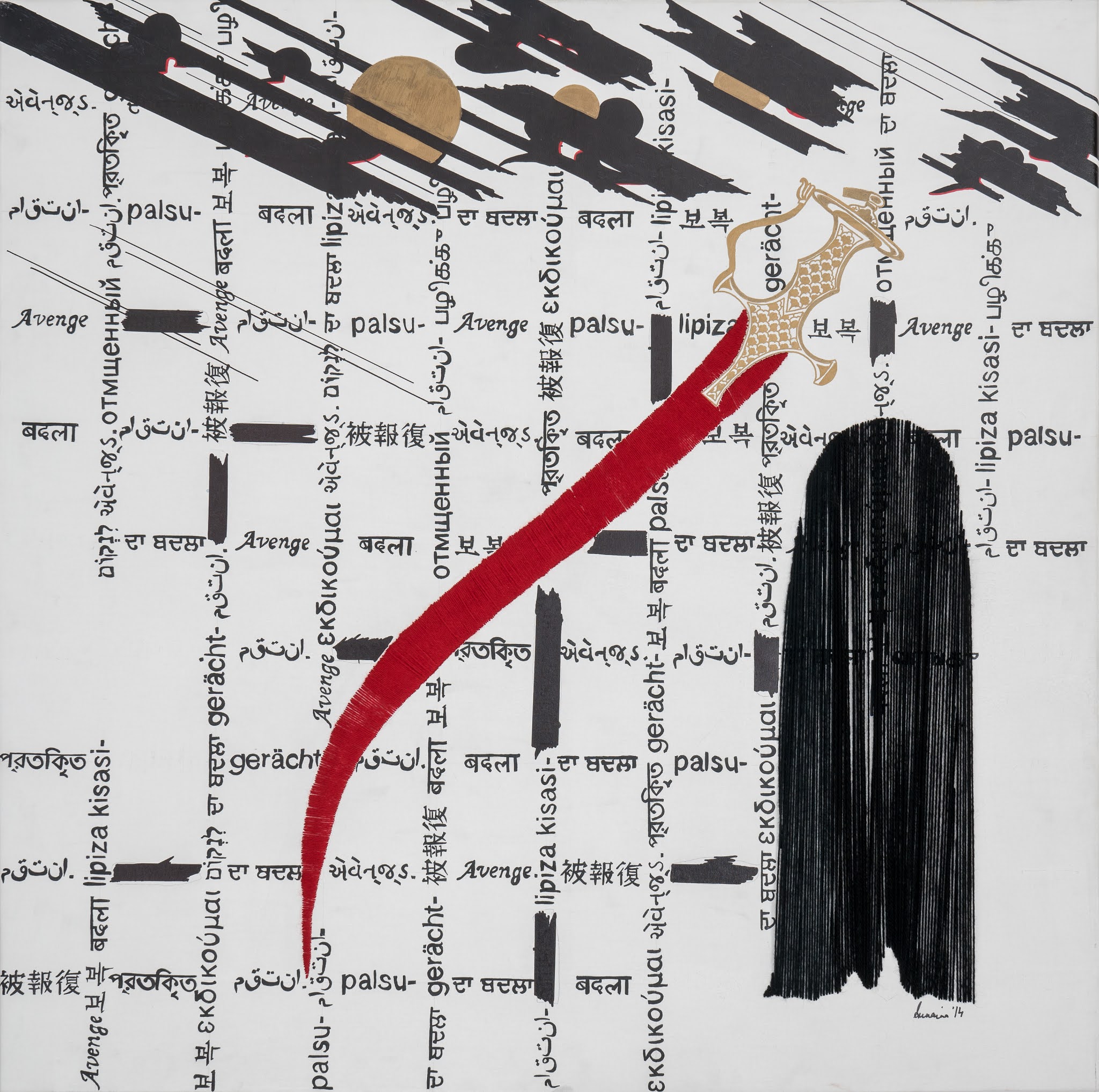
Avenge


Throughout this time,  I was in constant touch with my textile print making. I conducted, and continue to do block printing workshops in Singapore, South East Asia and the US . Recently commencing the first workshop at the National Gallery in Singapore. In addition, I have been working with a block carver in India, who belongs to a family of block makers. His grandfather had an atelier during the East India Company over a 100 years ago, and his father is the recipient of four National Awards. In my endeavour to  support his craft, I offer these hand carved blocks for sale at each workshop, the proceeds of which go to  him and his family. He also carves block that I have designed for use in my own art practice. In total, I  have amassed a collection of over two hundred blocks.

In the past couple of years there has been a renewed focus of working with fabric, where I have added usage of medical detritus and embroidery. I was never trained in it but I find the basic stitch very powerful, visually and metaphorically. A lot of stories can be mapped out with the simple stitch.

I am now focusing on the body and exploring traditions in healing, mapping the physical and mental shifts in perception, behavior and reaction to pain and chronic health conditions.

I am a proud survivor of a number of interactions with disease and health conditions and I hope I will be just as positive for the next phases in my life as I grow older.  Working with the hand and especially with embroidery is an important  part of my practice and I hope to continue evolving as an artist through this medium .


Survivors


Sunaina Bhalla has an MFA from Lassalle College Singapore. A conceptual artist, art educator, printmaker and a mother, Sunaina is a textile artist who has experimented with various art forms but returns to work with textiles. More of her work can be seen on her website: www.sunainabhalla.com and her instagram handle: bhalla.sunaina