Showing posts with label washed ashore. Show all posts

Sunday, 7 July 2024

Stitch Meditations , 7th July 2024


Music has been an integral part of my life, be it playing the piano or singing. I gave up the piano when the instrument I had was too old to be tuned and the piano tuner also died.  At this point I was past 50. 


And returned to singing (after some 30 years) which I had given up to pursue the piano. While I’m doing crochet - working on the ‘Patterns in Being’ project, I try and do some riyaaz. With the tanpura to keep sur now an app, I can do this quite easily, though not as often as my teacher would like me to. This is a ghazal she suggested I learn. I recorded it to share with her as my last class was missed. It’s far from perfect. I start off, off-key and the high notes are still a challenge, but it’s a WIP, just like my crochet project. 

https://youtu.be/Lvq6Ii6a6iA?si=ot_ibSpoHtwWJuck


As I sang, pondered on the lyrics and popularity of this ghazal, a 6mm aluminium crochet hook weaving the fabric - of a pattern I used to make a lovely silk scarf from my younger sister’s recent birthday. Having constructed a 7ft long one the pattern should have been second nature, but using two threads instead of one didn’t permit the usual flow. This too added to my reflections on stitch and the song.


The lyrics of which were written by Fayaz Hashmi, a 20th century Pakistani poet and songwriter who also worked in the Indian film industry.  The music was composed by Sohail Rana and the song was popularized by classical vocalist, Habib Wali Mohmmad who also sang it as playback singer for a Pakistani film ‘Badal aur Bijli, in 1973. 


The profoundly romantic and soul piercing lyrics expressing the pain of unrequited love and longing for a beloved, combined with a heart stirring melody creates an emotional listening experience, and has inspired many artistes to add it to their repertoire. My favourite rendition is by Farida  Khanum  (1993) whose vocals evoke the intensity of yearning that’s real and palpable.  I remember hearing it for the first time and feeling a familiar tug of the longing the poetics evoke. 


And don’t we all? I mean isn’t that why the lyrics appeal to so many?


Making me wonder if somewhere our idea of love and romance has become associated with longing, that which we cannot have. The unattainable, the challenge which brings us to a state of pathos. Pushing us into the depths of being, rising up like the phoenix from the ashes of disappointment. Like moth to flame, unrequited love can become an addictive pattern that challenges the being, its growth. 


Often, when I think of the verses that Swami Parmahansa wrote and sang during satsangs and which have become part of the Sadhna of his devotees, I find this same sense of longing for the idea of God, for what is attainable but ever so briefly or through rigour and intense discipline. Or always just beyond one’s reach. Saint poets like Lala, Andal and Mahadeviakka also spoke of pain, rigour and strife, as the ways into the soul of our being.


Yet, the world judges those that seek but do not find. That strive but fail. Often shaming each other. Even as our most romantics hero’s are Heer and Ranjha, Romeo and Juliet and even Rumi’s profound poetry comes from his separation from Shams. A pattern of social acceptance seems to be to reject the idea of longing even as it’s what’s embedded in our psyche. 


The old Hindi film songs, which I so love. That era of poetry in film that made the songs so memorable and singable, are also more about longing, more than love itself. The bitter-sweetness of parting, waiting to be re-united and that ilk. It’s almost as if we are programmed to fail to achieve the desired, because the journey is probably more exciting, hopeful, poignant than the destination. Which in the context of human love is inevitably a huge disappointment. 


And we cope with heartbreak to realise we were never really broken, but being opened up to explore horizons of being, beyond our imagination. And, these songs remind us of that journey, that longing, the hope - that romance of being which is never quite fulfilled through another, if at all. 


With these words 

“Waqt ke qaid mein, zindagi hai magar 

Chand ghadiyaan yehi hai jo aazad hai 

Inko khokar mere jaan-e-jaana, umr bhar 

na taraste raho. Aaj jaane ki zid na karo” the poet almost suggests that the beloved leave, for otherwise who would yearn so sweetly for him/or her…..


This post is in continuum of the previous one 

http://gopikanathstitchjournal.blogspot.com/2024/05/stitch-meditations-on-being-patterns.html

Monday, 10 June 2024

Stitch Meditations on Being - The Patterns and Hues


“They fuck you up, your mum and dad.

They may not mean to, but they do.
They fill you with the faults they had

And add some extra, just for you.
But they were fucked up in their turn

By fools in old-style hats and coats,
Who half the time were soppy-stern

And half at one another’s throats.
Man hands on misery to man.

It deepens like a coastal shelf…….
                                                                                                                                                    - Philip Larkin


These words say it all, without revealing the gory details or gruesomeness of the wounds we all carry within us. Largely disguised in various ways but played out subconsciously. Most of the time we are unaware of why we do what we do and of the influences of the “soppy-stern…….at one another’s throats” that created who we are, beyond just the physical mating, but the why and how of our psychological make up.

When Larkin says “Man hands on misery to man. It deepens like a coastal shelf” he evokes the patterns we form and re-create (subconsciously for the most part). Habits make it easier for us to negotiate life - such as driving a car or bike and even drawing, crochet, knitting and that ilk. But, it’s the emotional and psychological patterns that create the problems, where human misery “deepens like a coastal shelf”


Yet, as Larkin put it, it’s inevitable that we inherit dysfunctional ways/patterns and also play them out, passing them on generation to generation. Unravelling these patterns may or may not create the potential for change, but it’s interesting to do so for the purposes of understanding your own psyche/self. Beyond that, what can we do?


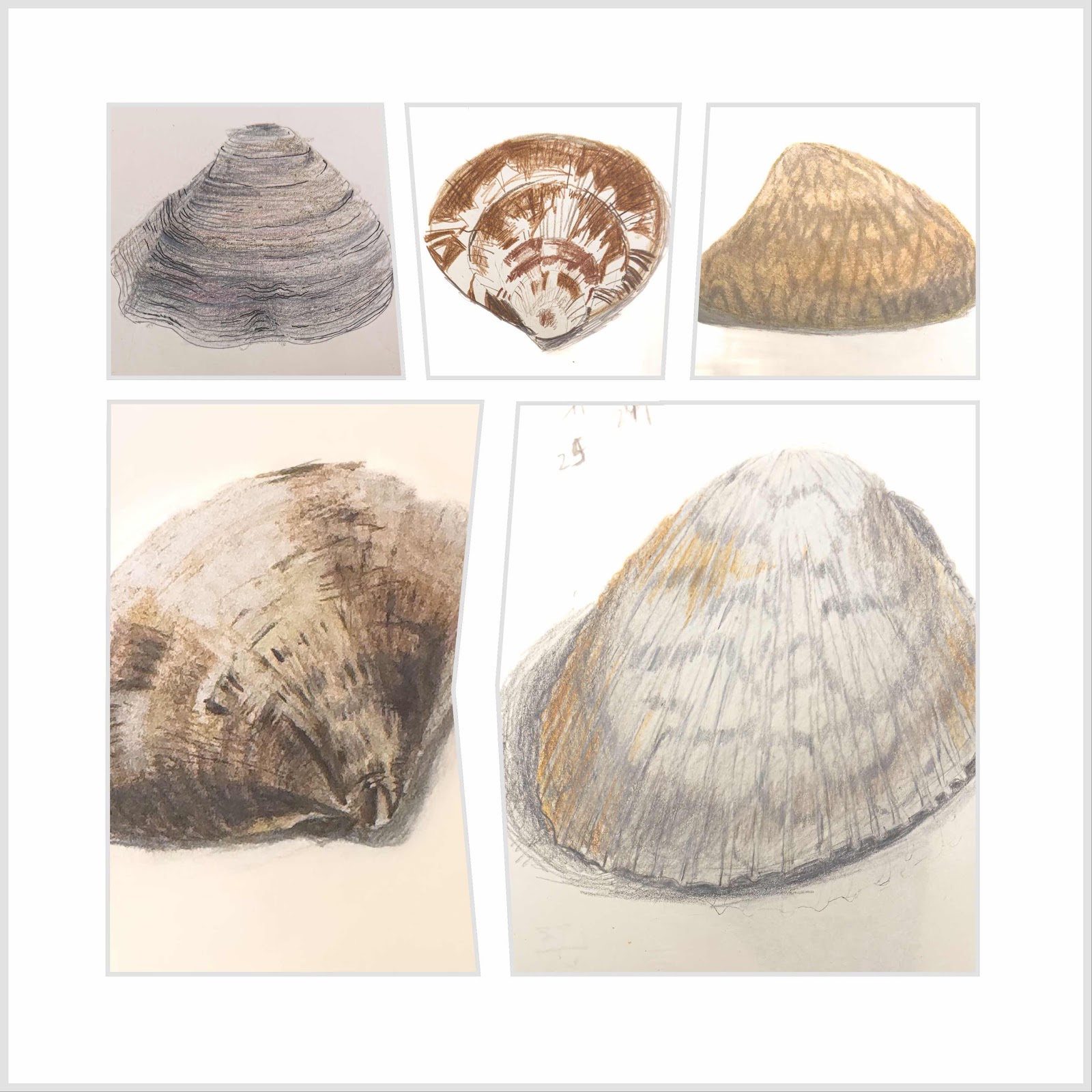
This was a dilemma that I faced and struggled with until I started studying the patterns on the molluscs along the Goan coastline. These patterns were unique, as inimitable as our finger prints. It was virtually impossible to find two clams with identical colours and patterns.


What was even more interesting was to learn that these patterns are created by virtue of genetic and environmental conditions. A neurological response for camouflage and survival. Even so, the radula of other species did manage to drill through and suck the animal out, and if not, it wasn’t for lack of trying. Wherein the holes they drilled, became another level of embellishment to the strokes of colour that decorated the exoskeletons.

I studied these patterns in various ways: through the camera, by drawing and eventually by zooming into the photos I took of each. This was fascinating because in pixelating the images, I found the patterns were a configuration of colours.


Colour, as we have seen through the ages, carries symbolic meaning that varies from culture to culture. Lisa Feldman Barrett, social scientist and author of the book ‘How Emotions are made’ asserts that our emotions also vary from culture to culture. Colour and emotions, have long been linked:  green with envy, yellow for happiness and joy, red for love and anger and more in that vein.

But, Feldman Barrett says there is no singular way to describe any of the human emotions. Each culture and person within it, experiences a variety of sensations within anger, joy, love and despair. The subtle gradations and differences between fury, rage, anger, frustration, being irked etc are just that - subtle variations.

In this zoomed in and pixelated photo of a clam shell, that’s what I see, subtle gradations of colour - so subtle that it’s driving me insane trying to reproduce them in thread.


I have two versions of the thread adaptations. The first was a cross-stitched replica where I mixed the threads - two to three different colours from over 400, colours of cotton floss, collected from various thread makers including Anchor and DMC. It took me a long time to complete one piece and the second is in progress. A slow process which I often abandon to tackle something else and return to until it is done. The first one took me a year.


However, the piece that I’m currently working on, isn’t just about getting the colour right, it’s also about patterns and how the same hue can alter with the pattern. The idea is to make a large crocheted and knitted piece instead of embroidery. The reason the colours are taxing both mind and pocket is that unlike embroidery threads, the colour range is extremely limited for knitting and crochet. At least in any one count of yarn to enable some symmetry in scale to join the 5  inch squares.

I had started the pattern blanket (for want of another term)with some vague idea, with regard to how I wanted to put theknitted and crochet squares together. It evolved over two to three years and I made the squares from all the colours I could muster but I just couldn’t figure out how to really work them together to create any visual that appealed to me. This resulted in my abandoning the project and the 300 odd squares I’d already made, not to forget the hours of painstaking knitting and crochet – often at the end of the day. It didn’t make me happy but I didn’t know how to move forward. I thought it was a failed project and hadn’t looked at it for over a year.


Then a couple of weeksdiscovered wood borers had inhabited my rather extensive book shelf which stretches across about half my apartment. I had to empty all the shelves and cabinets below that housed stationery, fabric and my stash of embroidery threads as also hundreds of books amassed over the last four decades and some inherited from my parents’ collection. Art magazines, old issues of Selvedge, Piecework, Surface Design, Embroidery and the now extinct Fiber Arts, Marg Magazines, India magazines (also extinct),BBC music magazine, piano scores and about 100 art magazines - a series I collected in my student days about artists - one issue on each artist (sadly none about Indian artists but focussed on western art history). And of course a collection of books - fiction, non-fiction, poetry, textiles, art, spirituality and more. Basically it was a lot to place around the apartment and at the end of it all, the only free space was my bed.

My knitting and crochet stash is housed in my bedroom, in various draws  usually by colour. This was not disturbed by the pest control requirement. So I decided to revisit the abandoned pattern blanket and changed tack by using the template I had already embroidered in cross-stitch. The 1/4 inch embroidered squares took me about ten minutes each to execute, with seven of those minutes to get the colours to match. In the knitted and crochet version, I am facing similar issues with the subtle gradations of hue, but more so because I’m not working with just cotton floss, but yarns ranging from wool, acrylic, rayon, nylon, cotton, wool and cotton blends, and also the counts are all different from very fine crochet yarn at a 40’s count to chunky 4-6 ply. Often, I have to work  differing counts together to try and approximate the colours.


It was a challenging week both with the rather smelly pest control, putting things back into place and this creative project. But I now have a template that gives me the direction I need. What I’m grappling with, in addition to the technical issues, is what I hope to achieve by engaging in this rather esoteric idea of replicating the colour boxes in both hue and pattern.

While working on the cross-stitch version, I marvelled at the numerous shades there were and recreating them helped me understand that there are so many hues to each emotion. It’s impossible to understand what another person is feeling because what they feel is unique to them - culturally, socially, experientially, genetically, environmentally and more. That was a great insight because one does tend to think we know how others are experiencing emotion or what they may be feeling, but Feldman Barrett also suggests that it’s not possible - at best we can imagine within the range of our experience, based on our own emotional shade card. Our emotions and the hue gradation of the occurrence is uniquely personal.


Most of our thinking comes from conditioning. And is the result of social constructs geared to create a sense of order with the existence of so many of us who inhabit this planet. However, through centuries of the existence of mankind, the ideas have evolved in a rather unthinking and dysfunctional way. In many ways much of our thinking could be deemed be distorted by ideas that most likely germinated through limited knowing and were handed down with incompleteunderstanding by those before us, who didn’t know better.  Quite like Larkin says in his poem. They fuck you up, …..They may not mean to, but they do.”


Patterns are prevalent throughout nature and also in our emotions and thinking. My professional training has been in textile design and patterns are nofirmly etched in my DNA. We were taught to create designs for fabric by dissecting vegetables like okra – a cross section with the seeds visible; drawing this and repeating the form in differing ways of  formal repeat patterns for printing motifs on cloth. The challenge was to ensure that the repeat wasn’t visible and also contributed to the visual outcome; trying to disguise the vegetable form through repeating the motif in creative ways. The repetition made almost everything pleasing to the eye because familiarity  is what enables a sense of well-being and makes something agreeable to the senses.


As I evolved into  a fibre artist, examining my own persona – a journey of self-actualization through my art, I started exploring the idea of mind-stains or ideas that cause us to feel less than good, feeling shame and doubt and self-cynosure. Initially I explored this through notions of tea stains on my saucer as I spilled the tea I was drinking. It was a long exploration of seven years, wherein I realised that one could still flower – fulfil the human potential despite these feelings that seem to hold one back. 


When I moved to Goa, I didn’t give up the idea of stains for they were very much a part of my inner explorations relating to  experiences that created these inhibitors. But, living along the coastline of the Arabian Sea, I went beyond human nature to study nature in her full glory and life by the seaside has been fascinating in this sense. Wherein colliding ripples of water, washing over mud adhesion ripples at the River Chapora estuary and further down the beaches of Morjhimand Aswem, with wind adding to the rippling effects and the diffused rays of sunshine at dusk – complimenting and complicating the patterns, I began seeing these patterns of colliding energies as incredibly beautiful. 


It was the complexity that appealed for it related to the intricacy of configurations that become our patterns of behaviour. Of energies inherent in the psyche formulated through generations of conditioning, one’s own experiences – of colliding with other energies, bringing out these patterns. Where we recreate them because energy draws us to others when we recognising something familiar. In re-creating we feel grief and anguish, become aware and the tendency is generally to view ourselves in a negative light. Something that needs to be changed. But the wisdom of the ocean suggests that there is incredible beauty in these engagements and that the tendencies may change through the collisions of energetic fields as we negotiate our lives, but the overlaying effects of these fields are intriguing, dynamic and awe-inspiring. If only one could look at the self as we see the natural world.


Through the study of  clams shells, the sand bubbler crabs and their feeding residue and also the ripples of sand and water, I started seeing that patterns are formed by colour and the collision of energies in the elements. By extension I made the correlation that emotions seen as colour, in the human psyche, form patterns and vice-versa. Therefore adding pattern to the art work, going beyond mere colour became imperative.


However, this further complicated the process of trying to create the sublet hues uneven thread counts and a variety of ornamental thread configurations through crochet and knitting. At this point, can only envisage a blanket that’s an uncomfortable evocation of how we exist together with our unique experience and understanding of emotion, alongside others who feel and perceive these differently.

But, I’m a long way yet from being able to see this. I have under 100 squares when I need close to 640. I often rip out the squares because they’re either too big or I need to add a row or two if it’s smaller than I need it to be. Some are tight and sit awkward, others are delicately delightful. It’s going to be another task to whip them all together, possibly like one struggles to negotiate this world with the billions of others beside us….


Wednesday, 24 March 2021

Kya Soch Rahe Ho........(What are you Thinking)


Sometimes, I don’t know what I’m thinking. Especially when engaged in doing household chores, cooking and such stuff that I try and get over with as fast as I can, I’m rarely focused on what’s going on the mind screen. Thoughts come and go but I am too busy with the job in hand that I can rarely recollect what they were.

Often, when I’m knitting and crocheting my ‘thought-nets’, I’m also not really focusing on thoughts either. It’s not that I don’t want to, it’s not always easy to understand one’s own disposition. And the essence of issues that plague the mind - the deeper and untiring dialogue with self, is usually buried under the busyness of the day. If I want to look at myself think I do, but otherwise I watch something on nextflix, listen to a talk on YouTube or a book on Audible, to switch off from the superficial chatter of the daily rubble.


Sometimes, when the rant spills over, I can’t watch or listen to anything. My head is just screaming to be heard. If I can, I write in my journal or if it’s too chaotic to form sentences and if there too much emotion, I may speak to a friend. If I don’t feel comfortable talking to anyone, I babble into my phone and record the tirade. When I hear it back - the emotion, irritation and anxiety of what’s been said -that is if I can bear to go over the whole thing again, I do get a clearer picture of the problem at hand. Of why I’m feeling stressed. If I can’t hear that stuff again, I’m relieved that my mind is lighter for off-loading it. Usually it’s stuff that’s deemed unnecessary, pertaining to a whole host of mundane things that are detracting from the essence of what some part of me wants to think about, but the mind is exhausted with itself and cannot muster the discipline to do so. Sometimes feelings overwhelm and they cannot easily be put into thoughts and words – at best disjointed ones.


I’m a reflective sort of person, so I usually begin my day, writing in my journal. I start with reading the previous entry to get a sense of where I left off, because unresolved things have a habit of playing like elevator music, that’s heard but not really listened to - not enough to recognise the melody, not unless it’s a familiar tune, when we do sing along effortlessly – if we like the tune. In trying to get through the processes of living, which requires focus on the mundane, on driving, cooking, folding clothes and other tasks - the screaming is actually this underlying background dialogue that’s unfinished and unresolved, which is demanding it’s time and share of attention.


When I start this morning dialogue with myself, if I’m in a self-reflective mood, I can write for hours. If not, I leave off where I cannot go farther with the thought. Either I’ve said enough or I just can’t quite get to any point of understanding. Often I have to leave things for the thoughts to emerge. Where a movie, a talk or something else - even the rhythm of knitting sheds light.


And, more often than not, it is conversations or interactions with someone else that really helps shed light on what’s going on in one’s own mind - a reflective surface kind of mirroring dialogue. If it doesn’t automatically occur to me, I put my attention on what about the conversation struck me, moved me, or the advice I may have given . And it’s almost always what I need to think about for myself, albeit in a varying degree or context. This then requires deeper reflection which takes me into those areas that eons of exploration leave me tired and unfulfilled, but ideas that I need to resolve to whatever extent possible, because unless I do so I’ll never be free of the distressing inner rant.


A net by its very nature is something to catch things. Fishermen use it to catch fish, which is food for the human body. In Goa, many outdoor restaurants and cafes suspend nets under over-arching trees to catch the falling leaves so that the foliage debris doesn’t hamper happily chomping guests.


So what does a ‘thought-net’ do? What does it catch, or prevent from imposing or entering a protected space or field of vision?


If I put the larger and more cumbersome nets that I’ve created over my head, as an extension of my mind - an evocation of what’s going on inside my head, then it’s a kind of trap. A net that binds me within its threads. And not unlike repeating thoughts which bind us to people, situations and circumstance. But, the irony is that ranting and venting - going over the same ideas - creating this ‘thought-net’, is also a way out of this bind.


When we vent or rant - go on and on about a situation, most of us want sympathy because we see ourselves as victims of an unfair circumstance or relationship. Or we don’t have the courage to do or say what we really feel. Or perhaps we don’t have clarity and have conflicting feelings that need detailed analysis. In some sense, the situation challenges us.


I’ve often noticed this about myself that, if I’m on top of things, or matters are going well, there is no need for a dialogue. It’s only when I’m not able to get a grip on what’s going on that, the why’s and why-not’s circle around endlessly. And depending upon the intensity of the situation and emotion it evokes, I may lie awake at night, wondering why I can’t sleep despite vigorous exercise and feeling pretty darn sleepy too.


I was speaking quite recently to a friend, about the paradoxical beauty of our thoughts. This had occurred to me when I was looking at an embroidery pattern I had created within a series of ‘thought-nets’. The resultant ‘thought-net’ was visually attractive and led me rethink the very idea of ‘thoughts’ as being a burden. Of our ‘thought-patterns’ being something destructive. Such that new age philosophy underlines, telling us to get let go the past, to change our thoughts etc. Enticing us with absolutely miraculously solutions that almost never work quite as effectively and definitely not in the long term. Not unless we are on the brink of taking that leap by having done plenty of the work already.


Our thinking patterns, the template of our moral, ideas and ideals arise from societal norms, familial dictates, cultural morals and more that have evolved through individual, social, cultural, national and world events. All of which have collectively framed the psyche of our elders and educators, their ancestors and theirs: going as far back as time itself. Therefore, inherited ‘patterns’ are really not something we can get past easily enough. And, they are the real reason that the thread of ‘thought-nets’ catch us, binding the imaginative mind, curtailing the freedom of our spirits - keeping us from transforming our human destinies and exploring the potential of our human selves, even going beyond this.


My friend’s response was that negative thinking cannot be seen as beautiful, despite what the ‘thought-net’ I was showing her was proof of. She appreciated the artwork, but couldn’t correlate it with what she herself experienced when her mind is gripped with dismaying thoughts - negative thoughts in common parlance.


At one level, I agree with her. When you’re going on and on in a non-empowering way it’s enervating - for both you and the person listening to you. Fact is that negative gives power, when it’s changed through its charge into positive, and the two together is what generates energy. Negative thinking disembowels, but it is also creating an unacknowledged impetus within us, to rise above. If we were happy in that state, there really wouldn’t be any need to rant, complain or drag us and everyone around us, down the dingy steps of despair. We do that because we want a way out, but can’t see it. But lightening the load, getting consolation from friends, seeing that we are not alone in these things, lends confidence to delve within. That’s what we really want. Not necessarily advice, but solace. Not solutions that someone else gives but a means to reduce the thought load and find a way to the subtler voice of our own wise being. At times advice is sought, solution providers can be useful too but essentially the two charges of negative leading to positive - self-affirmation and feeling good, is what brings forth the energy. And in an instant the binds of the ‘thought-net’ are torn asunder. And we taste that enviable taste of freedom. Of being unstoppable.


I think that makes the process quite beautiful, don’t you?


Sunday, 29 July 2018

The Shell in my Stones' Jar - Crochet Stories (Washed Ashore)

 
I have spent many hours on the beach, walking and thinking and often trying not to collect. Not to pick up anything but eventually coming home with something or other. I disinfect, scrub and clean each piece of my booty and sort them  out into categories based on size and type. I have glass jars of varying sizes  and designs, all around my apartment, housing the various shells and stones that I have amassed. Yesterday, I spied what looked like a shell, lurking erroneously, in my large stones’ jar. I fished it out and realised it was one of those interesting pieces that I hadn’t been able to leave behind on the beach. Neither a stone nor a shell, but I had placed it in with the stones because this materiality dominated its form. It was a red laterite stone with an oyster shell stuck onto it.
 
 In Siolim, along the Chapora and at Ashwem beach one sees a lot of shells, mounted one on top of the other, clinging to the porous laterite stone which makes the stone very rough and difficult to sit on, or even walk over – especially bare footed. Out of curiosity, I once asked a local restauranteur why they do that and he said that oysters grow on rocks, which I found absurd, but for lack of any other information  kept mum. And then a few weeks on, as the quest continued, it was a  fisherman who enlightened me. Apparently the oysters secrete a substance that allows them to cling to the rocks and onto each other, to stay stable during the ebb and flow of the tide and river current. And they do this when they are breeding. Now that made much more sense than oysters growing on rocks but, I remember the other story better because it adds to an already curious shell-stone form.
 
The day had been a busy one. I had a meeting with the lawyer so had to leave before noon. The moment I parked it pelted down and the umbrella was no cover. My beige coloured trousers were splattered with mud and by the time I reached the courts – barely a three minute walk, I was soaked. As it happened the lawyer wasn’t there and I had to coax his colleague to listen to the details I needed him to understand, which he may not have understood from a cursory glance at the documents. Thereafter, I had to complete many odd chores and finally came home with the cushions that complete the interior décor of my flat, seven months after I have moved into it.
 
Simona comes to help out on  Fridays and so, despite the fact that I was rather tired by this point, the kitchen chores also had to be done. I had lots of other paper work to complete. I hate these constant phone calls and follow-ups. It is so annoying that no-one does anything until you remind or beg them to. So while Simona cut and chopped, I did my share of begging and reminding for the pest control, the internet cable to be installed, for a refund pending five years, for my car insurance claim that is almost a year overdue and more in the same vein. It’s work that has to be done but it’s not work that I enjoy doing.
 
 
I didn’t think that I would get any crochet done today. It was the shell in the stone jar, that inspired me. When I had dug it out, I left the it on my work-table, so couldn’t help but see it as I pottered around. Weeks went by and it lay there tempting me but, clearly it didn’t evoke the right feeling and many other stones and shells got crocheted. But today, as I winded down the day, even though it was late, I felt the need for some clarity. Precisely because the day had been so crowded with doing and phone calls and all the rest of it that, I hadn’t had much time for reflection. Aside from the early morning writing in my journal, which thankfully, I had managed to do before I drove to Mapusa, Porvorim, Panjim and back.
 
Laterite is a rusty-red-maroon stone that is quite nubbly in itself. The oysters add to this and make it even more rugged. This particular stone, with the shell attached to it,  also had some largish white spots dotted over its surface which may be because that the oysters eventually do get washed away with the tide and the secretion they use to adhere to the rock, changes its colour. I haven’t studied this  nor asked around, so it’s pure conjecture. But, holding this odd looking rock in my hands, pondering what colour to use, I decide that I  wanted to show off its texture as much as I could and picked an off-white yarn.
 
I hooked a chain of about forty stitches and closed it around the shell, just below where it sat, because it formed a ridge where the circle of chains could sit, hopefully, without slipping off. Then, I proceeded to crochet, adding another row of single crochet onto this line, working on the stone. I find this both challenging and fascinating because the object I am crocheting suggests what to do where, and I have to keep it simple. I cannot get all lacy and curvy with the chained lines because, with every stitch my steel hook hits the stone, scraping itself along the unrelenting and uneven surface making a grating sound, which isn’t pleasing. Nor is it easy to work around the form. I have less manoeuvrability and ease of access. Also, until I reach a point where the fabric is snugly fitting the stone and stops slipping off, especially when I pull the thread a tot to even out the tension of the stitches, it involves a lot of yanking up of the fabric, positioning it around the stone-shell and only then moving on. I have to do this manoeuvre, consistently, with almost each stitch.
 
However, this stone didn’t take too long to complete. Wanting to reveal more than cover, I used a lot of double crochet, which adds length very quickly. It is also no more than a couple of inches or just a bit more. It was late at night and I was listening to Eckhart Tolle on YouTube, speaking about accepting the unacceptable. Not a riveting talk because he repeats himself constantly, but when my hands are engaged, I am too involved with the thread work to be bothered to switch off the video, so I let it play on. By the end of it, between my crochet and Tolle’s droning on about being in the present, about being grateful even in the most difficult moments of life – for the simple fact that one is breathing and therefore all is well,  I felt calmer and relaxed enough, to feel like sleeping.
 
 
There is something about the hooking of thread and the complexity of working around these stones and shells, that engages with an intensity that somehow alleviates the tumult of emotion within.  I am not quite sure how it works but have noted the results and sometimes, pick up a stone to crochet just to get past difficult feelings of the moment.
 
It was passed midnight. It had been a long day, busy with daily-living chores and driving around navigating the rain. Even so, I was chuffed that I still managed to do some crochet. Having these moments to ponder on living with the flow of thread, or in this case, erratic needling of the chain, I feel a sense of ease that is difficult to put into words. But, having  done something more than just tend to the business of living, there is a sense of well-being. It doesn’t have to be a grand creative endeavour.  Sometimes just this little is enough to alleviate the stress.