Showing posts with label knots. Show all posts

Monday, 16 February 2026

The Knot Of It


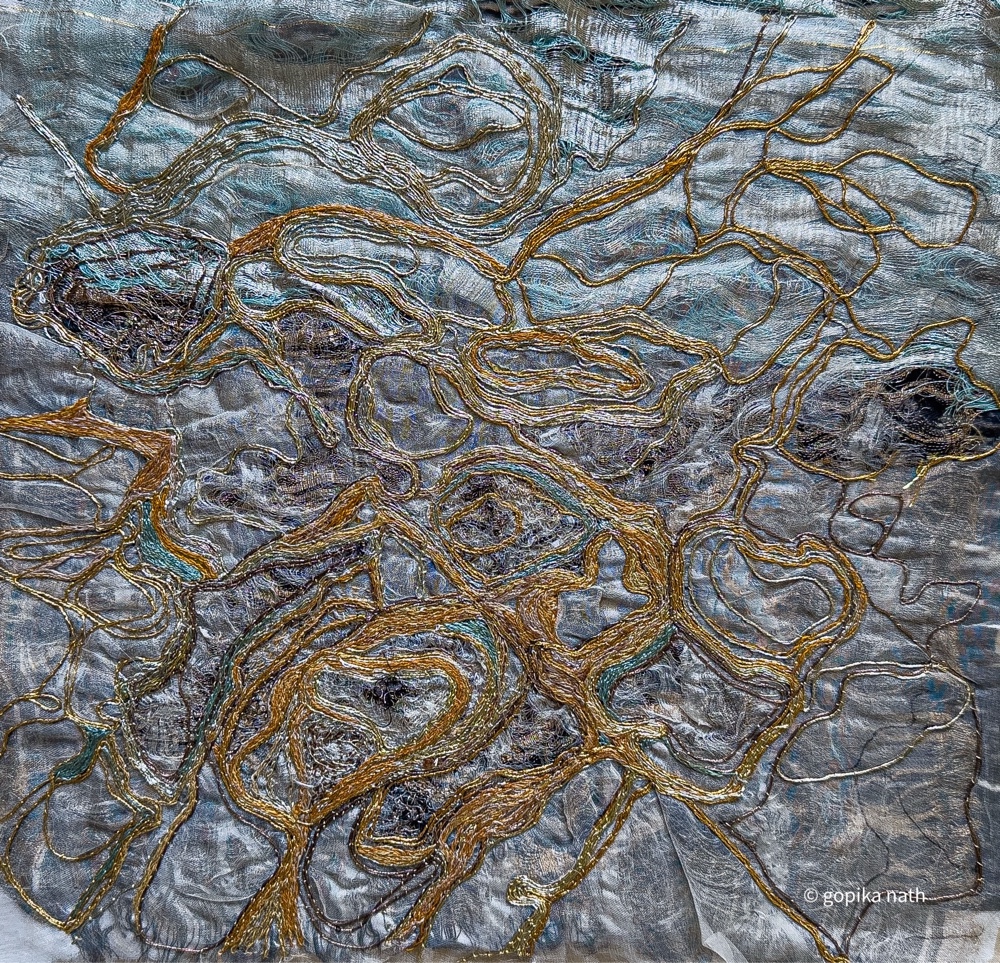
I’ve been working on  Co-Creation III for too long. It started out, with me wanting to create a border — a kind of ‘hashiya’, where the border is separate yet conducts an oblique dialogue with the central image/painting. (The ‘hashiya’ comes from Mughal miniature paintings were artists used the border in dialogue with the main subject.) I decided that I had been working long enough and just had to finish. I know myself: I could keep adding more and more. I just had to stop working on this piece. But, there were couched areas that needed to be completed.

I continued with couching the six-ply zari thread. It has a rhythm to it. You hold the thread to be couched, and you keep the fabric taut, holding the laid thread close. Because I’m couching large, uneven spaces I don’t use a hoop. Both hands work in tandem as if dialoguing with each other. Left  hand thumb and index finger over the thread to be couched, keeping it in place. Other three fingers below the fabric, keeping it close to the laid thread—light pressure from top and bottom. Right hand, holds the needle between thumb and index finger, little finger and side of hand, over the thread— when it’s slack, keeping the tension-mild but keeping thread straight to avoid the knots. I’ve tried using a hoop but it interrupts the rhythm of long laid threads to be couched. Yes, the laid thread may pucker a bit, but that’s okay because the inspiration, for this piece and others in the series,  is sun glinting off ripples of water.

The same week, an incident occurred in my residential complex that left me feeling exposed. It was xenophobic and violent, and  made me feel unsafe and threatened in my own home. I was preoccupied and agitated. I missed a day or two of stitching because I simply couldn’t settle. I’d sit with the piece in front of me, but the very idea of more thinking — more decisions to be made, felt too large a task.

And when I returned to the couching, I noticed knots coming up.

Before stitching, knotting was already a way of making textile. Not as embellishment, but as structure. Nets, cords, bindings, even early fabrics and carrying slings. Whole surfaces could be created  through knotting, loop after loop. In that sense, knotting isn’t secondary to stitch. It’s older than stitch, and it has its own intelligence and lineage.

When I was learning to weave, one also learnt the weaver’s knot. It’s a really elegant knot: left over right, is the primary instruction I remember—to put the thread in the left hand over the thread in the right hand—and the rest is muscle memory—the hand remembers.

Both threads held between thumb and index finger of left hand. Taking the right hand thread over left hand thumb, holding it down with the 2nd finger of left hand, bringing the right hand thread between left thumb and index finger where the two threads are held. Left hand thread then goes into the loop made by the right hand thread over left thumb, while 2nd finger holds the end of the right hand thread and pull. Voila! The perfect knot.

Quite an instruction to remember—I can’t. I wrote this while observing myself create a weaver’s knot. Stopping frequently to annotate. I’m glad the hand remembers and I don’t have to recount the entire process verbally. I think I’d probably confuse more than guide the hand.

The weaver’s knot was invented as a join that’s flat, allowing the knot to move through the heddles of the loom without encumbrance. Once learnt (1982, for me) it’s hard to forget, but learning it in the  first place, is a challenge. My sister is an avid knitter, I’ve tried to teach her, but it still doesn’t form as easily as I can make it. It’s most useful when knitting or crochet and the ball of yarn finishes—to join another seamlessly.

And then there’s the other meaning of knot, the sailing knot, a measure of speed. One nautical mile an hour. Suddenly the word shifts from snag and interruption to movement and distance. Sailors tie knots that must hold in wind and salt and strain. It makes me think that knotting isn’t a mistake at all. Knotting is older than stitching. Rope, nets, rigging, lashings. The forms of making that come before cloth.

But none of this is what I’m meeting here. I’m not doing macramé. I’m not deliberately making a textile through knots, neither am I traversing nautical miles at sea. I’m in the middle of a stitch rhythm, and the thread knots itself anyway. The snag arrives as interruption, not as design.

 It is really annoying. You can’t leave the knots, because they won’t sit under the couching thread. They form a little loop and sit there— an uncomfortable bulge. What’s strange is that the knot doesn’t happen where I can see it form.  It happens in the slack, in the bit of thread behind and under my right hand, in that length that has its own life. I could swear that I don’t leave it too slack, holding it down carefully, but clearly I am not vigilant enough. It is the only way a knot could form.

I follow the rule of thumb — of keeping the thread no longer than the distance from my index finger to my elbow. Still, even when the thread is quite a bit shorter — quite short in fact, I still get the odd knot. The thread forms a loop into itself. Most of the time I can simply put my needle into the loop and holding the threads that precedes the knot, down with my left hand, pull it upwards with the needle(in my right hand)— and it comes undone with a gentle sound that tells me it’s undone. Something like a ‘khitt’ that’s softly whispered.It’s momentary, a small hesitation, the acknowledging ‘khitt’ and I can keep stitching.

But the other day, I struggled and struggled, and it got worse and worse, until I had to do what I absolutely hate: cut the thread. Cutting the thread feels like admitting defeat. Not because it’s a tragedy, but because I was in rhythm. I was in flow. And now I have to stop, stitch in ends, re-thread, restart. It’s like being pushed out of a trance and get down to the nitty-gritty of mundanity.

And because I’m couching gold thread, there’s a glare with the light. The golden thread reflects light back at me. The glare doesn’t allow me to see my stitches clearly. I try and keep the distance of the stitches within a certain perceived gap, and I’m really focused. The rhythm aids my ability to keep that space— it provides a measure. But when I have to stop for the palaver of cutting the thread, re-threading the needle and finding my place back in the work. It interrupts everything.

The knot has a lineage. The problem is that it arrives uninvited.


Just like the xenophobic assault did: interrupting the rhythm and pace of life. A knot that cannot be undone.


Wednesday, 24 June 2015

Knots, a Long Way


All who know, those who've attempted those tricky stunts, have all said we shouldn't keep the thread too long. But I was in a hurry. I had so much I needed to do. I thought the longer thread would sew faster.

I was wrong. It got into a twist as soon as I pulled the needle through the fabric. At the first tug through uneven terrain, a knot emerged. I wasn't ruffled. After all, knots are part of this whole threaded affair. But as I inserted the needle into the centre of the knot, carefully trying to prise it open, I realised it wasn't just one knot there. It seemed as if three of them were nestled together, really, really close. And, unravelling them was trickier than anything I'd tackled before. I could have cut my losses, started over and this time gone with the knowledge of seers, taking a shorter thread. But I'm stubborn. I like to finish whatever I've started and rarely cut the knots out of the thread.
 
I pulled and poked and tugged and cursed. I got some slip. It gave me confidence so I tried harder and persisted. The second one opened and I thought okay, it's going to be alright! But the last one was such a bummer. It wouldn't relent. And after the lengthy struggle, when it gave way and the threads separated and I could sew again, there was no thrill, no sigh of relief.
 
And then for a while, each time I pulled the lengthy thread through the layers of fabric, it knotted and I went through quite an ordeal.

All I could think of was that the time it took, it wasn't worth it. I was self-critical, judgemental and grouchy. But gradually the working eased up and after it was approximately half the original length sewing was a breeze. As I stitched in running stitch, tacking a finished embroidery onto organza, for it to be framed as if in mid-air, something stirred in me, akin to hope. No, not hope but something that seemed to revive hope.

I found the thread was nearly long enough to go right round the perimeter of the fabric - like a parikrama. Of walking around a sacred space and completing it from corner to corner, where this parkirama symbolizes the cycle of life - from non-being to being to self-realisation of that state of non-being. Although I didn’t manage this with devout faith, the idea was both heartening and interesting. This journey through life towards realising the fundamental essence of being as non-being is, after all, what the scriptures encourage us towards defining as the essential purpose of life, isn’t it?

But, it ended just two stitches short of it. This made me consider, that if I hadn't started from the uneven terrain, where the delicate organza was heavily layered with cross-stitched matte, which meant beginning a little before the actual corner, then it would have been a perfectly calculated length. But the reason I'd started out at that angle was because I wanted a strong support for the knot - that knot that secured the thread to the fabric.
 

This was a tricky dilemma. It had taken a long time. It had been a tiresome and knotty ordeal. I hadn't followed the prescribed wisdom of those that went before me. The beginning had taken up more thread and resulted in an incomplete parkirma. I could say that I had learned things along the way, unravelling the knots. I had tried something out that I'd seen through to the end – if not the end of the journey, but the end of the thread? And besides, what guarantees does one have that the shorter thread wouldn’t create its own knots? The length of thread was no longer the issue in my mind.

The crisis I faced, was at that crucial juncture when the thread ran out, which was the hardest to bear. It seemed such a cruel fate to have to re-thread, start all over again because even though I'd selected intuitively, even though my perception and foresight were profoundly correct, they still fell short of that perfect bulls eye - of getting it just right and validating all my choice in the process.

It seems simple doesn't it, to just pick up another length from the same reel of thread and carry on? But somehow, this isn't how we deal with the nitty-gritty of living, is it? If this were a situation that involved emotional issues, that sense of falling short would have been cause for recrimination and beating of the proverbial chest and questioning the existence of God. I mean, it would be perfectly natural to question that if I could come so close, why couldn't my intuition have guided me with the perfect length of thread? And so much would be said in a similar vein. But, a thread spun of cotton fibre, or that of the fibre of experience, at the end of the day are just that - a thread with which we keep sewing. Or isn't it?

I didn’t finish the parikrama, I left it two stitches short. It didn’t matter for the purpose of tacking the finished work, but would it matter in the larger scheme of living? I wonder. What do you think?

Monday, 23 June 2014

And Wish That I Did Not Feel


 This well is far too deep, deep and black, a watery void.

These dark grey ageing stones are holding onto the surface with bitter ambition, old and darkening, adorned with olive-green mosses. This well was built by my hands, each stone laid down under a waxing moon. I am fated to drown
                                                              beneath its brown shameful waters, waters that flow so deep they touch the very Past, Present, and Future.

I will sink ever further through stagnant tides with my lungs overflowing and my eyes blind, sinking past the places beyond the light of the living world.

I will touch the solid core of the Earth with cold lifeless hands and wish that I did not feel.”


Still Waters [a poem]
Reproduced with the kind permission of Jade Kennedy
www.jadekennedywriter.blogspot.co.uk


The last line of this poem grips me, and knots me up in a bundle of complex emotions which is what the whole idea of ‘feeling’ does to me – of being alive to sensations of pain, of not understanding something and feeling overwhelmed by things – by life as it unfolds.

Why do we feel? Why can't I just be there for someone regardless of my needs and feelings – of unresolved pain, from things in the past, between us? Why must there always be this kashish – this pull, this tension between people and in almost every aspect of living? Why do feelings always seem to get in the way? 

The other day I picked up a piece of six-ply floss that I had earlier removed a two-ply strand, but carelessly left the rest without straightening it out, [as I usually do] thinking that I would be using it soon. But, typically, something had come up and my embroidery and tools hurriedly bundled away. When I came to use it a day or so later, the bunched up strands, of what had been perfectly straight threads, had become knotted.

Just like those unresolved thoughts that one didn’t quite get around to dealing with, because something else came up.

It took time to open the entangled threads and the funny part is that it wasn’t really a knot, but appeared to be one because the threads had become twisted. I pulled a little here, and tugged at the thread a little in the opposite direction. I inserted a needle and made space in the knot so that I could pull the threads out. It took quite a bit of patience and I could feel this irritation welling up inside me. It was my own fault. I had left things carelessly and had no choice but to deal with it, just as the poem says:

“This well was built by my hands, each stone laid down under a waxing moon. I am fated to drown
                                                              beneath its brown shameful waters, waters that flow so deep they touch the very Past, Present, and Future.”


 In its own time – of tackling those uncomfortable twists and turns, the floss was unravelled as if the knot had never been there.  I am always amazed at how this happens. Experience has taught me that I don’t need to cut the thread and throw away almost half the strand but that I can unravel it. And when the knot opens it is such a lovely surprise, always.

It’s almost as if the knot was never quite the struggle it seemed and its funny, but I often get the same sense when there is contention in my mind and I sit and ruminate or fume in isolation but, when I meet the person or people who have been catalysts for creating this, I get this really strange feeling that none of that was ever an issue. And yet, I know it had been sitting there like a leaden weight – a knot, somewhere in my being.

However, it did take time and a lot of patience to unravel the threads, much like those complex issues that keep running through the mind, which if left too long, seem to get into a twist.


In this instance, I took the time needed to open out the entangled thread but, when I need space to deal with the stuff that experience throws my way, I lament at why it needs so much time and I can hear my own voice judging me, as selfish!..... and more such epithets.


Yes, I know it's a conditioned reflex that leans on those voices that taught me to how walk and write and more - that it's a voice of judgement that denies or rejects a need in me in order fulfil that of another, but it's a tough call - this tension within, the conflict between what's right by me and to do right by others that often torments me and I throw up my hands in despair saying why, why do I have to feel!

I wish I didn’t feel so much, when every incident didn’t affect me in so many ways – get me into a twist. It isn’t just a sense of pain that one may feel when life tests you, but also feelings of being alive in the world, alive and awakened to the external stimulus of the world, of people and places  - the pain and pangs of being and also the beauty of nature around me, all of that makes me feel. And sometimes, when there isn’t time to savour a pleasant experience that too can be a problematic feeling.

These things need to be put into perspective. What is the world revealing to me? What is the message from the universe? What did the fallen leaf say? Why did those words, that incident topple my emotional balance? Does the spate of raging summer storms reflect the storms brewing within me? Is there any other way in which I could have handled a particular conversation and changed the outcome of things? 


These are countless questions that I keep asking myself each day, as I pause by the window, as I stand up to stretch my limbs after hours of working, shoulders hunched, on my embroidered pieces or typing on the computer. Or as I brush my hair and go about doing other such mundane functions of living.

At one level life is beautiful because one can feel. I cannot imagine looking at the radiant sunsets, especially in the monsoon season and wishing I didn’t feel. The sense of joy that surges through me when I see those transient colourscapes in the sky, is something that I wouldn’t give up at any cost. But the irony is that life is a paradox and feelings don’t always convey such exultation in being.  Those feelings that drag us down – taking us, reluctantly, deeper into ourselves - into that unseen core our beings, where it seems as if we are alone, at the mercy of “cold life-less hands” that do not have the capacity to hug and hold and provide comfort in being, but dispassionately compel us face ourselves, are the ones that most of us would rather avoid feeling.

 That sense of pain, of rejection, of not quite getting what we wanted in the way that we did - when we feel challenged by the world around us, is what takes us into those dark unknown crevices of our being where we would otherwise not have tread, where the poet says:  “I will sink ever further through stagnant tides with my lungs overflowing and my eyes blind, sinking past the places beyond the light of the living world.”


And paradoxically, it is in those dark, hitherto unknown crevices that lay the secrets to release us from these very moments of darkness that we resist. Secrets that life will reveal, only if we allow ourselves to feel - even as the poet proclaims:  “I will touch the solid core of the Earth with cold lifeless hands and wish that I did not feel.”

When I read this poem by Jade Kennedy, an English poet who lives in Kingston on Hull, [whom I met on a Google+ community] I felt a stab in my gut – of recognition of something I’d felt too, but hadn’t been able to put into words, at least not quite so poetically,

 I empathized with the poet and echoed her sentiments. This poem gave me solace in knowing that someone else felt the same way, which counts for a lot in my book. It  made me realise that the poet in allowing herself to feel the full intensity of being in that given situation which echoed something I too was familiar with, had been able to articulate what many others like me may well feel, but are unable to express  - put into words and find this kind of clarity. But reading the poem lent that clarity and with it a sense of relief too.

It is in sharing that we lend a bit of ourselves to others so that they may find something of themselves in that. And it is only in finding these fragments that we do in effect, experience some sense of wholeness. In a world where the essential spirit of our being is separated by form and identities that question each other, what other way can there be to experience this?

It made me think - If as a creative person, I could enable people around me to find a piece of themselves, this alters my perspective on being an artist and writer. It allows me to feel less selfish and self-indulgent, for needing the time and space to put my life into perspective – deal with my feelings.

 Even as I continue my lament alongside the poet when she says:

“I will touch the solid core of the Earth with cold lifeless hands and wish that I did not feel.”