|
| Rafoogar Bathak,Najibabad |
Najibabad, my hometown in Bijnor district of Uttar Pradesh, has historically served as a hub of the shawl trade in North India for the past 250 years, and has been known as the country’s most important centre for the specialized repair of valuable antique Kashmir kani shawls. At one time a profitable industry in Kashmir, the weaving of these beautiful textiles with their tapestry techniques, complex designs and intricate colour combinations is in sharp decline today.
 |
| Rafoogar demonstrating his craft, photo credit Priya Ravish Mehra |
My own journey into the world of textiles began in childhood through the sight of kani shawls and other precious fabrics that were often brought to the family home by local rafoogars, expert darners who pass their carefully protected traditional skills from one generation to the next – fathers to sons, elders to youngsters, master artisans to apprentices – within their community. The rafoogars’ relationship with my ancestors had continued unbroken for decades. It was my rare good fortune to be raised by artistic parents – from the late 1930s to mid-1940s my mother and father had been students of Nandlal Bose, Binode Bihari Mukherjee and Ramkinkar Baij, the three renowned Santiniketan modernists. I grew up in a house where handicrafts were integral to daily life, and where creativity and aesthetic interests were highly encouraged and appreciated. Kani shawls were prized items in our family collection, and my intimate familiarity with these exquisite objects from the time I was very young proved to be the core catalyst for my interest in the textile traditions of India, and later of the world.
 |
| Untiled-Kantha fragments with paper pulp, 14.5 in x 17.5 in -2016 |
My deep fascination with textiles took concrete form when I abandoned my postgraduate studies in mathematics and joined Santiniketan. Five years (1982-87) as a student in this renowned institution helped me to develop my interest in textiles as both an area of study and as a personal art practice.
 |
| Untitled - Various thread with paper, 12 x 10 inches 2014 |
Over the years various opportunities to exhibit in solo and group shows in India and other countries came my way, and I received encouraging responses to my work. At present I am documenting the darning tradition in India, specifically the mending of Kashmir kani shawls, perhaps the only significant textile woven using tapestry techniques (with the possible exception of Deccan paithani saris). My research project, Making ‘Invisible’ Visible, is about a living tradition of craftsmanship, continuously upheld in difficult economic conditions by Najibabad’s rafoogars who have carefully protected the pushtaini (hereditary) knowledge required for the conservation of antique kani, keeping their specialized skills within the community and hence ‘invisible’ to outsiders.
 |
| The invisble darning |
My research is a form of homage to these largely unseen and unacknowledged virtuoso artisans whose collective contribution to the great treasury of Indian cultural forms is missing from India’s textile narrative as well as from the sociological record. Other than the rare passing reference in Mughal manuscripts, quoted by various authors in modern studies of Kashmir shawls, there is no historical documentation of rafoogari as a profession or darners as a community. For me as a researcher, their discursive absence also embeds a symbolic irony, since the goal of repair and hallmark of expert rafoo is to render ‘invisible’ the damage on any kind of fabric.
 |
| Untitled- Indigo fabric with paper pulp 11 in x 8 |
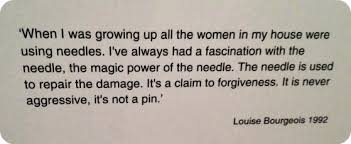
I am not a textile scholar, textile historian or design/art pedagogue. My research is informed by my passion for textiles, my creative work as a textile art practitioner, my intuitive understanding of darning as an art form, my family associations with Najibabad’s rafoogars, and my deep concern for this vulnerable and unsupported community whose survival is under threat in an era of mechanization, as is the case with traditional artisans all over India. In more subjective terms, my research focus on the mending and restoration of degraded cloth acquired great significance for me some years ago when I was diagnosed with advanced cancer. I am still under treatment; and in this context the role of the rafoogar committed to preserving the unique life of a fragile, damaged kani shawl, who undertakes to repair it through difficult, meticulous, unseen, expert darning, has profound emotional resonance for me – as does the action of rafoo, which like all traditional Indian art forms is infused with meditative as well as cathartic and therapeutic potential.
 |
| Untitled- Indigo fabric with paper pulp 2, 11 in x 8 |
The medieval saint-poet Kabir, himself a weaver, frequently uses images from the craft to signify the process of material embodiment as well as of transcendence. The whole universe is stretched out on the cosmic loom fashioned from earth and sky; the sun and moon are simultaneously plied as twin shuttles… what was the warp, what the weft, what thread was used to create the finely woven, spotless sheet woven out of the five elements, the pristine cloth inevitably soiled, stained, defiled by the ignorant humans who wrap themselves in it…? So sings the poet, who concludes that only the Weaver can mesh thread with thread… with a formless shuttle weave a shawl with no edge… Today I am easily able to transpose Kabir’s lyric assertions to my own prolonged experience of an illness that has coerced visible and invisible uncertainties, fluctuations, blemishes and disruptions into the once-reliable order, logic and symmetries of my own somatic ‘warp and weft’. But I have also come to marvel at and respect the perfect design of the priceless perishable ‘sheet’; I have come to understand how the edges of each rip and gash have to be continuously aligned by the ‘darner’, firmly yet delicately pinioned, and then sealed stitch by careful stitch, to prevent further damage and to render the resilient cloth intact and whole. I have been absorbing and integrating those deeper intuitions simultaneously into my artistic life and my daily existence.
 |
| Untitled-Jute Fabric fragment with Daphne pulp,14 in x 21 in, 2016 (2) |
Rafoogari thus represents an intimate merging of the artistic and personal paths within my life’s journey. My ongoing rafoogari research bestows a sense of coming full circle, a return to my origins which are also the source of my textile art practice that definitively germinated from my childhood love for kani shawls. Earlier, my ‘life’ and my ‘work’ were flowing in parallel, but now they seem to have become one. While my research documents the aesthetic, the technical skills and the sociological truths of the rafoogar community, it also provides me with an invaluable chance to assimilate various aspects of both visible and invisible darning as a powerful metaphor – to understand ‘repair’ as a vital modality of self-knowledge, and to experience the place, significance and act of such ‘darning’ in the fabric of a life, as well as in the life of a fabric.
 Priya Ravish Mehra is a
Delhi-based textile artist, weaver, researcher and designer. Graduating from
Visva-Bharati University, Santiniketan, she later studied tapestry weaving at West
Dean College, Sussex and at the Royal
College of Arts, London under a
Charles Wallace Fellowship. To study the maintenance and preservation of Indian textiles, especially Kashmir shawls in public and private collections in the US, she also received an Asian Cultural Council
Grant Her battle against
cancer has been aided and inspired by her work in rafoogari.
Priya Ravish Mehra is a
Delhi-based textile artist, weaver, researcher and designer. Graduating from
Visva-Bharati University, Santiniketan, she later studied tapestry weaving at West
Dean College, Sussex and at the Royal
College of Arts, London under a
Charles Wallace Fellowship. To study the maintenance and preservation of Indian textiles, especially Kashmir shawls in public and private collections in the US, she also received an Asian Cultural Council
Grant Her battle against
cancer has been aided and inspired by her work in rafoogari.
If you’d like to contribute to this project, drop me a line.