Showing posts with label healing through art. Show all posts

Monday, 20 January 2025

Who’s to Blame….Whose Fault is it…..


May the tide
never tire of its tender toil
how over and over
it forgives the Moon
the daily exile
and returns to turn
mountains into sand
         as if to say,
you too can have
this homecoming
you too possess
this elemental power
of turning
the stone in the heart. into golden dust. 
                                     

(Forgiveness) by Maria Popova


Patterns fascinate me. I’ve been studying patterns in myself. I found them difficult to contend with, find forgiveness, acceptance and leave behind regret and shame. Years of therapy helped, but not nearly enough. It was my walks along the sea shore, looking at nature in its myriad patterns that solace started emerging. 


Nature is renowned for her exquisite patterns and living by the Arabian sea, I have been spoiled by those created by water, wind, crabs, sand, leaves and the sky. I’ve been particularly mesmerised by the patterns that water creates. Or, rather co-creates, wherein the resultant pattern that the eyes see is the consequence of multiple layers of water, over sand, rippled by water and wind, and water rippled by incoming and out going tides and/or the wind, as also the sun glinting on these ripples. It’s a marvellous experience to see this unfold and I never tire of it. 


My training as a textile designer, means that I have created numerous patterns over the years. I recall my early years of learning -  one of our assignments was to dissect a bhindi (okra),  draw it, the repeat it in pre-set ways.


The Art Nouveau patterns with their sensuous lines and mirrored repeats have been another favourite. However, all these years of making patterns, looking at fabrics with patterns, has probably sensitised me to finding them everywhere. 


The patterns I’ve seen at the banks of rivers and the sea shore can be complex in their layers, such that they become evocative of the patterns of our psyche which emerge in similar manners. 


As human beings, we are co-created in layers. By people who themselves are layers of history, politics, familial and cultural traditions and conditioning, technology and so much more. It’s impossible to visualise them, much less find any sense of awe and fascination in them. Particularly in contemporary times, when scientific analysis creates a kind of judgement, even if it’s not intended. Psychology labels these patterns and traits creating scope for judgement rather than acceptance and forgiveness. 


For instance, if you have/had a narcissist parent, you have developed patterns of coping that may habituate you to accepting abuse as familiar and even attractive (however weird and foolish it may sound) This leads one to create more and more painful experiences. Some may recall the Stockholm syndrome, which is not that different. When you realise the reasons for manifesting this and other patterns, there’s judgement of both parent and self. Acceptance that it’s just another facet of being, in the larger canvas of life, could take a life-time of therapy, if that. 


Earlier, before CBT and other kinds of psychotherapy became popular and were deemed necessary, it was all put down to karma. Cause and effect, which it is. There’s not much one can do about the patterns that life generates within us, knowing what caused it quells some of the anxiety perhaps, but visually perceiving the tantalising effects of the patterns co-created at the river banks and sea-shore provide a very powerful tool for finding beauty where otherwise one is inclined to blame, shame and self hate. 


We need to find forgiveness for ourselves and others. Taking photographs isn’t enough to move beyond the negative feelings and connotations that have been imprinted on the mind, leading to feelings that self-destruct, so I decided to try and re-create the patterns I witnessed the manifestation of, at the river bank.


I had some photographs sand ripples and patterns digitally printed onto cotton fabrics. This provides the bottom-most layer. I then drew out warp and weft threads from a black and gold tissue fabric. Initially I had intended to just reduce the ends per inch to make it supple. But, the weft was plastic thread covered with gold metal and it didn’t lend itself well to being tweezed out of the fabric. I then started to pull the gold threads together, creating dense woven threads amid a loose weave left by moving the weft threads. They formed ripples and I loved the effect. I later did the same drawn thread processes with the aquamarine and silver tissue fabric and white silk organza. 


I haven’t covered the entire base fabric equally. The layers are replicating the colours of the bank of the River Chapora in Morjhim, Goa. 


The top layer is fine silk organza. It creates a layer that is transparent and holds all the others together. 


I’ve printed the photograph so that I can trace the dappled light and create a template for embroidery. I’m not sure whether to embroider the organza extraneous to the rest of the layers and then add more stitches later to bind them together, so do the needle work with all the layers, picking up some with the embroidery thread, but just minimally, to keep it light and evanescent. 


I’m thinking of the latter for it’s more organic, albeit more complex too. The thread will be stranded cotton and some metallic threads in gold and silver. The Split stitch seems just perfect for this. All in all a tall order, but I’m super excited. 


An inspiring passage by Nick Cave is what I’m hoping to meditate upon as I stitch, recreate the water dappled with sunlight, the sand ripples adding the dark backdrop for perfect reflection on the water’s surface. Where he  shares that “- In a way my work has become an explicit rejection of cynicism and negativity. I simply have no time for it. I mean that quite literally, and from a personal perspective. No time for censure or relentless condemnation. No time for the whole cycle of perpetual blame. Others can do that sort of thing. I haven’t the stomach for it, or the time. Life is too damn short, in my opinion, not to be awed……We all have regrets and most of us know that those regrets, as excruciating as they can be, are the things that help us lead improved lives. Or, rather, there are certain regrets that, as they emerge, can accompany us on the incremental bettering of our lives. Regrets are forever floating to the surface… They require our attention. You have to do something with them. One way is to seek forgiveness by making what might be called living amends, by using whatever gifts you may have in order to help rehabilitate the world. - Nick Cave


Stitching is meditative. It’s expressive and the layers, the photographs add such a sense of beauty to this process, that one hopes, it will re-habilitate me and you. 

Monday, 4 November 2024

Mending Beyond Fabric, Rafooghar -The House That Mends, Guest Post - Pooja Dhingra


In a country where the marginalized are often swept out of sight or rendered invisible in the name of beautification while hosting global events, beauty is rarely extended to them, depriving them of basic necessities, greenery, and dignity. Women in these neighborhoods suffer the most and are often denied spaces to rest, find joy, and express themselves freely.

Yet, in a small room tucked away in one of New Delhi’s most disadvantaged neighborhoods, women have found a place of sukoon (peace), fursat (leisure), masti (fun), and made it beautiful with their presence, stories and embroidered works that decorate every nook and corner of this space.

 Rafooghar- the community space decorated with women’s powerful stitched artworks. 

Rafooghar گھر, was set up by Compassion Contagion in collaboration with Yellow Streets and Artreach India, so that for a few hours every Sunday, women who have faced discrimination and social exclusion and are marginalized on the basis of their caste, class, religion and gender, could leave behind the demands of cooking, cleaning, caretaking to rest and to reclaim a bit of themselves by sitting and stitching together.

Photograph by Harmeet Basur
                                               
Some of the women, mostly homemakers, come from the overcrowded, tiny lanes of  Shaheen Bagh- a small, nondescript locality in Delhi that gained international attention for the historic protests led by Muslim women against a discriminatory citizenship law. Others who work as domestic workers or day wagers hail from the makeshift shanties in Jasola and Madanpur Khadar, areas populated by families who moved to the city in search of better opportunities but found themselves in precarious living conditions.

Women from these communities are always engaged in labor, both physical and emotional, with little time for self-care. They are always expected to be productive, juggling multiple tasks at all times. In the initial days, many women found it challenging to take out even an hour to spend at the space. Some women would bring their children along because raising children remains largely a mother’s responsibility; while others would abruptly be called back home by family duties, unexpected guests, or their employers’ demands.

"All I want is some moments of peace" - Gulafsha

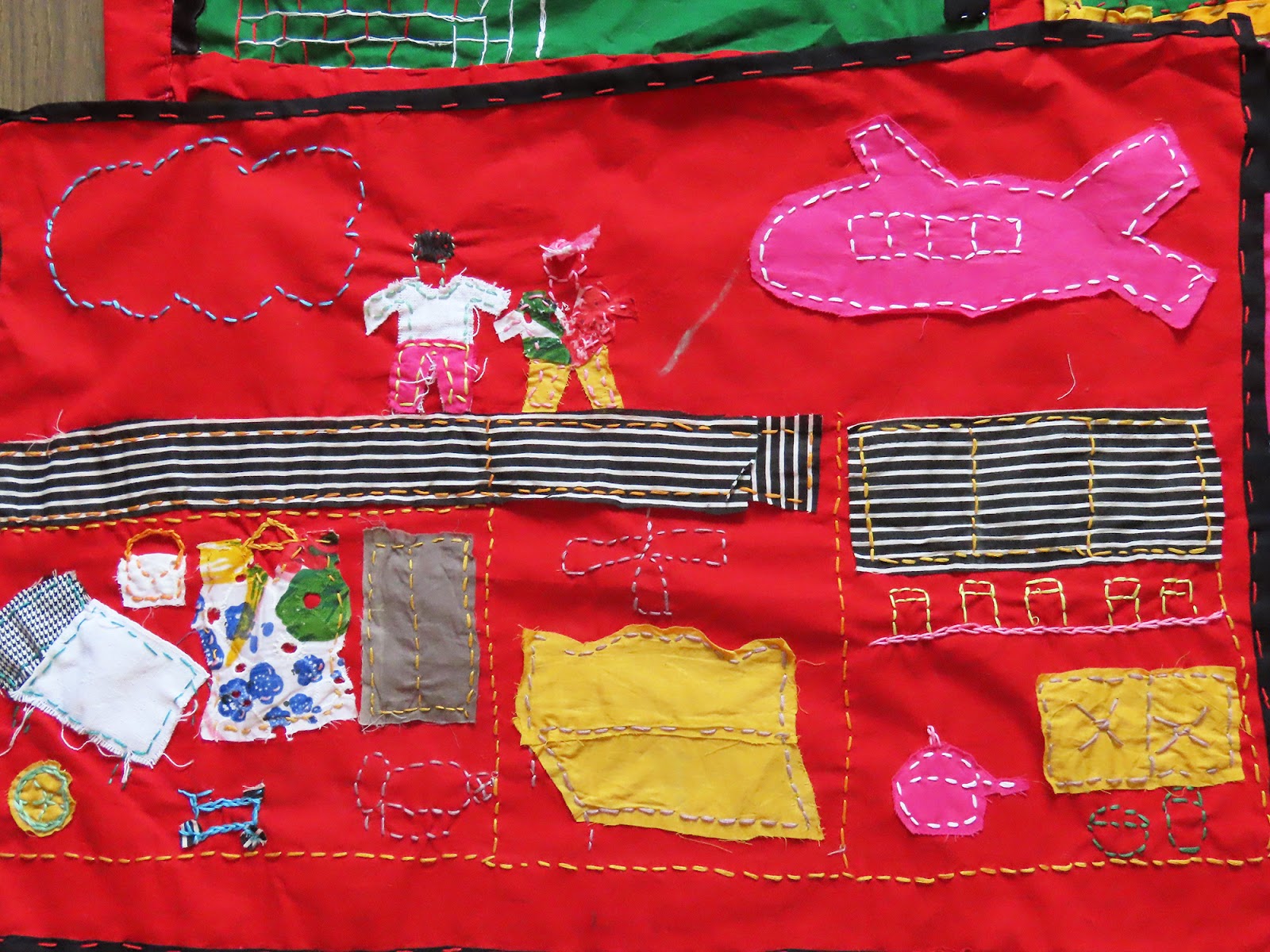
An embroidered artwork by Gulafsha who just wants some peace and free time. Her idea of ‘sukoon’ is tucking her four children and husband in bed before embarking on a solo adventure in her husband's auto. She fondly recalls another special  and peaceful moment when they stood together under an umbrella in the rain.

The only reason they get ‘permission’ to come here is because it's just for Silai (stitching)- an acceptable, non-threatening activity, fitting neatly within traditional gender roles.  

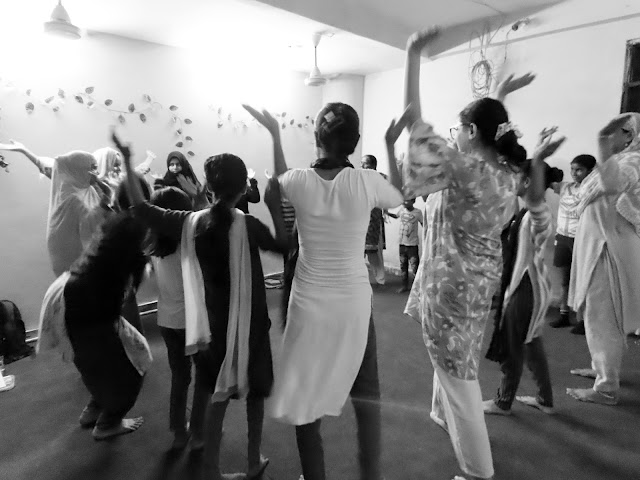
Movement based ice breaking session facilitated by Artreach India

But here in this space, stitching is not just a chore or a means of livelihood; it’s a tool for women to express themselves, feel heard, and valued. 

Rafooghar draws its inspiration from the word Rafoogar—a traditional Indian master darner or cloth mender. Rafoogars are not just skilled artisans who invisibly repair damaged garments; they are also healers who breathe new life into these torn fabrics. In the same spirit, Rafooghar—The House that Mends—is a space where women gather to share their stories, release their emotions; repair their emotional wounds;  restore their broken selves and relationships; rejuvenate and resist the erasure of their identities through the mediums of stitching and textiles.

women from Jasola and Shaheen Bagh sitting together and stitching 'Love Lihaaf' - a community 
quilt made by  piecing together individual narratives of everyone

Stitching facilitates a new form of freedom because this non-verbal medium allows women to stitch what they can’t express with words. Stories of daily struggles and injustices; of oppression and liberation;  of unfulfilled dreams and harsh realities; of childhood memories and the burdens of adult responsibilities; of fleeting moments of joy amidst abuse and violence; of sorrow, pain, grief, longing, rage and resistance - are all voiced fearlessly on the fabric

“I spend a lot of time at home. I love looking at flying planes from my terrace".-Shahista


My life is full of problems. Everyone says I cry a lot. I have shown myself
crying in my portrait but look I have filled a river with my tears, it’s now
full of fish and a tree has grown too!- Billo Photograph by Hansika Sharma

In marginalized communities, often, the mental well-being of women goes unnoticed-even by the women themselves. There is frequently a lack of vocabulary to articulate their mental health concerns, and therapy is often unaffordable and inaccessible. The slow and repetitive process of stitching offers a space for self-reflection and therapeutic benefits. Stitching, combined with other interventions, has been shown to reduce anxiety, depression, and PTSD symptoms,  particularly in the context of trauma related to gender-based violence. Practicing stitching collectively provides an opportunity to build bonds and create a culture of care.

         Haal Khayal Module -  Mark making for Mental well-being facilitated by Ahmedabad-based                  textile artist-Hansika Sharma

Our modules are, therefore, thoughtfully designed to promote mental well-being while delving deeper into themes of identity, agency, and mobility. Created in collaboration with Artreach India, art therapists, educators, our community contact Yusra Khan from Yellow Streets, and the women of Rafooghar, each session focuses on the issues and needs of the community women. We begin with movement and theatre-based ice-breakers, followed by art warm-ups and stitching prompts centered around a theme. Sessions conclude with a sharing circle to spark conversations and discussions around the stitched stories, as well as to address challenging issues. 

Meri Zindagi ka Naksha: an embroidered activity template that aids 
participants to reflect on  their past, recognise how it has impacted and
where they are in life currently and what they want in the future .
Embroidery by Usha Dhingra
                       
The process of sitting, sharing and stitching together has led to a strong sense of sisterhood among the women. They bond over similar experiences in spite of their differences and find support and courage to take action against shared injustices. For e.g, when one woman’s children were denied their right to a mid-day meal in school, she shared her story with others at Rafooghar during a session. The encouragement, support and advice she received from her fellow participants gave her the courage to go to the school and demand what was rightfully due to her children. In another instance, when a woman from Jasola was beaten by her in-laws, the women from Shaheen Bagh went to confront her in-laws, showing their collective strength and support.

This space and community support also encourages several of them to break their silence, seek help, and take steps towards healing and justice. A fifteen year old girl, after three years of domestic abuse, finally found the courage to file an F.I.R against her husband and her in-laws.

Rafooghar participants with ‘‘Umeed ka karavaan’- the travelling quilt of hopes and dreams.

Rafooghar is only a year old, yet it has already brought about significant changes in the community, simply by giving women a place to rest and the creative outlet of stitching. Women who once hurried to leave now stay for hours, even after the sessions end. They have also started leaving their kids at home with husbands taking care of them as well as some household chores, a significant change since they previously had no break from childcare responsibilities. The right to rest has allowed these women to recharge, reflect, and reinvent themselves.

It’s been a packed year for them ever since their first community exhibition Daastaan-e-Rafoo: Stories in Stitches. They've showcased their work at major events like the India Art Fair and the 19th Asian Women’s Film Festival, taking on new roles by assisting in workshops and exhibitions. Some have even represented Rafooghar internationally at the Participatory Design Conference in Malaysia, and others will soon be traveling to Thailand for the AWID Forum. They have just started a study group to teach themselves English and are now dreaming of bigger things to rewrite their destinies.

Rafooghar participants with "Umeed ka Karavaan" - the travelling quilt of hopes and dreams

Rafooghar may have started as a modest space for rest and leisure, but it has grown into a powerful place for quiet resistance and transformation. In a world that often pushes the marginalized to the edges, the women of Rafooghar are finding their voices, forming new friendships, and  reclaiming space. Each stitch is an act of defiance against invisibility, a declaration that their stories matter.

Daastan--Rafoo: Stories in Stitches at the 19th Asian Women's
Film Festival. Photograph by Antasa Vairagya


Pooja Dhingra is an independent conceptualiser, art director and graphic designer. She is the founder of Compassion Contagion, an online archive that has been documenting acts of compassion, hope and resilience through art. She spends her Sundays at Rafooghar (the house that mends), a community space where women who live on the margins and face social exclusion gather for sukoon (peace) and (fursat), share and stitch their stories and lived experiences on fabric.

Pooja's personal work revolves around waste management, sustainability, and addressing the patriarchy through humor and satire.


Wednesday, 21 February 2024

Golden Sands


I started this embroidery some weeks ago. An Instagram post with haphazardly laid slubby yarn inspired me to scour the Delhi market for some ghicha (tasar silk) which has a wonderful multi-hued (from dull gold to dark brown) texture that’s rough but soft to touch. 


Ghicha is traditionally made from wild tasar silkworms and produced in a variety of ways, one of which is by allowing the worm to emerge from the silk naturally, (without boiling them alive - now called ahimsa or non-violent silk) . The cocoons which are single-shelled and oval-shaped  are collected from the forest or rearing fields and dried naturally in the sun. The empty cocoon is then boiled to soften it for easier extraction of the thread. Ghicha silk fibres are short and coarser hence the silk is not reeled in a continuous thread like mulberry (bombyxymori) and other silks. 


There are several species of Tasar silk moths (family Saturniidae) in China, India, Japan, Africa and North America. The moths are large and have a prominent eye marking on their wings. The caterpillars are bright green, as wide as a man’s finger and they feed on a wide range of plants like Asan (a common herb also called Bijaka) Arjun - a large deciduous herbal plant (tree) and Sal. Valued for its natural golden to brown hues - said to be derived from the tannin in the leaves that the moth feeds on, the main producers of Tasar silk are the Jharkhand and Bihar regions in India.


Why did I find myself drawn to the slubby ghicha, is something that I have been preoccupied with ever since I embarked on this work. For so many years, I have worked with cotton fabrics, not really caring much for the quality of cloth and usually veering towards markeen or mulmul- not the fine muslin of yore, but mill-made cotton voile. I did use silk organza some decades ago, and that too has returned to my repertoire, but Tasar wasn’t ever on my radar. 


Anyhow, this Instagram post - I’ve never been able to find it again, set me on a purposeful journey to find ghicha fabric. The idea was to remove the yarn - ghicha is usually used in the weft, with finely spun Tasar or cotton for the warp and it’s easy to unravel.


I spent way too much money on this, buying all manner of silk - mulberry and organza included, adding muga tussar blends and silk cotton blends. Good quality tussar can cost upto ₹3,500/- per metre, organza around ₹850/- and gold tissue about ₹1,500/- per metre. Sometimes I bought a metre but usually only half a metre. Even so I ended up spending over ₹20,000/- on a single trip and there were more sprees.  Given that all I had were cut pieces that I was going to shred it really does seem like extravagance but when it comes to work, I never stint. 


As soon as I returned from my shopping spree I got down to work by taking out the thread. Some fabrics weren’t so easy to unravel so I got just the yarn length of the fabric width and kept them neatly together for use later. One of the fabrics was a dream: I could actually reel the thread off the fabric and create small balls of it. I use this for embroidery. I’ve been trying to get a spool or two of the finer Katia thread to work with, but as yet haven’t had much luck as the yarn isn’t made locally and suppliers are wholesalers. 


I then used some of these fabrics that I had drawn the threads from and rendered fragile, by layering them upon each other and trying to tack the loosened threads. The end result was a mishmash of fabrics quite large and unwieldy.  I liked some of the textures that stitching had created, and wanted to pursue that - make the work smaller and focus on the detail. 


So, I cut the whole into bits - just random bits. I then divided the organza and gold tissue fabrics into equal parts and got 8 rectangles from each measuring 9.5 x 11 inches each. Hence the series of 8. 


I tried tacking the randomly cut bits of tasar onto the organza overlaid on the gold tissue by hand but it was treacherous. I indulged in getting one of those mini sewing machines I’ve been eyeing for sometime now. I have a good enough sewing machine at home in Goa and didn’t need to add clutter to an already overflowing studio, so it didn’t make sense then. But I’ve been in Delhi since early November, with another two months (when I started the work) to go before I returned home, so I knew I had to get it. It’s reasonably priced and did the basics. Just about that too. The stitches were too large on the lighter end of the  fabrics (you cannot modulate the length) which ended up being a boon in the long run because I just ripped out the stitching once the embroidery had started and the loosened ghicha threads were more manageable. 


I’ve been in n Delhi, taking care of mum who’s ailing. She’ll be 92 in June this year, has Parkinson’s which has affected her swallowing mechanism. This means that she cannot eat. Beginning with a Riles tube, we had to put in a PEG tube in the stomach to feed her every two hours. This site got infected and the doctors  inserted an NJ (nasal jejunum - it goes deeper into the stomach than a RT). She’s pretty much bedridden with her severe osteoporosis and limited mobility plus has had a UTI almost constantly for the last 5-6 years. She’s alert, misses eating her favourites and once in a while asks for coke or chocolate or tea and we feed her licks or by teaspoon. It’s hard and she’s miserable. And, there’s a sense of gloom that pervades the whole place. Her home has been neglected or rather left to the staff to run, so almost nothing works and despite continuous repairs, it’s hardship living for us. 


Knowing the situation and that I was to be here for 4 months this time around, I decided to post most of my stuff and set up a temporary but workable studio on the large oval dining table that seats eight (half of it). I’ve been working regularly and it’s been my salvation. I had brought pieces that I had been working on and there were a lot of samples to be made for a 4 module workshop that I conducted at the Kiran Nadar Museum of Art in Saket. But, sometimes, things can’t be worked to order and one needs some expression that’s more in tune with situation and circumstance of the present. In fact, I find that the chaos of life actually lends itself well to authentic expression. 


My exploration of life along the seashore in Goa, as a mirror to self has been a seven year journey thus far. I have explored and studied the shells and their markings - zoomed in on what scientists have said are neurological responses to the environment - with genetic traces too, to realise that it’s pure colour that make up these patterns. Subtle gradations of colour. I have a series of cross-stitch pieces that replicate my photographic recording and pixilation of these patterns that are fascinating in their hues. I’d been working on one of them, (they take a year to do each) when the Instagram post sent me on another track. 


But, it really wasn’t another track just another way of looking at neurological responses.  And, in studying the colour of these responses as I tried to match each hue - and it’s the most demanding thing I’ve ever tried for each square of 16 crosses takes me approximately ten minutes to complete: 2 minutes to stitch and the rest to match the right colour and tone, I’ve explored emotions in the human context and how we use them to respond to situation and circumstance. 


This led to the understanding that there is a geography of emotion. A terrain that isn’t linear but layered. Like patterns are formed in our subconscious behaviour, emotions also have patterns. How we respond to people is based on these patterns and hence they are referred to as the geography of emotion. 


In mapping this geography, initially I referred to my album of images from my weekly walks on the beach, when I’m resident in Goa. And I found the correlation quite fascinating. But, then my sister came to share the caregiving and running of house responsibilities and all hell broke loose. 


The cook who pretty much runs the house was going on leave and the two of us were to do this along with mother’s care. Our personalities are like chalk and cheese. While she externalises, I internalise. And, we haven’t lived together our entire adult lives - not since we were in our teens. Not only that, we have a troubled past too - I guess most families have their issues and we do as well. It was an ambitious plan that within days became nothing short of a nightmare. My head was screaming overload. I’m used to living alone and barely managed the numerous people involved in mums home and care till sister arrived and then to deal with her entirely different stress coping mechanism  - one that imposed on me, was impossible and that’s how these pieces came into being. But, it’s not just this that created them for I had started the initial work prior to my sister’s arrival. I was under stress and she just became the trigger for something visceral. 


Inspired essentially by the sand bubbler crabs whose radial feeding residue patterns create a lace-like pattern across the sand. These patterns are fascinating in themselves, but the story behind them is equally so - actually more so and lends meaning to what I’m attempting to do with this series of embroideries. 


The sand bubbler crabs are tiny, shy creatures that run into their burrows at the sight of me. They dig these burrows and live in them until the tide brings forth the stuff they feed on. Then, they scuttle out of their hiding places and roll bits of wet sand in their mouths, digesting organic waste and detritus of animals, discarding the rest as little globules that dot the beaches. They work radially outwards from the burrow. And in leaving these globules they inform their tribe that this sand has been sifted and there’s nothing left to feed on. But, the part that I find most interesting is that in consuming the waste and detritus these sand bubblers actually clean the beaches. without which, there would be a stench. 


In these pieces, I’m using this concept of dealing with the detritus of one’s emotions to clean the environment. I started them, despite my beck and shoulders in agony. Finished two aided by a week of daily Physio therapy and then got a whopping cold. First, one side of the nasal tract and then the other with a really lovely chesty bronchial cough. All of which left me no choice but to abandon sewing and sleep it off. 


Not everything can be sorted by mere creative ideas. But, it’s all part of the healing process. If it hadn’t been for the rest, I’d never have cleared my head enough to write this! 


Hope you enjoyed this post. Stay tuned for more on the Golden Sand series - on why silk and gold have become emblematic of this series and other stitching stories.


Resources: 

https://en.m.wikipedia.org/wiki/Tussar_silk

https://asiainch.org/craft/ghicha-silk-weaving-of-bihar/)