Sunday, 11 October 2026

What Is My Dharma in This?

This morning somebody sent me a video from Delhi. A young woman was being forcibly moved by a group of police officers. At one point she was upside down, her legs held up by two people like logs of wood. Her upper body hanging close to the road. Her shirt had ridden up exposing her stomach and navel. Later, one sees her sitting in the road — dazed by what just happened. I was too. She had no control over how her body was being handled, or over what was being exposed. The indignity was crucifying.
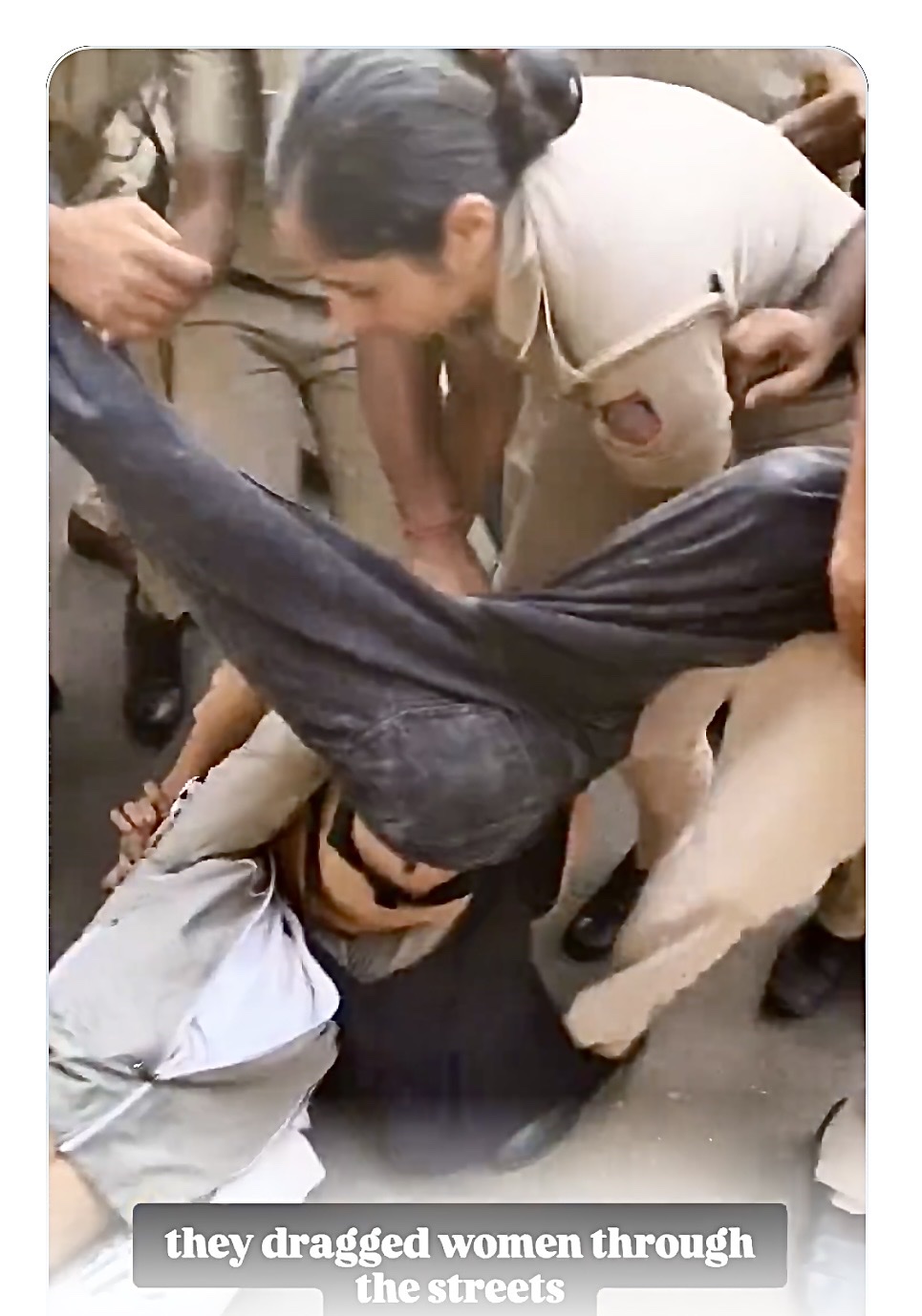


The protests in Delhi, led largely by young people and joined by opposition leaders, are centred on the controversy around the Special Intensive Revision of the electoral rolls. Protesters are alleging that legitimate voters have been removed from the rolls and that the revision has compromised electoral fairness — demanding the resignation of the Chief Election Commissioner, Gyanesh Kumar. In its defence,  the  Election Commission says the exercise is intended to clean up the rolls by removing duplicate and ineligible entries. The dispute has escalated and spilled onto the streets, where hundreds of protesters have been detained, and large parts of central Delhi have been locked down to prevent demonstrations.

There are reports that say people  were  slapped, kicked, dragged and threatened. One woman said she had been beaten while the police stood by; senior Delhi Police officers said they had rescued her and removed the men. No FIR had been filed against the men at the time of that report. So even the act of looking becomes complicated. Who is doing what? Who is watching? Who is intervening? Who is not?

There is a lot of brutality in the world. In the outer political sphere, certainly, but also much closer to home, within families, marriages, relationships. Brutality seems to have become so integral to life that perhaps we don’t even notice it until something makes us stop.

I remember being a young woman of twenty-two, being brutalised by my husband and not really raising my voice. Today I stand back and I am stunned by that young girl. He tried to kill me and I didn’t go out screaming into the streets. I didn’t lodge a police complaint. I didn’t tell anybody what had happened. I simply locked myself in the other bedroom until he apologised.

Why?

Why were we taught to endure?

This is one of the questions I keep coming back to now, all these years later, sitting in my studio in Goa, looking at what is happening elsewhere and also looking at my own life.

I look at the work I do. The violence that I enact, The violence that I enact is the needle piercing layers of fabric, the tearing and rupturing of cloth — perhaps a way of sublimating some of the violence I have borne.”. Sometimes I tear the cloth  in frustration. I rupture the carefully constructed weave because I am trying to understand what goes into it. I am trying to understand the layers beneath it. I am trying to understand myself. My life. My feelings. My anger, frustration and pain.

I go deeply into my craft, into what I do, how I do it, the decisions I make at this very minuscule level. I can spend enormous amounts of time considering a stitch, a thread, the way one layer sits over another, what happens when I cut through something, what is revealed underneath. Or erasing fragments altogether.

And then I wake up on a Sunday morning to read the news and see videos and snippets people are sharing, talking about what is happening on the ground in Delhi. Young people protesting. Women being manhandled. People being carried away like carcasses. And I am deeply, deeply disturbed by what I see.

What should my role be? Where should my attention go? What is my dharma in this?

A few Facebook notifications prompted me to open the app. These days Facebook first gives you a reel to look at, and the one that came up was Anne Carson talking about noticing, and about how noticing alters judgment. She suggested that if we look at people more closely, perhaps we become less judgmental about them. We begin to see the details, the circumstances, the complexities.

In other  news the student leader Neha Bora, president of the All India Students’ Association, was dragged along the road and pushed into a waiting bus. In a video statement,  she accused policewomen of elbowing protesters, digging their nails into them and pulling at young women’s clothing. Delhi Police say women were treated with dignity. I wasn’t there, and I can’t see what happened on that road.

What does deeper noticing do in such situations?

Do I notice that the policemen may have been given instructions? That they are acting within a larger machinery of power? Does that change my judgment of the individual policeman/woman? It may, but how does it alter the fact that a young woman has been brutalised?

Does noticing make brutality less brutal?

Or does looking closely sometimes make it more difficult to look away?

I remember going to Shaheen Bagh in the winter of 2019-20, when women - many of them Muslim women from the neighbourhood - had begun a continuous sit-in against the Citizenship Amendment Act and the proposed National Register of Citizens. The women sat there through the bitter Delhi winter, day after day, and Shaheen Bagh became a symbol of resistance across India. I went and sat with them in solidarity, also joining a choir to sing for the women. I remember people telling me I was crazy. My family included. I was in Delhi then, I wanted to add my voice of protest and did. But sitting so far away in Goa, I’m unable to do anything other than watch the brutality being enacted. Furious and frustrated.

The friend who’d accompanied me to Shaheen Bagh tells me she wanted to go to a protest at Jantar Mantar but her osteoporosis won’t take it. It is now a fight for the young ones, she says.

I suppose  it is.

My age and my body will not allow me to do many of the things I may once have done. And yet sitting on the sidelines feels unbearable too. I asked,  in a WhatsApp message, what can one do? One feels so frustrated.  “Armchair support” was the response.

And  that is precisely what troubles me.

I may tear fabric in frustration. I may rupture the carefully constructed weave. But what does that do?

How can art making of any kind really make a difference?

How does one support these young people who have the courage to get together and do what they do?

Having reached the age I have, occupying the space I do as an artist, a craftsman, craftswoman — whatever word one chooses — I wonder what I can actually do.

I feel frustrated. I feel hemmed in. I feel as though my hands are tied and that I want to jump out of this space and do something at so many levels. But instead I feel glued to this chair, tied down by these threads, as though I am going nowhere. These threads are what I know, but can they mean anything in today’s world?

Looking out at a stoic palm tree moving slightly in the gentle breeze, I think about the monsoon that wasn’t really one. Walking along on the beach yesterday, a fisherman spoke about the wells drying up. There will be no water, he said. Much of Goa’s water is provided by wells — where I live is too.

Is this nature’s brutality?

At some level we are responsible for this too, through what we have done to the planet, through climate change, through all the things we have collectively set in motion.

Yesterday another fisherman from Morjim told me, “I am Morjai.” He said, we were not created by God. Our ancestors created us. And so he was lighting lamps and putting them into the river as homage to his ancestors.

Making note of all that goes on around me, is said or suggested, is confusing.  There is so much information.

We have been conditioned in certain ways. We have been taught things socially, culturally, educationally, through our families. We are told where we came from, who created us, what to believe.

But when you think about it, yes,  we were created by our parents. But who created our parents? What was the beginning of this universe?

We don’t really know. The more I understand, the less I know anything.

And I wonder whether all this brutality is about a need to control, when there isn’t really any? To determine what is right and what is wrong, what belongs and what does not. Within families. Within nations. Between nations?

People in my neighbourhood  don’t like those of us who came from Delhi. I have been told to go back. A woman spat at my feet, called me mental, telling me I know nothing about Goa because I was not born and brought up here.

Again, belonging. Who belongs where? Who decides?

Who has the right to say, this is mine and not yours?

Wars have been fought continually over religion, land, identity, power. Two or three people disagree and it becomes a battle of wits, of right, of power.

And there is brutality at every stage. How does an individual respond to this? How have other artists responded?

Does it make an impact on the powers that be?

There is so much documentation now. So much video footage. We can watch brutality almost as it happens. And yet even seeing it does not necessarily bring change.

So what does witnessing mean? What does noticing mean?

When I was in my thirties, I used to get very upset about people eating in their cars and throwing the orange peel and pips onto the street. I remember being aghast at some people in a brand-new car pulling the plastic coverings off the seats and chucking them out of the window of their moving vehicle, onto the road.

Such lack of civic sense would infuriate me, I’d talk about it. One day I get a call from a well meaning but upset acquaintance, telling me that a journalist had written an article called, “Gopika ko gussa kyun aata hai?” Why does Gopika get angry?

The writer’s advice, as I remember it, was that I should contain my anger and make textile art instead of becoming so frustrated by all these things.

And now I wonder.

Is it because we are taught to contain our anger, sublimate it,  that we have arrived where we are today?

Where it is somebody else’s problem. Somebody else’s street. Somebody else’s protest. Somebody else’s child. Somebody else’s water shortage.

Perhaps we have not involved ourselves enough.

But then what does involvement actually mean? Posting something on social media? Going onto  the streets?

Making art? Writing? Sitting quietly and noticing?

Another friend complains that the art community is pathetic because nobody wants to post anything on social media. But there is fear too. People are afraid of what happens when they speak. So silence cannot always simply be called apathy.

I don’t really know what I want to say:  I am trying to understand myself within these circumstances, within this life. Looking ahead. Looking at something happening  far away from me  and feeling offended by it. Looking at my own life and what people have done to me and feeling equally offended by that.

I get numerous messages all day long. Today, there’s one from a bookshop saying, bring the book you are reading and let us swap plots and recommendations. Another is a video of Anish Kapoor’s exhibition at The Hayward Gallery in London. Showing entrail-like forms that speak more about the artist’s view of spirituality than about war or gore.

It’s all so removed from what is going on and what I’m trying to respond to. Everyone basically gets on with their individual lives, focussed on whatever. We are seemingly not united in any sense about anything.

I don’t know if that is good or bad.

Perhaps human beings were never united.

Perhaps this is simply what we are.

And yet, I remain deeply disturbed by the images I saw this morning.

Can I contemplate all these facets of life and absolve myself of what is happening elsewhere? Can I simply become absorbed in my own life, my own family, my own pain, my own stitching? Or is there something more being asked of me — that I am asking of myself?

When the Mahabharata was fought, Vyasa documented the war, and within that epic, Krishna speaks  to Arjuna about dharma, about what one must do when faced with an impossible moral situation.

I keep wondering whether there is any place for that idea in the world we live in now. What is dharma when you are sitting safely in Goa while someone protesting peacefully about their rights is being dragged away in Delhi?

What is dharma when your own body will not allow you to stand on the street in solidarity? What is dharma when what you know how to do is thread a needle and look very closely at how you stitch?

What is the meaning of this life? What have we come here to do?

Perhaps I am asking too many questions. Perhaps this is all I can do today.

I look closely at the fabric. I rupture it. I look beneath the surface. I am trying to understand how it is constructed — what holds it together and what makes it fall apart.

Doing exactly the same thing with the life, within and around me.


Monday, 14 September 2026

Thinking While Making— slowness, and making art in a frantic age


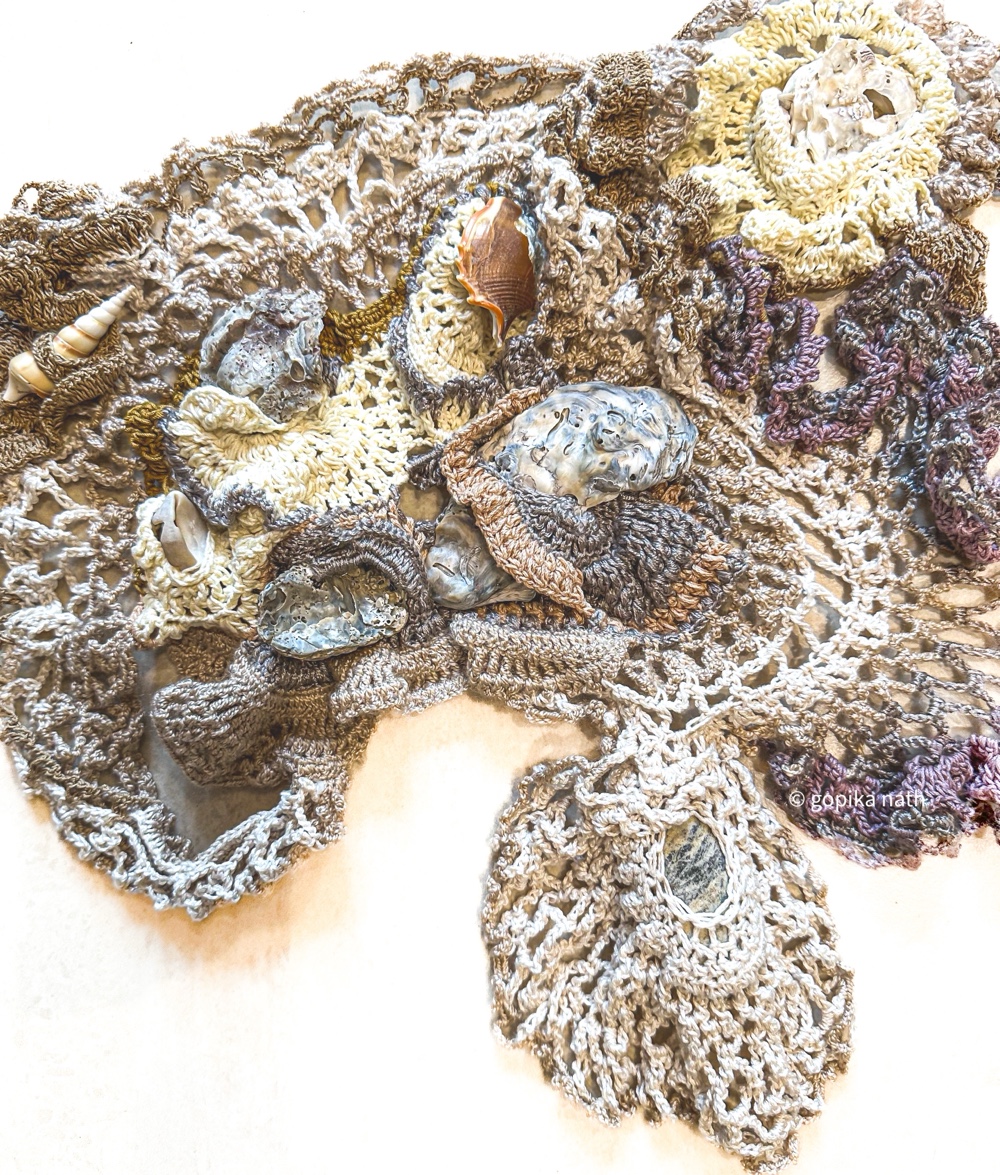
I've been working on a series of shells, going back to how I started with the Washed Ashore project. Sometimes I don't know why I do things — I'm just inspired to — and this was one such thing. I was making a piece called Tread Carefully, built up of numerous shells and stones. As I kept attaching more, it grew ungainly, so I began making pieces independently instead, thinking I'd connect them later — I'd even bought a canvas to stretch them onto, to  join them using Irish crochet — my style. But after two or three pieces, I realised working them independently was creating pieces in their own right.

So today I've picked up a rather large oyster shell — subtle shades of white and off-white, with little bits of pale yellow and grey. I'm using a metal crochet needle, three millimetres to start, though I've now moved to 0.7 millimetres. The thread isn't finely twisted, so it's not a stiff material to work with. I took the finer needle because the thicker one kept bumping against the shell and was difficult to negotiate. I began by crocheting five lines across the base, connecting th through natural holes in the shell. The intention is to work in layers emerging independently from these lines. The first line I started with double crochet, going straight rather than round, to keep this piece independent of the others.

The shell itself is about six inches by three, and it's a landscape in itself — undulating, full of hollows and holes I find useful for pulling my thread through. Multiple smaller shells are glued to it, and I'm fascinated by whatever glue lets shells adhere to each other this way. I love the oyster's texture — these tiny holes that aren't quite holes; I don't know if they're the radula of some other creature trying to get at the flesh inside.

I've gone back to the three-millimetre needle. After two rows of double crochet I'd moved further from the shell than I wanted, and the fine needle was catching on the plies, looking messy. It’s a steel hook with a fine point that had started chipping away bits of the calcium carbonate structure.  I like creative stitching, but I still want it neat. I'm not sure what comes next — I want the crochet to rise and clasp the shell, which means reducing stitches or holding steady. So I'm trying half crochet to tighten and shorten it, then maybe single crochet to help it hug the shell.

I work very intuitively with these pieces — it's hard to plan around a shell. I need holes to hook into, and I need to let the shell dictate the direction. I like this randomness, especially after a month-long, still-unfinished phase of disciplined cross-stitch. Maybe I'm restless and indisciplined, or maybe that's just how the mind works — only so much discipline before it needs release. It's also been a busy couple of weeks, preparing lectures for my mentoring Thursdays, which have been fascinating for me and my students — tracing how different genres of art evolved through social, environmental, and political conditions.

Making me think about the art we make today, in an age of short attention spans, saturated with images, where information is at our fingertips but there's no time to absorb the finer details of anything. That's part of why I write about my process — so that it isn't lost. How is a thing made? What does the making do to the maker?

I notice that textile art is increasingly becoming larger than life, grants and competition briefs also stress pushing boundaries of making, as though its acceptance into the art world requires it to leave behind the domestic, the craft, everything it was once associated with.

I'm not sure I agree, even though I understand the impulse. I appreciate that the machine-made has its place — we live in a post-machine, digital era. Community projects, farming work out to craftsmen — I see the value in this too. But for me, it's always been about being the craftsperson myself.

I first ran into this question when working as a designer, painting saris — literally running around five and a half meters of fabric so the paint wouldn't dry or drip more than I wanted. It was a different kind of skill than fine lines and delicate shading, but skill nonetheless. I once asked a client to raise the price for a sari, and he said, "But why? It can't have taken you more than half an hour." That was a moment of reckoning. I told him: maybe half an hour, but that half hour rests on almost three decades of drawing — since I was five or six — plus a whole studio helping lift the frame, tilt it, mix the dyes. Where does that money go? It doesn't just land in my pocket.

Around the same time, I was working on projects in Bastar, Chhattisgarh, Kashmir, and Andhra Pradesh, with weavers, rug makers, embroiderers, printers, and ikat weavers. I saw their conditions, and I saw the resentment toward designers who walked in and told them what to do — it was intimidating to play God. You had greater value if you could give them business. Since these were government sponsored projects, there were bureaucratic wrangles over who represented the work at Heimtextil, and some projects simply went unpaid. A lot of mismanagement.

The one thing I felt I could do was bring value to handcrafting by becoming a craftsperson myself — an artist bringing this work into the gallery. That was the initial impulse, which has led to much more.

I recognise that the artists working large are, in effect, drawing attention to textiles, and that different approaches are necessary. But that approach runs contrary to what I want my work to say. I want it to speak to the detail: why change the hook, why change the needle, how is the shell responding to my touch, how does it feel against my skin. The shell is uncomfortable to hold, and I hold the hook in an odd way — not the ladylike way that’s established tradition.

I've made another line at the back to pull the fabric in, and I'm struggling again with the three-millimetre green aluminium hook — prising each chain apart, literally jabbing the hook through — thumb and middle finger of my left hand steadying the thread, the hook itself held between thumb, middle, and index finger of my right. Getting the hook into a single crochet is proving difficult, my fingers rub  against the shell's rough, brittle, fragile-but-hard surface. One stitch through — the next equally hard, piercing against my middle finger before it pulls through. I'm skipping a few chains at the back where perfection doesn't matter, just enough to join it legitimately to the last row. Fewer stitches here has tightened the join so it won't show.

I'm now working behind the rows I've already done — three rows of double crochet, two more of double crochet, one of half double crochet — using the small gaps between them to add another line of half double crochet underneath, hoping it will tighten the crochet against the shell at the front. What I'd done before hadn't worked; the crochet had risen past the height of the shell itself.

I'm not really a crochet expert. I learned about ten years ago, when I first moved to Goa. Before that I only embroidered — running stitch, cross stitch, occasionally stem stitch. But Goa shifted my whole landscape, and I didn't know what to do until I started picking up stones and shells from the beach. Then the question became: what do I do with them?

A friend —Venetia, a Goan who owns a restaurant on Candolim-SinquerimBeach — kept handing me plastic bags of shells every time I visited. I'd protest that I'd collected enough; she'd say, "I know you. You'll pick up more." I tried embroidering with the shells first, but it looked strange and unfamiliar — I'd never worked with found objects this way. Crochet was her suggestion.

I taught myself off YouTube, and within a week could make a perfect chain. From there I just experimented — going around the shells, hearing about fractals from someone who'd tried something similar, and the research kept unfolding on its own.

I became curious about crochet's history in Goa — who brought it here, how it arrived. The best answer I've found is that it came through the Jesuits and the nuns who taught it to people here. Crochet's broader history is well documented, so I won't go into that, but for me, crochet has come to mean Goa specifically, and I'm still trying to trace exactly how — though maybe that's a small, futile pursuit given how little time there is and how many things pull at my attention. Not just that, these domestic crafts have never received much attention from academics and a lot of history is lost.

This piece has created something — not quite what I intended. So I have to reinvent what I was doing — another chain row underneath, to grasp the ridges of the shell below. With these pieces, it never goes the way I expect. It's almost as if the shell, needle, and thread are dictating their own story. It is my story, but it feels like they're helping me tell it.

The external world has always been my starting point. Partly through this piece, working these multiple, difficult lines, I asked myself: why make it so hard? And I laughed, thinking — maybe making this difficult gives me some companionship in the difficulty of life itself. Maybe overcoming it gives a sense of triumph, a way of creatively transcending difficulty to make something beautiful. Isn't that what art does?

Which brings me back to the idea of art in the age of Instagram, AI, and digital technology — I'd genuinely like to know what you think it should say. For me, quiet contemplation, with occasional writing, is a space to reflect, to make decisions, to organise my mind around everything I'm doing — including thinking through my lectures, my students, what more I can show them, how else I can help bring out their artist voice etc.

I'm not the kind of teacher who just says "carry on." I push my students — not everyone likes it, but I had teachers who pushed me, and I benefited enormously from what pinched the ego.  That's probably where it comes from, along with the fact that I push myself the same way.

So I'd genuinely like to know: what do you think about art in the digital age? I believe this could be an era where working with the hands gains more ground than ever. I have found that can't really relax without doing something with my hands — maybe it's habit, but I think there's a real neurological link between hand and brain. I remember reading that infants move their hands while suckling, and researchers have found a neurological  connection between mouth and hand that soothes the baby as it suckles.  I suspect there's a similar connection between hand and mind.

I feel that connection acutely doing this kind of crochet — concentrating hard to get the three-millimetre needle into tight single-crochet lines, trying to reach back to where I'd drifted from the shell. My face, contorts with every difficulty — not pretty faces, I’m sure though I have no mirror to confirm it.

I'd thought to work along the top line of the piece, but halfway through realised it had flattened things. So I'm trying the line between the back holes instead, to see if it does something different — working  a single chain.

I'm holding the hook the "ladylike" way now. My friend Venetia once watched me crochet at her restaurant and remarked at how awkwardly I was holding the needle — I told her it was just how I managed the difficult parts. But held between thumb and middle finger, the tension is better, the stitch cleaner. It takes me time to find my way back there.

Some people hold it in an almost fist — all four fingers and thumb wrapped around it — which is what I reach for when I need a surer grip, especially when the needle keeps slipping against the shell's calcium-carbonate surface.

This section hasn't produced anything spectacular, so I'm cutting the thread and moving to another portion, possibly with a colour change. I have a tencel yarn, not quite tightly twisted either, but with a nice sheen. The thread I've used here is a dirty ecru, close to the shell's own colour — the shell itself carries so many hues, it's almost magical. I've finished this end; the loops and edges can wait. Two knots done. Now, cream, beige, or grey for the next stretch — there's a blue-grey somewhere too, if I can find it.

When I think about social media now, I remember being fairly active on it once, enjoying the exchange. But about twenty months ago my mother passed away, at ninety-three, after a long illness. What followed shattered something between my siblings and me, and I went into deep mourning — not just for her, but for the fragmentation of our family, which hadn't started with her death at all, but had been building for years. I withdrew from social media entirely. A few people checked in when they hadn't seen me for a while. I found the distance such a relief that I never really returned, beyond the occasional blog post. I feel that engagement on social media is largely superficial — an economy of image rather than word.

That's part of what makes me think about what art can do instead: bring us back to something more authentic in ourselves. Do we need to scroll a thousand images a day, watch every reel, comment on every story? I don't think so. I think the quality of relationships and of life matters more, and that requires spending time with ourselves — asking who we actually are. I've been reading James Hollis, What Matters Most and An Examined Life, alongside each other — his idea that in the second half of life (where I clearly am now), our task shifts. In the first half, we're largely following what we've been told, taught, shown. At some point the question becomes: is any of this actually me? Does it relate to who I am? Why did my life bring me to this pass? Is this what I want, does it fulfil me?  And that means sitting with the decisions and choices that got you here — why, and what they became.

For me, the way to meet this furiously racing world is to step back and give it time. Embroidery and crochet let me do that — let me feel the needle scrape against shell, hear that faint screech, and connect it to something that lives in my own throat: a screech of non-belonging, of restlessness and insecurity.

Stepping back from a racing world isn’t easy. And when I do step back to think about art itself, I find myself wondering whether spectacle can sustain us indefinitely. I see a great deal of work being made collaboratively and communally now, and while I understand what that makes possible — many voices, participation, exchange — I sometimes find myself missing the intimacy of one person’s sustained engagement with material, and the particular quality that comes from skill developed over time.

I understand what conceptual art opened up for us — Duchamp fundamentally altered the question of where art resides, shifting attention away from the handmade object and towards the idea. That shift was necessary and enormously generative. But I find myself asking a different question now. If an artist conceives something and someone else executes it, what happens to the knowledge that comes through making? What happens to all those decisions that are made only because the material resists, surprises, refuses, or suggests another direction?

And perhaps AI makes that question even more interesting. If machines can increasingly generate images, texts, forms and possibilities for us, perhaps the value of working with our own hands changes rather than diminishes. Perhaps the awkwardness matters. The time matters. The resistance matters. The fact that I have to struggle to get a three-millimetre hook through a tight chain while holding an uncomfortable shell in my hand matters.

I don’t think this means that everyone must make everything themselves, or that one kind of art is more legitimate than another. But for me, the making is inseparable from the thinking. If I hand that part over entirely, I lose something I am actually trying to understand.

And perhaps that is what I keep returning to: in an age when so much can be done for us, what remains particular to the human hand, the human mind, and the encounter between them?

What do you think?


Friday, 14 August 2026

I Didn’t Know What I Was Doing, Until I Was Doing It


I had been working on the crab lace piece for months. I reached a point where I no longer knew whether it was finished, and when that happens, I put the piece away.

I turned to something else I’d been meaning to start — perhaps another piece for the co-creation series, which now has four. While looking for fabrics, I came across some digitally printed cotton panels of shell photographs I’d taken years ago — enlarged fragments in which the shells’ patterns become almost abstract.

I don’t know why they caught my eye, or what I meant to do with them. There was just an internal nudge, and I followed it.

What has always interested me about shells is that their pattern isn’t decoration applied to a finished surface. The shell is built incrementally, by the mollusc’s mantle, which secretes new material and pigment at the growing edge. Research suggests this growth is under neurosecretory control — neural activity shaping the secretory cells as each increment is laid down. The pattern accumulates over the animal’s life, recording a history in the shell itself, and it can keep changing as the animal grows or as conditions around it shift. Pigmentation is inherited, but its expression is shaped by environment.

This is what first made the shell compelling to me as an analogue for psychological patterning: something built over time through an interaction of what is inherited and what is lived, leaving a visible record. In a person, that record isn’t visible on the body. The shell gave me a way to imagine what it might look like if it were.

When I have fabric printed, I usually order two or three copies, so I can layer and play with them. I began by placing two identical prints together over two layers of cotton markeen, the fabric usually used for lining furnishings. I stitched through all four layers with running stitch, pulling the thread so the surface puckered and became tactile, following the ridges of the shell to deepen their indentation.

When I stopped to look at what I’d done, I thought: what am I doing? What is the stitch adding to what the shell is already saying? It didn’t sit right. The pattern felt too bold, too blunt, too exposed.

This became one of those pieces where I didn’t know what I was doing. I wasn’t illustrating an idea — I was working intuitively, letting something pull me along and following it anyway.

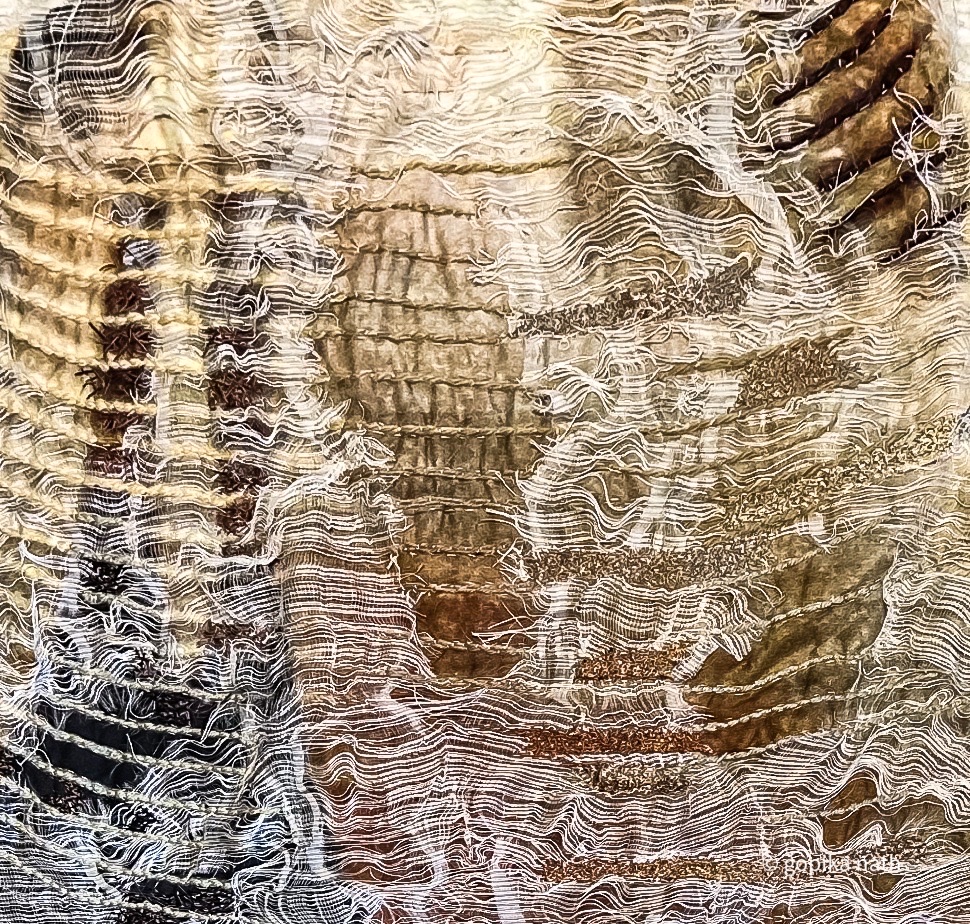
I took a piece of silk organza — not plain, but woven with self-checks, which let me pull out warp and weft threads. I began disturbing the fabric, pulling threads loose, tearing it, and laid it over the shell. I liked the effect, but now the organza was eclipsing the shell entirely. Again: what am I doing? I went with it anyway.

I cut away parts of the organza so some areas of the shell were fully exposed and others stayed veiled. Then I took thicker threads — crochet cotton, wool, whatever I had in the right gauge, in colours drawn from the shell — and couched them along the ridges still visible.

This was layered over the running stitch I had already spent a day doing. For a while I wondered whether that work had simply disappeared beneath the organza. But the quilted texture underneath remained perceptible. Something I could no longer fully see was still affecting the surface, giving it a depth no flat print could have.

I began working over the exposed areas with a crazy cross-stitch — straight stitches placed in an ad hoc way, the thread used almost like paint, building colour in layers. A black area, looked at closely, is never simply black: there’s maroon in it, violet, dark brown, rust, a daub of grey. It took me back to my college days in Delhi, learning watercolour, learning to see the many hues folded into a single colour — a blue inside a green, a pink inside a green. That way of seeing has stayed with me.

But working the cross-stitch over what was already exposed felt redundant — why stitch what I could already see?

So I moved to the areas where the shell was only partly visible through the organza, drawing out fragments of colour and pattern I could barely make out beneath it. I wasn’t reproducing the shell. I was choosing: intensifying some areas, leaving others alone, letting the stitches start large and taper down to something close to seed stitch.

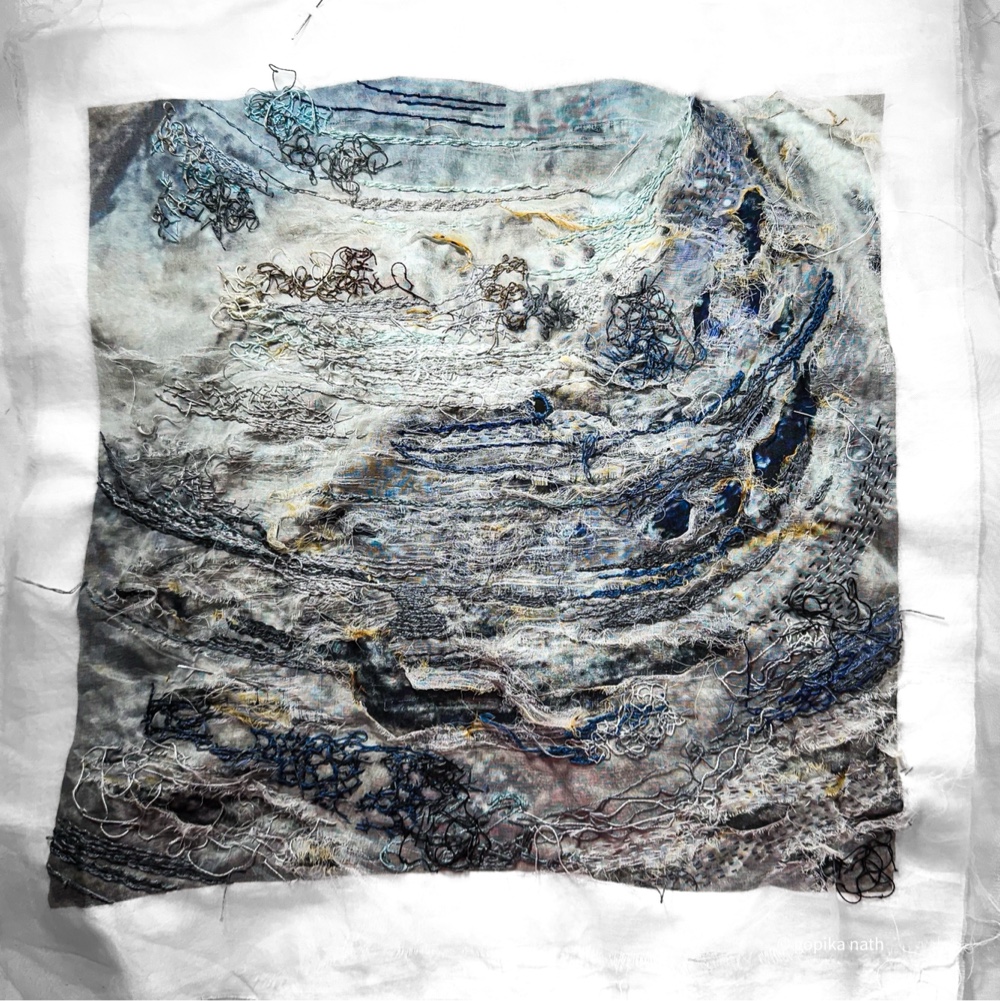
I photographed the piece as it changed. At one point I looked at it and thought: this is like a frame grab from a video. I had somehow grabbed a state of mind.

I had begun with the shell’s pattern already in mind as an analogue for our own psychological patterning — the inherited and learned responses that shape how we react to others, mostly invisible to us until we look. But something else was happening now. The pattern was still there, but no longer whole. A veil had fallen over it, and the veil itself had been torn — some parts of what lay beneath fully visible, some partly, some almost entirely hidden.

I began to see the piece differently: less an illustration of psychological pattern, more a rendering of what it feels like to look at oneself.

The usual explanation — that we repeat our early family dynamics in later relationships — never fully convinced me. It felt too tidy, a category. Life and living are more complex than that —— with many more shades of grey than that suggested framework allows for.

What emerged instead, through the stitching rather than through thinking it out in advance, was something more specific: less about who I was drawn to, more about how I behaved once a relationship had taken hold — the adapting, the allowances, the doubting of my own read on things. That recognition arrived through the making, not before it.

This matters to me because of what it says about how I work. I don’t always begin with an idea and give it form. Sometimes the making does the thinking — shifting the question, showing me a distinction I hadn’t had words for, or revealing that the pattern I’d been taught to look for wasn’t the one actually operating.

We excavate our patterns through experience, often through pain, and come to recognise certain tendencies and where they might have come from. But that awareness doesn’t hand us a complete picture. The veils don’t lift and vanish — they stay, shattered, along with the sense of self we carried before we saw them at all. There is a loss in that seeing too: perhaps of innocence, perhaps that sense of self we were accustomed to. A knowing that was challenged.

Some things become clear. Some we only glimpse. Some we choose to look at directly; others we leave alone.

What I’d made, perhaps, was an image of that: the pattern underneath, the shattered and provisional self, what pain and experience bring into view, and what stays concealed — all present at once, none of it resolved — if it ever can be!

Understanding a pattern doesn’t free you from it. Awareness doesn’t guarantee you’ll recognise it in the moment, or choose differently the next time. We live with what we’ve discovered about ourselves, and with what stays hidden, and with the shattered veils through which we see both.

The piece is still evolving. So, probably, is my understanding of it.

Because I’d started thinking of it as a frame grab, a captured moment, it seemed to need an edge — something to hold it. I began a cross-stitch border on 14 count Aida matte that I’d attached to the original fabric. I haven’t decided how it will end up — even on all four sides or not. But as I worked it, the idea of a border opened out further than simply extending the colours of the shell into the border area.

Borders have been part of my visual vocabulary for years, particularly through designing sarees, where a border is never an afterthought — it has a fundamental relationship with the field it contains.

 I’ve also been drawn to the hashiya in Mughal painting, the margin surrounding the central image, which could carry its own imagery, ornament, calligraphy, or poetry. It didn’t just frame the painting. It ran alongside it, sometimes echoing the centre, or opening a separate layer of meaning entirely — a parallel dialogue. This in particular appealed to me for this piece.

I thought that if the central field holds the visible and obscured pattern, the torn veil, the excavation and the partial seeing, then perhaps the border could carry something else.

I began thinking about words.  They may not describe the image directly, but would  belong  to the same psychological terrain. Repeated around the edge, I visualised them as a pattern with their own meanings. I envisaged them almost disguised and hidden within colours — the pigmentation of the shell fragment that I was extending into the border. 

A border that would no longer simply contain the work. It would carry a parallel dialogue with what the work had revealed to me.