Showing posts with label sand bubbler crabs. Show all posts

Sunday, 14 June 2026

Mind Replays While Tacking


It's almost four in the afternoon. It's been a strange kind of day. Rain, no rain.

As I awoke to the day, looking out of the window, I noticed how serene it looked. So innocent—as if the cloud and the fronds of the palm leaf were cradled in a baby blue crib.

Then, as the day progressed I had to dress my wound. I'd burnt my hand three days ago while cooking. I wasn't exactly careless, but I didn't pay enough attention to the fact that the lip of the new saucepan is a little tricky— doesn't pour neatly—spills and splashes—most annoying.

Anyway, the long and short of it is that I pouring hot soup into the mixie, I burnt the top of  my left hand. A very, very severe burn. After seeing the skin wither and peel off with pus beginning to rise,  I had to go to  a nearby primary healthcare center. They gave  me an injection for the pain, some antibiotics and painkillers. I was yelping in pain. It was really bad—terrible!

I couldn’t stitch for a few days because any movement of the left hand, disturbed the dressing, which in turn aggravated the wound.

It was uncomfortable and I couldn’t help but think how people can inflict this on anybody else, but more than that, how do people self-immolate? I remembered the protests against the Mandal Commission and those students in Delhi setting themselves on fire. I didn’t witness it myself, but newspaper images of young men flailing—their bodies aflame—aren’t easy to forget. I don’t know why my mind went there, but it did. We read about bride burning and such things and it’s awful, but burning my own hand this way made these images come alive as never before.

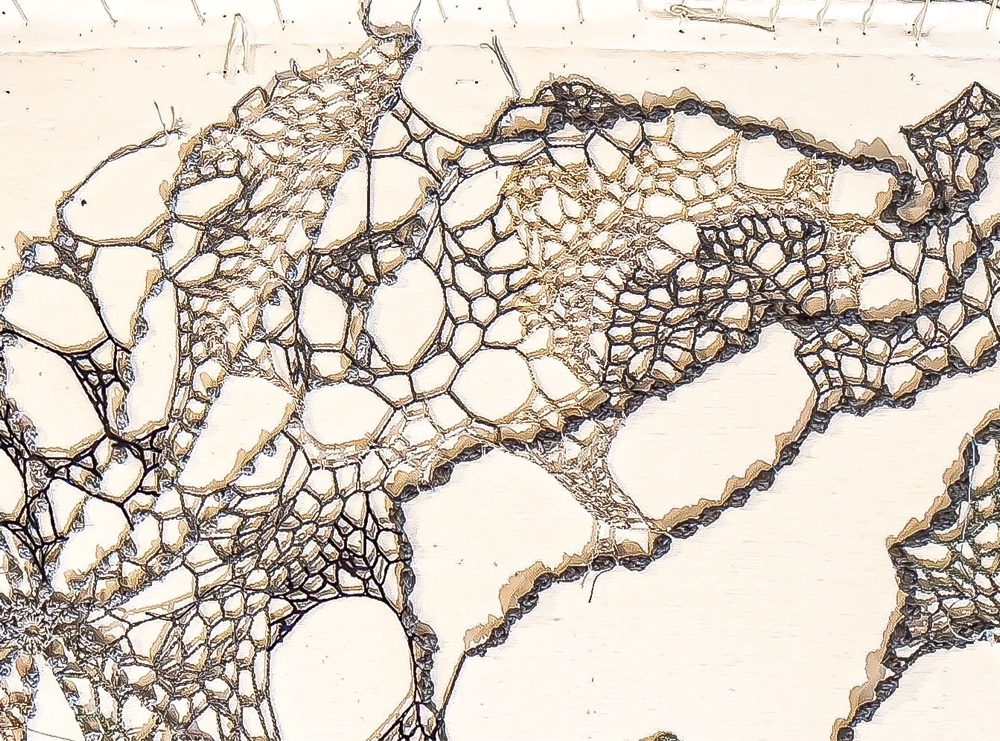
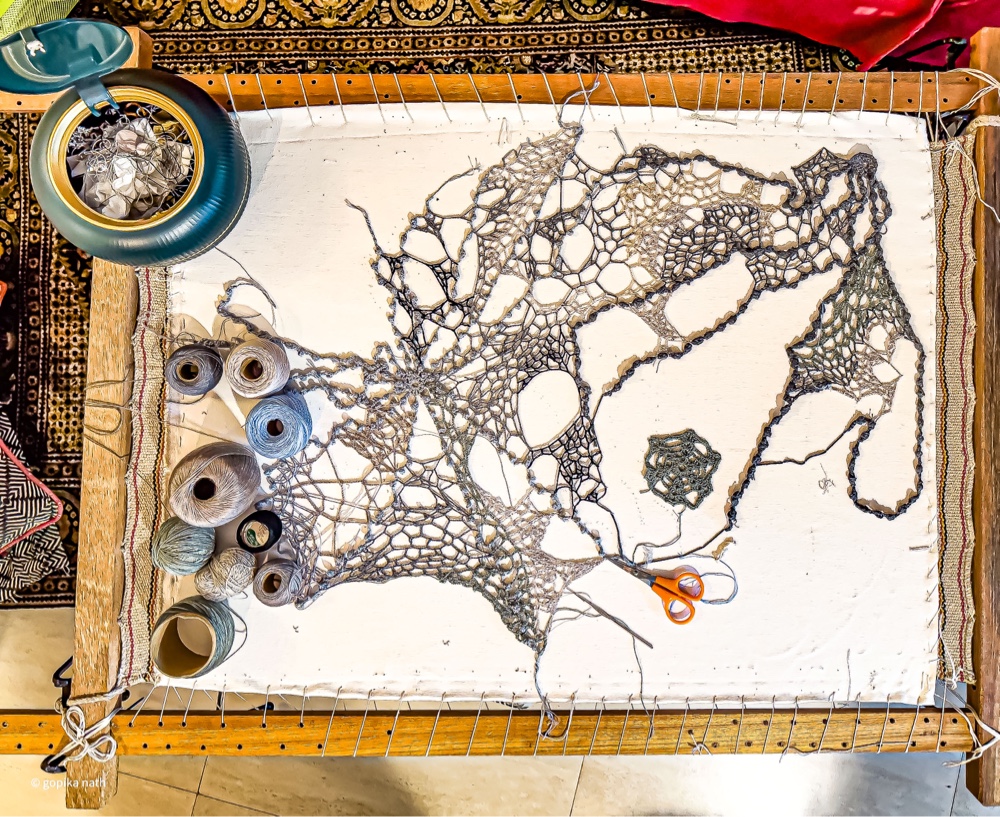
I'm now working on this piece—tentatively called Crab Lace. I've been doing it for a long time and it's taking forever because a lot of tacking work has to be done between the five layers of fabric before I can begin any embroidery. Tacking isn’t something that makes me think too much about what I’m doing. My mind starts replaying all that I have read/heard etc. 

There’s the war in Iran—neither war nor peace, a supposed ceasefire that's not. Glancing at the NYT headlines, disturbed the serenity of the day and what I’d been observing about the weather. Making me think that,  I have the luxury of these gentle moments, even the observations I make about my stitching. Those in war strife zones are striving for basic survival. It seems unfair.

The stitching piece  is inspired by the way the crabs feed off the debris on the beach and in effect clean it for us. Perhaps that’s something we could do for ourselves. Chew on those moments of grief, of pain, of discomfort—digest them.

Now, I have  a knot.  Most uncomfortable. I'm inserting the tip of my needle into the core of the knot, but it is so tight I can't get needle-point into it. If I could, I'd be able to wrestle with it and open it out. It's so tight and so small, I probably need a magnifying glass.

Recently I got news that two of my friends have been diagnosed with cancer. It’s troubling me. My father had cancer and I know what it did to him—to all of us. I know it was decades ago and medicine has made significant advances—but those memories don’t just go away.

I'm holding the thread in my left hand—the burnt hand—it still stings a bit. Between thumb. and index finger, assisted by the second finger, I’ve pulled it taut so that I can try and find the space to inset the needle point to loosen the knot. I'm doing a lot of guesswork because I can’t really see the gap in the threads that have knotted. I have a really fine needle, but maybe I can get a finer one.

Okay, so I've got the finer needle into it. The knot is moving. Now the question is whether I can open it all the way through—unravel the threads to resume stitching.

And I have.
It is so satisfying when you can open a knot.

To me, this  likens  to the wound sitting inside us— things that are knotting in our stomach—the acidity and tension. If you can just release it, it is does indeed lend a sense of satisfaction, doesn’t it?

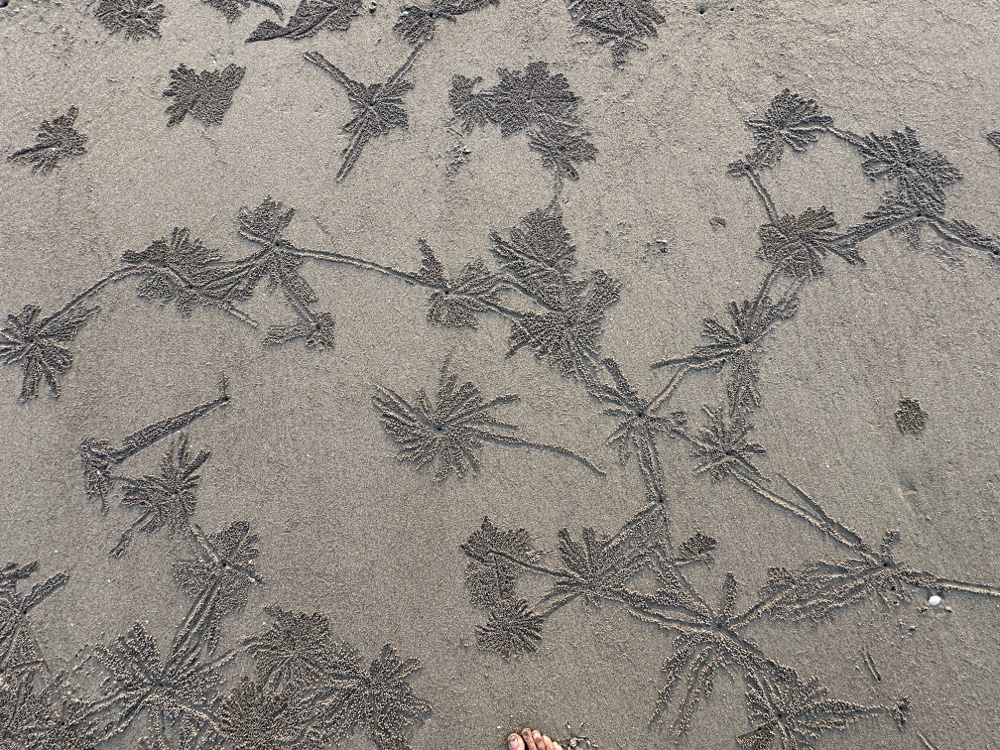
I like the parallel of the crab digesting its food with us digesting our emotions and cleaning up the environment so that subconscious actions don’t create a stench. Rolling bits of sand in its mouth—then rolling it out into minute balls of sand —moving out of its burrow radially and depositing the feeding residue like sand-lace. It’s a  beautiful image that allows me to think there can be, that there is beauty in dealing with our feelings and emotions. The healer in me wants to believe that we can lessen our body suffering if we pay more attention to what's going on in the mind.

Perhaps I've cultivated that kind of sensitivity. Perhaps that's the kind of person I am. It’s certainly the direction my life has taken. It’s arduous, it tedious—much like the labour of the minuscule sand bubbler crab—especially given its size—its  persistence and ardour are memorable. 

see a lot—both a blessing and a curse. Noticing minute details of life around me. Getting easily stimulated. I can be sitting in my room just drinking water and I will notice the sky. Noting changes in the colour, clouds,  how the shadow travels among the leaves and how delectable that vision is—between filling glasses, between sips. 

And then the mind goes to those who live in war-strife zone. These countries, people living in that region  don't have that luxury. But doesn't that make my capacity  all the more pertinent?

Art is made in all sorts of spaces—in many ways that range from being guttural and spontaneous—responsive in a direct way to subtler visuals. The kind of art that I make is slow and can get quite tedious. The immediacy of expression isn’t possible. Even though the impetus to start something is. But Crab lace—the piece I’m presently working on—it’s more about what the crabs do that inspires me than something I’m feeling aggrieved about.

I’ve been  stitching the layers for months. I’m trying to re-create my own version of the patterns I find on the beach. Evoking the kind of residue that emerges once I’ve been through the emotional vortex—what remains. Sometimes I don't want to come and stitch. It's so tedious. It's not giving me a moment of discovery. It's not challenging me technically. It's not challenging me emotionally. It’s just about tacking and more tacking.

And then I talk myself through it, as I am doing now. I've got the audio on my phone on.  And I'm just talking through the stitching so that the moment is as real as it is.

I am processing like the crabs do.

The zigzag stitches from underneath, which I'm not trying to cover, are a subtle expression of the way the mind does work. So many thoughts, so much that comes up when there is a little space from insta, news, fb and the rest of it. 

I've come to the end of my thread, so I'm cutting the tail after I’ve done  two or three repeated stitches in the same place, and then through those two or three threads, I take the needle and and thread out—hopefully it will not come undone. And quite frankly, the kind of piece I am stitching, if it does come undone, it might very well be more evocative than perfect stitching.

I think of my mother who suffered such a great deal with severe osteoarthritis and Parkinson's. For the last two years of her life, she was fed by a tube. She’d beg us for taste of aam papad, coke, chocolate or tea and mangoes. A lick was all she was allowed. I often wonder if she’d paid greater attention to her emotional wounds that her body wouldn’t have had to take on so much suffering. There’s no scientific proof for this, but I think about it all the time. 

I wake each morning wanting to know what I'm feeling. I journal to understand that feeling. Sometimes I have weird dreams and then I write them out, wondering what my subconscious mind is telling me.  Then I’m distracted by a dark-skinned man climbing up my neighbours coconut tree and I lose the thread. Mind screams overload. Is it because I’ve sensitised myself to the subtler dimensions of being, or is this the way it is with all of us—perhaps not consciously?

The world gets uncomfortable with pain. It wants people to move on. But grief doesn't work like that.

As I sip some elaichi chai, the mug I'm drinking from was painted by my school friend Punchie. She paints these mugs with Hopi style, North American—Indian inspired black-and-white designs. As I savour my tea, I think of her:
She recently lost her mother.

Even though I lost my own mother ten months ago, and we didn't have a particularly close relationship, all kinds of wounds continue to surface. Grieving is something you cannot put a timeline on.

Sometimes the thinking and feelings that come up while stitching gets  so intense that I have to get up after half an hour, or even after ten minutes of stitching. I just need a break from it. From the emotional vortex, from focus on both this and the stitching at hand.

I may put on some TV, but honestly that doesn’t really stop the undertow of thoughts—just helps me keep going. And then later at night, I lie awake with what’s bothering me . 


Monday, 16 March 2026

Crab Lace


“The greatest thing a human soul ever does in this world is to see something and tell what it saw in a plain way.”

                                                                   —John Ruskin


When the tide recedes along the beaches of Goa, particularly at Morjim and Ashwem, sand bubbler crabs emerge from their burrows beneath the sand. During high tide they remain hidden deep within these burrows. As the water withdraws, they come out to feed.

Working slowly outward from the mouth of the burrow, each crab takes tiny mouthfuls of sand, extracting organic debris and decaying matter. The cleaned sand is rolled into small pellets and deposited beside them. As they continue this quiet labour, the beach gradually fills with delicate radial fields of pellets — intricate, lace-like traces that mark where the sand has been sifted and cleaned.

These patterns are not decorative. They are the residue of feeding — the visible outcome of a process that clears the beach of organic decay.

What interests me in these formations is not simply their beauty but the logic of their making: emerging from a centre, repeated movements across a surface, and the gradual transformation of feeding residue into patterns that are lace-like—delicate, decorative yet with a physiological purpose that serves the ecosystem.

This embroidered work, that I have recently resumed, began nearly seven years ago with the observation and study of the sand bubbler crab’s behavioural tendencies.

At the time I was learning crochet and was far from adept at it. I began experimenting with the medium because it allowed me to create small bobbled forms that reminded me of the pellet-like residues left by the crabs. I did not initially consider translating these patterns into stitch. Crochet felt like the right technique for the idea.

I started by crocheting thick strands that radiate outward from a burrow-like centre. Along these strands I created pellet-like forms, loosely echoing the residue left by crabs. Each radial element was made individually over time.

Two of these strands were then stretched and lightly stitched onto a canvas mounted on an adda. The adda provides the tension and stability necessary for the work to remain open while I build a net-like structure between the strands. Without anchoring the crocheted elements to this temporary ground, it would not be possible to add further threads or develop the network of connections. Off the frame, the crocheted forms collapse into an amorphous bunch of thread.

Working on the adda also requires my body to move constantly around the frame. As the crochet structure grows, it becomes awkward to reach certain areas from one side, and I shift positions, moving around the frame or sitting on the opposite side to work. Because my studio space is limited, getting in and out of the frame itself becomes part of the process — the body slipping into the structure and then out again, without toppling the frame, in order to reach the next point of connection. I am not formally trained in Irish crochet, and many of the joins emerge through this improvised negotiation between hand, thread, and the physical position of the body around the frame. My discomfort of sitting on the floor, also determines the end result. Partly because it requires me to stop frequently, get up and stretch my legs, which in turn allows me a different perspective.


Once the strands are secured in place, I begin working into the spaces between them.

Using finer crochet threads in muted greys and beiges, I join sections across the gaps. In doing so, I draw on the logic of Irish crochet, where individual motifs are connected through a network of stitches that gradually forms a lace-like field between them.

The materials themselves play an important role in this process. I work with threads of different gauges and fibres — cotton, rayon, and Tencel — each requiring a different crochet hook and producing its own tension and texture. Some threads hold the structure, others create softness or sheen. These variations allow the lace to develop a tactile surface that goes beyond simply emulating the crab patterns.

Sometimes the connections remain light and open, formed by long chains bridging two strands. At other times the space becomes denser and begins to layer. In some areas the lace sits flat against the surface; in others it rises slightly, creating a second layer over the first. The structure gradually becomes a network of overlapping threads and textures. I didn’t like the overlapping layers, so undid them.

These decisions emerge slowly in response to the structure already present. Some areas need openness; others require closer gathering of threads. The hand moves between the strands, joining, adjusting, and undoing, allowing the work to evolve through the negotiation of its internal spaces.

The process is slow and uncertain. Each connection raises questions: how much to join, where the structure should remain open, and how the tension of one section will affect the rest. Because the piece only holds its form while stretched on the frame, every adjustment must be made with awareness of the flexibility of the eventual form. What I see on the frame, may not be what reforms in another space. Quite like site-specific installations.

The eventual shape and structure of the work is still unresolved. I am considering whether it will remain a loose structure, suspended so that its openness remains visible, or whether it might be mounted onto a translucent ground such as organza or net to stabilise it. Its scale also remains fluid. New elements can still be added, but the frame itself sets limits, requiring the work to be repeatedly removed, adjusted, and returned to the surface. And as the crochet progresses, I’m realising that It will not hold in too large a piece as I had initially intended. So, I’ve decided not to add any more radial strands.

I am not attempting to reproduce the crab's patterns. What interests me is the logic of their labour — the transformation of residue through patient, incremental action.

This idea of residue has appeared in my work before. In the Chai series, I looked closely at the stains left behind in a teacup — marks that became a metaphor for the residues carried in the mind. Those works emerged from reflecting on shame: the subtle and overt ways in which individuals are judged, corrected, or diminished by the expectations of family, society, and culture. Shame leaves traces that are not easily erased. Like stains in a cup, these experiences remain embedded within memory and emotion.

For me, the act of making is inseparable from the work of processing feelings and emotions. Visual expression becomes a way of entering that inner labour — giving form to what is otherwise difficult to see or understand. Through the slow repetition of stitch and thread, the work creates a space where emotional residues can be attended to.

Watching the sand bubbler crabs at work, I am struck by their patience. The crab does not attempt to clear the beach in a single gesture. It works through what lies immediately around it, grain by grain. Sometimes the pellets themselves are larger than the crabs that make them.

In my own work, the hand engages in a similar form of labour — attending to what accumulates: the grief that sits unspoken, the anger that has nowhere to go, the fear that returns without warning. The sand bubbler does not merely set the processed sand aside; it digests what it takes in, extracting what can nourish and releasing the rest. Something analogous happens in the slow work of making. As emotional residues are processed rather than suppressed, they lose their density. What was opaque, now finds clarity and relationships can be addressed more consciously.

At another level, it is in that clearing that something deeper becomes reachable. Jung spoke of the collective unconscious — a layer of the psyche beneath personal history, shared across human experience. The relationship we have with ourselves is the only reliable ground we carry through life, and it is only when that ground has been tended — when the accumulated sediment has been worked through — that we become capable of touching what lies beneath the individual: the part of us that is universal—wisdom that has become collectively ours—accumulated through eons of life and living.

Like the patient work of the sand bubbler crab that processes each grain of sand, leaving behind a residue that is delicate and attractive, I imagine that if we did this with our emotional stuff, hard work though it is, we’d be creating these lace-like links between us.

Whatever in our experience of living is not adequately processed—often because the labour feels tedious or time-consuming—returns through unconscious acts and words that can confound and distance relationships. The sand bubbler crabs clean our beaches, so that decaying debris doesn’t leave a stench. Perhaps we could learn something from their labour and its residue.

If my earlier works considered the stain — the mark that remains — this piece turns toward the possibility of working through those residues slowly and attentively, until they begin to form another kind of pattern.

And, I attempt this kind of work beyond my art making. Spending considerable time, often frustrated by having to do so, processing complex feelings to find some measure of clarity. I not only relate to the effort of the sand bubbler; I’m inspired by them to continue with this arduous processing of emotions. Even as I’m often told I’m intense and think too much. I look at them and wonder: do I?