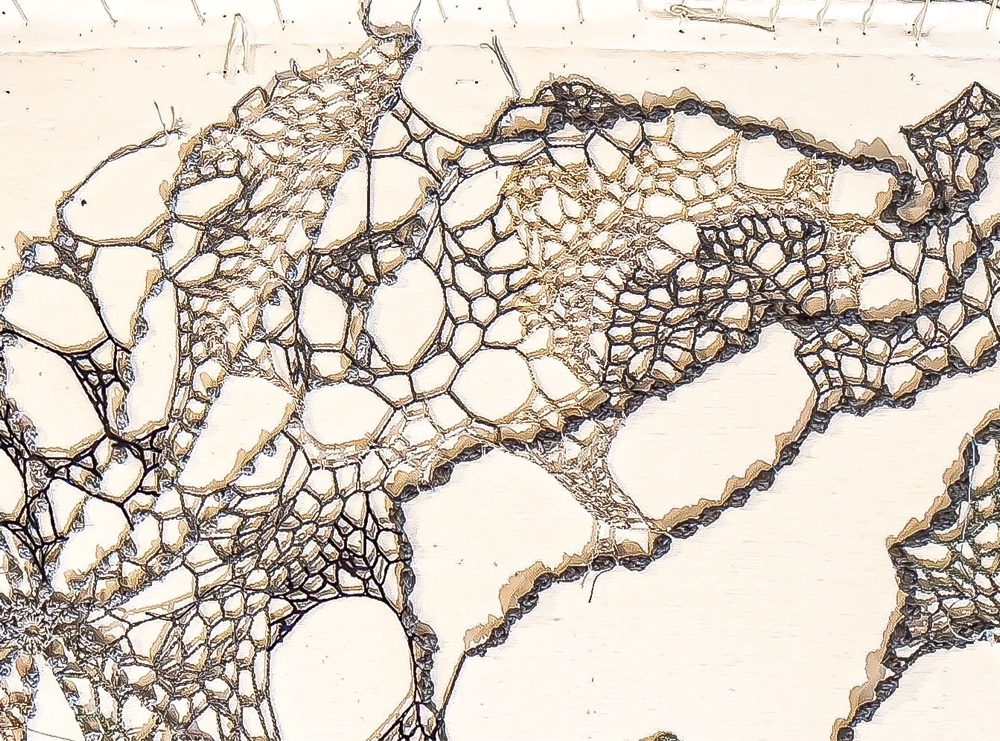
“The greatest thing a human soul ever does in this world is to see something and tell what it saw in a plain way.”
—John Ruskin
When the tide recedes along the beaches of Goa, particularly at Morjim and Ashwem, sand bubbler crabs emerge from their burrows beneath the sand. During high tide they remain hidden deep within these burrows. As the water withdraws, they come out to feed.
Working slowly outward from the mouth of the burrow, each crab takes tiny mouthfuls of sand, extracting organic debris and decaying matter. The cleaned sand is rolled into small pellets and deposited beside them. As they continue this quiet labour, the beach gradually fills with delicate radial fields of pellets — intricate, lace-like traces that mark where the sand has been sifted and cleaned.
These patterns are not decorative. They are the residue of feeding — the visible outcome of a process that clears the beach of organic decay.
What interests me in these formations is not simply their beauty but the logic of their making: emerging from a centre, repeated movements across a surface, and the gradual transformation of feeding residue into patterns that are lace-like—delicate, decorative yet with a physiological purpose that serves the ecosystem.
This embroidered work, that I have recently resumed, began nearly seven years ago with the observation and study of the sand bubbler crab’s behavioural tendencies.
At the time I was learning crochet and was far from adept at it. I began experimenting with the medium because it allowed me to create small bobbled forms that reminded me of the pellet-like residues left by the crabs. I did not initially consider translating these patterns into stitch. Crochet felt like the right technique for the idea.
I started by crocheting thick strands that radiate outward from a burrow-like centre. Along these strands I created pellet-like forms, loosely echoing the residue left by crabs. Each radial element was made individually over time.
Two of these strands were then stretched and lightly stitched onto a canvas mounted on an adda. The adda provides the tension and stability necessary for the work to remain open while I build a net-like structure between the strands. Without anchoring the crocheted elements to this temporary ground, it would not be possible to add further threads or develop the network of connections. Off the frame, the crocheted forms collapse into an amorphous bunch of thread.
Working on the adda also requires my body to move constantly around the frame. As the crochet structure grows, it becomes awkward to reach certain areas from one side, and I shift positions, moving around the frame or sitting on the opposite side to work. Because my studio space is limited, getting in and out of the frame itself becomes part of the process — the body slipping into the structure and then out again, without toppling the frame, in order to reach the next point of connection. I am not formally trained in Irish crochet, and many of the joins emerge through this improvised negotiation between hand, thread, and the physical position of the body around the frame. My discomfort of sitting on the floor, also determines the end result. Partly because it requires me to stop frequently, get up and stretch my legs, which in turn allows me a different perspective.
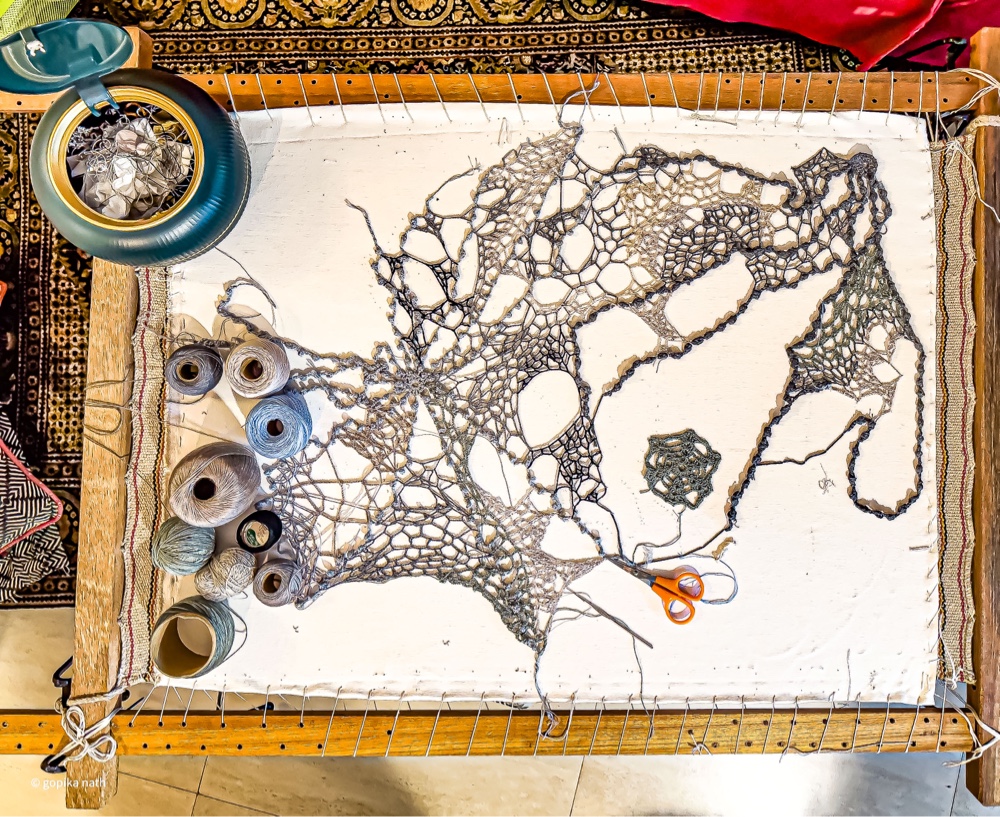
Once the strands are secured in place, I begin working into the spaces between them.
Using finer crochet threads in muted greys and beiges, I join sections across the gaps. In doing so, I draw on the logic of Irish crochet, where individual motifs are connected through a network of stitches that gradually forms a lace-like field between them.
The materials themselves play an important role in this process. I work with threads of different gauges and fibres — cotton, rayon, and Tencel — each requiring a different crochet hook and producing its own tension and texture. Some threads hold the structure, others create softness or sheen. These variations allow the lace to develop a tactile surface that goes beyond simply emulating the crab patterns.
Sometimes the connections remain light and open, formed by long chains bridging two strands. At other times the space becomes denser and begins to layer. In some areas the lace sits flat against the surface; in others it rises slightly, creating a second layer over the first. The structure gradually becomes a network of overlapping threads and textures. I didn’t like the overlapping layers, so undid them.
These decisions emerge slowly in response to the structure already present. Some areas need openness; others require closer gathering of threads. The hand moves between the strands, joining, adjusting, and undoing, allowing the work to evolve through the negotiation of its internal spaces.
The process is slow and uncertain. Each connection raises questions: how much to join, where the structure should remain open, and how the tension of one section will affect the rest. Because the piece only holds its form while stretched on the frame, every adjustment must be made with awareness of the flexibility of the eventual form. What I see on the frame, may not be what reforms in another space. Quite like site-specific installations.
The eventual shape and structure of the work is still unresolved. I am considering whether it will remain a loose structure, suspended so that its openness remains visible, or whether it might be mounted onto a translucent ground such as organza or net to stabilise it. Its scale also remains fluid. New elements can still be added, but the frame itself sets limits, requiring the work to be repeatedly removed, adjusted, and returned to the surface. And as the crochet progresses, I’m realising that It will not hold in too large a piece as I had initially intended. So, I’ve decided not to add any more radial strands.
I am not attempting to reproduce the crab's patterns. What interests me is the logic of their labour — the transformation of residue through patient, incremental action.
This idea of residue has appeared in my work before. In the Chai series, I looked closely at the stains left behind in a teacup — marks that became a metaphor for the residues carried in the mind. Those works emerged from reflecting on shame: the subtle and overt ways in which individuals are judged, corrected, or diminished by the expectations of family, society, and culture. Shame leaves traces that are not easily erased. Like stains in a cup, these experiences remain embedded within memory and emotion.
For me, the act of making is inseparable from the work of processing feelings and emotions. Visual expression becomes a way of entering that inner labour — giving form to what is otherwise difficult to see or understand. Through the slow repetition of stitch and thread, the work creates a space where emotional residues can be attended to.
Watching the sand bubbler crabs at work, I am struck by their patience. The crab does not attempt to clear the beach in a single gesture. It works through what lies immediately around it, grain by grain. Sometimes the pellets themselves are larger than the crabs that make them.
In my own work, the hand engages in a similar form of labour — attending to what accumulates: the grief that sits unspoken, the anger that has nowhere to go, the fear that returns without warning. The sand bubbler does not merely set the processed sand aside; it digests what it takes in, extracting what can nourish and releasing the rest. Something analogous happens in the slow work of making. As emotional residues are processed rather than suppressed, they lose their density. What was opaque, now finds clarity and relationships can be addressed more consciously.
At another level, it is in that clearing that something deeper becomes reachable. Jung spoke of the collective unconscious — a layer of the psyche beneath personal history, shared across human experience. The relationship we have with ourselves is the only reliable ground we carry through life, and it is only when that ground has been tended — when the accumulated sediment has been worked through — that we become capable of touching what lies beneath the individual: the part of us that is universal—wisdom that has become collectively ours—accumulated through eons of life and living.
Like the patient work of the sand bubbler crab that processes each grain of sand, leaving behind a residue that is delicate and attractive, I imagine that if we did this with our emotional stuff, hard work though it is, we’d be creating these lace-like links between us.
Whatever in our experience of living is not adequately processed—often because the labour feels tedious or time-consuming—returns through unconscious acts and words that can confound and distance relationships. The sand bubbler crabs clean our beaches, so that decaying debris doesn’t leave a stench. Perhaps we could learn something from their labour and its residue.
If my earlier works considered the stain — the mark that remains — this piece turns toward the possibility of working through those residues slowly and attentively, until they begin to form another kind of pattern.
And, I attempt this kind of work beyond my art making. Spending considerable time, often frustrated by having to do so, processing complex feelings to find some measure of clarity. I not only relate to the effort of the sand bubbler; I’m inspired by them to continue with this arduous processing of emotions. Even as I’m often told I’m intense and think too much. I look at them and wonder: do I?

Well written and so simply put
ReplyDeleteThank you
Delete