Showing posts with label process. Show all posts

Monday, 30 March 2026

In Conversation With Elaine Mc Bride


When artists speak about their practice, they often describe a clear separation between the mind that conceives the work and the hand that carries it out. The idea originates in thought; the hand simply executes it.

Yet when one listens closely to how makers describe their work, something more complex appears. Decisions emerge during the act of making. Adjustments happen through touch, perception, and repetition. Knowledge seems to reside not only in the mind but in the hand itself.

This is what I have come to think of as the thinking hand—not only what the hand does, but what unfolds through the act of making, before it is fully known.

But this way of understanding making is not always shared.

Reading Elaine McBride’s reflections on her embroidery practice raised precisely this tension. Her description of decades of stitching reveals a process shaped by experience and intuition, yet one in which the hand is still described as executing decisions formed in advance.

What follows is an email conversation between Elaine McBride and myself, where this difference in understanding unfolds.


GN

Elaine, when I read your statement, what struck me was the time you have spent with embroidery. Nearly five decades with the needle is a long time—a duration like that changes the relationship between maker and medium. It can no longer be just about stitching.


EM

Gopika, you are right that the relationship to the medium deepens over time, but for me the turning point wasn’t only the years spent stitching – it was realizing in graduate school that embroidery could operate as a form of image making. Although I grew up around utilitarian textile work, I had not considered it an artistic tool until a course with Renie Breskin Adams revealed that stitches could function like painterly marks. That discovery allowed me to merge my background in drawing and painting with textile technique. From that moment, embroidery became my primary language for narrative imagery, not an extension of domestic practice. The hand and the material were part of the learning curve early on, but my focus quickly shifted toward conveying the idea through the medium rather than exploring the medium itself.

 For nearly five decades, embroidery has been my chosen medium. Since adopting it in 1978, I have refined a process that is now intuitive and largely subconscious. My work aims to reveal essential information while leaving space for the viewer’s own interpretation. Its small scale reflects both its intimacy and my sense of its preciousness.

Through long practice, I understand how colors blend, how stitch direction can imply movement or shape a sense of space, and how a single stitch can function like a painter’s brushstroke. My early training as a painter informs this sensibility; embroidery allows me to maintain that painterly language while embracing the tactile qualities of textile—surface, sheen, weight, and texture. Technique and process serve the imagery, not the other way around.


GN

You say that your stitching process has become intuitive and largely subconscious. I am curious about what happens in that space where intuition takes over.

What interests me here is the phrase: “through long practice, I understand.”

That kind of understanding must develop through repeated encounters between hand, needle, thread, and cloth. And the hand naturally begins to carry knowledge. You describe knowing how stitch direction can imply movement or shape space. A knowledge that seems to emerge in the doing, through memory stored in both hand and mind.

This is what I call the thinking hand—knowledge that arises through the act of making.


EM

I understand the idea of the “thinking hand,” but in my process the conceptual work happens before I begin stitching. I plan the narrative through drawings and compositional studies, and those decisions determine color, stitch direction, and surface effects. Because I have stitched for so many years, the physical act is automatic – the hand simply follows decisions already made. Intuition plays a role, but it grows out of long practice rather than spontaneous discovery in the moment.

I work from impressions and memories that require contemplation, and stitching has become the subconscious means by which those ideas are realized. My choices of thread color and stitch placement require conscious decision-making, but the physical act of stitching is second nature. The hand simply functions as the tool that carries out these decisions.


GN

Here is where I pause.

You describe the hand as carrying out decisions, yet elsewhere you speak about stepping back from the work, evaluating the emotional tone, and adjusting the palette. That suggests a more fluid exchange where progress on the work influences what the next move would be—in terms of stitch, direction of stitch, colour choice, modulation etc.

So I wonder whether the hand is only executing decisions, or whether in the act of making the hand is also shaping them.


EM

Stepping back is essential for me as well, especially given the small scale and close working distance of embroidery. Viewing the work at a distance helps me confirm whether the stitching is supporting the narrative and emotional intention. The hand executes the decisions, but those decisions continue to evolve as I evaluate the image during the process. My eye, not the material, ultimately guides each adjustment.  

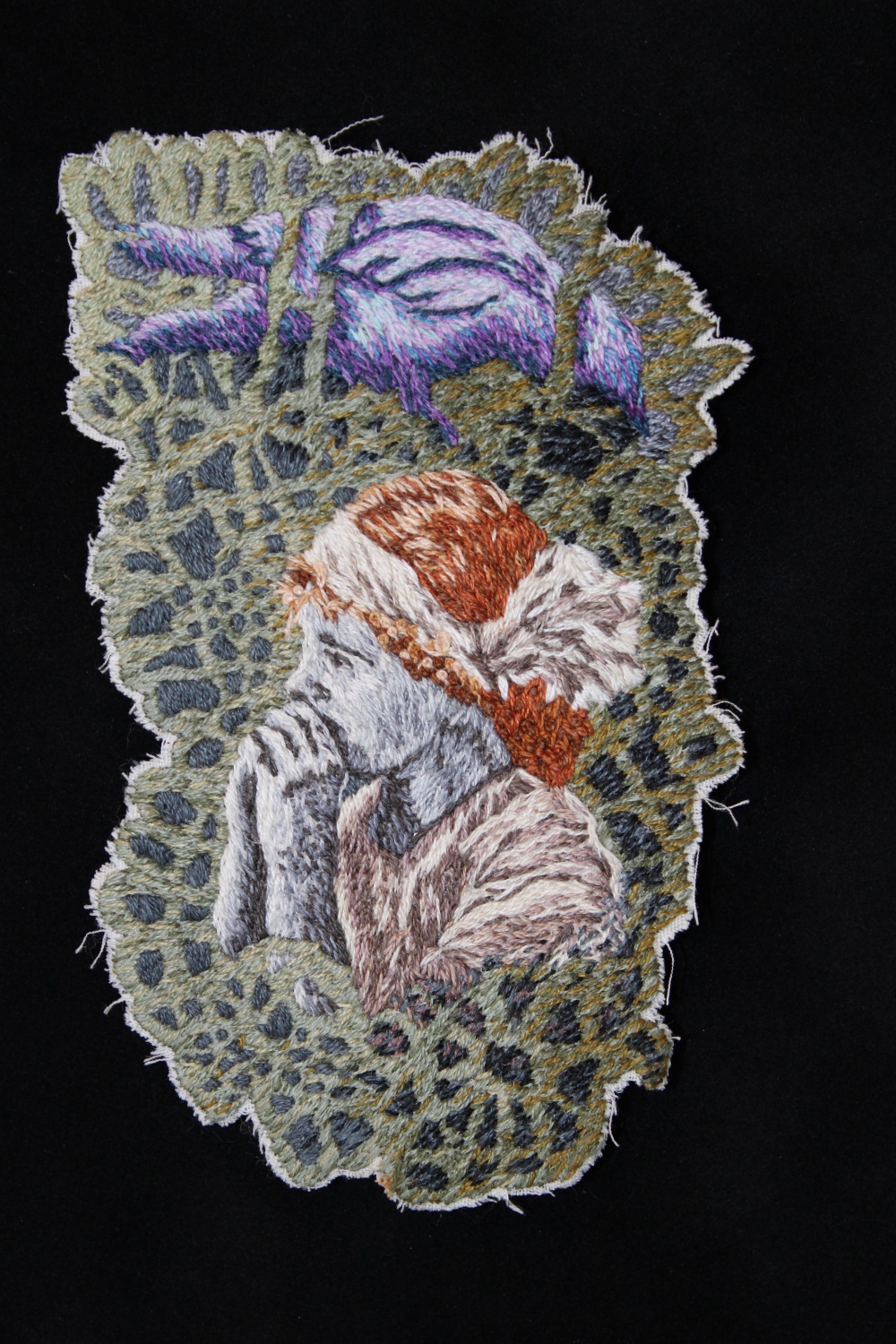
In recent work, I’ve used muted grays and browns to evoke dreamlike spaces softened by memory. Old family photographs often serve as starting points; I gather fragments of the subject and reconstruct them in thread as recollections rather than portraits.

In Incredulous (2024), for example, I repeatedly stepped back from the piece to evaluate its emotional tone. That process led me to mute the background palette so the figure appeared enveloped in quiet ambiguity. Her skin, stitched in grays, browns, and creams, evokes statuary and timelessness.


GN

That moment of stepping back is something I need to do frequently. I don’t work with a drawn image, so here, it’s fundamental for me to keep gauging the next step. But you work with a predetermined narrative and drawing, yet you too stop  to look again and again. The image as it emerges suggests the next move.

In that moment, as a maker you seem to be responding, as I do,  to what the work itself reveals. The cloth and thread are participating in the decision. In the risks you may take, and in the texture and materiality of the finished piece, where the material’s intelligence is also factored in.


EM

I see how your process invites the work to guide the next step, but my approach is more like painting. I begin with a drawn structure, and the embroidery develops within that framework. I aim to fully cover the fabric so the surface becomes analogous to a painted panel, often drawing inspiration from illuminated manuscripts and early miniatures. Although I make adjustments as the work develops, the driving force remains the narrative image rather than the material asserting its own needs.


Constructing each piece is slow and deliberate. I begin with a drawing that establishes the narrative, then refine color and compositional choices while stitching. Embroidery is a lowtech practice, and my decisions evolve from my reflections on the emerging image: warm or cool palette? Depth through contrast or subtle modulation?


My lived experience informs each piece, as does knowledge carried over from prior work. In Chill (2019), a cool palette in the foreground created a harsh, cold environment, contrasted with a vivid, fiery sunset on the horizon. Those visual strategies later informed Flashbulb (2023), where a warm interior contrasts with the cold night sky and ruins beyond the window.


GN

So the work evolves through the act of making. The drawing may establish the narrative, but the embroidery continues the thinking. Experience accumulates in the hand, and each work carries traces of earlier decisions.


EM

Yes, the work continues to evolve as I stitch – just as most artworks change from their initial conception. My experience with color and composition shapes every decision, and the pleasure of working this way lies in discovering how color can define form, space, and mood. Even when I have a plan, the piece still reveals surprising possibilities. That ongoing dialogue is part of what keeps the medium engaging after so many years.

In all of this, the hand remains the tool that executes the idea. It holds the needle, draws the thread, untangles knots, and allows muscle memory to support the process. The narrative and visual decisions come from decades of drawing, painting, and studying color.


GN

Muscle memory is an interesting phrase. Repetition stores patterns of movement in the body. After many years, the hand moves without calculation, yet those movements carry decades of experience. So, is the hand merely a tool?


EM

You are right that muscle memory plays an important role. It allows the hand to place stitches precisely and consistently, which is essential in such detailed work. But I still see the hand as carrying out decisions shaped by years of drawing, painting, and stitching experience. Like a potter on the wheel or a practiced golf swing, the body remembers what it has learned – but the intention and design come first.


GN

I’ve been inspired by many writers in craft, such as Richard Sennett to look deeper into my process. Especially Glenn Adamson observation that “craft is process” has also influenced me. It’s made me become a witness to how I hold the needle, what I do with thread; becoming aware of every decision I once made intuitively through muscle memory. Are there any writers on craft who inspire you or whom you relate to?


EM

The writing that resonates most strongly with me is Ben Mitchell’s The Jewelry of Ken Cory – Play Disguised. Cory’s miniature sculptures elevate the everyday through wit and close observation. His narrative approach mirrors my own interests. Mitchell notes that Cory’s works “tell a story… composed pictorially, as if the pieces had first been drawings and then were rendered in metal and enamel.”

Cory himself said, “My primary concern is the idea behind the piece. Design follows idea.” His prioritization of narrative and concept reflects how I think about my work; technique is essential, but always in service to the story.


GN

Your reference to Cory is revealing. You place narrative and idea at the center of the work, yet acknowledge how technique itself shapes the stitched narrative.  The direction of a stitch, the blending of thread, and the modulation of tone influence how your stories are embroidered on cloth.


EM

After more than fortyeight years with needle and muslin, stitching feels as natural as breathing. I often stitch in the evenings, as my grandmothers did when I watched them quilt, mend, and embroider.

Though my studio supports the planning stages, the act of stitching has become a familiar daily rhythm. Each piece still feels like a discovery, and each new work quickly becomes my favorite until the next one emerges.

At 74, embroidery is inseparable from who I am. It is not merely what I do—it is how I know, remember, and translate experience. I want the intelligence of muscle memory and the quiet accumulation of years to register on cloth and to let memory and material meet through the simplest of stitches.


GN

When you say embroidery is how you know and remember, that brings us close to what I would call the thinking hand. Not the hand as a passive instrument of thought, but the hand as an active participant through which knowledge unfolds within the act of making—where the conversation between hand, mind, needle, cloth, and thread continues to evolve.

In my own work, I often begin without a fixed image. A stitch is placed, and only then does the next decision become visible. The direction of thread, the density of the surface, the way colour settles into the cloth—these are not predetermined. They emerge in response to what is already there. In that moment, the hand is not executing a plan; it is discovering the work as it unfolds.


EM

Your perspective has given me a new way of considering how the hand participates in making. Earlier in my career I may have been more aware of that connection, but now my attention is centered on constructing the narrative image. Still, I appreciate the idea that the hand holds its own form of knowledge. Continuing to stitch keeps me engaged and grounded, and I am grateful for the chance to reflect on these ideas through our conversation.



Thursday, 22 January 2026

Observations of Stitching Without A Script


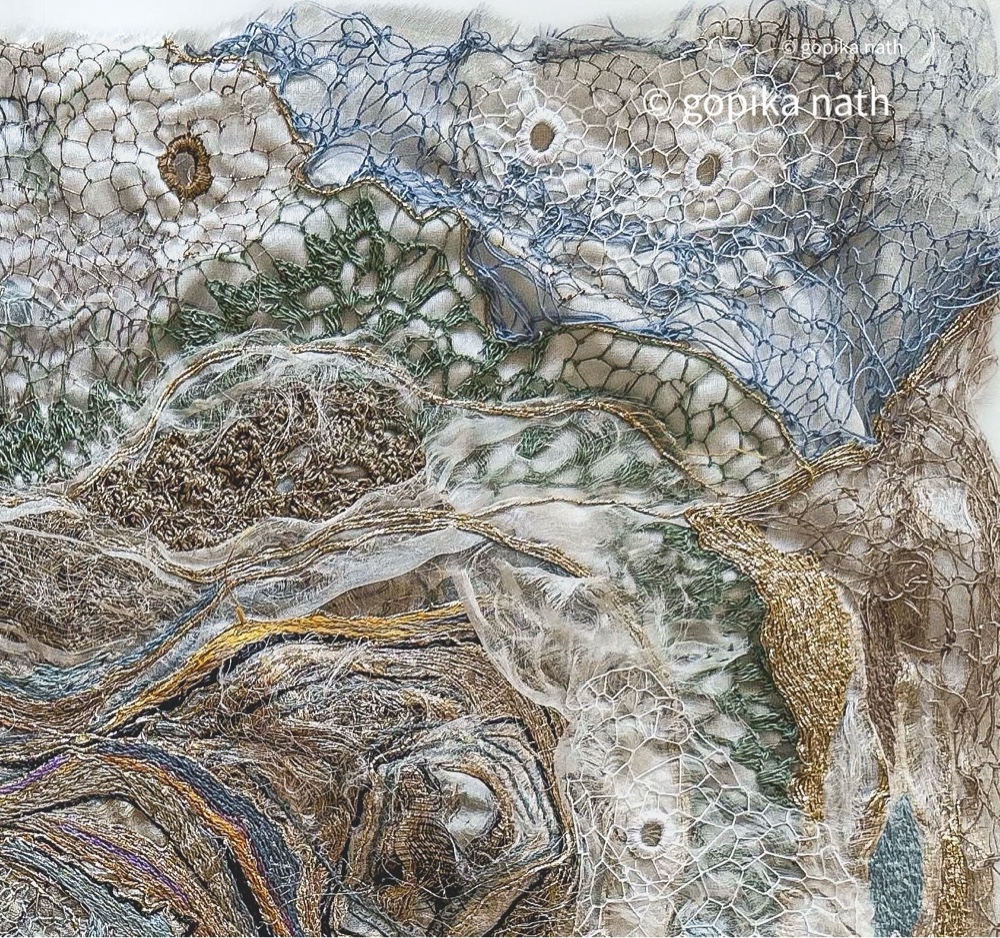
Today, while couching the six ply zari, I found myself moving beyond the original knitted lines. Those lines rose and fell like tidal waves, vertical yet fluid, and I wanted to honour that undulation. At the same time, I had to break it. I couldn’t fill everything. Something had to give.

So the work became a series of decisions. Where to begin. Where to stop. Where the thread should turn. How much of the line to keep. How many lines were enough. I would place the thread, finish one run, put it aside, then stand up and look. Step back. Return. Decide again.

This is where I have arrived through practice. What David Pye named the workmanship of risk describes this precisely: a way of working in which quality is never assured in advance, and where every move carries consequence. Nothing is secured by a plan. The work lives or fails in the moment of making.

When there is a design, you don’t have to do this. You simply follow what has already been decided. But I am not working from a fixed design. I am working from a space I don’t quite have a word for yet, where attention replaces certainty, and where decisions are made in response to what unfolds rather than what is prescribed.

This is often called intuitive, but that feels insufficient. What is actually happening is a conversation. The material pushes back. The line resists or yields. The hand answers. Form emerges through this exchange— what Tim Ingold describes as correspondence: making as an ongoing dialogue rather than an act of control.

The original impulse came from co-creation: the sun on water, water on sand, wind on water, ripples in sand. The glinting light. That moment of recognition that nothing is made alone, that form is always relational. You know this, but sometimes it becomes clear only through the act of looking— being present. And, I’ve chosen to investigate it further through making—stitching.

I am using gold as light. And light, for me, is wisdom. Not ornament, but perception. In that sense, thinking through craft, as suggested by Glenn Adamson, is not an abstract position but something that happens in the work itself, in judgment, hesitation, revision, and care. As I read his book on the subject, I became curious as to its academic stance. Adamson is not a maker, he’s an art historian and scholar, attempting to locate craft within the fine art mileu. I am too, in a sense. But his writing inspired to me to articulate the nuances of my stitch-craft-art making practice from within it, rather than as a academic who observes, their uses and writes.

Working so much with gold has also made me more aware of how this material is received. Zari, sheen, surface, what might easily be dismissed as bling. Even though it comes from a long and specific lineage, the certified art world is uneasy with this kind of material density and materiality. Textiles are of interest to the art world today, but they are expected to transcend themselves, to become something else in order to be taken seriously.

What I am doing does none of that. These are small works. Twelve inches, fourteen, sixteen at most. They stay firmly within the language of stitch, of couching, of repetition and adjustment. I am not trying to dismantle categories or reinvent technique. I am staying inside what these materials already know how to do. In fact, I revel in the materiality — in the infinite possibility that textile, embroidery, crochet, knit and their materials give scope for, in terms of expression—making art. And for me, art is what Ananda Coomaraswamy wrote: that it wasn’t what you did, but how you did it, that made it art—devotion and  presence presided rather than  the intellectual concept that fine art now revers.

My work is demanding. It asks for sustained attention, judgment, and presence. Much of it is about watching myself work, noticing how decisions are made, how hesitation enters, how form slowly clarifies. I work as an artist, but I do so through material insistence rather than conceptual distance. The thinking is not above the work. It is embedded in the stitch, in the process, in the insistence of the hand.

So each day I am finding my way through it. Slowly. Sometimes reluctantly. There are moments when, despite stitching being somatic and grounding, I resist returning to it. Not because it is difficult, but because it demands decision-making. Presence. Accountability.

This is where risk lives. Not in grand gestures, but in choosing without a script. In staying with uncertainty long enough for the work to reveal what it needs to become.

There is also a question that sits alongside all of this, and I don’t yet have a clear answer to it. While academics may want to analyse what the craftsperson does — how decisions are made, where risk enters, how the hand moves, how the material responds — language always comes later. It describes what has already happened.

What I am more interested in is what this awareness actually does to the making.

At the moment, I find myself watching myself work. Not judging or correcting, just noticing. How a decision forms. Where hesitation enters. When a line feels complete and when it doesn’t. It feels a bit like being a witness to yourself while you are still living, still inside the act.

Perhaps the merit of this awareness is not only for the person making the work. If the making is clearer, if the decisions are more present, then the work itself may carry that clarity. It may also allow the viewer to come closer, to sense how the piece was arrived at, not through explanation but through looking.

This may shift the experience of viewing. Less emphasis on what the work is saying, and more attention to how it came into being. A slower, more intimate relationship with the work.

At the same time, for me, meaning  and process are entangled. What the work says emerges through how it is made. The decisions, the risks, the material itself — all of this shapes the work’s voice. I am not interested in choosing between concept and craft. The work holds both.

It is also clear to me that  reading Adamson, Pyle, Ingold and others has fed back into the work. I might not have thought of what I am doing in terms of risk, or noticed it so clearly, if I hadn’t read David Pye, or thought about correspondence in the way Tim Ingold describes it, or encountered Glenn Adamson’s writing on thinking through craft. The ideas did not replace the experience, but they gave me a language that sharpened my attention. I began to see what I was already doing.


Wednesday, 14 January 2026

A Walk With The Chitari


I often drive down to Sawantwadi for Ayurvedic treatments. It’s about an hour’s drive through the Western Ghats, across vast tracts of green fields and rivers. Over the last few years, I must have been there ten times, perhaps more. Each time, I told myself that I would visit Chitari Aali. And each time, I didn’t.

This week, I finally did.

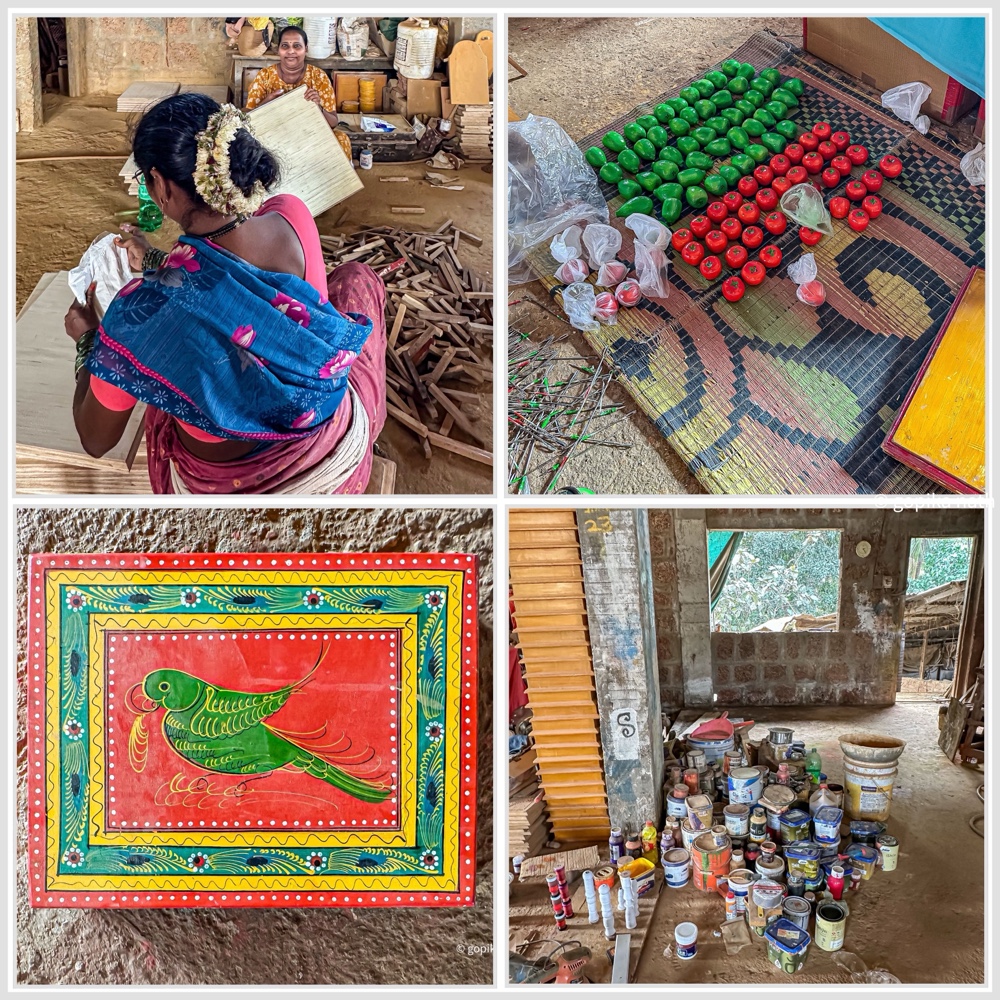
I left early. I had time. I stopped at the Sawantwadi Palace, asked for directions while having a cold coffee, then followed the route I was given. I parked the car just below the aali and walked up. The market rose on a hill, a fairly steep climb, lined with all kinds of wares being sold along the way. At the top, I turned right and found a couple of small shops selling wooden toys, painted objects, and familiar Chitari forms.

I entered the first shop and said, quite simply, that I wanted to see where the work was made.

A young man named Prabhakar came out. He told me that his elder brother was the designer and that he could take me to their factory. It was in Kolgaon, about four kilometres from there. I said yes.

He sat in the car and I drove to Kolgaon.

The workshop was registered as Kamalanayan Handicraft Centre in the name of Pratibha G. Chitari, Amit’s wife. We climbed the stairs to the first floor, took off our chappals, and entered the space. The building was semi-constructed. There were no windows, only openings for them. No doors, only door frames. The staircase had no banister. The floor was bare cement. As I walked around, I noticed cobwebs everywhere. The machines were carefully covered, I imagine because they are expensive, costing a few lakhs each.

It was only after arriving that I learnt it was a Monday, when the region does not get electricity. So no production was happening. The machines were silent.

And yet, work was still going on.

Bhargav, the youngest brother, brought Amit to meet me. As we talked, Amit sat down to paint a large Ganjifa wall piece depicting the Dashavatara of Vishnu—a commissioned work. There were only three workers present that day. One was packing wooden fruits made from moulds. Two others were preparing wooden panels for painting, applying Fevicol, sanding, polishing.

Before Amit arrived, I spoke briefly to a couple of them. Sonali Chauhan had grown up in this village, married here, and has been working in the workshop for about five years. She handles most of the preparatory processes. I asked her what the work felt like to her, how she thought about it, how she experienced it.

All she said was,  “achcha lagta hai.”

I asked why, what she liked about it. She paused, as if to think, but merely reiterated, “achcha lagta hai.”

There were no words for it, perhaps no need to think. Perhaps the language lay in the doing itself. Sustained, skilled making is known to generate a particular bodily chemistry: endorphins that soften effort, dopamine that registers quiet satisfaction when action meets intention, and oxytocin associated with calm, trust, and nervous-system ease. These states do not arrive as thoughts or explanations. They register as sensation, steadiness, absorption, a sense that the body is at home in what it is doing. Articulated simply as “achcha lagta hai”, this is not a lack of language, but a bodily coherence that does not ask to be translated.

What I am trying to name here is not what she lacks, but what I am attempting to do. Her “achcha lagta hai” is a complete articulation within the conditions of her work. My search for language belongs to a different practice, one that asks what happens when attention, reflection, and articulation are allowed to accompany making, not to replace embodied satisfaction, but to create another kind of value around working with the hand.

It was only after this exchange that I began speaking more fully with Amit. One of the biggest surprises was learning that he had studied at the JJ School of Art and later worked in the film industry, before choosing to return to the family profession. He is a fourth-generation Chitari artisan and introduced himself quite simply as Amit Chitari.

His father worked without machines. Amit works with them. The machines do not replace the hand, they assist it. He explained that earlier, the left hand would turn the wood and the right hand would shape it. Now, the machine does the work of the left hand, while the right hand continues to shape. The intelligence of the hand remains.

They use woods like shivan, jamun, mango, and sheesham


, woods often considered waste wood. Shivan, in fact, is a wood I know well; my own desk is made from it. Amit told me they use roughly a thousand gun-feet of wood, though whether that was per month or per year was not entirely clear. What was clear was that government support is minimal, permissions are complicated, and survival dictates scale and repetition.

What struck me was not the absence of skill or intelligence, but the absence of time. No time to finish the building. No time to install windows or doors. No time to clean the space. No time to pause and articulate what the work means, how it feels, or where it might go next.

When I spoke to Amit about my own practice, about how sometimes the needle seems to take over, to hold sway, he understood immediately. But he didn’t have a language for it.

And that stayed with me.

Chitari art is not native to Sawantwadi, though it is now closely associated with it. The craft has its roots in Cuncolim in South Goa, where the Chitari community practised wood carving, painting, and lacquer work. Historical accounts suggest that during the seventeenth and eighteenth centuries, members of the Bhonsle royal family encountered Chitari artisans while in Goa. When the Bhonsles later established themselves in Sawantwadi, these artisans are believed to have travelled with them.

Over time, Sawantwadi became a centre for Chitari work, particularly wooden toys, lacquered objects, and later Ganjifa playing cards, shaped by royal patronage and market demand. The craft adapted in order to survive.

Today, the Geographical Indication tag for Chitari art is held by the Sawantwadi Palace, not by individual artisans or the town at large. While this offers visibility and institutional recognition, it also fixes the craft within a controlled framework. Artisans continue to carry the skill, labour, and continuity of the tradition, but authorship, naming, and the right to define what counts as Chitari largely sit outside their individual control.

Knowing this history made my visit to the workshop feel differently weighted. What I was seeing was not simply a family business struggling with time and resources, but a lineage shaped by migration, patronage, and survival, a craft that has learned to endure by staying close to what is sanctioned and saleable. As Amit put it, “hum apna kuch nahin daal sakte”, we cannot add anything of our own.

It surprised me that, despite having studied Fine Arts at a prestigious institution, Amit did not feel drawn towards creating even small departures from the Chitari script, forms that might retain technical and material continuity while allowing some personal inflection.

In other craft sectors, particularly textiles, one has seen innovation emerge through exposure to new markets, foreign buyers, and collaborations with designers and artists. The infrastructure often remains the same, the looms, the courtyards, the animals nearby, but the product is reimagined to meet new contexts.

Perhaps this is what is missing in Chitari practice, not ability, but exposure. There is enough business within the known script that there is no necessity to devise new forms or colours.

Craft and hand-making are among the oldest human inclinations. I remember reading, long ago, that it took five thousand years for sculptors to perfect the meditative repose of the Buddha, generations refining an eye, a fold, a posture, inching towards stillness. Today, we are no longer perfecting skill in that way. We are inventing beyond it. Variety and novelty define the predilections of the marketplace.

At the level of Chitari practice, the work is not oriented towards representational improvement or personal meaning-making in the way contemporary practitioners like myself might frame it. It is oriented towards subsistence, carrying forward a cultural and family lineage through repetition, skill, and continuity.

Amit barely has time to meet market demand, to keep the workshop running, to generate income. Sitting with this, I found myself turning inward, asking questions about my own practice.

As I write this, I am aware that these questions have been arising alongside my own stitching practice. In recent weeks, sitting with cloth and thread, I have been paying attention to posture, to the way the needle sometimes seems to take over, to how memory does not return as narrative but as structure. Unlike the Chitari workshop, I have the scope to notice this, to dwell, to articulate it. That difference is not one of imagination, but of conditions. What I am able to reflect on in stitching is not separate from what I witnessed in Kolgaon; it is shaped by a different ecology of time, language, and permission.

But this also raised its own set of questions. What am I doing. Why am I doing it. Does paying attention to process, going deeper into it, create a different kind of value. Does it deepen understanding. Does it change how craft is seen or valued. And can that kind of attention ever be of relevance to craftsmen like Amit.

I don’t have answers yet. What I have is an encounter, a space, a set of hands at work, and a growing awareness of how differently thinking and making are allowed to unfold.

Three decades ago, when I first began working as an artist-craftsperson, my impulse was to bring that work into an art gallery space, to see whether visibility and context might generate value. Over time, I realised that the gallery was not enough. It could show the work, but not the thinking, the negotiations with material, the discipline of repetition, or the quiet intelligence of the hand. This stitch journal emerged from that recognition. It is an attempt to invite the reader inside practice, to attend to how history shapes and material behaves, how posture shapes attention, how the hand learns, insists, adapts. In setting my own practice alongside encounters such as this one with the Chitaris, I am not proposing improvement or intervention. I am asking whether language, attention, and reflection might create a different kind of value for working with the hand, one that I can articulate from where I stand, and that I hope may, in time, also speak back to traditions that have rarely been asked to speak for themselves.

For now, that is enough to sit with.