Showing posts with label self expression. Show all posts

Sunday, 19 December 2021

Personal Threads: The Needlecraft Road, Guest Post by Beth Arnold (assisted by Julia Robinson Shimuzu)

It started with a skid on the low pile carpet at work, then a shaky left foot, then a slow uneven gait, my left arm no longer swinging…it was Parkinson’s.  It does not and will not define me.  My needlework defines me.  My travels define me.  My family defines me.  

Several years ago, on a weekend beach trip in southern California with two women who also have PD, we stopped at a needlework shop in Ventura where I found a kit for a glorious, red-headed counted-cross stitch Mermaid.  She came with beads and required over 40 skeins of colored cotton embroidery floss.  I bought the kit and ordered olive green 30-count linen.  I could not wait to get started.   I love going through my collection of embroidery thread that is organized by number, pulling out the ones I have and making a list of those I don’t.  I also love going to the craft store and pulling the new colors I need.  Over the years I have worked on her and she now stands at about 80% complete. 


Mermaid

When I told a good friend about my predicament with my mermaid she said “your mermaid is beautiful and unfinished, just like you”.  And I thought, she is right, at least about the unfinished part.  She taught me that I have more to give, more art to create where I will be inspired and energized by color and texture and flowers and my travels. 


Wild Flower

My husband was working in the Bay Area for several years while I remained in Los Angeles and I had many nights and weekends alone where my Mermaid kept me company along with other needle crafts like knitting, embroidery and sewing (both hand and machine).  That ended a few years ago and I put my mermaid and other projects aside after my husband and I bought a new home on a hill that we have decked out with interior and exterior entertainment spaces.  My favorite is our rose terrace that has over 30 rose bushes.   Sometimes I joke that I raise roses in lieu of not having children.  We also have a parterre, fruit trees and a Zen garden with topiaries.  We have a lovely view of the glen from our living area bay window.  

About a year ago I started having double vision. My doctor says it’s the PD.  One of the many odd PD symptoms.   There is nothing to be done.  My fine motor skills are also changing, making it harder to thread a needle and sew or knit or write or type when I am “off”.  This “off” period that can vary but in my case is about an hour, refers to the transition time between medication doses which I take at six different times a day.  So we go on and off, up and down, just like in sewing.  

It was startling when I realized I could no longer work on my Mermaid. Thirty count linen was just too small and I have not been able to find a comfortable magnifier stronger than the one I own.  So I started anew with a blank slate thinking of what I could make with my growing collection of tulle, felted wool, beads, fabric and metallic thread.  Starting with my tulle collection I did an internet search and learned you can singe the edge of a round piece of tulle to make flower petals.  I made a few small flowers this way and sewed them on little felt jewelry pouches.

I began thinking about how I could use the tulle in other ways. For years I have been buying up tulle remnants from fabric stores, tucking them in a drawer to my craft table.  Like with the embroidery floss, I adored the colors and the idea that something fancy could be made with them and I needed to own as many as I could find on sale. 

I have always enjoyed close up pictures of flowers, maybe from the influence of Georgia O’Keefe who I discovered in college, and ever since getting my first camera I have taken hundreds of flower close-ups from places I have traveled to such as Red Butte Gardens in Salt Lake City, Utah. It was particularly “fruitful.” On a trip to Denmark in the midd-80’s I fell in love with their brightly colored Danish Flower Thread, cross-stitched linen botanical designs.  


Yellow Embroidered Pillow 

With the grace of God, I was inspired to pull up a few of my flower photos and began piecing together the felted wool and tulle petals in small tapestries.  I needed to hold the tulle and felt in place.  I tried stabbing wool roving into both and the result was really pleasing.  I am able to use the wool roving like oil paint, mixing color, using contrasting colors. It was thrilling to find online retailers selling roving samplers. I now own over 100 colors.  I recently organized my roving using “The Secret Lives of Color” by Kassia St. Clair.    There were names I have never heard of before like “woad” (in the blue family) and “verdigris”.  I spent hours grouping and re-grouping my lovely colors into eight boxes like a rainbow. 

To help use felted wool remnants and add unique detail to my tapestries, I use small dots or beads for tiny [part of flower that looks like dots].  To make this easier I purchased a Japanese punch needle for making small wool dots.  Oh, and I also have lots of beads, purchased at General Bead in San Francisco (can you imagine two floors of colored beads)? I’m also building up my metallic thread collection


Daffodils 

My interest in needle felting goes back to 2005 when I befriended a little neighbor girl who love doing “hands-on” projects with me.   I found a kit for her to make a penguin using wool roving.   That is when I first started working with roving.  Like embroidery floss, it comes in many colors.  A few years later I stumbled on a shop called “The Wool Lady”, now sadly closed, and I got my first taste for felted wool applique. 


Tapestry 1, Daffodils

The colors, textures and designs were endless.  I became interested in Jacobean designs and made several pillow tops with intricate designs.   [photo?] I continued to make counted cross stitch pieces, looking for patterns with lots of color.  [consider photo of partially finished mermaid – cannot see to finis due to PD – caused blurry vision] Parkinson’s can affect fine motor skills so my hand-writing has become a mess unless I go super slow.  This makes embroidery and knitting difficult so I schedule my crafting that requires a steady hand during my “on” times.

Tapestry 2

My mom would be so pleased to see my latest creations. She grew up on a small farm in Buffalo, Kentucky and her mom, my Grandma Mom, moved around the south because my great grandfather was a heavy handed school teacher and kept getting fired.  Both my mom and grandma influenced my interest in crafts.  My grandma crocheted me a colorful doll blanket using remnants.  I think that may have been my first experience with fiber arts and I was certainly captured by the colors in my blanket. The blanket sits safely in my cedar chest. 


Grandma's Colorful Crocheted Blanket


My mom went on to be a homemaker with four of us kids, me being the oldest. My first memory of sewing is with her using her old Singer sewing machine. She made clothes for my Chatty Cathy doll. A favorite is a purple grape print with white rickrack. And my mom made most of my clothes (we wore uniforms to school).  One year my mom made red flannel pajamas (3 girls and 1 boy) for each of us.  Can you imagine all that red flannel?!! Her work was beautifully done and immaculate.


Red Flannel Pyjamas


My mom taught me to sew on her Singer and I made rudimentary attempts at making doll clothes.  As a girl scout I learned about embroidery and our troop leader taught us how to knit using sharpened No. 2 pencils for needles!


Pink Dress

In high school I took   Home Economics and continued honing my sewing skills. By the time I started college, I was able to make blouses, dresses and skirts.   My freshman year I took a life-drawing class.  I will never forget my embarrassment seeing a stark naked man for the first time.  The model at one point turned his seat so he faced me and then took a pose where he pointed directly at me!  

I took art history classes in additional to business administration and planned to become a CPA.  And once out of college I headed to Texas to begin my career in accounting and finance.  

Having little money, I made most of my clothes including blazers and skirts and blouses.  After passing the CPA exam I had more free time and that afforded me visits to art museums and galleries which I had loved since my teens when my dad introduced them to me on a family trip to NYC. Over the years I took various painting classes.  I loved oil painting and mixing and merging colors.  As I progressed in my career over the years I spent less time sewing my own clothes and painting (oils are pretty messy and having proper space and light became an issue.) But I always planned to come back to oil painting.

To satisfy my creative leanings I continued to knit, sew, embroider over the years.  I have a habit of not finishing my knitting and embroidery projects. Fortunately, our new home has a small basement and a loft in the garage, affording me space to safely store my work.  I sometimes wonder how many hours were consumed while I thought about work problems that needed solving or family issues or what to fix for dinner. I always planned on returning to my projects when I retired.   


Beth Arnold with her friend Julia
who helped type out her story

Life is a wonderful journey.  My niece recently told me she wants to learn to knit.  And she inherited mom’s old singer sewing machine. I look forward to showing her my mermaid and other projects.  Maybe she will be interested in my tapestries too. It’s comforting to know during these pandemic times with so many options and distractions to know that some of life’s basics matter.  Sewing, knitting, embroidery live on.


I am 62 years old (and) live in Los Angeles (I) was diagnosed with Parkinson’s over 10 years ago. (I) love color love art love wildflowers especially thistle. I’ve started making small tapestries using some of my favorite media: tool, wool, beads, metallic thread here is a couple of examples Based on some of my own photographs. (this is how Beth introduced herself to me via email. Parkinson's makes it hard for her to type, so I have left the typos intact. Her friend Julia assisted in  putting together this story, which took quite a while.


Beth Arnold is a retired chief financial officer who has been battling Parkinson’s disease since 2009, when she was diagnosed, at the age of 50. Her lifelong passion for color has been satisfied by working with embroidery, knitting, oil painting and most recently tapestries where she combines felted wool, wool roving, beads and metallic thread to make colorful tapestries inspired by her own botanical photographs taken during her travels. 

Saturday, 13 October 2018

Personal Threads: I Stitch To Pray. Guest post by Reverend Annabel Barber


Journal and sketch-book covers (on the theme of the sea)
made in 2018, using cotton fabric coloured using ‘inktense’ blocks,
shells, sheer fabric, threads, sequins and glass beads.
Techniques include piecing, applique, couching,
hand-stitching, and machine quilting

Quilting. There’s a word that breathes life into my soul! The piecing together of fragments and leftovers to make something ‘new’ and beautiful. I am not an artist. I stitch to pray and to grapple with scripture (like Jacob, ‘I will not let you go until you bless me!’). I experiment and, as with all experiments, I learn from those that don’t work, which become the unfinished, the UFOs that sometimes haunt me.
 
 
Me as a baby in a dress my godmother
hand-made and hand-smocked for me.


I was born in a home for unmarried mothers in the late 1950s. I write this sentence knowing that it doesn’t convey the pain, shame and cruelty my birth mother endured. At six weeks old I was removed from every trace of her and my heritage, and given a completely different life, on a Lincolnshire farm. The fields around me formed a changing patchwork of colours, green in spring, apart from the beautiful wild golden fields of daffodils, growing in the flat Dutch-like landscape. In autumn the vista changed to the golden-white of the ripe corn, and then the rich red brown of newly turned fertile soil after ploughing. Maybe that’s why I spend my time diligently piecing a colourful patchwork of fabric together!


The Path to Heaven, Wall-hanging.  2013/14
after a quilt retreat in Colorado led by Ricky Tims.
Made using hand dyed cotton, hand-dyed silk velvet, and beads.
Techniques used include applique, piecing, hand and machine quilting,
 hand and machine embroidery and hand beading. 


When I show my quilts (mainly to church groups, those I hope will ‘get’ something of what I am trying to do), I am always asked two questions: ‘How long does it take to make one of these?’ And ‘How did you first start quilting?’ The first question is unanswerable. Each project takes my whole life, and everything I have experienced, sometimes I cannot finish a project for years because I haven’t yet acquired the skills I need for it.
 
 
The Path to Heaven (close-up) .  2013/14 . 

But it is easy to explain how I started. I remind my audience of ‘Golden Hands’, a long-running series of UK magazines from the 1960s and 70s. These magazines (cheaply bought in bulk from the local newsagent when they were out-of-date), with their clear instructions and good illustrations were my teachers, along with my adoptive mother, who was an exquisite needlewoman and knitter. She had been orphaned at 16, and mainly picked up her skills from friends and their mothers. It enabled them all to creatively make more of their ration coupons during the Second World War. She lived in lodgings for some years before her marriage, having moved from the urban sprawl of Bradford to the small Lincolnshire town of Louth to be near her older brother. One particularly talented friend of hers became my godmother, and made beautiful smocked dresses to celebrate my arrival in the family. As a child. I didn’t have the patience to master my mother’s skills, too fond of time spent with my head in a book! And I was always one for speed over accuracy – she described my dress-making as ‘blowing things together’! Living on a farm everything had a practical purpose, no cross-stitch samplers for us! I sewed to make clothes. Patchwork was putting leftover scraps and bits from the rag-bag together – not that I actually made much with them, they were ongoing projects, a bit like life.


Loaves and Fishes wall-hanging, 2012 .
Exhibited at the 2013 Sacred Threads exhibition in Virginia (USA).
This quilt shows the loaves and fishes from the feeding of the 5000,
one of the greatest miracles. Christ takes the simple food a child offers,
blesses it and feeds those who are hungry. We each have our gifts,
our loaves and fishes that can feed the world, both physically
and spiritually. But it takes courage to offer something of ourselves,
 to come to Jesus and give him what we have and allow him to use it for others.
 And too often our society seems to be saying “But I want a burger and fries,
not loaves and fish!” Using cotton, mixed fibres, sequins and lace.
Techniques used include applique, piecing, hand and machine quilting. 


Life. Which took me away from the farm and the countryside. Which made me choose between art, English, and science. At 18, in 1977, I chose science, went to University in Leeds to do a BSc in Pharmacology, and then into a job in science publishing. At least I could be creative with the use of words,  and this was the closest I could get to stitching together the disparate drivers in my life.
 

Loaves and Fishes wall-hanging, 2012 . close-up.
Using cotton, mixed fibres, sequins and lace.
Techniques used include applique, piecing, hand and machine quilting. 

But what about faith? That I certainly didn’t get from my adoptive family, who were occasional reluctant attenders at church at best. But it has always been the foundation, the bedrock of my life. As a child from the age of seven I used to walk to where the long drive of the adjacent farm ended, to be collected for church and Sunday School in the local town. I remember my surprise when I began to realise that not everyone talked with God as I did. Even as a child I made my own rituals to keep me safe.

 
Detail from a quilt made for the school where my daughter taught. Begun in 2008, finished in 2017. I wanted the children to have something comforting to cuddle under in their ‘Reading corner’. Cotton, machine pieced and quilted.

I grew up, married, and our family grew with our first child being born in 1988. My sewing kept me (relatively) sane, and then in 1993 we went to Texas. The (UK) Cambridge-based company my husband worked for wanted him to relocate to Austin, so when he was needed in the US for the launch of a project the family went too, to experience first-hand a little of what living in America was like. My two older children were three and five, and it wasn’t an easy visit until I met the quilters.


Detail from wall-hanging of Jonah in the belly of the Whale
made in 2016. It was made as my response to the Biblical
story of Jonah being swallowed by the whale.
Cotton hand-dyed material, beads.
Techniques are machine quilting and hand sewing.

I had braved the Austin traffic to drive to a Quilter’s Guild meeting to hear Doreen Speckman speak. A wonderful evening, and beautiful, inspiring quilts. Everyone was kind, but I was shy and out of my depth. At the end of the evening, I inadvertently left through the wrong door and, disoriented, couldn’t find where I had parked my car. An enormous white Cadillac drew up alongside me, driven by a very small lady who could just about see over the steering wheel. With her help I found, not only my car, but laughter and loving friends who sustained me during the rest of the visit. My remaining time in Austin was swept into sewing days with my new-found friends, who even lent me a Singer Featherweight to use during my visit. I still have the ‘watercolour’ quilt pieced on that machine. They shared fabric with me, and taught me about American strip-piecing. They were greatly amused by my Laura Ashley fabric laboriously pieced over paper hexagons, which really wasn’t the ‘done’ thing in 1990s America.
 

Baby quilt made for a church fund-raiser (2017).
Cotton fabric, machine pieced and quilted.

After a few months, I came back to the UK having realised that I was too European to thrive in America. There’s quite a gap between the pioneering spirit of America, and the deep historic rootedness that I had discovered in myself. During our visit, I reacted by becoming more English as the days went on, and was in danger of demanding cucumber sandwiches with my Earl Grey tea at 5.00pm each day! But I came back having been well and truly bitten by the patchwork bug.


In 1995 I enrolled on a 2-year, City and Guilds adult-education course on Patchwork and Quilting, learning technique after technique, grappling with art and design, and ignoring the lectures on colour (I value my innate colour sense, and didn’t want to be ‘taught out’ of using my instincts). My third child arrived early, just before I finished the course, and I patched and pieced my chaotic life together. I pieced through a sudden move from Cambridge to York. I sewed through loneliness of being uprooted from a village to city living, and medical emergencies that spiralled as my both my father and mother’s health deteriorated, and my brother had a liver transplant. And then I began training as a Spiritual Director.
 

Mandala wall-hanging created during Ann Myrhe’s online course
(Mandala Unplugged, 2018). Cotton fabric, silk ribbon, beads,
silk and metallic threads. Techniques include knitting, crochet,
silk ribbon embroidery, applique, (all hand-stitched).

‘Draw Hope’, was our first  assignment for the course. So frustrating, as I have the same innate ability to draw as a giraffe. I went home, pieced-together ‘Hope’ from fabric and took it to the group a couple of weeks later. Something astonishing happened. Everyone related to quilted ‘Hope’ from where they were, they saw things in the piece that resonated for them, but which had not been part of my intention. I suddenly became aware that I could connect visually, spirit to spirit, in a completely different way. I could ‘speak’ my soul in cloth.

After a long illness my brother died, and stitch became my only prayer as I walked through grief. The slow journey to priesthood quickened in me and I sewed my spiritual autobiography (I’m not sure this is what my tutors expected when they said we could submit the assignment ‘in any form’). I designed the silk stole in which I was ordained Deacon, and which I wore again when I became a Priest a year later, in 2005.


Safe to shore (close-up) wall-hanging (2017). Made as an example piece for a retreat I shall be facilitating later this year. Cotton hand-dyed and commercial fabrics, shells, lace and glass beads. Techniques include piecing, applique, hand embroidery and machine quilting.

I stitched through my three years as a Curate, which is the initial training post that all Church of England clergy take up, it felt a bit like being a Priest with training wheels! I continued to stitch through the challenges of being a hospital chaplain in a deprived ex-fishing town, the post I went to when my 3-year curacy ended. I stitched through my own tears when stillborn babies were born in the hospital to very young couples, or when I accompanied and prayed for patients and their families who struggled to come to terms with the realisation that life is ending. Sometimes I helped family members while away a long bedside vigil with stitching and prayer. Sitting at my own father’s bedside as he lost his battle with cancer I took up knitting again, the companionable silence that fell with the rhythmic click of the needles as I knitted socks had a calming effect on us both.


Fair Isle knitted cushion cover (2008 my design)


A fellow priest’s description of the difference between painting as art and as prayer released me to share my spiritual musings in stitch with others. ‘Art’ had an external value, it could be ‘judged’, given a pass or fail, sometimes it wasn’t ‘good enough’.  But prayer is about my connection with God and the life of the Spirit, there is no judgement in it, it is always good enough for God, and sometimes it may have something to say to other people as well. Creativity seems to flow across disciplines and is many people’s main connection with the Creator God. Encouraging and fostering creativity in craft enables people to be creative in other areas of their lives. Learning stitching can help someone find a new pathway through grief, or the rhythm of hand-stitching or knitting can enable the quiet rhythm of prayer. My congregation in Waddington have, I hope, benefitted from events that involve creativity - cutting and sticking for the little ones, colouring, card making, origami or sewing for the more mature in the congregation. We mark St Michael’s day (our patron saint) each year with an impressive celebration of dragons and Saint-inspired crafts before a short service and simple shared meal.
 

My first attempt at goldwork (2018)!

Maybe it is the rhythm of the needle that is prayer to me. Certainly I have seen its calming effect on retreatants during textile art retreats that I have facilitated for the Creative Arts Retreat Movement. Maybe it is my own need to piece together the broken that drives me. Maybe I am stitching my fractured soul together. But, for me, patchwork is prayer, and I am so grateful to those who have helped me to this realisation. Maybe it is ‘only patchwork’, ‘craft not art’, but patchwork has taken me to places I would never have dreamed of visiting. It has given me friendships that I will always value, and truly for me is ‘peace work’.


Washed-up! (work in progress 2018) wall-hanging.
Cotton and nylon fabric and sheers, beachcombed shells,
embroidery threads. The background was machine quilted
and then ‘crashed’, shells applied under sheers,
with cross stitch and some hand embroidery


Annabel R. Barber MA, is Rector of the parish of Waddington near Lincoln in the UK. She is also Rural Dean of Graffoe Deanery, and is involved in the ministry of spiritual direction. She occasionally facilitates retreats and quiet days for the Creative Arts Retreat Movement (CARM). More information about CARM, and the retreats and quiet days that it organises can be found on their website: http://www.carmretreats.org or on facebook: https://www.facebook.com/CARMRetreats/


Sunday, 8 October 2017

Personal Threads: Louise Bourgeois: An Unfolding Portrait, by Uma Nair, India, Guest Post


Louise Bourgeois, from her Fabric Book [Image Courtsey MOMA/Uma Nair]

“Clothing is...an exercise of memory...
It makes me explore the past...
how did I feel when I wore that..

                                
                                                -  Louise Bourgeois
Louise Bourgeois, threads in a spidery format -
her favourite theme, [image sourced from internet]

MOMA will have a select retrospective of Louise Bourgeois opening at the end of this month [September 2017 – January 2018]. Among the many drawings sculptures and prints will be a fabric book created by her, which I saw as an exhibition in Washington DC in 1997.
Why do I a humble critic from India consider it a personal thread ?
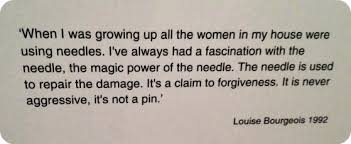
The magic power of the Needle - Louise Bourgeois quote 1992, [image sourced from internet]
I read and researched about Bourgeois and realised that she held thread and needles as close to her as confidants. Bourgeois’ connection to fabric goes back to her childhood years when she helped out in her family’s tapestry restoration workshop. As an adult, she long associated the act of sewing with repairing on a symbolic level, as she attempted to fix the damage she caused in personal relationships. She even held a special regard for spools of thread and needles as tools -she considered important instruments in the service of man.
Louise Bourgeois - another fabric creation
 on her best known theme of spiders
[image sourced from internet]


Fabric became her ally-her medium of dreams and fantasies and her narrator-fabric became her sculptural element .In the 1990s, as she began to mine material from clothes accumulated over a lifetime. She hung old dresses, slips, and nightwear in installations, and then manipulated timeworn terry cloth into nearly life-size figures or eerie portrait-like heads.
Louise Bourgeois Pink Days and Blue Days. 1997.
Steel, fabric, bone, mixed media.
 Collection Whitney Museum of American Art
[image sourced from internet]

 In 1999, she hired a seamstress, Mercedes Katz, to help with this work and set her up in a workshop-like area on the lower level of her house, where she also installed two small printing presses. By 2000, Bourgeois had turned to printing on old handkerchiefs, and then other fabrics. She also constructed books of fabric collages.


Louise Bourgeois - Spider [image courtsey MOMA/Uma Nair]
Printing on fabric was a major preoccupation of Bourgeois’s later years and she highly valued her collaboration with Katz and the various printers with whom she worked. The greatest lesson in honesty came from her sharing the truth about her collaborations. The old fabrics  resonated with memories .She made use of technology, and  took advantage of digital possibilities for duplicating aging or fading effects. In contrast to her prints and books on paper, Bourgeois’s fabric works have a tactile presence that gives them a decidedly sculptural dimension. Delicacy of line and an intensity of poise and purpose define her fabric books. Of course her greatest work The Spider 1997  is a sublime collaboration of Steel, tapestry, wood, glass, fabric, rubber, silver, gold and bone .
Louise Bourgeois, Louise Bourgeois, Maman, 1999,
Steel, 35 ft in height, Tate Modern, London [image sourced from internet]
Her words stand as a symbolism for all ages. “The spider—why the spider? Because my best friend was my mother and she was deliberate, clever, patient, soothing, reasonable, dainty, subtle, indispensable, neat, and as useful as a spider.”
Louise Bourgeois
[image sourced from internet]
‘Louise Bourgeois: An Unfolding Portrait’ at MOMA, for architectural digest is currently on display  till January 2018. It explores the prints, books, and creative process of the celebrated sculptor Louise Bourgeois (1911–2010), whose extraordinary creative process is the organizing principle behind the exhibition, highlighting the themes constantly revisited in her art, all of which emerged from emotions she struggled with for a lifetime.Uma Nair has reviewed this exhibition for Architecural Digest.
Uma Nair is art critic of 30 years.  She considers multiple media, including textiles, as one of the greatest testimonies of art that can last a lifetime. In an India that has been invaded by western wear she still wears saris that go back 30 to 40 years. She writes as critic for Architectural Digest, The Hindu and Millennium Post, other than her own blog PlUMAge on Times of India.

Monday, 22 August 2016

Personal Threads: Rendering With Needle and Thread - Guest Post by Richard McVetis [UK]


Richard_McVetis
Title - 29:59
Materials & technique - Hand stitch on wool / Straight stitch / insertion stitch
Dimensions - 6cm x 6cm x 6cm
2016


As an introvert and a perfectionist, embroidery is more than just about mark making but about taking control and slowing down parts of my day. It’s become a recharge point where I can collect my thoughts and take time out. It also allows for an intimate relationship with the work.  

Richard_McVetis
Title - Units of Time (detail)
Materials & technique - Hand stitch on wool / Seed stitch / Straight stitch / Insertion stitch
Dimensions - 6cm x 6cm x 6cm each cube / Total – 18cm x 20cm x 12cm
2015


The introduction to embroidery was an accident. It was a visit to the open day of an Embroidery degree at Manchester Metropolitan University that really opened my mind to the broad sense of embroidery as medium for expression. What attracted me to this place was the chance to learn one of world’s oldest crafts whilst exploiting the contemporary possibilities of this medium at the same time. The diversity and exploration of the medium was liberating. 


Richard_McVetis
Title – Light Abstraction Mid-East
Materials & technique - Hand stitch on wool / Seed stitch
Dimensions - 47cm x 47cm
2015


My need to explore I think stems from my childhood and the things I was able to experience and see. In 1982 my parents immigrated to South Africa, and the following year I was born. As a white child in apartheid South Africa everything was normal and I knew no other way of life, in reflection it’s hard to believe that we were part of that system. Since leaving in 1992 I have always tried to ask questions, to not except the normal and through art understand my purpose. This has given rise to many opportunities to live in different countries, Iceland, Norway and Spain to name a few. All of which have contributed to my outlook, inclusivity and aesthetic.  
 

Richard_McVetis
Title – Proportions of a Male Figure (detail )
Materials & technique - Hand stitch on wool
Dimensions – 53cm x 70cm
2011


My artistic practice centres on my training as an embroiderer through the use of traditional hand stitch techniques and mark making. Laboured and meticulously worked wools, multiples of embroidered dots and crosses explore the similarities between pen on paper and thread on fabric. I use a limited vocabulary of mark making and deliberately subdue the colour to create a binary simplicity.

After Manchester I then headed to The Royal College of Art to do an MA in Textiles. My tutor was artist Freddie Robins. She was supportive and allowed us to discover our own paths; challenging me to think about my own practice. I was fortunate to have great tutors at the RCA and Manchester. All of who still provide me with inspiration and motivation to pursue a life in art. My time at the RCA was a challenge but so valuable and enjoyable, I was able to explore the scale of my work and think more about my use materials.  
  

Richard_McVetis
Title - Light Abstraction NYC
Materials &technique - Hand stitch on wool / Seed stitch
Dimensions – 47cm x 47cm
2015


As a child the medium I had most access to, was pen and paper. I would create entire worlds on the back pages of my school exercise book, building and destroying futuristic cities with a black ballpoint pen. The miniature scale of these worlds I created is a key element in the understanding and organising of space that I have now. I found this method of drawing with black ink to be very satisfying and my interest in this continued right through to high school and college. One inspiring book I remember particularly well and one to which I refer to on many occasions is Van Nostrands ‘Manual of Rendering With Pen and Ink’. I loved the idea that with pen and ink you were able to explore and create different subtleties in texture and materials. 
 

Richard_McVetis
Title - 29:59
Materials & technique - Hand stitch on wool / Straight stitch / insertion stitch
Dimensions - 6cm x 6cm x 6cm
2016


Embroidery for me has become an extension of this exploration of surface through rendering.  Substituting the ink for thread and the paper for fabric.  The subtle dimension of stitch continues to fascinate me. When I’m stitching I’m endeavoring to recreate the flatness of pen on paper. 
 

Richard_McVetis
Title - Units of Time
Materials & technique - Hand stitch on wool / Seed stitch / Straight stitch / Insertion stitch
Dimensions – 6cm x 6cm x 6cm each cube / Total – 18cm x 20cm x 12cm
2015


Today, my work reflects a preoccupation with process and its ritualistic, repetitive nature exploring the subtle differences that emerge within the repetition process. In addition, mapping out space, marking time and form are central themes. My most recent series of work ‘Units of Time’ is an enquiry into the way time and place are felt, experienced and constructed. Ideas are often developed in response to, or created specific to a moment, visualising and making time a tactile and tangible object. The pieces created explore how objects, materials and places through the action of hands bear witness to the passing of time.
 

Richard_McVetis
Title – My Grey Pencil Case
Materials & technique - Hand stitch on canvas
Dimensions – 22cm x 39cm
2008


This dimension of time within textiles is also evident in earlier works ‘My Grey Pencil Case’ traces the movement of my body over a period of a few years, unpicking the seams of the pencil case to reveal a drawing on the inner surface, pens and pencils secretly recording the rhythms of daily life. ‘Five o’clock Shadow’ is a more obvious record of a specific moment, capturing the shadow of my partner on a sunny parquet floor in Madrid. The title also references the invisibility of time, revealed only through the processes of our bodies.
 

Richard_McVetis
Title – Five o’clock shadow
Materials & technique - Hand stitch on wool / Straight stitch
Dimensions – 19cm x 19cm
2013


Many of the patterns that inspire me happen to be the ones that are very rarely noticed. These patterns are part of your everyday, a place you pass routinely, the metal tread of a station entrance or the shadow created by the morning sun light. Taking notice of these, removing them from their context, elevating the mundane to a higher status. London, the city I now live in, is full of these moments, beautiful and unnoticed. These moments are punctuations of time; slowing me down in what it quite a fast paced way of life. Through embroidery I try to capture these moments. The embroidered cubes, the compositions, constellations and arrangements that I create, directly reference the urban grid and my transient relationship to the built-up environment. 
 

Richard_McVetis
Title - Units of Time - Formation II
Materials & technique - Hand stitch on wool
Dimensions - 6cm x 6cm x 6cm each cube
2015

This year sees further exploration of my embroidered cubes. I’m excited by their architectural characteristics and the possibilities they have to affect a large space. When grouped and arranged in constellations the cubes take on a whole new dimension.  To explore this further I have begun work on my most ambitious piece of work that I will present next year at Collect 2017: The International Art Fair for Contemporary Objects as part of the Collect Open in partnership with the Crafts Council. This piece draws inspiration from the work of artist Sol Lewitt and the systems we employ to measure time. My aim for this new work is to show time and form as both logical and playful, as an ever-present invisible force. This work also demonstrates my continuing obsessive drive to make.


Richard McVetis is a British artist-maker, known for his meticulously embroidered drawings and objects. Since his training in the traditional process of embroidery at The Royal College of Art, he has been exploring his pre-occupation with process and its ritualistic and repetitive nature for over ten years.

Richard is based at Kingsgate Workshops, West Hampstead, London. His work has been exhibited across the UK, North America, France, Ukraine and Korea.

More of his work can be seen on his website: http://www.richardmcvetis.co.uk/