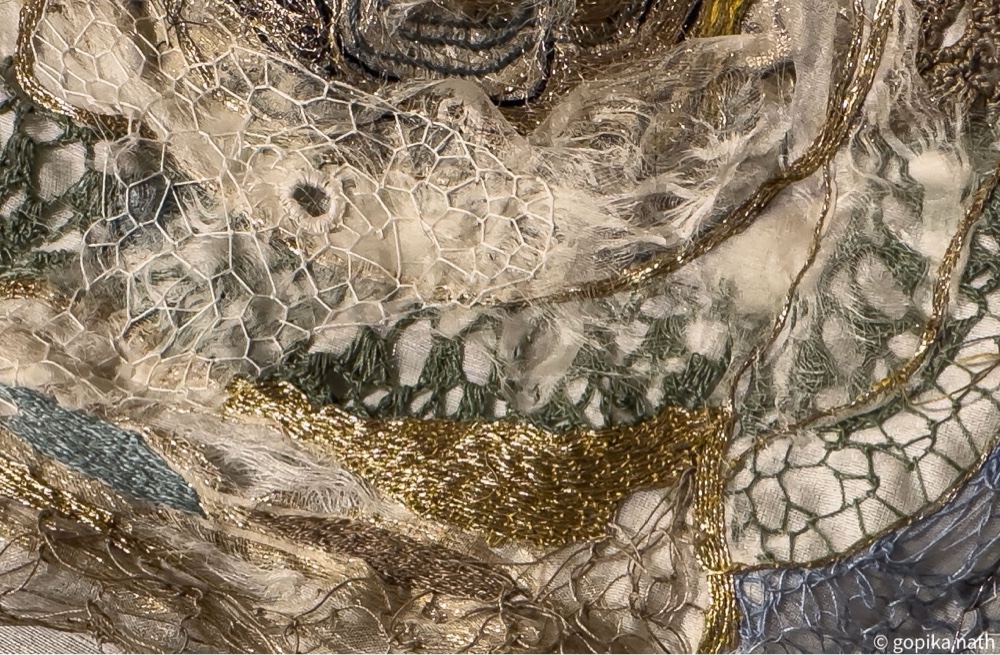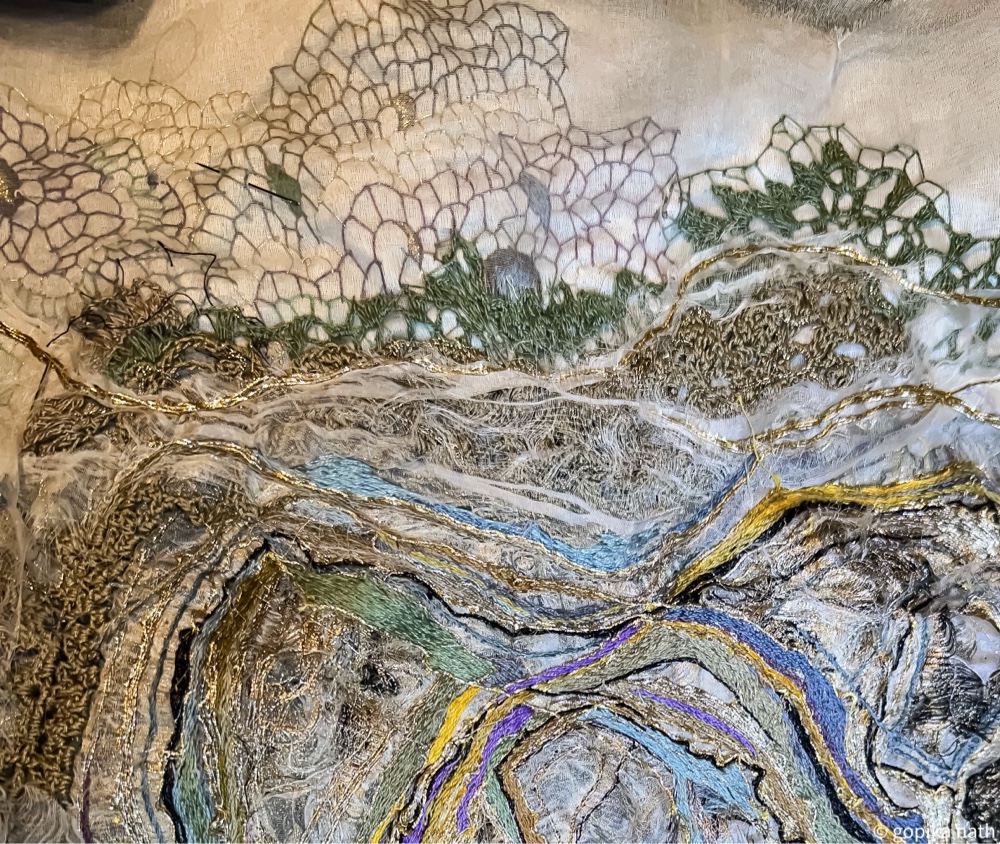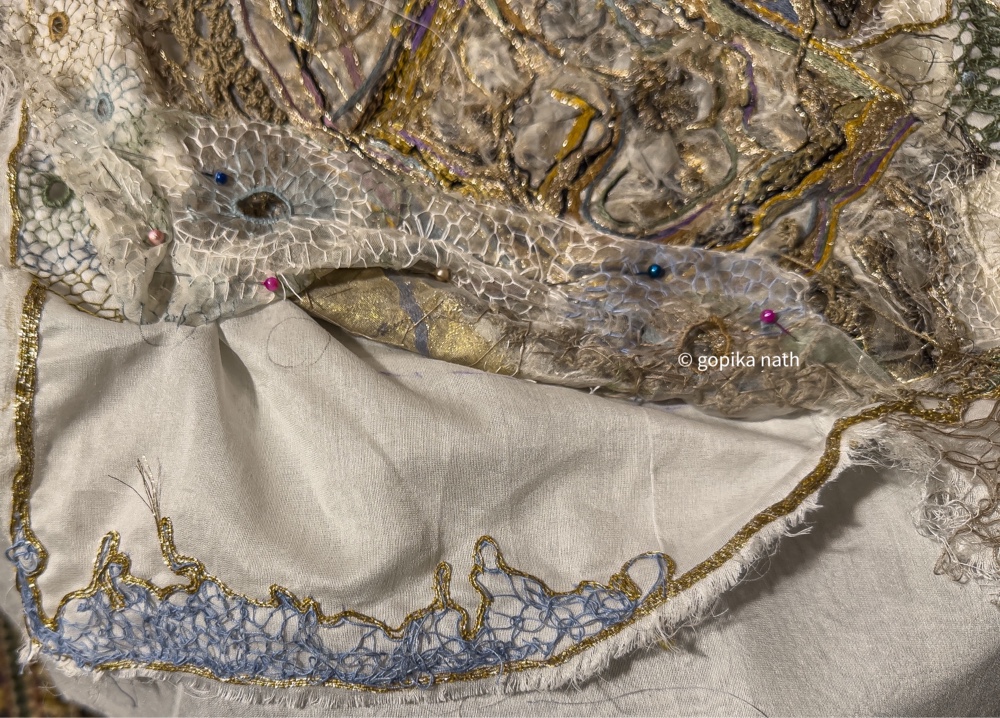
The work on my third co-creation piece continues. I have been doing a great deal of couching with 6ply gold thread or Zari. As I was couching around a particularly unregulated space, the process became uncomfortable. Moving along the uneven threads of a knitted piece that I had cut and placed into the work— threads I had earlier couched, or tacked— the surface was uneven. The lines moved up and down, curved inward, then rose again, at one point I was couching a strand of 6ply zari around a single strand of 2/30’s cotton. Needless to say, it was a taxing stitching experience
The intense presence required of me to focus so completely on the thread I was couching with and the six-ply Zari itself—brought several thoughts to mind.
One was how much we take for granted the work we see around us. Zardozi work does not refer to couching at all. It is simply called sui ka kaam. The work is intricate, often impossibly complex, and yet one cannot truly understand what it entails unless engaged in doing it oneself. Even when I am couching the 6ply gold thread in straight lines, a seemingly simple task, I find that my couching stitches are not at regular intervals.
Part of the difficulty is visual. I work with a lot of electric light focussed on the work. The gold of the sari shines back at me. The couching thread itself is dyed yellow. Between the two, visibility is compromised. I am also not bent over an adda like the craftsmen are. I sit back on my sofa, sometimes working at a table, and at this point with the fabric resting on my lap, supported by a cutting mat underneath for stability.
I am acutely aware that I do not work the way traditional craftsmen do. They sit on the floor, cross-legged, bent forward over an adda, the body trained into a posture that brings eye, hand, and cloth into a fixed and intimate relationship. I cannot sit like that. My body does not allow it. I work seated on a couch or a chair, adapting the surface to my lap or a table, stabilising the fabric as best I can. This difference in posture is not incidental. It affects visibility, control, rhythm, and endurance. What the craftsman achieves through a lifelong bodily discipline, I mediate through adjustment and compensation.
What is at work here is physical negotiation. The hand is constantly adjusting to uneven tension, to the glare of gold against yellow thread, to limited visibility. It compensates for posture, and it stabilises the work with whatever is at hand. These are not conceptual decisions. They are moment-to-moment bodily responses. The intelligence involved is motor, accumulated through doing, refined through repetition and resistance.
Much of what happens in this work is decided before it can be named. The hand adjusts, compensates, responds. Thought follows action, not the other way around. The hand carries its own intelligence, shaped by repetition, resistance, and material encounter.
All of this made me acutely aware of the importance of skill, and of how skill is acquired across generations. The level of perfection achieved by traditional craftsmen comes from beginning very young, often at the age of fourteen or even earlier, with nimble fingers trained through repetition. This led me to think about the histories that precede and influence us. How did this gold thread come into being? Who invented it? Who first thought of turning metal into thread?
Historically, gold thread is believed to have originated in China, where thin sheets of gold were beaten into leaf, cut into fine strips, and wrapped around a core of silk. In Chinese practice, paper too was transformed into textile material. What was known as zhi bu—literally paper cloth—referred to paper that was strengthened, coated, sometimes laminated with metal leaf, and then cut into narrow strips to function like thread.
I remember visiting the artisanal district of Nishijin in Kyoto, where I saw this process continued in Japan as Shifu, which uses the same characters and means the same thing: paper cloth. Gold leaf was meticulously laid onto paper, then hung vertically beneath the boards of the atelier to dry so that no dust could settle on it. Once dry, it was cut into extremely fine strips. By the 1980’s, Japan had computerized looms producing elaborate designs for obis and kimonos, yet the gold thread itself—the Shifu—was still inserted by hand. As techniques travelled from China to Japan, pronunciation may have shifted, but the material logic endured: paper becoming textile, metal becoming thread.
Although gold thread is used extensively in India today, it did not originate here. The word Zari itself is Persian, derived from zar, meaning gold. From China, this material knowledge travelled westward along trade routes into Central Asia and Persia, carried not only as finished textiles but as technique. In these regions, where metalworking traditions were already highly developed, gold thread gained technical refinement and symbolic importance, becoming integral to court dress, ceremonial garments, and religious textiles.
India has always worn gold—often heavily, abundantly, and with deep ritual meaning. Gold jewellery has been central to bodily adornment, temple wealth, marriage, fertility, and lineage. Necklaces, bangles, anklets, waist belts, nose rings—gold sits directly on the body in Indian culture, in intimate contact with skin. In ancient times, there was no cultural hesitation about wearing gold as metal.
What did not emerge in India, however, was the widespread transformation of gold into thread as a dominant textile material. This distinction has less to do with aesthetic preference and more to do with climate, clothing structure, and where status was displayed.
In the Indian subcontinent, the hot and humid climate favoured minimal, draped, breathable garments—saris, dhotis, and uncut lengths of cloth. The body remained the primary site of ornamentation. Gold worn as metal remained visible and effective. Heavy surface embroidery with metal thread would have weighed cloth down and interfered with fluidity and drape. Decoration therefore emerged through weaving, borders, pallavs, dye, and pattern rather than through dense metal-thread embroidery. Today, these factors are overridden by things like air-conditioning and heating of our lived spaces.
In contrast, in West and Central Asia and the Middle East, layered garments evolved out of environmental and social necessity. Desert regions are marked by extremes of heat and cold, abrasive winds, and dust, and many societies were nomadic or semi-nomadic, constantly moving across terrain. Clothing functioned as protection and portable shelter. Over time, layered robes, coats, and structured garments also became associated with dignity, authority, and public modesty. As the body became increasingly covered, jewellery worn directly on the skin lost its visibility and practical relevance. Status therefore migrated onto the garment itself. For wealth and power to remain legible, gold had to enter cloth. It is in this context that gold thread gained both technical importance and symbolic force, becoming integral to courtly, ceremonial, and religious textiles.
These regions also possessed long-standing metalworking traditions—wire drawing, filigree, armour making—which made the transition from metal to wire to wrapped thread technically continuous. Through trade, migration, and court patronage, this material intelligence travelled into the Indian subcontinent, where gold thread was absorbed, adapted, and eventually refined within local practices, gaining extraordinary prominence in ceremonial embroidery.
What is interesting is that contemporary Zari behaves very differently from older forms. Today, Zari can pierce fabric, allowing it to be used for stitches such as stem stitch or satin stitch, not only for couching. This is not a very recent development. I have seen ecclesiastical embroideries in the Museum of Christian Art in Goa where Zari is used in satin stitch rather than laid on the surface.
We also have Dabka, the purled gold wire, which is a different material altogether. Today, Dabka is made from copper or aluminium wire coated with a gold-coloured finish. Modern Zari itself is produced through a fascinating industrial process, where a microscopically thin layer of metal is vacuum-deposited onto a polyester film called Mylar. This metallised film is then cut into fine strips and wrapped around a core thread, creating the illusion of metal while remaining light enough to pass through fabric—an extraordinary convergence of ancient visual language and modern material science.
The other moment that struck me came when I turned the fabric over to secure the thread at the back. Looking at the reverse—the unregulated, overlapping stitches in dyed yellow thread that allows me to couch the zari onto the surface without being overtly visible, something shifted. What surfaced in that moment was the memory of my wedding lehenga—the weight of it, the labour embedded in it, the unseen back of the work. I cannot fathom why the back and not the zari itself brought to mind the peach-saffron lehenga—perhaps the underside was evocative of traditional Zardozi work more than my contemporary rendition.
It made me think about how history and memory move together, how they converge into what we are doing today, who we are today. And it brought me back, very clearly, to the essence of this piece—what I call co-creation.
Nothing arises in us without history, conditioning, precedent and our own sense of being human.