Showing posts with label patterns. Show all posts

Monday, 20 January 2025

Who’s to Blame….Whose Fault is it…..


May the tide
never tire of its tender toil
how over and over
it forgives the Moon
the daily exile
and returns to turn
mountains into sand
         as if to say,
you too can have
this homecoming
you too possess
this elemental power
of turning
the stone in the heart. into golden dust. 
                                     

(Forgiveness) by Maria Popova


Patterns fascinate me. I’ve been studying patterns in myself. I found them difficult to contend with, find forgiveness, acceptance and leave behind regret and shame. Years of therapy helped, but not nearly enough. It was my walks along the sea shore, looking at nature in its myriad patterns that solace started emerging. 


Nature is renowned for her exquisite patterns and living by the Arabian sea, I have been spoiled by those created by water, wind, crabs, sand, leaves and the sky. I’ve been particularly mesmerised by the patterns that water creates. Or, rather co-creates, wherein the resultant pattern that the eyes see is the consequence of multiple layers of water, over sand, rippled by water and wind, and water rippled by incoming and out going tides and/or the wind, as also the sun glinting on these ripples. It’s a marvellous experience to see this unfold and I never tire of it. 


My training as a textile designer, means that I have created numerous patterns over the years. I recall my early years of learning -  one of our assignments was to dissect a bhindi (okra),  draw it, the repeat it in pre-set ways.


The Art Nouveau patterns with their sensuous lines and mirrored repeats have been another favourite. However, all these years of making patterns, looking at fabrics with patterns, has probably sensitised me to finding them everywhere. 


The patterns I’ve seen at the banks of rivers and the sea shore can be complex in their layers, such that they become evocative of the patterns of our psyche which emerge in similar manners. 


As human beings, we are co-created in layers. By people who themselves are layers of history, politics, familial and cultural traditions and conditioning, technology and so much more. It’s impossible to visualise them, much less find any sense of awe and fascination in them. Particularly in contemporary times, when scientific analysis creates a kind of judgement, even if it’s not intended. Psychology labels these patterns and traits creating scope for judgement rather than acceptance and forgiveness. 


For instance, if you have/had a narcissist parent, you have developed patterns of coping that may habituate you to accepting abuse as familiar and even attractive (however weird and foolish it may sound) This leads one to create more and more painful experiences. Some may recall the Stockholm syndrome, which is not that different. When you realise the reasons for manifesting this and other patterns, there’s judgement of both parent and self. Acceptance that it’s just another facet of being, in the larger canvas of life, could take a life-time of therapy, if that. 


Earlier, before CBT and other kinds of psychotherapy became popular and were deemed necessary, it was all put down to karma. Cause and effect, which it is. There’s not much one can do about the patterns that life generates within us, knowing what caused it quells some of the anxiety perhaps, but visually perceiving the tantalising effects of the patterns co-created at the river banks and sea-shore provide a very powerful tool for finding beauty where otherwise one is inclined to blame, shame and self hate. 


We need to find forgiveness for ourselves and others. Taking photographs isn’t enough to move beyond the negative feelings and connotations that have been imprinted on the mind, leading to feelings that self-destruct, so I decided to try and re-create the patterns I witnessed the manifestation of, at the river bank.


I had some photographs sand ripples and patterns digitally printed onto cotton fabrics. This provides the bottom-most layer. I then drew out warp and weft threads from a black and gold tissue fabric. Initially I had intended to just reduce the ends per inch to make it supple. But, the weft was plastic thread covered with gold metal and it didn’t lend itself well to being tweezed out of the fabric. I then started to pull the gold threads together, creating dense woven threads amid a loose weave left by moving the weft threads. They formed ripples and I loved the effect. I later did the same drawn thread processes with the aquamarine and silver tissue fabric and white silk organza. 


I haven’t covered the entire base fabric equally. The layers are replicating the colours of the bank of the River Chapora in Morjhim, Goa. 


The top layer is fine silk organza. It creates a layer that is transparent and holds all the others together. 


I’ve printed the photograph so that I can trace the dappled light and create a template for embroidery. I’m not sure whether to embroider the organza extraneous to the rest of the layers and then add more stitches later to bind them together, so do the needle work with all the layers, picking up some with the embroidery thread, but just minimally, to keep it light and evanescent. 


I’m thinking of the latter for it’s more organic, albeit more complex too. The thread will be stranded cotton and some metallic threads in gold and silver. The Split stitch seems just perfect for this. All in all a tall order, but I’m super excited. 


An inspiring passage by Nick Cave is what I’m hoping to meditate upon as I stitch, recreate the water dappled with sunlight, the sand ripples adding the dark backdrop for perfect reflection on the water’s surface. Where he  shares that “- In a way my work has become an explicit rejection of cynicism and negativity. I simply have no time for it. I mean that quite literally, and from a personal perspective. No time for censure or relentless condemnation. No time for the whole cycle of perpetual blame. Others can do that sort of thing. I haven’t the stomach for it, or the time. Life is too damn short, in my opinion, not to be awed……We all have regrets and most of us know that those regrets, as excruciating as they can be, are the things that help us lead improved lives. Or, rather, there are certain regrets that, as they emerge, can accompany us on the incremental bettering of our lives. Regrets are forever floating to the surface… They require our attention. You have to do something with them. One way is to seek forgiveness by making what might be called living amends, by using whatever gifts you may have in order to help rehabilitate the world.Nick Cave


Stitching is meditative. It’s expressive and the layers, the photographs add such a sense of beauty to this process, that one hopes, it will re-habilitate me and you. 

Monday, 10 June 2024

Stitch Meditations on Being - The Patterns and Hues


“They fuck you up, your mum and dad.

They may not mean to, but they do.
They fill you with the faults they had

And add some extra, just for you.
But they were fucked up in their turn

By fools in old-style hats and coats,
Who half the time were soppy-stern

And half at one another’s throats.
Man hands on misery to man.

It deepens like a coastal shelf…….
                                                                                                                                                    - Philip Larkin


These words say it all, without revealing the gory details or gruesomeness of the wounds we all carry within us. Largely disguised in various ways but played out subconsciously. Most of the time we are unaware of why we do what we do and of the influences of the “soppy-stern…….at one another’s throats” that created who we are, beyond just the physical mating, but the why and how of our psychological make up.

When Larkin says “Man hands on misery to man. It deepens like a coastal shelf” he evokes the patterns we form and re-create (subconsciously for the most part). Habits make it easier for us to negotiate life - such as driving a car or bike and even drawing, crochet, knitting and that ilk. But, it’s the emotional and psychological patterns that create the problems, where human misery “deepens like a coastal shelf”


Yet, as Larkin put it, it’s inevitable that we inherit dysfunctional ways/patterns and also play them out, passing them on generation to generation. Unravelling these patterns may or may not create the potential for change, but it’s interesting to do so for the purposes of understanding your own psyche/self. Beyond that, what can we do?


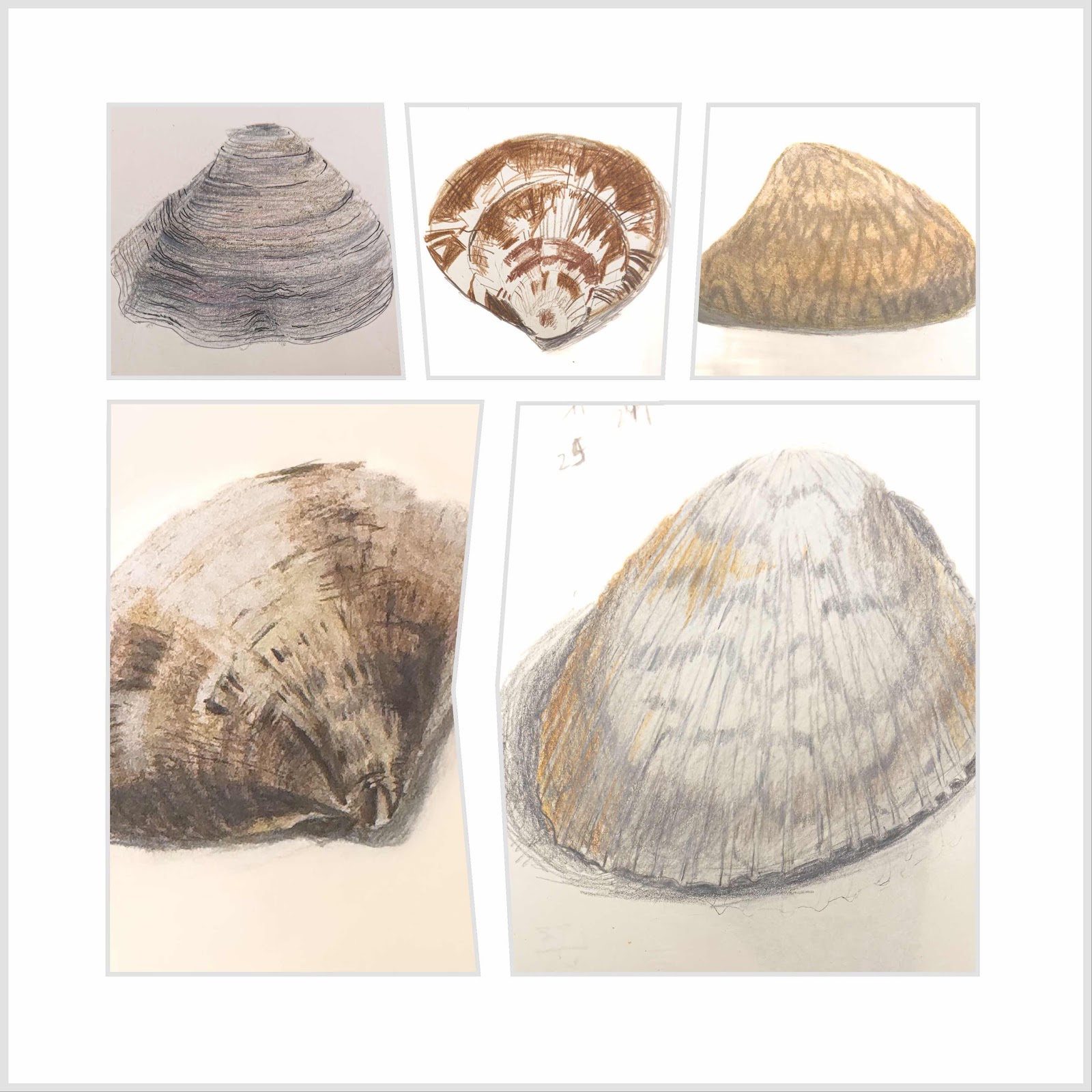
This was a dilemma that I faced and struggled with until I started studying the patterns on the molluscs along the Goan coastline. These patterns were unique, as inimitable as our finger prints. It was virtually impossible to find two clams with identical colours and patterns.


What was even more interesting was to learn that these patterns are created by virtue of genetic and environmental conditions. A neurological response for camouflage and survival. Even so, the radula of other species did manage to drill through and suck the animal out, and if not, it wasn’t for lack of trying. Wherein the holes they drilled, became another level of embellishment to the strokes of colour that decorated the exoskeletons.

I studied these patterns in various ways: through the camera, by drawing and eventually by zooming into the photos I took of each. This was fascinating because in pixelating the images, I found the patterns were a configuration of colours.


Colour, as we have seen through the ages, carries symbolic meaning that varies from culture to culture. Lisa Feldman Barrett, social scientist and author of the book ‘How Emotions are made’ asserts that our emotions also vary from culture to culture. Colour and emotions, have long been linked:  green with envy, yellow for happiness and joy, red for love and anger and more in that vein.

But, Feldman Barrett says there is no singular way to describe any of the human emotions. Each culture and person within it, experiences a variety of sensations within anger, joy, love and despair. The subtle gradations and differences between fury, rage, anger, frustration, being irked etc are just that - subtle variations.

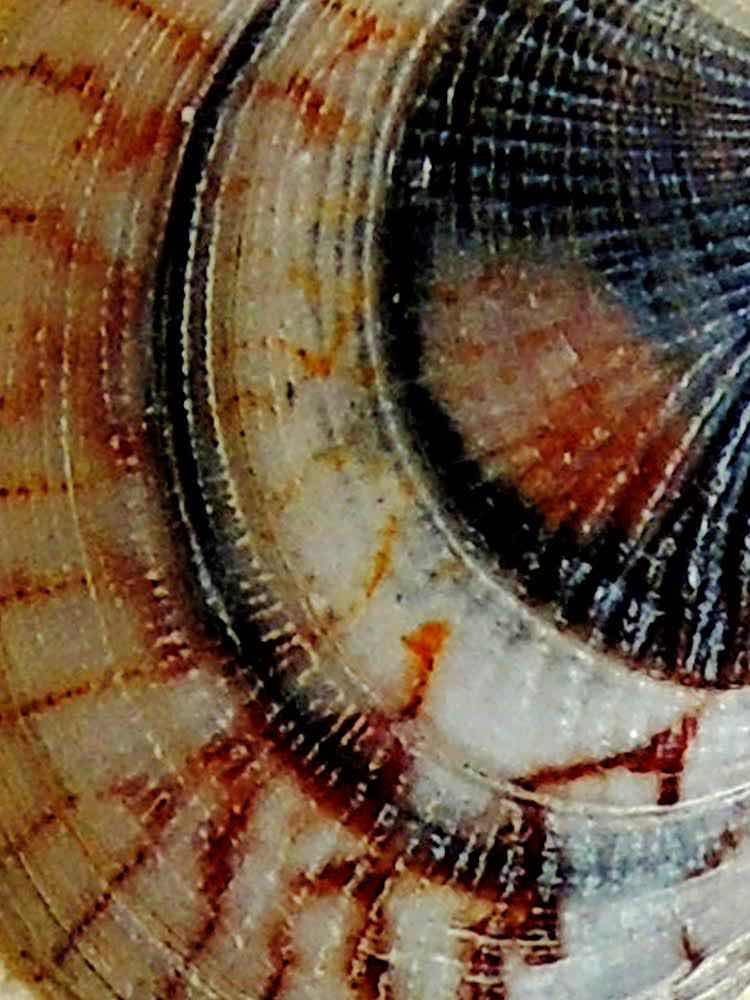
In this zoomed in and pixelated photo of a clam shell, that’s what I see, subtle gradations of colour - so subtle that it’s driving me insane trying to reproduce them in thread.


I have two versions of the thread adaptations. The first was a cross-stitched replica where I mixed the threads - two to three different colours from over 400, colours of cotton floss, collected from various thread makers including Anchor and DMC. It took me a long time to complete one piece and the second is in progress. A slow process which I often abandon to tackle something else and return to until it is done. The first one took me a year.


However, the piece that I’m currently working on, isn’t just about getting the colour right, it’s also about patterns and how the same hue can alter with the pattern. The idea is to make a large crocheted and knitted piece instead of embroidery. The reason the colours are taxing both mind and pocket is that unlike embroidery threads, the colour range is extremely limited for knitting and crochet. At least in any one count of yarn to enable some symmetry in scale to join the 5  inch squares.

I had started the pattern blanket (for want of another term)with some vague idea, with regard to how I wanted to put theknitted and crochet squares together. It evolved over two to three years and I made the squares from all the colours I could muster but I just couldn’t figure out how to really work them together to create any visual that appealed to me. This resulted in my abandoning the project and the 300 odd squares I’d already made, not to forget the hours of painstaking knitting and crochet – often at the end of the day. It didn’t make me happy but I didn’t know how to move forward. I thought it was a failed project and hadn’t looked at it for over a year.


Then a couple of weeksdiscovered wood borers had inhabited my rather extensive book shelf which stretches across about half my apartment. I had to empty all the shelves and cabinets below that housed stationery, fabric and my stash of embroidery threads as also hundreds of books amassed over the last four decades and some inherited from my parents’ collection. Art magazines, old issues of Selvedge, Piecework, Surface Design, Embroidery and the now extinct Fiber Arts, Marg Magazines, India magazines (also extinct),BBC music magazine, piano scores and about 100 art magazines - a series I collected in my student days about artists - one issue on each artist (sadly none about Indian artists but focussed on western art history). And of course a collection of books - fiction, non-fiction, poetry, textiles, art, spirituality and more. Basically it was a lot to place around the apartment and at the end of it all, the only free space was my bed.

My knitting and crochet stash is housed in my bedroom, in various draws  usually by colour. This was not disturbed by the pest control requirement. So I decided to revisit the abandoned pattern blanket and changed tack by using the template I had already embroidered in cross-stitch. The 1/4 inch embroidered squares took me about ten minutes each to execute, with seven of those minutes to get the colours to match. In the knitted and crochet version, I am facing similar issues with the subtle gradations of hue, but more so because I’m not working with just cotton floss, but yarns ranging from wool, acrylic, rayon, nylon, cotton, wool and cotton blends, and also the counts are all different from very fine crochet yarn at a 40’s count to chunky 4-6 ply. Often, I have to work  differing counts together to try and approximate the colours.


It was a challenging week both with the rather smelly pest control, putting things back into place and this creative project. But I now have a template that gives me the direction I need. What I’m grappling with, in addition to the technical issues, is what I hope to achieve by engaging in this rather esoteric idea of replicating the colour boxes in both hue and pattern.

While working on the cross-stitch version, I marvelled at the numerous shades there were and recreating them helped me understand that there are so many hues to each emotion. It’s impossible to understand what another person is feeling because what they feel is unique to them - culturally, socially, experientially, genetically, environmentally and more. That was a great insight because one does tend to think we know how others are experiencing emotion or what they may be feeling, but Feldman Barrett also suggests that it’s not possible - at best we can imagine within the range of our experience, based on our own emotional shade card. Our emotions and the hue gradation of the occurrence is uniquely personal.


Most of our thinking comes from conditioning. And is the result of social constructs geared to create a sense of order with the existence of so many of us who inhabit this planet. However, through centuries of the existence of mankind, the ideas have evolved in a rather unthinking and dysfunctional way. In many ways much of our thinking could be deemed be distorted by ideas that most likely germinated through limited knowing and were handed down with incompleteunderstanding by those before us, who didn’t know better.  Quite like Larkin says in his poem. They fuck you up, …..They may not mean to, but they do.”


Patterns are prevalent throughout nature and also in our emotions and thinking. My professional training has been in textile design and patterns are nofirmly etched in my DNA. We were taught to create designs for fabric by dissecting vegetables like okra – a cross section with the seeds visible; drawing this and repeating the form in differing ways of  formal repeat patterns for printing motifs on cloth. The challenge was to ensure that the repeat wasn’t visible and also contributed to the visual outcome; trying to disguise the vegetable form through repeating the motif in creative ways. The repetition made almost everything pleasing to the eye because familiarity  is what enables a sense of well-being and makes something agreeable to the senses.


As I evolved into  a fibre artist, examining my own persona – a journey of self-actualization through my art, I started exploring the idea of mind-stains or ideas that cause us to feel less than good, feeling shame and doubt and self-cynosure. Initially I explored this through notions of tea stains on my saucer as I spilled the tea I was drinking. It was a long exploration of seven years, wherein I realised that one could still flower – fulfil the human potential despite these feelings that seem to hold one back. 


When I moved to Goa, I didn’t give up the idea of stains for they were very much a part of my inner explorations relating to  experiences that created these inhibitors. But, living along the coastline of the Arabian Sea, I went beyond human nature to study nature in her full glory and life by the seaside has been fascinating in this sense. Wherein colliding ripples of water, washing over mud adhesion ripples at the River Chapora estuary and further down the beaches of Morjhimand Aswem, with wind adding to the rippling effects and the diffused rays of sunshine at dusk – complimenting and complicating the patterns, I began seeing these patterns of colliding energies as incredibly beautiful. 


It was the complexity that appealed for it related to the intricacy of configurations that become our patterns of behaviour. Of energies inherent in the psyche formulated through generations of conditioning, one’s own experiences – of colliding with other energies, bringing out these patterns. Where we recreate them because energy draws us to others when we recognising something familiar. In re-creating we feel grief and anguish, become aware and the tendency is generally to view ourselves in a negative light. Something that needs to be changed. But the wisdom of the ocean suggests that there is incredible beauty in these engagements and that the tendencies may change through the collisions of energetic fields as we negotiate our lives, but the overlaying effects of these fields are intriguing, dynamic and awe-inspiring. If only one could look at the self as we see the natural world.


Through the study of  clams shells, the sand bubbler crabs and their feeding residue and also the ripples of sand and water, I started seeing that patterns are formed by colour and the collision of energies in the elements. By extension I made the correlation that emotions seen as colour, in the human psyche, form patterns and vice-versa. Therefore adding pattern to the art work, going beyond mere colour became imperative.


However, this further complicated the process of trying to create the sublet hues uneven thread counts and a variety of ornamental thread configurations through crochet and knitting. At this point, can only envisage a blanket that’s an uncomfortable evocation of how we exist together with our unique experience and understanding of emotion, alongside others who feel and perceive these differently.

But, I’m a long way yet from being able to see this. I have under 100 squares when I need close to 640. I often rip out the squares because they’re either too big or I need to add a row or two if it’s smaller than I need it to be. Some are tight and sit awkward, others are delicately delightful. It’s going to be another task to whip them all together, possibly like one struggles to negotiate this world with the billions of others beside us….