I often drive down to Sawantwadi for Ayurvedic treatments. It’s about an hour’s drive through the Western Ghats, across vast tracts of green fields and rivers. Over the last few years, I must have been there ten times, perhaps more. Each time, I told myself that I would visit Chitari Aali. And each time, I didn’t.
This week, I finally did.
I left early. I had time. I stopped at the Sawantwadi Palace, asked for directions while having a cold coffee, then followed the route I was given. I parked the car just below the aali and walked up. The market rose on a hill, a fairly steep climb, lined with all kinds of wares being sold along the way. At the top, I turned right and found a couple of small shops selling wooden toys, painted objects, and familiar Chitari forms.
I entered the first shop and said, quite simply, that I wanted to see where the work was made.
A young man named Prabhakar came out. He told me that his elder brother was the designer and that he could take me to their factory. It was in Kolgaon, about four kilometres from there. I said yes.
He sat in the car and I drove to Kolgaon.
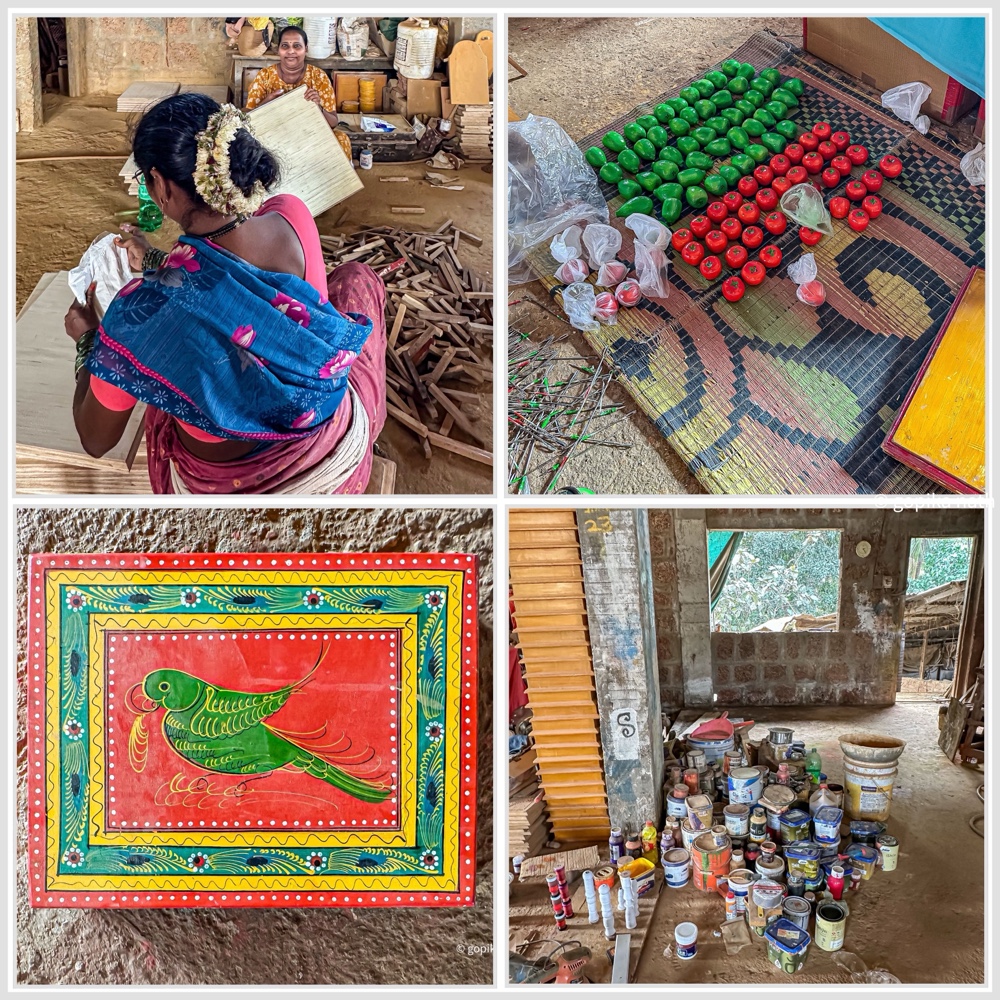
The workshop was registered as Kamalanayan Handicraft Centre in the name of Pratibha G. Chitari, Amit’s wife. We climbed the stairs to the first floor, took off our chappals, and entered the space. The building was semi-constructed. There were no windows, only openings for them. No doors, only door frames. The staircase had no banister. The floor was bare cement. As I walked around, I noticed cobwebs everywhere. The machines were carefully covered, I imagine because they are expensive, costing a few lakhs each.
It was only after arriving that I learnt it was a Monday, when the region does not get electricity. So no production was happening. The machines were silent.
And yet, work was still going on.
Bhargav, the youngest brother, brought Amit to meet me. As we talked, Amit sat down to paint a large Ganjifa wall piece depicting the Dashavatara of Vishnu—a commissioned work. There were only three workers present that day. One was packing wooden fruits made from moulds. Two others were preparing wooden panels for painting, applying Fevicol, sanding, polishing.
Before Amit arrived, I spoke briefly to a couple of them. Sonali Chauhan had grown up in this village, married here, and has been working in the workshop for about five years. She handles most of the preparatory processes. I asked her what the work felt like to her, how she thought about it, how she experienced it.
All she said was, “achcha lagta hai.”
I asked why, what she liked about it. She paused, as if to think, but merely reiterated, “achcha lagta hai.”
There were no words for it, perhaps no need to think. Perhaps the language lay in the doing itself. Sustained, skilled making is known to generate a particular bodily chemistry: endorphins that soften effort, dopamine that registers quiet satisfaction when action meets intention, and oxytocin associated with calm, trust, and nervous-system ease. These states do not arrive as thoughts or explanations. They register as sensation, steadiness, absorption, a sense that the body is at home in what it is doing. Articulated simply as “achcha lagta hai”, this is not a lack of language, but a bodily coherence that does not ask to be translated.
What I am trying to name here is not what she lacks, but what I am attempting to do. Her “achcha lagta hai” is a complete articulation within the conditions of her work. My search for language belongs to a different practice, one that asks what happens when attention, reflection, and articulation are allowed to accompany making, not to replace embodied satisfaction, but to create another kind of value around working with the hand.
It was only after this exchange that I began speaking more fully with Amit. One of the biggest surprises was learning that he had studied at the JJ School of Art and later worked in the film industry, before choosing to return to the family profession. He is a fourth-generation Chitari artisan and introduced himself quite simply as Amit Chitari.
His father worked without machines. Amit works with them. The machines do not replace the hand, they assist it. He explained that earlier, the left hand would turn the wood and the right hand would shape it. Now, the machine does the work of the left hand, while the right hand continues to shape. The intelligence of the hand remains.
They use woods like shivan, jamun, mango, and sheesham
, woods often considered waste wood. Shivan, in fact, is a wood I know well; my own desk is made from it. Amit told me they use roughly a thousand gun-feet of wood, though whether that was per month or per year was not entirely clear. What was clear was that government support is minimal, permissions are complicated, and survival dictates scale and repetition.
What struck me was not the absence of skill or intelligence, but the absence of time. No time to finish the building. No time to install windows or doors. No time to clean the space. No time to pause and articulate what the work means, how it feels, or where it might go next.
When I spoke to Amit about my own practice, about how sometimes the needle seems to take over, to hold sway, he understood immediately. But he didn’t have a language for it.
And that stayed with me.
Chitari art is not native to Sawantwadi, though it is now closely associated with it. The craft has its roots in Cuncolim in South Goa, where the Chitari community practised wood carving, painting, and lacquer work. Historical accounts suggest that during the seventeenth and eighteenth centuries, members of the Bhonsle royal family encountered Chitari artisans while in Goa. When the Bhonsles later established themselves in Sawantwadi, these artisans are believed to have travelled with them.
Over time, Sawantwadi became a centre for Chitari work, particularly wooden toys, lacquered objects, and later Ganjifa playing cards, shaped by royal patronage and market demand. The craft adapted in order to survive.
Today, the Geographical Indication tag for Chitari art is held by the Sawantwadi Palace, not by individual artisans or the town at large. While this offers visibility and institutional recognition, it also fixes the craft within a controlled framework. Artisans continue to carry the skill, labour, and continuity of the tradition, but authorship, naming, and the right to define what counts as Chitari largely sit outside their individual control.
Knowing this history made my visit to the workshop feel differently weighted. What I was seeing was not simply a family business struggling with time and resources, but a lineage shaped by migration, patronage, and survival, a craft that has learned to endure by staying close to what is sanctioned and saleable. As Amit put it, “hum apna kuch nahin daal sakte”, we cannot add anything of our own.
It surprised me that, despite having studied Fine Arts at a prestigious institution, Amit did not feel drawn towards creating even small departures from the Chitari script, forms that might retain technical and material continuity while allowing some personal inflection.
In other craft sectors, particularly textiles, one has seen innovation emerge through exposure to new markets, foreign buyers, and collaborations with designers and artists. The infrastructure often remains the same, the looms, the courtyards, the animals nearby, but the product is reimagined to meet new contexts.
Perhaps this is what is missing in Chitari practice, not ability, but exposure. There is enough business within the known script that there is no necessity to devise new forms or colours.
Craft and hand-making are among the oldest human inclinations. I remember reading, long ago, that it took five thousand years for sculptors to perfect the meditative repose of the Buddha, generations refining an eye, a fold, a posture, inching towards stillness. Today, we are no longer perfecting skill in that way. We are inventing beyond it. Variety and novelty define the predilections of the marketplace.
At the level of Chitari practice, the work is not oriented towards representational improvement or personal meaning-making in the way contemporary practitioners like myself might frame it. It is oriented towards subsistence, carrying forward a cultural and family lineage through repetition, skill, and continuity.
Amit barely has time to meet market demand, to keep the workshop running, to generate income. Sitting with this, I found myself turning inward, asking questions about my own practice.
As I write this, I am aware that these questions have been arising alongside my own stitching practice. In recent weeks, sitting with cloth and thread, I have been paying attention to posture, to the way the needle sometimes seems to take over, to how memory does not return as narrative but as structure. Unlike the Chitari workshop, I have the scope to notice this, to dwell, to articulate it. That difference is not one of imagination, but of conditions. What I am able to reflect on in stitching is not separate from what I witnessed in Kolgaon; it is shaped by a different ecology of time, language, and permission.
But this also raised its own set of questions. What am I doing. Why am I doing it. Does paying attention to process, going deeper into it, create a different kind of value. Does it deepen understanding. Does it change how craft is seen or valued. And can that kind of attention ever be of relevance to craftsmen like Amit.
I don’t have answers yet. What I have is an encounter, a space, a set of hands at work, and a growing awareness of how differently thinking and making are allowed to unfold.
Three decades ago, when I first began working as an artist-craftsperson, my impulse was to bring that work into an art gallery space, to see whether visibility and context might generate value. Over time, I realised that the gallery was not enough. It could show the work, but not the thinking, the negotiations with material, the discipline of repetition, or the quiet intelligence of the hand. This stitch journal emerged from that recognition. It is an attempt to invite the reader inside practice, to attend to how history shapes and material behaves, how posture shapes attention, how the hand learns, insists, adapts. In setting my own practice alongside encounters such as this one with the Chitaris, I am not proposing improvement or intervention. I am asking whether language, attention, and reflection might create a different kind of value for working with the hand, one that I can articulate from where I stand, and that I hope may, in time, also speak back to traditions that have rarely been asked to speak for themselves.
For now, that is enough to sit with.

Psychology of Skilled Craftsmanship and the particular kind of joy derived... Insightful article... Thousands of such crafts languish because of lack of exposure and encounters!
ReplyDeleteYou are so right Dr. Koshy, crafts and craftsmanship in India is in abundance and languish because of a lack of exposure.
DeleteThe above comment is by me Dr Darlie Koshy PhD IITD Strategic Advisor WCC-AISBL and an admirer of Gopika 's work 👏👏
ReplyDeleteThank you Dr. Koshy
ReplyDeleteDeep insight, so well articulated. Always a pleasure reading your works. 💫
ReplyDeleteThank you for reading. And, your appreciation. Much appreciated 🙏
DeleteBeautiful description and write up
ReplyDeleteThank you
DeleteWonderful article and such truth in the observations and consideration of practice based contemporary work. Im going away with much to think about. Thank you Gopika x
ReplyDeleteThank you for reading Heidi. Yes, as a practitioner yourself, the insights would seem significant. Come back with your own observations.
DeleteI was thinking about the difference between making something known in a fixed method, and making something only half known as the process evolves. How sometimes the head stops the hands, to assess and make decisions, and sometimes the hands continue before conscious decisions are reached.
DeleteDoes the head stop the hands or the other way around? I’d have said that the hands stop because they feel the discomfort, want to change direction - the hands stop knows before the mind comes into play, doesn’t it?
Delete