Showing posts with label craft. Show all posts

Tuesday, 21 April 2026

Texture Is The Narrative


It all began with a singular question.


After listening to a talk by Savia Veigas at Arthashila Goa, I found myself wondering about her use of stitch in relation to narrative. She emphasised that the visual carried the work — that the stitch itself was not something she thought about in depth. And yet, looking at her work, I could see stitch doing things she hadn’t named.


This left me with a more fundamental question: what does stitch actually do? Is it only a line, like charcoal or ink, or does it carry something else entirely — can it elucidate a narrative, shape it in ways not immediately visible?


When an artist chooses charcoal, watercolour, or oil, the medium shapes the expression. Charcoal smudges and resists precision. Watercolour bleeds and disperses. Oil holds and saturates. The material is not neutral.


From my perspective, stitch is even less neutral. And I find myself seeing it in narrative visual  embroideries too.


A split stitch gives a clear, controlled line. It holds a curve, allows detail, builds density, and can modulate colour with great subtlety — as medieval church embroideries in Europe demonstrate. I am drawn to its flatness, especially when contrasted with other textures.


A satin stitch smooths a surface into colour, though never entirely flat. A cross stitch breaks the surface into a grid, allowing colour to mix in the eye rather than in the thread. I often work with a freer version — what I call a ‘crazy cross stitch’ — where the grid loosens and layering becomes possible, building intricate shading through accumulated color and stitches.

A buttonhole stitch can close a form or open it into lace, depending on how it is worked. I like opening it out into a permeable hexagonal lace, allowing one layer to be seen through another — particularly on transparent fabrics like silk organza, where fine zari thread lends an ethereal quality.

Crochet shifts the surface altogether. It introduces relief — a whole new dimension within the ambit of stitch. Even in fine thread, it sits on the surface, creating another fabric rather than merging into the base.

Each stitch carries its own behavioural tendency. It is this that shapes what can be said through it.


In my own work, which has gradually moved towards an abstract narrative, I choose stitches for what they do to the surface.

In my work, texture is not an addition. It is the story.


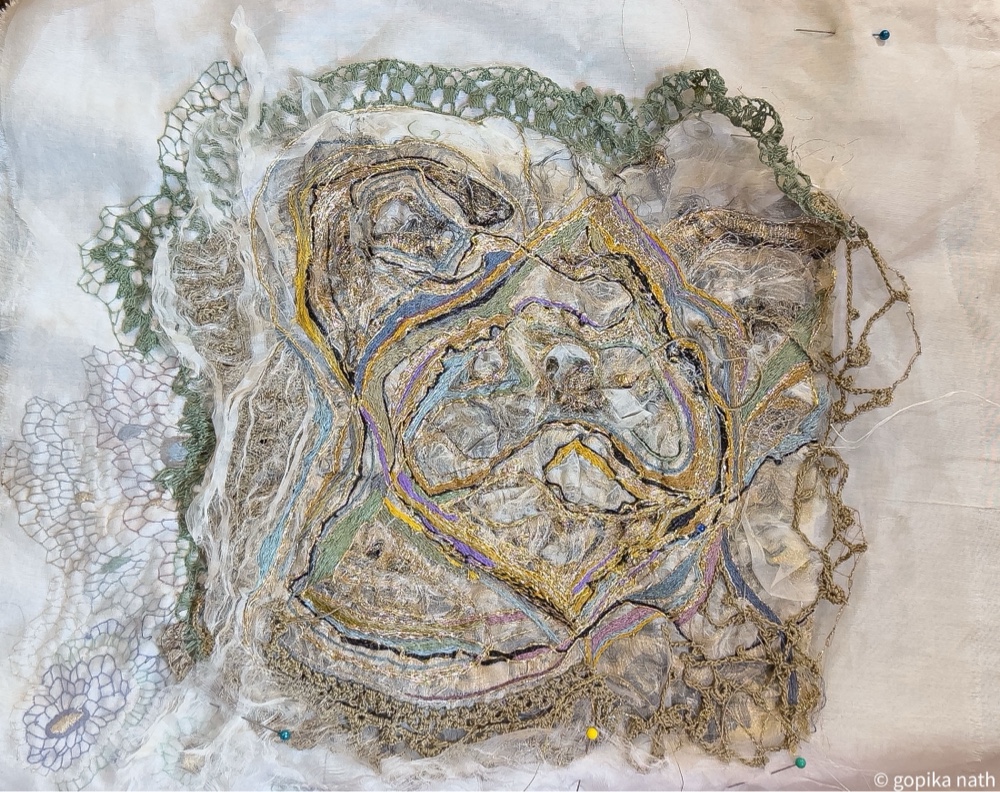
At present, I am working with what I call crab lace. Crocheted nets are layered, joined, and stitched through. The top layer is made of varied yarns — tightly spun mercerised cotton, slubby threads, tencel — held together using an Irish crochet netting technique and placed over undyed silk organza.

Beneath it lies another crocheted net in pale grey, resting on a mid-grey open weave cotton fabric with its selvedge cut and threads unevenly drawn apart. Below this sits another layer of organza. The piece currently holds multiple layers, though not consistently across its full surface of 1.5 x 1 metres.

The grey open weave is not tacked. It adheres lightly to the organza. The pale crochet is only loosely held. As I stitch the upper layer, the thread passes through all layers, binding them into a single body.


Earlier, I tried to keep the stitching invisible, slipping the thread beneath the crochet lines. Then I stopped. Why should this disappear?

The movement of the thread across layers, its irregular path, its appearance and disappearance — all of this is part of the texture. So I let it remain.


A pale grey (polyester cotton) thread moves across whites and off-whites, soft greys, green-grey, dark grey and black — the surface of the crocheted net. Sometimes it shows, sometimes it recedes. That fluctuation matters. It begins to map an inner terrain, the texture of emotional work.


The form itself comes from watching sand bubbler crabs. Not by imitation, but through observation. Their lace-like formations on the beach are delicate in appearance, yet formed through repetitive labour. The crab takes in sand, processes it, releases it. Again and again. A repetitive, arduous labour of feeding and cleansing.


For me, the parallel is: a thought, a feeling returns. You examine it. You turn it. You release it. Then it returns again, slightly altered. There is a back and forth until something clears — a moment of knowing, of clarity.


The work attempts not just to hold that process, but to create a tactile evocation of it.

The layering, the density, the interruptions, the small fragments of crochet and open fabric inserted between layers — all of it builds a surface that is not smooth, not resolved. It holds effort. It holds time.

The piece has not been easy to work on. It is large. It requires patience. There have been days of only looking, without the courage to stitch.


After tacking the top layer down, I find it is beginning to reveal its layered texture. I have been thinking about the spaces between — large areas of open ground that I want to work with subtle textures.


I have thought of circular running stitch, as in Kantha. The stitch has a distinctive texture of its own, and when the thread is pulled, the ripple effect is exaggerated — particularly on layered cotton.

The repetition is meditative, its circularity perhaps mirroring the circularity of emotional processing. But I hesitate. It works well on layered cotton; on organza, the ripple flattens. And the surface must not be crowded.

I am also considering buttonhole stitch — beginning from a central opening and building outward into a radial lace, following the patterning of the sand bubbler’s residual pellets. Perhaps in conversation with the running stitch, though I remain unsure.

This uncertainty is part of the process.


On the surface, the day moves normally. Cooking, laundry, conversations. But underneath, something continues — a sorting, a returning, a clearing. The texture is that underside, always present, clarity emerging when the day is done or in early morning quiet.


It is the texture — the gnawing in the gut, the pull at the back of the throat, the stiffness in muscles—paying attention to them allows clarity to emerge. It is what makes it possible to read, to research, to teach, to be present.


The work of clearing the mind is not separate from the work of making art.


Monday, 2 February 2026

What Remains, What Repairs…


“Craft is healing. It helps people feel grounded, purposeful, and whole.”

— Betsy Greer


I spent most of the day stitching.

Yesterday was a long, social day. I’m feeling unsettled. Words cannot quite express my overstimulated mind: teaching a five-week online course, an enriching talk on Hampi, meeting old friends, recriminations, affection, chiding, eating a delicious but heavy meal. Grocery shopping en route to the meetings. Overspending and then returning home to put everything away. Sleep was elusive, as it often is when I’ve done too much.

I need to stitch. I need its somatic, meditative movements. I need thoughts to form, not be dismissed in the way they might be through yoga nidra or meditation.

As the needle enters the cloth and exits again, as the thread tightens and holds, as one action follows another, my day in the world becomes, briefly, coherent.

It’s often said that stitching is healing. But is it? What do we really mean by healing?

We have all seen ruptures of the flesh, wounds that heal. Yet scars remain. The body remembers. Can one truly heal memory, or the recurrence of pain that arises from it?

I have lived with the idea of healing for decades. I am a three-decade-long Reiki practitioner. I practise various modes of energy healing for myself and for others. It is a deeply misunderstood term, and one I have spent years trying to fathom.

Stitching as healing may create a sense of calm, regulation, relief, and an increased ability to cope. These are not trivial states. They matter. They allow one to function, to endure, to remain present. Regulation, not transformation.

This is where the language around healing, including energy healing, needs clarity. Intention alone does not bring about change. Healing practices can support awareness, soften resistance, and create the conditions in which something might shift. But they cannot replace responsibility. They cannot override lived reality. They cannot act in place of recognition or choice. A healing practice may help one cope with exhaustion, grief, or overwhelm, but it cannot decide for us when something continues to tear, when repeated repair is no longer enough, or when it is time to stop and acknowledge the damage.

Healing operates within possibility, not promise. It unfolds only to the extent that a person is able, willing, or ready to respond. Without this participation, healing becomes maintenance, a way of remaining functional within structures that continue unchanged.

Much of what circulates as healing is essentially about making life bearable without altering its underlying structure.

True healing, when it occurs, is rarely gentle. It does not arrive as comfort. It often dismantles rather than restores. In healing parlance, what is latent often rises to the surface when attention is directed inward. This can feel unsettling, even as though something has gone wrong. Old emotions, exhaustion, sadness, or self-dislike may emerge. Physical symptoms too—falls, colds, bouts of flu—are often understood as signals rather than setbacks, pointing toward what needs rest, recognition, or change.

This distinction matters when speaking about stitch and its potential to heal.

When Betsy Greer writes of craft making people feel grounded, purposeful, and whole, these words describe states of coherence and regulation. They do not promise cure or resolution.

Rozsika Parker, in writing  about middle-and upper-class women in Britain in the late eighteenth and nineteenth centuries, especially the Victorian era, spoke of embroidery as a means of psychic survival. She was studying  women who were excluded from paid work and public life, whose labour was confined to the domestic sphere, and for whom embroidery was not freely chosen but prescribed as part of feminine virtue and value. Parker did not frame this as empowerment, self-expression, healing, or liberation. What she described was far more constrained. For many women living with little agency, embroidery provided structure to time, a way to concentrate attention, and a place to contain anxiety, anger, grief, or frustration that could not be spoken. Often unmarried, or trapped in marriages they could not leave, financially dependent yet intellectually capable, socially silent and expected to appear calm, grateful, and composed, these women could not protest their circumstances or even name their dissatisfaction. Embroidery offered a private, repetitive act, somewhere excess emotion could be placed, a way of enduring without collapsing. Not flourishing. Not transformation. But staying intact. Parker’s insistence was a warning against romanticising needlework: not to mistake endurance for freedom, or survival for repair.

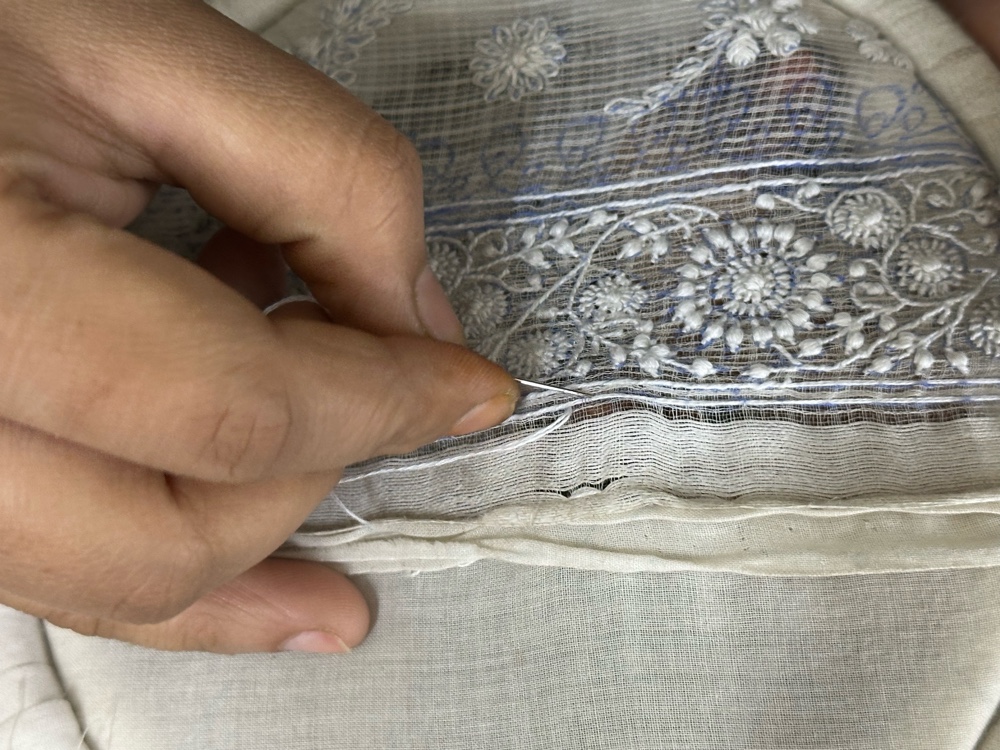
This, reminded me of my visit to Lucknow last April, learning from women engaged in chikankari. Here the context is different, and is not intended as a historical parallel. These were largely Muslim women, many of whom were not permitted to move freely outside the home. They arrived at the atelier covered from head to toe—stepping in wearing burqas, and then, once inside this all-women’s space, unveiled and stitched through the day. The workroom became a contained world — sanctioned, protected, but bounded. Stitch did not alter the structures that governed their lives. It did not offer emancipation. What it offered was time, focus, and a place to speak, share and where attention could rest. Listening to them, and later transcribing those conversations, I was struck by how often stitching appeared not as aspiration or expression, but as continuity — a way of remaining intact within conditions that were unlikely to change.

Repair, in cloth, does not erase damage. It holds a tear. It strengthens an edge. It works with weakness rather than denying it. When I think about repair in this way, it becomes clear that it is not an abstract idea for me, but something I am constantly negotiating through the act of stitching itself. Repair is not something I arrive at conceptually and then apply. It is something that unfolds through attention, constraint, and decision, moment by moment.

I see this most clearly when I think back to how I arrived at the work that day. I was overstimulated, scattered, carrying the residue of too many conversations, obligations, and decisions. Nothing dramatic was wrong, but nothing felt settled either. Stitching did not resolve that state or make it disappear. What it did was hold it. The repetition slowed my breathing. The sequence of actions gave shape to what had been diffuse. The work did not erase the frayed edges of the day, but it strengthened them enough for me to remain present.

I also recognise that the frenzied state was not only about fatigue or overstimulation, but about a lack of clarity. Too many loose threads of thought were creating a sense of chaos. Stitching steadied my breath and slowed the pace enough for those thoughts to come into focus. Once that happened, I could see what needed attention. I made phone calls and  addressed what had been weighing on me instead of carrying it as unnamed anxiety. The stitching did not resolve these issues, but it made it possible to recognise them and act. In that sense, repair was not withdrawal from the world, but a return to it with greater clarity.

Those who have written about craft and making speak of its closeness to lived experience, and of making as a process of correspondence rather than control, where one is in dialogue with material, unspoken perhaps, but real. The material, and how it behaves within the realm of our capacities to interact with it, suggests what we can or cannot do.

As I continue my work on Co-creation III, I am aware of risk at every step. I do not fully control the material. I choose a direction. I commit to a tension, regulate intervals of where the stitch holds the thread, enters the cloth, not always with perfection. Limited by various conditions—eyesight, electric light, glare from shining zari thread and the hued proximity of the thread I couch it with—whatever choices I make within these conditions and my capacity to stitch, skill or lack of it, I live with the consequences. As one does in life.

In this sense, stitch cannot heal the wound. It may effect repairs within the conditions under which the wound can be lived with honestly. Not altering the path, but changing the possibilities of how the path is walked.

And sometimes that is the only kind of healing that is possible.

No miracles. Sometimes not even relief. But an understanding of how the wound, the hurt, even arises.

Within my continued work on Co-creation III, I see this play out repeatedly. A lack of discipline while couching without the fabric stretched on a hoop. The small chaos that emerges when material resists intention. The urge to keep going, to make sense, to hold things together through repetition. Limited by light, eyesight, fatigue, and time, I work within what is possible rather than what is ideal. Each decision holds. Each compromise remains visible.

Stitch does not resolve this.

It asks me to stay with it.

And perhaps that, too, is a form of repair.


Monday, 15 December 2025

Thinking Aloud —


Where the Judgement Comes From


I began this process journal partly in response to reading Glenn Adamson’s Thinking Through Craft. I was hoping to encounter a discussion of craft as lived process, but instead found a great deal of art‑world language aimed at making craft legible to contemporary art discourse.


For me, craft does not need to be translated into theory to be understood. Process is the very core of crafting. Working with textile and stitch, meaning emerges through material negotiation, repetition, resistance, and decision over time. I began recording my process not to analyse myself, but to pay closer attention to how material intelligence operates in the making itself — how fabric, tension, layering, and intuition shape the work as it unfolds.


13 December 2025


Fact is, when I think of tabulating my working process — the process by which I make my art — I realise that so much of it is ingrained in how I look, what I feel, how I approach it all.

Yesterday, I was working on one of the co‑creation–inspired pieces. The third one. I had been more creative with it, introducing blues and a lot of gold. What I noticed was that it looked bare without my usual tendency to create a border.

I found the idea of adding crochet around it and then using that to create buttonhole lace interesting. But as I worked on the crochet, I used Doli. thread, which made it feel rather heavy and ungainly. Trying to contain the original within the framework that was evolving seemed clumsy.

But that sense — that it looked clumsy — where did that come from? What was I trying to achieve that made it appear clumsy? What aspect of design composition, visual impact, or my own sense of beauty was being thwarted by this feeling of clumsiness?

What am I trying to arrive at? What idea, ideal, or beauty am I moving towards, and why?

What I mean by ungainly is this: the thread is heavy, and the work itself is on organza. I have layered it with tissue organza and ripped the fabric by taking out threads and exposing different layers. It has a very delicate quality. But the Doli thread is thick. I wanted to create a muddy kind of texture relating to the sandbanks of the river — the ripples that are co‑created by sun, light, and wind. That is one reason why I’ve added so much gold.

I’ve used 6 ply metallic thread or zari, which is couched, and I’ve also stitched with single‑ply zari. When I added the border, that thread was thicker, and it felt clumsy because of the imbalance. Yes, it is a perceived imbalance, and I’m trying to interrogate why this imbalance feels uncomfortable to me.

The reason I give a border to my work — and this is a tendency of mine — is that borders are something most block‑printed textiles have. Every sari pretty much has a border. I have a quilt with block‑printed bootis (motifs) and a four‑sided border. Perhaps it comes from that tradition. Perhaps it comes from the Mughal miniature tradition of the hashiya, where the border is also saying something, in conversation with the piece.

I like the idea of the hashiya because it allows me to have that conversation. The reason I wanted to create something with buttonhole lace was that if I framed it in the usual way, I would have contained it within a mount, and I didn’t like that idea. It would have given the piece no space to breathe. And if I had just left it in the awkward shape it had evolved into, it looked unfinished.

And perhaps that is my discomfort too — that I don’t like to leave things unfinished, or what looks unfinished. How do I decide what is finished? How do I decide what is unfinished?

Perhaps this comes from my training as a designer. Perhaps it comes from an inherent need in my mind to resolve everything. Perhaps it comes from a deep sense of shame that I carry.

A sense of shame that emerges from past experiences that were erroneous — where, in retrospect, I feel naïve, ignorant, and downright stupid—embarrassed to have been that person. I’m still unravelling that sense of shame, but perhaps, within that context, I try to finish everything with a neat border.

Perhaps.


Monday, 28 June 2021

Personal Threads: Stitching Up the Wounds - Guest Post by Sunaina Bhalla

Rhythm # 1


Growing up I was told I would never be an artist because my drawing was deemed terrible! Both my sisters were creative and I would get yelled at by my chemistry teacher for being unable to draw even a beaker. Who knew then, that I would end up being an artist, and that too working with textiles.

After school, I had no idea what course I wanted to enroll for. My closest friend was applying to the Polytechnic for a Fashion design course, so I decided to follow her there. With a total lack of understanding I sat for the entrance exam for Textile Design assuming it had the least drawing requirements, but I got in and the rest is history. I loved the course turned out to be a fairly student. I found working with patterns, repeats and creating motifs to be relaxing and meditative and it was these facets that later transformed my practice from mere art making to healing.

After graduating with a Diploma, I was employed by Satya Paul as part of the small team of designers who drew and painted each pattern for their printed sarees. It was quite a laboured task, taking up to a month to finish an intricate ‘pallu’ design. Subsequently, I got married and moved to Bangalore. Here, I did some freelancing work where I found a lot of opportunities for printing and hand painting on running fabric for salwar suits as well as sarees, which allowed me to experimented pattern making and printing.


Rejuvenation

Another shift occurred when my husband was given a project in Tokyo. I had never been outside of India and the prospect of going to Japan filled me with dread. Even though I accompanied him with trepidation, the minute I stepped into Tokyo’s Narita airport I fell in love with the country and felt welcome. We were supposed to have been there just three months, which was extended to a year and then longer. At this point I decided to find some work. However my Diploma in Textile Design from India and no knowledge of the Japanese language, made it impossible. However I found a textile teacher at a university who spoke a smattering of English and I started learning fabric dyeing and printing with a technique called ‘Tsutsugaki’, using rice paste as a resist-dyeing patterns on fabric. The names of the materials and dyes are lost to me since I only knew the Japanese names. At the same time I also got pregnant and once my son was born, time for any creative work became limited. 

About a year into my apprenticeship, my teacher retired and once again I was left with no idea what to do. As luck would have it,  a friend introduced me to  a fantastic class on ‘Nihonga’ Painting - a traditional form of Japanese painting using ink and gouache on silk boards. These classes were pivotal in the direction my art practice would take. The rules of Nihonga are very strict in respect of colour palettes and subject of the painting etc. To gain knowledge of the technique, the first couple of years were spent creating replicas of work by Grand Master works.  Our sensei Suiko Ohta organized several group shows which gave me the confidence to venture into India for my first solo show of these paintings. 

In we left Japan in 2003, moving to Singapore. It was here that my art became truly independent of any external influences,  creating my own  ideas of colour, form and subject. For me the hardest part was to change my mindset from that of a designer to being an artist. A designer works within parameters of printing techniques and is looking for solutions. However, as an artist I needed to allow  ideas and visuals  to flow freely – away from the security of repeating patterns, borders et al. 


Block-printing and Embroidery on Gauze bandage

In those days, Singapore had few galleries, where most focused on  showing Chinese art, which meant that there weren’t many opportunities to exhibit my work. This made me look towards India to connect with galleries and curators. Aided by Singapore’s geographical proximity to India as also the opening up of  the internet and email becoming standard practice.

In 2005 I gave birth to my second child, a daughter. Domestic  chores took precedence over art,  but I started feeling restless and wasn’t content  just being a mother and wife. I created a small makeshift studio  in our guest bedroom. For years I struggled to create a dedicated space to work in and only in he last seven years, that I have a studio at home – an actual workspace.  


Devotion

However, as is often with life, it threw me a curveball. In 2010 my daughter was diagnosed with Type 1 Diabetes. Type 1 is an autoimmune disease, completely different from Type 2 diabetes which is more common and arises from high sugar content in the blood. The impact on all our lives was devastating. Adjusting to a new life based on keeping my three year old daughter alive by regulating insulin injections and controlling her food intake, was mentally and physically exhausting. But I never stopped making art. This became an outlet for the angst I felt and, though few and far in between, I continued having exhibitions in India.

Two years later, in 2005, I was diagnosed with  Breast Cancer and given just one week to decide whether to keep my breast or lose it. I kept it. Fearing that I may not have much time left I also went into overdrive and got all the medical check-ups needed for my daughter. It turned out that she had developed two more auto immune conditions-Celiac disease and Hashimoto’s syndrome. At that point I laughed  hysterically, and then became hysterical to think that the universe really was testing me in such an unbelievably cruel way.  To cut a long and agonizing story short I survived it all  and during that bizarre year decided to further my art education.


Pain, Prayer, Peace...


Something was missing in my art practice but I couldn’t put my finger on it. I took several online courses on art history, and an online course with Gopika Nath, an established textile artist in India. She helped me break through some of the rigid mindsets and ideas I was working with,  but I needed more. I enrolled into the MFA programme at Lasalle College in Singapore; graduating with a dual degree from Lasalle and its affiliate - Goldsmiths College in U.K.

I was exposed to art theory and learned how to question and critique my own work. It was ground breaking and the materiality of my work changed completely. I could now view material from the standpoint of their inherent characteristics, textures and visual and tactile language – expanding my visual vocabulary.


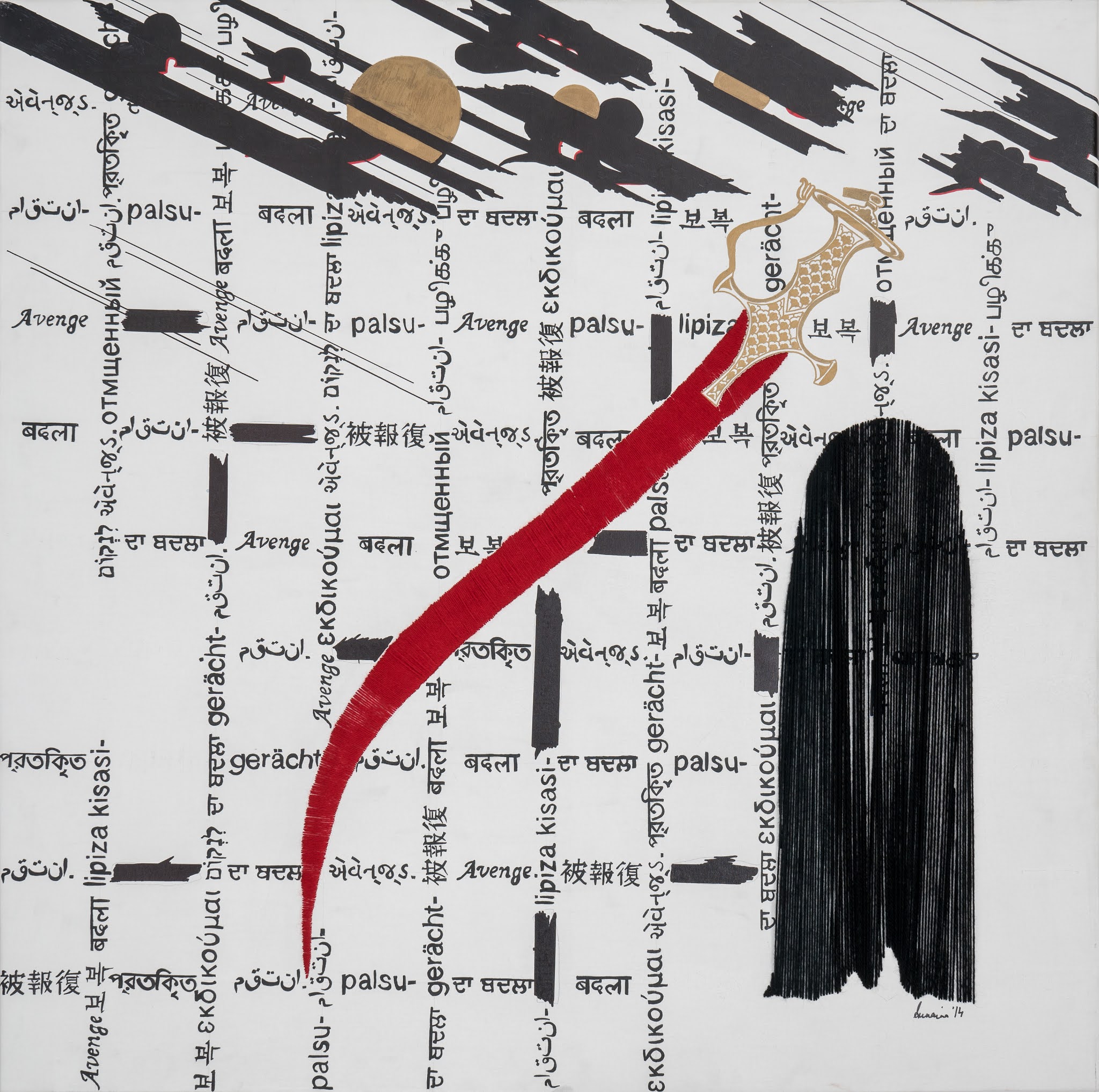
Avenge


Throughout this time,  I was in constant touch with my textile print making. I conducted, and continue to do block printing workshops in Singapore, South East Asia and the US . Recently commencing the first workshop at the National Gallery in Singapore. In addition, I have been working with a block carver in India, who belongs to a family of block makers. His grandfather had an atelier during the East India Company over a 100 years ago, and his father is the recipient of four National Awards. In my endeavour to  support his craft, I offer these hand carved blocks for sale at each workshop, the proceeds of which go to  him and his family. He also carves block that I have designed for use in my own art practice. In total, I  have amassed a collection of over two hundred blocks.

In the past couple of years there has been a renewed focus of working with fabric, where I have added usage of medical detritus and embroidery. I was never trained in it but I find the basic stitch very powerful, visually and metaphorically. A lot of stories can be mapped out with the simple stitch.

I am now focusing on the body and exploring traditions in healing, mapping the physical and mental shifts in perception, behavior and reaction to pain and chronic health conditions.

I am a proud survivor of a number of interactions with disease and health conditions and I hope I will be just as positive for the next phases in my life as I grow older.  Working with the hand and especially with embroidery is an important  part of my practice and I hope to continue evolving as an artist through this medium .


Survivors


Sunaina Bhalla has an MFA from Lassalle College Singapore. A conceptual artist, art educator, printmaker and a mother, Sunaina is a textile artist who has experimented with various art forms but returns to work with textiles. More of her work can be seen on her website: www.sunainabhalla.com and her instagram handle: bhalla.sunaina


Wednesday, 24 March 2021

Kya Soch Rahe Ho........(What are you Thinking)


Sometimes, I don’t know what I’m thinking. Especially when engaged in doing household chores, cooking and such stuff that I try and get over with as fast as I can, I’m rarely focused on what’s going on the mind screen. Thoughts come and go but I am too busy with the job in hand that I can rarely recollect what they were.

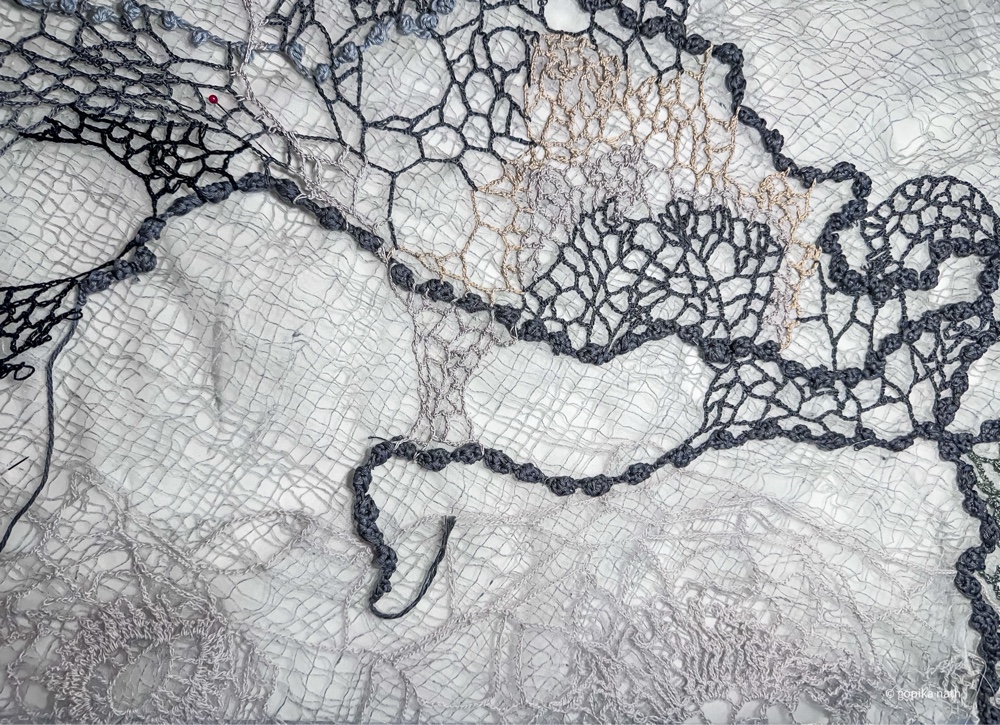
Often, when I’m knitting and crocheting my ‘thought-nets’, I’m also not really focusing on thoughts either. It’s not that I don’t want to, it’s not always easy to understand one’s own disposition. And the essence of issues that plague the mind - the deeper and untiring dialogue with self, is usually buried under the busyness of the day. If I want to look at myself think I do, but otherwise I watch something on nextflix, listen to a talk on YouTube or a book on Audible, to switch off from the superficial chatter of the daily rubble.


Sometimes, when the rant spills over, I can’t watch or listen to anything. My head is just screaming to be heard. If I can, I write in my journal or if it’s too chaotic to form sentences and if there too much emotion, I may speak to a friend. If I don’t feel comfortable talking to anyone, I babble into my phone and record the tirade. When I hear it back - the emotion, irritation and anxiety of what’s been said -that is if I can bear to go over the whole thing again, I do get a clearer picture of the problem at hand. Of why I’m feeling stressed. If I can’t hear that stuff again, I’m relieved that my mind is lighter for off-loading it. Usually it’s stuff that’s deemed unnecessary, pertaining to a whole host of mundane things that are detracting from the essence of what some part of me wants to think about, but the mind is exhausted with itself and cannot muster the discipline to do so. Sometimes feelings overwhelm and they cannot easily be put into thoughts and words – at best disjointed ones.


I’m a reflective sort of person, so I usually begin my day, writing in my journal. I start with reading the previous entry to get a sense of where I left off, because unresolved things have a habit of playing like elevator music, that’s heard but not really listened to - not enough to recognise the melody, not unless it’s a familiar tune, when we do sing along effortlessly – if we like the tune. In trying to get through the processes of living, which requires focus on the mundane, on driving, cooking, folding clothes and other tasks - the screaming is actually this underlying background dialogue that’s unfinished and unresolved, which is demanding it’s time and share of attention.


When I start this morning dialogue with myself, if I’m in a self-reflective mood, I can write for hours. If not, I leave off where I cannot go farther with the thought. Either I’ve said enough or I just can’t quite get to any point of understanding. Often I have to leave things for the thoughts to emerge. Where a movie, a talk or something else - even the rhythm of knitting sheds light.


And, more often than not, it is conversations or interactions with someone else that really helps shed light on what’s going on in one’s own mind - a reflective surface kind of mirroring dialogue. If it doesn’t automatically occur to me, I put my attention on what about the conversation struck me, moved me, or the advice I may have given . And it’s almost always what I need to think about for myself, albeit in a varying degree or context. This then requires deeper reflection which takes me into those areas that eons of exploration leave me tired and unfulfilled, but ideas that I need to resolve to whatever extent possible, because unless I do so I’ll never be free of the distressing inner rant.


A net by its very nature is something to catch things. Fishermen use it to catch fish, which is food for the human body. In Goa, many outdoor restaurants and cafes suspend nets under over-arching trees to catch the falling leaves so that the foliage debris doesn’t hamper happily chomping guests.


So what does a ‘thought-net’ do? What does it catch, or prevent from imposing or entering a protected space or field of vision?


If I put the larger and more cumbersome nets that I’ve created over my head, as an extension of my mind - an evocation of what’s going on inside my head, then it’s a kind of trap. A net that binds me within its threads. And not unlike repeating thoughts which bind us to people, situations and circumstance. But, the irony is that ranting and venting - going over the same ideas - creating this ‘thought-net’, is also a way out of this bind.


When we vent or rant - go on and on about a situation, most of us want sympathy because we see ourselves as victims of an unfair circumstance or relationship. Or we don’t have the courage to do or say what we really feel. Or perhaps we don’t have clarity and have conflicting feelings that need detailed analysis. In some sense, the situation challenges us.


I’ve often noticed this about myself that, if I’m on top of things, or matters are going well, there is no need for a dialogue. It’s only when I’m not able to get a grip on what’s going on that, the why’s and why-not’s circle around endlessly. And depending upon the intensity of the situation and emotion it evokes, I may lie awake at night, wondering why I can’t sleep despite vigorous exercise and feeling pretty darn sleepy too.


I was speaking quite recently to a friend, about the paradoxical beauty of our thoughts. This had occurred to me when I was looking at an embroidery pattern I had created within a series of ‘thought-nets’. The resultant ‘thought-net’ was visually attractive and led me rethink the very idea of ‘thoughts’ as being a burden. Of our ‘thought-patterns’ being something destructive. Such that new age philosophy underlines, telling us to get let go the past, to change our thoughts etc. Enticing us with absolutely miraculously solutions that almost never work quite as effectively and definitely not in the long term. Not unless we are on the brink of taking that leap by having done plenty of the work already.


Our thinking patterns, the template of our moral, ideas and ideals arise from societal norms, familial dictates, cultural morals and more that have evolved through individual, social, cultural, national and world events. All of which have collectively framed the psyche of our elders and educators, their ancestors and theirs: going as far back as time itself. Therefore, inherited ‘patterns’ are really not something we can get past easily enough. And, they are the real reason that the thread of ‘thought-nets’ catch us, binding the imaginative mind, curtailing the freedom of our spirits - keeping us from transforming our human destinies and exploring the potential of our human selves, even going beyond this.


My friend’s response was that negative thinking cannot be seen as beautiful, despite what the ‘thought-net’ I was showing her was proof of. She appreciated the artwork, but couldn’t correlate it with what she herself experienced when her mind is gripped with dismaying thoughts - negative thoughts in common parlance.


At one level, I agree with her. When you’re going on and on in a non-empowering way it’s enervating - for both you and the person listening to you. Fact is that negative gives power, when it’s changed through its charge into positive, and the two together is what generates energy. Negative thinking disembowels, but it is also creating an unacknowledged impetus within us, to rise above. If we were happy in that state, there really wouldn’t be any need to rant, complain or drag us and everyone around us, down the dingy steps of despair. We do that because we want a way out, but can’t see it. But lightening the load, getting consolation from friends, seeing that we are not alone in these things, lends confidence to delve within. That’s what we really want. Not necessarily advice, but solace. Not solutions that someone else gives but a means to reduce the thought load and find a way to the subtler voice of our own wise being. At times advice is sought, solution providers can be useful too but essentially the two charges of negative leading to positive - self-affirmation and feeling good, is what brings forth the energy. And in an instant the binds of the ‘thought-net’ are torn asunder. And we taste that enviable taste of freedom. Of being unstoppable.


I think that makes the process quite beautiful, don’t you?