Showing posts with label machine embroidery. Show all posts

Thursday, 10 March 2022

Personal Threads: Portraits Without Faces, Guest Post by Stewart Kelly


Stewart Kelly’s work is one that revolves around the observation of the human form. He produces work that gives insight as to who we really are as an organic entity, stripping away the layers of pretence. These are not portraits of obvious personality, there are no faces, no identifiable poses, no costumes, no props.”

John Hopper (Inspirational 8)

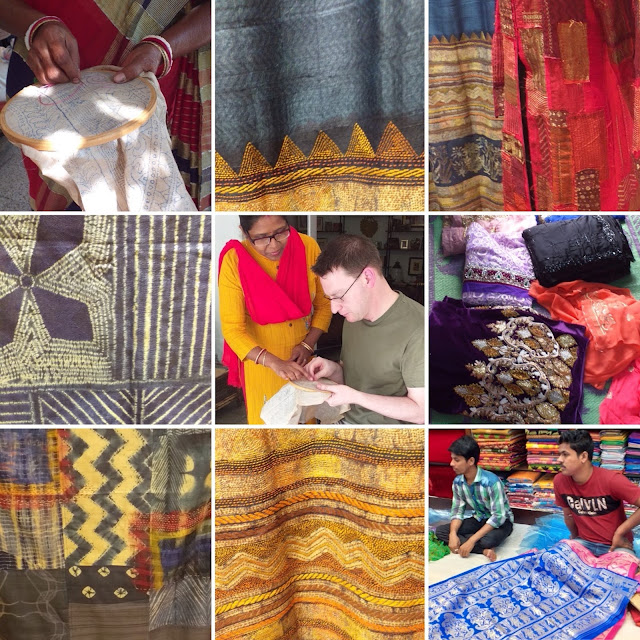
Studying Kantha Embroidery, West Bengal, 2019.

 
My current practice lies at the intersection of art, health and wellbeing. Through practice-based research, I am interested in reflecting on how the ritual of hand stitching can document emotional experiences. 

During 2019, I travelled to West Bengal and visited artists, often in remote villages, working in their studios. My interest was in researching Indian textiles, specifically Kantha embroidery, which is synonymous with this region. Experiencing the sights, sounds, colours and people of India was a revelation in many ways. Through speaking to artisans, I became increasingly aware how tradition and beliefs are integral to the nation’s cultural identity. 

 West Bengal 

Map of West Bengal, India.


West Bengal is a state in the eastern region of India along the Bay of Bengal. With over 91 million inhabitants, it is the fourth-most populous state and the fourteenth-largest state by area in India. Part of the Bengal region of the Indian subcontinent, it borders Bangladesh in the east, Nepal and Bhutan in the north. It also borders the Indian states of Odisha, Jharkhand, Bihar, Sikkim and Assam. The state capital is Kolkata, the third-largest metropolis, and seventh largest city by population in India. 

 Kantha Embroidery 


 Kantha Embroidery, Kolkata, 2019.


In Sanskrit, the word 'kontha' means rags. Kantha is the most popular form of embroidery in West Bengal, and has been around for more than 500 years. Initially, Kantha was used on cotton or silk, however, it is now used on other fabrics as well like Georgette, crepe and chiffon. 

Originally made from old, recycled fabrics, the traditional kantha cloth is an example of flat, or un-wadded quilting, worked on multiple layers of fabric. Bangladeshi or Bengali kantha cloths were made by women for use in their own homes as bedcovers, mats and all-purpose wrappers. The stitching consists of embroidered patterns, ranging from simple floral motifs to elaborate scenes, combined with running-stitch quilting in a colour matching the background fabric. 

Portraits without Faces 

 Although there is a wealth of traditional textiles produced in India, my thoughts focused on the lives of the artists. Many of whom work long hours, tirelessly investing their skills, for little financial reward. On my return from India, I revisited drawings I had created prior to my trip, consisting of multiple figure studies. I began to embellish the surface, emulating labour and repetition through intensive periods of stitching. 

Baptism of Fire and Wake Up 

The first two pieces I created for this project were called 'Baptism of Fire and Wake Up'

Baptism of FireInk & Machine Embroidery on Paper, 

80 X 60cm, 2020.


The pieces evolved in several stages, over many months. The basis of each piece was an ink drawing on paper. The drawings consist of multiple figure studies, made from observation, overlaid over a period of time. In the studio, I began to machine stitch over the surface of the drawings, initially to enhance certain lines and fill in spaces. 

However, through intensive periods of stitching, the pieces began to transform dramatically. I frequently stitched on the reverse side of the work, unaware of the image evolving on the front. The image almost became irrelevant, and the process of repetitive stitching, became the focus of the work. 

Baptism of Fire (Detail), Ink & Machine Embroidery

 on Paper, 80 X 60cm, 2020.


As the pieces evolved, the paper began to break away in places, caused by the perforations made by the machine needle. At this point it was necessary to add additional support to the work in order to progress. This process of working became an interesting metaphor in the work, especially as my practice is informed by themes surrounding the human condition. 

Wake Up, Ink & Machine Embroidery on Paper, 

80cm X 60cm, 2020.


Through the process of creating the work, the work became fragile and began to degenerate. 

Out of the Blue and Spectrum 

 Out of the Blue (Detail), 

Hand & Machine Embroidery on Digital Print 65 X 50cm, 2020.


The following two pieces in this series were called 'Out of the Blue and Spectrum'. These pieces also evolved in several stages over many months. Initially, I photographed a series of drawings before digitally manipulating the images to add colour and definition. Following this, I collaborated with the Centre for Advanced Textiles at Glasgow School of Art in order to digitally print the images on to cloth.

In the studio, I began to hand and machine embroider onto the surface of the printed cloth. However, these pieces began to evolve in a different way to the earlier works on paper. Through intensive periods of stitching, the cloth began to gather and sculpt in unpredictable ways. Through this process of working, the pieces were transformed, and formed a new identity. 

Out of the Blue (Detail), 

Hand & Machine Embroidery on Digital Print, 65 X 50cm, 2020.


My creative process can vary depending on a specific project, however, many of my pieces evolve over a period of time. I find this approach enables me to explore the full potential of working in a particular way. I frequently work on more than one piece of work at any one time. I find this process of working valuable in being able to reflect and assess the progression of a particular project. I normally work on one piece for a while, put it away, try to forget about it, and start to work on a different piece. After a period of time, I will return to the first piece, and for a short time, I can be the viewer of my own work. I can assess what is going well, and what is not working. At that point I am often able to make bold decisions about how to move the piece forward. 

Spectrum, Hand & Machine Embroidery on Digital Print, 

65 X 50cm, 2020.


Slow Motion and Daydreamer 

The final two pieces in this series were called 'Slow Motion and Daydreamer'. The basis of these pieces were drawings digitally printed on to cloth. However, hand stitching and the inclusion of kantha embroidery is more predominant in these pieces. 

 Slow Motion, Hand & Machine Embroidery on Digital Print, 

75 X 55cm, 2020.


On reflection, I began to consider how the drawn line is immediate, whilst stitching is slower and more reflective. Through a complex network of drawn gestures and stitched lines, I attempted to establish order amongst the chaotic background of lines and colours. 

What lies beneath the surface? How can hand embroidery enable communication between the conscious and subconscious, and serve as a subliminal connection to the world? In addition, how can the hand drawn qualities of stitching, create a narrative to intertwine the fabric of this inner and outer connection?

Slow Motion (Detail), Hand & Machine Embroidery on Digital Print, 75 X 55cm, 2020.


I also considered how my practice seeks to explore reasons for using stitch to express male identity, and how embodied textile practice encourages well-being in men. The significance of stitch as a feminist-based practice is well documented. However, the use of stitch as a reparative tool, and craft as a method of embodied textile practice for men, has rarely been assessed. 

Daydreamer, Hand & Machine Embroidery on Digital Print, 

75 X 55cm, 2020.


How can engaging with material processes report, reflect and discover the spiritual act of stitching through contemplation, meditation, resilience, transition, physical and emotional healing? In addition, how does the intimacy of repetitive touch leave a trace of the artist’s presence? 

Craft is immortalised by the hands, and draws an association with the processes it is engaged with. The artist initiates a dialogue with the material, and the act of the hand. However, is there a relationship between craftsmanship and sensitivity in a conversation of the hands? 

Daydreamer,(detail) Hand & Machine Embroidery on Digital Print, 75 X 55cm, 2020.


Conclusion 

Through the development of this project, I reflected on how the ritual of hand stitching can document emotional experiences. The intimacy of the medium itself, with the suggestion of repetitive touch, lends a poignancy to bodily associations, providing an intimate and ambiguous trace of the artist’s presence.

Out of the Blue (Detail), Hand & Machine 

Embroidery on Digital Print 65 X 50cm, 2020.


Making hand stitched textiles can be therapeutic, a crucial tool for reflection and developing self-awareness. Working on slow, reflective projects has allowed a better understanding of the connection between the self and my desire to make art. 

 The work marks time, and chronicles emotional changes through the physical and reflective act of stitch. In addition, the work aims to convey the concept of transformation in life, the importance of reflection, and the exploration of creativity as part of artistic identity.


Thursday, 26 February 2015

Photograph Album


I had started this project of working with stains by photographing the marks in my tea-cup and then getting them digitally printed onto fabric. Suddenly, about a month ago, it struck me that I wanted to work with photos and not have them printed on fabric. I wanted to use photographs from an album and embroider them. I went to the photo album of stains on my computer, edited some images – posterized them and played around on with the little photoshop stuff I had picked up over the years.
 

 There was a sense of urgency to the whole process. I was excited and wanted to see what would emerge, as much as the need to work through  a very stressful phase where I wasn’t getting the usual time to exercise, meditate and write in my journal – dealing with all that came up with the kind of careful scrutiny and analysis I have used to deal with the emotional build-up. I was quite stressed and didn’t have the patience to work with the hand so I used the sewing machine. Actually it was next to impossible to really get much done with hand sewing. Photo paper is thick and the stitches were large and gangly and didn’t really do much to alleviate or express the frazzled state.
 
I hadn’t really used the machine much since my last lesson; the experience of which I shared in a recent post. I didn’t have a clue as to how the machine would respond to photographic paper but some exploration and experimentation revealed that the machine is really quite amenable. If I had any problem it was with the paper, which tore easily. But that was resolved by using fabric beneath and above the paper. Yes, this did sort of create a veil and softened the stains, which made me want to add another element. And that was when I decided to burn the photos.


Armed with candles, some I burned with the fabric already stitched. And some were set alight before I put them under the scrutiny of the needle. As the photos of the stains, that I had recorded some time in 2009, burned, I realised that I was in some sense burning the stains – those marks that symbolized embarrassment, guilt and shame. I felt my frazzled nerves calm down almost as if I was off-loading emotional baggage - catharsis was taking place and without the usual ritual of conversations.


Burning photos, I found, was different to burning ordinary paper.  I didn’t want to really burn them to ashes so I kept a close watch over the photos as they burned and noticed a few things. They burned slowly. And instead of shrivelling up with a bundle of soft and feathery ash beneath them, like regular paper did, the ink smoulders, the paper melts and cracks. The ash is not soft and papery and in some sense purified by the fire, like paper being reduced to ashes – it has a kind of ugly quality.  It is not even ash, the photos crackle into a kind of putrid, thick and almost sticky, black substance. Photographs being burned created the oddest sensation which I encapsulated in a poem.

Flame
Yellow Orange
Ice-blue
within the burning red  

sets ablaze
photos

Ink smoulders
Paper melts
smokes
crackles into putrid ash


After the ritual of burning I sewed into the layers of photo-paper and fabric. It was a very intense process. Controlling the machine - to go round and round the marks, as I do by hand, is easier said than done. Especially with a novice like me trying to do it, but I had such fun. I wasn’t interested in making a piece of work that spoke of fine craftsmanship but wanted to explore the idea of erasing marks in the mind – memories that mark us. Going round and around the marks allows for tracing those marks – like going over the conversations or experience and putting them into perspective.

As I worked with the machine and then the hand - sewing in those odd details that only the hand can do, I realized that the stains or marks of experience that one may try and ‘burn’, are never really erased from memory. They can be buried in time, warped through its seconds and minutes, months and years, but what the mind may feel is forgotten becomes embedded in the body. The body doesn’t forget.
 
Those cells which supposedly renew themselves, they seem to retain the nature of our experiences in a way that our minds seem to have forgotten. I mean, think about it: if we have truly erased, forgiven and forgotten, then what accounts for the countless diseases that abound? 

As a healer I am all too familiar with the idea of stuff being buried under the carpet which shows up as dis-ease and therefore I think it is more about pushing things out of our minds, which often  may seem as if we have forgotten.  It’s worth pondering on why some people are healthier than others – especially those who are more cantankerous, miserable and vocal about their woes.


Memories
sewn as thought 
fade

These marks
buried in time


warped through weft   

the body
doesn't forget

Sunday, 4 January 2015

Are You A Failure......Is Anyone......?

Failing doesn’t make someone a failure, quitting does
                                        – Bob Proctor

'FAILURE' is of those word-stains that I haven’t really wanted to deal with - for the simple reason that I am not sure what this word really means. Of course I know what the dictionary says, but as the above quote implies - simply failing to achieve doesn’t make us failures, only quitting, or terminating the process of trying to achieve does. Then, as long as we keep trying, we are still in the process of achieving and haven’t technically failed. But are there not limits to trying?  Are there also not limits set as to the kind of time one should technically take to achieve something? Aren’t these the parameters that have been dinned into our heads? And more often than not, when one doesn’t achieve something in a designate or reasonably good time, then we consider ourselves failures and give up. Until Lisa Nichols and others like her incite us to keep going with “Quitters don’t win, winners don’t quit”. 

So like I said I don’t really understand how to deal with this word and what it means because where I come from, it has often been said that one should know when to quit....so how does this work?
 
 
But let’s forget for a moment whether we concur on the meaning of ‘Failure’ or if the word should technically even exist in the larger perspective of things and consider instead that often, it’s the mistakes we make that becomes our failures – failure to know better, failure in being able to judge better or do better. Failure seems to dog us, no matter if we give up on something or not, right?

And how many mistakes we do make in a life-time. And then make some more? So, does anyone ever really feel like a winner, all the time? Do you? 
 
I don’t know anyone who really does. Even those who stand up and conduct self-help courses and seminars or webinars as they call them today, or write that pile of books I have on my shelves, have all fallen down and picked themselves up, just like you and I do, every single day.  But the more of these there are around, the more I feel like I am a failure. Sometimes, precisely because I cannot stand up and tell you how to succeed. I don’t have that fool-proof, designed to succeed sure-shot plan.

There have been many times that I have felt like a failure. There have also been those times that I have felt like more like a loser than a winner. Yes, on some days I do feel pretty chuffed with myself – especially when I win ten out of the ten games I am playing on scrabble. But, on most occasions I tend to feel less so, and wonder what have I achieved?
 
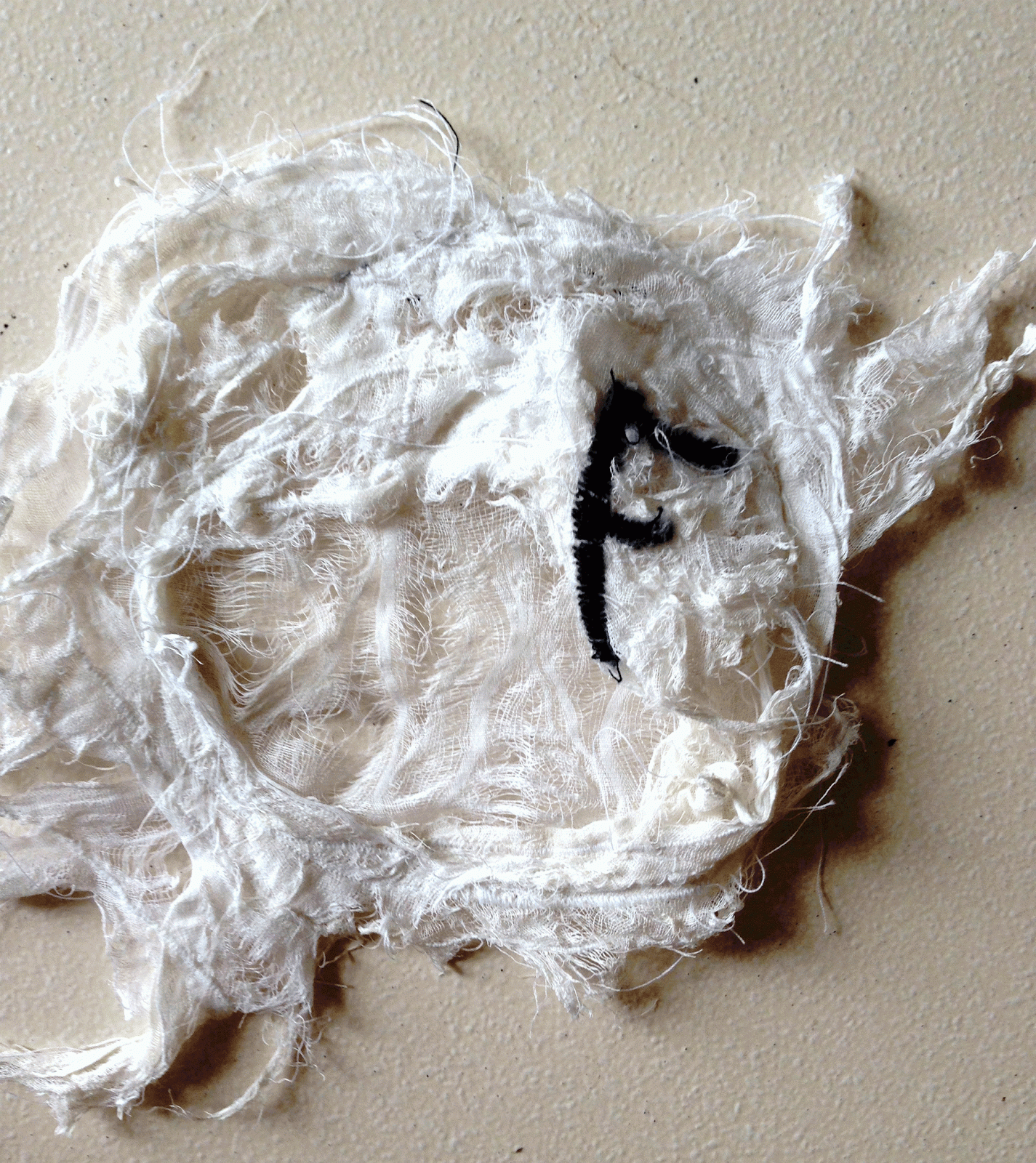
However, the other day, I had a small success. I wanted to learn how to use the sewing machine and the class went very well. I actually managed to write out the word FAILURE through the machine and then cut some fabric into little bits and play around with the multiple stitch options. The result was quite familiar. Yes, you read it right. I said familiar because it was almost exactly what I felt within me -a  total lack of order, no control over where I was going –  concentrating so hard on trying to co-ordinate the hand and foot and while it wasn’t quite the same as learning how to drive, it was a challenge.

I have resisted using the sewing machine because I feel good doing
hand-work which slows one down, in tune with the rhythm of the body. However, the past weeks had been rather stressful and the mental strain was just not allowing me to access that natural rhythm of the body easily enough - making me feel even more of a failure. I mean, where was all my training as a yoga practitioner, reiki healer and someone who has done intense meditation for twenty years? What was going on, where was I headed with this screaming inside my head?

One after the other some domestic issue was cropping up  -  tantrums from the help, one maid left, a new one started – totally raw and now I have the pressure of training her to boot.  The fridge was over-cooling and no parts were available – there was a special offer on so I bought a new one. That should have been easy, but the fridge turned out to be, not the one I’d ordered. But I couldn’t have got that one anyway because Samsung had misrepresented the product in their catalogue. I was over-charged and had arguing marathons that fried my brain and am have given up trying to get Samsung to explain the mess-up.  The list continues in this vein – an almost non-ending list that anyone who runs a home must be familiar with. 
 
Anyway, young Advesh from Usha Sewing Machines came to give me a demo and also instruct me, on how to use the sewing machine that I’ve  had with me, for a while now, but never used. I felt like an excited child with her new toy and before I knew it 3 hours had lapsed.  I was simply delighted to have just about learned to thread the needle and move the fabric - to get the needle to go along the lines that I wanted it to – very basic stuff. I was glowing with the praise from my tutor who said that he had never seen anyone manage quite so well, on their first attempt.  How wonderful that sounded to ears that had been on living on battle lines and only heard criticism from within and without, for days together!

I hope that soon I will gain greater control over the process because truthfully, by the time he left, I was nothing short of exhausted. It took every ounce of my concentration to press the pedal and trace the needle over the word ‘Failure’ written in running hand, on the fabric. 
 

Advesh is 24 years old and had come all the way from Faridabad. This is his first job and he’s been doing it for three years. It was very reassuring to have him around every time the thread caught in the needle because of a knot, or when I kept stitching and didn’t even realise the thread had snapped and was no longer in the needle, and a lot more of such glitches that came up. His practiced eye and hand guided me with patience and also watched me with utmost curiosity as I created a blob out of the word ‘Failure’.  I am sure he was cringing. It wasn’t the kind of embroidery he had ever seen, he said, but patiently guided me to do what I wanted.

The  reason that I chosen to learn how to work with the machine was because it occurred to me that in this age, where machines do so much of our work, could I really afford to continue to working with the hand alone? I needed to explore this dimension before I decided it didn’t work. And who knows, it may well turn out to be a useful support tool. 
 
I took great delight in allowing the machine to stitch. It was my first attempt and there was no expectation from myself – I just had to learn.  I was having fun and the machine suited the frazzled state of failure. I found a strange calm descending over me because for a while now, I had felt this intense desire to take some kind of a quantum leap to get past the plethora of thoughts that would run amok in my mind. I really was struggling to organize all aspects of my life – those fundamental things that needed doing from cooking and  more along with my professional work, and then burn them out of the mind by exercising - exhausting myself.

I did find some measure of peace at the end of the day when I was alone, to write or do some creative work. But, I would be so exhausted the next day that waking up was hard, I just didn’t want to. This strategy wasn’t working out well. I needed to figure out another way to express the angst and also find mental clarity and peace. It wasn’t good enough to dull the mind with exercise as it only got more intense the next day. What I needed was something that could adequately express the frazzle.  Working with the hand may eventually calm me down, but truth is that it wasn’t expressing the way I felt and expression of this fraught state of mind is what I sought – it was needed to get the ‘gunge’ out!

The whirring of the machine; the random stitching, making a piece that didn’t take hours but could be accomplished in a short while, made me feel as if I had accomplished something. At the end of three hours, my first three hours of sewing with a machine, I actually had something to show. 
 

It was different, it was a challenge and it also brought into play a whole different work ethic – all of which I managed. That day, I didn’t feel like a failure. I had learned to thread the sewing machine needle and make some marks with thread that expressed, somewhat, the way I felt. In the bigger picture if failure looms large, one needs to be reminded that it is the small things  we do achieve each day that add up to what can be called success.

I don’t think anyone can really be called a failure, even if we do give up. In the process of trying, it’s what we learnt that made us decide to give up, which is integral to the success of our story, is it not?