Showing posts with label kantha. Show all posts

Thursday, 10 March 2022

Personal Threads: Portraits Without Faces, Guest Post by Stewart Kelly


“Stewart Kelly’s work is one that revolves around the observation of the human form. He produces work that gives insight as to who we really are as an organic entity, stripping away the layers of pretence. These are not portraits of obvious personality, there are no faces, no identifiable poses, no costumes, no props.”

– John Hopper (Inspirational 8)
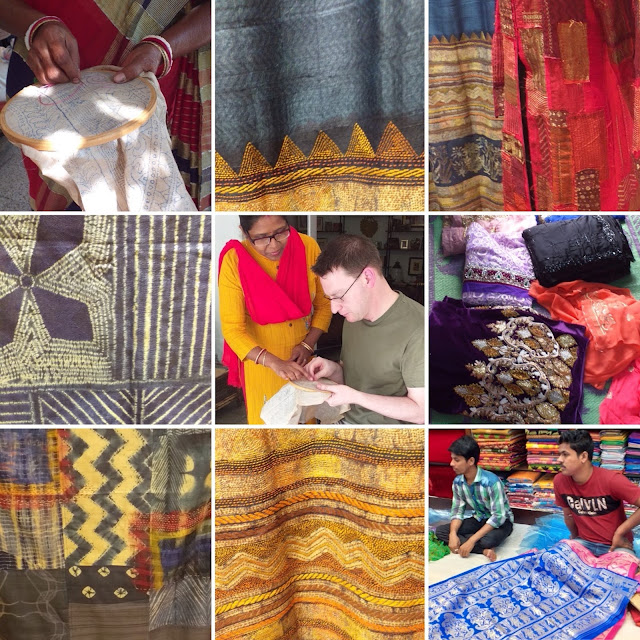
Studying Kantha Embroidery, West Bengal, 2019.

 
My current practice lies at the intersection of art, health and wellbeing. Through practice-based research, I am interested in reflecting on how the ritual of hand stitching can document emotional experiences. 

During 2019, I travelled to West Bengal and visited artists, often in remote villages, working in their studios. My interest was in researching Indian textiles, specifically Kantha embroidery, which is synonymous with this region. Experiencing the sights, sounds, colours and people of India was a revelation in many ways. Through speaking to artisans, I became increasingly aware how tradition and beliefs are integral to the nation’s cultural identity. 

 West Bengal 

Map of West Bengal, India.


West Bengal is a state in the eastern region of India along the Bay of Bengal. With over 91 million inhabitants, it is the fourth-most populous state and the fourteenth-largest state by area in India. Part of the Bengal region of the Indian subcontinent, it borders Bangladesh in the east, Nepal and Bhutan in the north. It also borders the Indian states of Odisha, Jharkhand, Bihar, Sikkim and Assam. The state capital is Kolkata, the third-largest metropolis, and seventh largest city by population in India. 

 Kantha Embroidery 


 Kantha Embroidery, Kolkata, 2019.


In Sanskrit, the word 'kontha' means rags. Kantha is the most popular form of embroidery in West Bengal, and has been around for more than 500 years. Initially, Kantha was used on cotton or silk, however, it is now used on other fabrics as well like Georgette, crepe and chiffon. 

Originally made from old, recycled fabrics, the traditional kantha cloth is an example of flat, or un-wadded quilting, worked on multiple layers of fabric. Bangladeshi or Bengali kantha cloths were made by women for use in their own homes as bedcovers, mats and all-purpose wrappers. The stitching consists of embroidered patterns, ranging from simple floral motifs to elaborate scenes, combined with running-stitch quilting in a colour matching the background fabric. 

Portraits without Faces 

 Although there is a wealth of traditional textiles produced in India, my thoughts focused on the lives of the artists. Many of whom work long hours, tirelessly investing their skills, for little financial reward. On my return from India, I revisited drawings I had created prior to my trip, consisting of multiple figure studies. I began to embellish the surface, emulating labour and repetition through intensive periods of stitching. 

Baptism of Fire and Wake Up 

The first two pieces I created for this project were called 'Baptism of Fire and Wake Up'

Baptism of Fire, Ink & Machine Embroidery on Paper, 

80 X 60cm, 2020.


The pieces evolved in several stages, over many months. The basis of each piece was an ink drawing on paper. The drawings consist of multiple figure studies, made from observation, overlaid over a period of time. In the studio, I began to machine stitch over the surface of the drawings, initially to enhance certain lines and fill in spaces. 

However, through intensive periods of stitching, the pieces began to transform dramatically. I frequently stitched on the reverse side of the work, unaware of the image evolving on the front. The image almost became irrelevant, and the process of repetitive stitching, became the focus of the work. 

Baptism of Fire (Detail), Ink & Machine Embroidery

 on Paper, 80 X 60cm, 2020.


As the pieces evolved, the paper began to break away in places, caused by the perforations made by the machine needle. At this point it was necessary to add additional support to the work in order to progress. This process of working became an interesting metaphor in the work, especially as my practice is informed by themes surrounding the human condition. 

Wake Up, Ink & Machine Embroidery on Paper, 

80cm X 60cm, 2020.


Through the process of creating the work, the work became fragile and began to degenerate. 

Out of the Blue and Spectrum 

 Out of the Blue (Detail), 

Hand & Machine Embroidery on Digital Print 65 X 50cm, 2020.


The following two pieces in this series were called 'Out of the Blue and Spectrum'. These pieces also evolved in several stages over many months. Initially, I photographed a series of drawings before digitally manipulating the images to add colour and definition. Following this, I collaborated with the Centre for Advanced Textiles at Glasgow School of Art in order to digitally print the images on to cloth.

In the studio, I began to hand and machine embroider onto the surface of the printed cloth. However, these pieces began to evolve in a different way to the earlier works on paper. Through intensive periods of stitching, the cloth began to gather and sculpt in unpredictable ways. Through this process of working, the pieces were transformed, and formed a new identity. 

Out of the Blue (Detail), 

Hand & Machine Embroidery on Digital Print, 65 X 50cm, 2020.


My creative process can vary depending on a specific project, however, many of my pieces evolve over a period of time. I find this approach enables me to explore the full potential of working in a particular way. I frequently work on more than one piece of work at any one time. I find this process of working valuable in being able to reflect and assess the progression of a particular project. I normally work on one piece for a while, put it away, try to forget about it, and start to work on a different piece. After a period of time, I will return to the first piece, and for a short time, I can be the viewer of my own work. I can assess what is going well, and what is not working. At that point I am often able to make bold decisions about how to move the piece forward. 

Spectrum, Hand & Machine Embroidery on Digital Print, 

65 X 50cm, 2020.


Slow Motion and Daydreamer 

The final two pieces in this series were called 'Slow Motion and Daydreamer'. The basis of these pieces were drawings digitally printed on to cloth. However, hand stitching and the inclusion of kantha embroidery is more predominant in these pieces. 

 Slow Motion, Hand & Machine Embroidery on Digital Print, 

75 X 55cm, 2020.


On reflection, I began to consider how the drawn line is immediate, whilst stitching is slower and more reflective. Through a complex network of drawn gestures and stitched lines, I attempted to establish order amongst the chaotic background of lines and colours. 

What lies beneath the surface? How can hand embroidery enable communication between the conscious and subconscious, and serve as a subliminal connection to the world? In addition, how can the hand drawn qualities of stitching, create a narrative to intertwine the fabric of this inner and outer connection?

Slow Motion (Detail), Hand & Machine Embroidery on Digital Print, 75 X 55cm, 2020.


I also considered how my practice seeks to explore reasons for using stitch to express male identity, and how embodied textile practice encourages well-being in men. The significance of stitch as a feminist-based practice is well documented. However, the use of stitch as a reparative tool, and craft as a method of embodied textile practice for men, has rarely been assessed. 

Daydreamer, Hand & Machine Embroidery on Digital Print, 

75 X 55cm, 2020.


How can engaging with material processes report, reflect and discover the spiritual act of stitching through contemplation, meditation, resilience, transition, physical and emotional healing? In addition, how does the intimacy of repetitive touch leave a trace of the artist’s presence? 

Craft is immortalised by the hands, and draws an association with the processes it is engaged with. The artist initiates a dialogue with the material, and the act of the hand. However, is there a relationship between craftsmanship and sensitivity in a conversation of the hands? 

Daydreamer,(detail) Hand & Machine Embroidery on Digital Print, 75 X 55cm, 2020.


Conclusion 

Through the development of this project, I reflected on how the ritual of hand stitching can document emotional experiences. The intimacy of the medium itself, with the suggestion of repetitive touch, lends a poignancy to bodily associations, providing an intimate and ambiguous trace of the artist’s presence.

Out of the Blue (Detail), Hand & Machine 

Embroidery on Digital Print 65 X 50cm, 2020.


Making hand stitched textiles can be therapeutic, a crucial tool for reflection and developing self-awareness. Working on slow, reflective projects has allowed a better understanding of the connection between the self and my desire to make art. 

 The work marks time, and chronicles emotional changes through the physical and reflective act of stitch. In addition, the work aims to convey the concept of transformation in life, the importance of reflection, and the exploration of creativity as part of artistic identity.


Friday, 6 September 2019

Personal Threads : Blessings From a Grandmother, Guest Post by Ina Puri


My dearest Samaira,
 
Long before you read about the fabled Pokkhiraaj - the winged horse that is believed to have magical powers to fight evil, you will own an exquisitely embroidered kantha that will narrate many a story. Tales of valour, romance and enchantment. When your great-grandmother, your father’s Nani Konchi, started stitching the kantha, it was for her grandson Arjun, your father. We were in Baharampur, Murshidabad, where my grandparents lived in a rambling house filled with books and memories.
 
Ina with her son Arjun

It is hardly mentioned now, but the British East India Company started its journey from Murshidabad which was the capital of pre-British Bengal, and Bankim Chandra  Chatterjee who composed the famed ‘Vande Mataram’, wrote his epic ‘Anandamath’ sitting on the banks of the Bhagirathi that flows through our very own Baharampur. In fact, Kashida, the exquisite silk embroidery on cotton was at one time exported exclusively from Bengal, its main centres around Dhaka and Murshidabad.
 
A Balaposh
Those days, I was looking for a Balaposh – a yearning for that subtly fragrant, soft and comforting quilt. Although it is a quilt, the only quilting stitches are on the edges. It was a speciality of the artisans of Murshidabad, made by craftspeople known to our family. The Balaposh is traditionally layered, with ‘attar scented’ cotton, infolded between two fabrics of silk cloth, and sewn at the edges. It was first made in the Mughal era on request by Nawab Shujauddin Muhammad Khan who commissioned a quilt  “soft like wool, warm like a lap, and gentle like a flower.” 
 
Flowering Bakul Tree (Indian Medlar)
On days that I stepped out, in search of a one, my mother (your great-grandmother) would sit in the garden, under the fragrant flowering Bakul tree (Indian Medlar or Bulletwood tree), stitching away. The evenings stretched long and as we, on my mother's side of the  family shared stories and anecdotes amongst ourselves, to while away the hours, Ma would spread out the silk cloth -a  smallish, baby-sized quilt length, and fill in the imaginary squares which she had, probably, already marked out in her mind. The box with different coloured silk threads and needles by her side, she would carry on stitching even when the lanterns and candles were brought out, during the daily power cuts.

Konchi's Kantha, Hand sewn for her grandson Arjun

It was a time I recollect with fondness, when our family, spanning generations - my maternal grandparents, mashis (aunts) and cousins, all gathered at our ancestral  home in  Murshidabad,  just to be together. It had been an uncharacteristically cold February that particular year, some thirty years ago, but the room was warm and alive with conversations and laughter. We begged Boro Mashi (Mahasweta Devi) to tell us one of her famous ghost stories and huddled close, as she obliged. Outside, the night was full of mysterious shadows, lit occasionally, by the dancing fireflies.
 
Ina with her cousin, mother and aunt Mahashweta Devi,
who is doing the alpana
 
Do you know, as long as I can remember, kanthas have always been a part of our household. A light blanket which was ideal for summer or monsoon nights, was usually made by the women who specialized in the art and turned discarded and worn-out sarees into a beautifully embroidered quilt. It was worked with the myriad stitches of kantha needlework. The main distinguishing feature of a kantha was the pattern created by the concurrent lines of running stitch, sewn in white thread securing together the layers of cloth, which gave the surface a textured, rippled feel. If the designate purpose was to use the cloth as a regular covering, this puckering quilted surface was left unadorned but, if it was designed as a wall hanging or stole, then the kantha-maker would embroider it with motifs that were artistic and imaginative.
 

Detail of Konchi's Kantha

 
My grandmother (your great-great-grandmother) told us that the earliest reference to kantha in Bengali literature date back to the verses in Charyapadas (8th to the 11th centuries CE) They are a collection of mystical poems, in the Vajrayana tradition of Buddhism, derived from the tantric tradition during the Pala Empire in Ancient Assam, Bengal, Bihar, Orissa. It was written in an ‘Abahatta’ (evolving language) that was the ancestor of Bengali and other Eastern Indo-Aryan languages, and is said to be the oldest collection of verses written in those languages.
 
 
The family celebrating Bhai PhoNta
or Bhai Dooj
 
A fleeting hush would descend when Didima spoke about the history of Bengal, its textiles or customs. The younger people in the room would find it  especially fascinating to know that Baharampur had such a rich heritage. We had all visited the historic ‘Hazarduari’ or a ‘palace with a thousand doors’ with our grandparents, built on the lands of the demolished fort Kila Nizamat which stood on  the banks of  the  Bhagirathi River, in Murshidabad.  And, with the pride of true Bengali’s  our hearts had thrilled to hear about the bravery and courage of Siraj ud-Daullah, the last independent Nawab of Bengal, who, deceived by his own men, faced the British cavalry fiercely, armed with a mere sword, in the decisive ‘Battle of Plassey’. The end of his reign marked the start of British East India Company rule over Bengal and subsequently the Indian Subcontinent.
 
Fort Bahrampur, on the banks of the River Bhagirathi
 
While the conversations flowed through the evening, Ma worked on her kantha completely lost to the world. Who can tell, what was going on in her mind.  I would ask myself, if she was imagining a conversation with her yet to be born grandson. In front of her, the Kantha she was embroidering was getting more and more elaborate every day, a magical fairyland inhabited with serpents, dancing peacocks, flowers and fruits, alphabets, nursery rhymes and board games with knots and crosses. In one corner, there were even the fabled birds familiar to us from our favourite bedtime storybook ‘ ‘Thakurmar Jhuli’, the Byangoma and Byangomi.
 
Another detail from Konchi's Kantha
 
 Samaira, wait till you are a little older, we will read these stories together and look at the pictures of all these enchanted creatures.
 
Baby Arjun
 
When I look at this kantha today, those soft folds that once swathed my infant son, following the layout with more focussed attention, I realize that what makes it so original is that Ma followed her own instincts when it came to the design. Creating a composition that was intimate yet visually appealing. We were aware that most conventional kanthas have a basic pattern that is common to them - a lotus at the centre embellished by vines of plants and motifs taken from old and worn sari borders. The four corners usually have the tree of life patterns that lead to the centre, with the ornamentations drawn from nature or mythologies. Images of goddesses are popular and Lakshmi is the one deity who remains a perennial favourite - her footprints  symbolically  represented through patterns of alpana. Newly married wives were known to show off their embroidery skills by making elaborate kanthas for their husbands, interspersed with lines of romantic poetry. In contrast, Ma’s creativity was uniquely her own personal language.
 
Manish Ghatak with his wife Dharitri Devi,
Ina's maternal grandparents
You would have enjoyed her company, Samaira. Ma was born to an illustrious family; her mother was Dharitri Devi and her father, the distinguished litterateur Manish Ghatak. He was a poet and novelist of the Kallol era (one of the most influential literary movements in Bengali literature), who used to write under the pen name ‘Jubanashwa’. Her eldest sister was the brilliant writer and activist Mahasweta Devi who studied in Shantiniketan. But, she was a strict disciplinarian when she came home for the holidays, keeping the large brood of younger siblings under a stringent regime. While the rest behaved, Ma was hauled up constantly. She was said to be extremely mischievous and was always getting into trouble. In her youth, she was a striking beauty with a fiercely independent mind, who stood up for what she believed was just and right. While her siblings went about their lives establishing themselves in diverse ways, Ma concentrated on her music.  And as she grew older, she developed  her other skills, like stitching, cooking and making alpana. She had just about started enjoying her life away from Baharampur, at her maternal uncle, the renowned sculptor, Sankho Chowdhury’s home in Baroda, where she was learning music, when her parents decided to marry her off to an eminent suitor, they considered suitable for her.

Ina's mother Konchi

No matter how tough life turned out to be, in later years, she never submitted to defeat and remained her indomitable self, full of spunk and laughter. Had she continued her studies in music, who knows, she might even have been a musician of distinction today. Yet, destiny had other plans for her, a life she lived with her entire being. Remaining till the end, unvanquished.
 
Another detail of Konchi's Kantha
Samaira, this embroidered cloth is a repository of song and words of poetry that came alive as she embroidered the squares, almost a delicate memoir of her recollections and desires. While she continued to stitch even after making this one for Arjun, she never made another quite so intricate or exquisite. Someday, when you are older, read this story  when you look at the kantha. Imagine the life that was, imagine the hands that held the fabric and fingers that lovingly sewed, carrying forth a tradition of our native Bengal
 
Ina with her mother
 If Ma were around, I know she would want to add just another frame, of a little girl with shiny eyes and curly hair, laughing hard. Of you.
 
 
With all my love,
Your fond Dadi, Ina


Ina Puri is a writer, biographer, art curator and collector. She is the author of several books, including In Black & White (a biography of Manjit Bawa), Faces of Indian Art (iconic artists seen through the lens of Nemai Ghosh) and Journey with a Hundred Strings (on the music and life of Pandit Shiv Kumar Sharma). She produced Meeting Manjit, a film on Bawa, her friend and collaborator, which won the National Award. She currently occupies the position of Editor at Art Varta and has recently published a pictorial memoir on Pt. Shiv Kumar Sharma entitled, The Man and His Music.  Ina’s three-decade-long engagement with the arts embraces everything from tribal art and folk theatre to contemporary performing arts, visual arts and literature. She lives in Gurgaon with her husband, Ravi, and canine soulmate, Leyla.
 

Thursday, 21 April 2016

Personal Threads: An American Kantha - Guest Post, Marty Jonas


Thread can be used in an infinite number of ways and has the ability to convey messages, alter meanings and transform the ordinary. The tactile qualities of fiber and thread, combined with surface design techniques, provide me with the opportunity to speak visually, expressing that which I cannot express in words. My goal is to create works that are complex enough to provide the viewer with interest when viewed from a distance as well as up close.  I try to use the medium to its maximum, pushing beyond tradition in the hope of sparking the viewer’s imagination, thoughts, and memories.
 
Fiber is an extension of my voice.
 
I am 72 years old and the youngest of three girls and live near San Francisco, CA. USA.  My mother taught me to knit, crochet, cook and sew and my father taught me to hammer, saw, solder and drill.  I cannot remember a time when I was not doing something creative, using thread or cloth. My father also taught me that when you do something and it turns out to be easier than you thought, then it was a waste of time and you should strive to do something better and harder. I was never allowed to sit and do nothing.  As a result, I am never at rest and work on my art for 8 to 12 hours a day.

In 1986, I bought an exercise gym so I could sell aerobic clothing that I started making for myself and friends.   When I was not making the clothing, I found myself at the gym all day and night as the only full time “employee.”  I started making pillows, using needlepoint kits to keep myself busy.  I quickly got bored with the kits and began to design for a store in the neighboring city of Napa, CA.  During this time, I came upon a stitched exhibition at Mills College in Oakland, CA.   I saw so many wonderful and new techniques using thread and picked up every available brochure. This led me to take a five-day class by the English textile tutor, Jan Beaney.  The class was held in a sewing machine store.  The facility had one sink, a toilet, and a hot plate to cook on.  We all slept on the floor and in the morning, we hid our sleeping bags, so the store did not look like a homeless shelter.   If I needed any supplies, then I would reach out and pluck it off the shelves. 
 
Thereafter, I enrolled in City and Guilds of London because I was interested in embroidery and in the USA, the emphasis was mainly in quilting and surface design.  I completed the course in embroidery, Part I and Part II with Julia Caprara and continued with additional courses in Embroidery from Middlesex College.
 
Discovering Kantha
 
I first heard of the word Kantha, in 1994, when I was required to make one for a class assignment. I could not find very much on the subject.  I did find the book, “The Art of Kantha Embroidery” by Niaz Zaman, which was available via mail from a bookstore in India.  It is a first edition from 1981 and I cherish it.  I have since bought an updated edition but I love the original with its yellowed pages and faded book cover. 
 

Personal Kantha, 1994, 8" x 8" (20cm x 20cm) Cotton Fabric, Silk Threads, Hand Embroidered
According to my assignment, I was to make a Kantha relating to my life.  I chose silk sewing threads in red, blue and yellow.  As you can see from the photograph, I followed the traditional format with the borders, tree of life, with a lotus motif in the centre along with Lakshmi’s footprints.  In order to personalize it and also inspired by the way the women of Bengal always brought in elements of their daily living, I added an easel and some paint brushes, which represent my husband’s love for painting. In this Kantha you can also see our dog Queenie as well as our daughter’s cat Skitzy.  I also included our 38’ sailboat.  This Kantha is one of my prize possessions, not only because it is a part of my past but because I stitched on it while sitting with my mom while she was recovering from a heart attack.   The Kantha consists of two pieces of thin cotton fabric that I painstakingly stitched so it could be viewed from either side.
 
A Personal Kantha, back-side view


A Trip to India
 
In October 2015, I took a 3-week textile tour to the Rajasthan area organized by ‘Creative Arts Safaris’ and focuses on textiles.    I highly recommend the tour and am planning to return with ‘Creative Arts Safaris’ in 2017 to the Bengal area of India to see more Kanthas. We started with a tour of the Craft Museum in New Delhi, and my heart fluttered at the sight of all the Kanthas.  We took an embroidery class on Zardozi Embroidery in Agra.  Zardozi means ‘sewing with gold’, it is an embossed metal embroidery which was once used to embellish the attire of kings and royals in the 17th century. Pearls and precious stones are also added for elegance.  We sat cross-legged on the floor in front of an adda or embroidery stand. Seeing the adeptness with which the craftsman sat, so effortlessly for hours, I realized that I should have learned to sit this way as a child.   The design was put onto our fabric using the ‘prick and pounce’ design technique.  We all made one flower using gold purl and several colors of embroidery thread. All of us grunted when we had to stand up after our session.
 
Detail of A Personal Kantha, 1994
As part of the tour we travelled to Jaipur and Udaipur where we learned mud resist block printing, badhini and also visited the the double Ikat weavers of Patan and a family of Mushru weavers.  I bought back a lot of textiles, including a beautiful Jain temple altarpiece, originally from Rajkot,  Dhurrie Rug from the Weavers of the Bishnoi people on route to Jodhpur and I also bought several Kanthas, bedspreads, and pillows.
 
My India Inspired Kantha
 
Upon arriving back to Benicia, CA., I immediately started working on a Swastika or Shorstir Chinho embroidery. This design is an abstract symbol which is quite popular in Jessore or Faridpur Kanthas. This piece, which I dyed using a clamp resist technique was stitched in November of 2015 and measures 10” x 10” (25cm x 25cm).
 

Outlined Kantha,  2016, 16" x 16" (40cm x 20cm)
    Silk Fabrics, Cotton Batting, Cotton Threads,  Hand Embroidered
While working on this, I found and ordered several books on the subject of Kanthas.I wanted to make a decorative Kantha using animals, and flowers.  I really liked a picture in the books and decided to try it as my test piece.   I altered the pattern and eliminated some designs and changed some others and enlarged the design to 16” and printed the design onto tissue paper. 
 
I sandwiched cotton batting in between a layer of raw silk and the mushru silk that I brought home from India.  I carefully turned in the edges and hand sewed the three pieces together.  Now this turned out to be my first mistake, as I realized that the pieces of fabric were too thick.  But because this was a test, and I was so anxious actually to get going, I said it will be fine and started up.  I tried to put a running stitch around the outside but found that the fabric was too thick to run my needle through and catch all three layers.  So I ended up using a ‘prick and poke’ technique which became much more time consuming.  I started on my first design and after a day decided that I did not like the fabric that I was using.  The fabric was too shiny and so I ripped out all the stitching, turned the fabric over and starting stitching on the reverse side.   
 
Half Finished Kantha, 2016, 16" x 16" (40cm x 20cm)
    Silk Fabrics, Cotton Batting, Cotton Threads,  Hand Embroidered
I normally use real silk thread but found that I either did not have enough colors in the right size or that it was too thin.  I also found that the silk thread knotted and twisted too much and I had to spend a lot of time, releasing knots.  I ended up working on piece using mercerized thread that I had purchased, to use on my knitting machine.  I had 24 different colors but added to the collection with other mercerized cotton threads.  
 
Next, I wanted to stitch the motifs using a running stitch but could not make them small enough because of the thickness of the fabrics.  I could have only stitched the top layer of the three fabrics and have maintained the tiny stitches but then the underside would be blank.  I chose to stitch the motifs using back stitch.

I had not taken into consideration that I would lose fabric width and length when I turned over the edges so now I had no room to incorporate a border design.  I took a black thread and outlined all the motifs using back stitch.  I planned to stitch the background with white silk thread after I completed all the motifs, but I needed instant gratification, so I played with the stitching as I went.  I used a thin silk thread, which is normally used to tie flies for fly fishing and only stitched the top layer of the Kantha.  I love the piece and am now ready to make a larger Kantha using a thinner material, using only two layers of fabric and not three. 
Finished Kantha, 2016, 16" x 16" (40cm x 20cm)
    Silk Fabrics, Cotton Batting, Cotton Threads,  Hand Embroidered


I started the background stitching before I had completed the motifs.   Besides the backstitch, I have used the kantha or running stitch, the Chatai or pattern darning stitch. When using the kantha or darning stitch, the surface of the material changes radically with the patterns flowing and swirling.


Marty Jonas is an embroidery enthusiast. I first saw her Kantha embroidery on a textile group on Facebook which prompted me to ask her to tell me more about her involvement with Kantha. At 72, she sews, travels the world and experiments with stitching. She lives and works in California USA. www.martyjonas.com