Showing posts with label hand crafting. Show all posts

Sunday, 14 June 2026

Mind Replays While Tacking


It's almost four in the afternoon. It's been a strange kind of day. Rain, no rain.

As I awoke to the day, looking out of the window, I noticed how serene it looked. So innocent—as if the cloud and the fronds of the palm leaf were cradled in a baby blue crib.

Then, as the day progressed I had to dress my wound. I'd burnt my hand three days ago while cooking. I wasn't exactly careless, but I didn't pay enough attention to the fact that the lip of the new saucepan is a little tricky— doesn't pour neatly—spills and splashes—most annoying.

Anyway, the long and short of it is that I pouring hot soup into the mixie, I burnt the top of  my left hand. A very, very severe burn. After seeing the skin wither and peel off with pus beginning to rise,  I had to go to  a nearby primary healthcare center. They gave  me an injection for the pain, some antibiotics and painkillers. I was yelping in pain. It was really bad—terrible!

I couldn’t stitch for a few days because any movement of the left hand, disturbed the dressing, which in turn aggravated the wound.

It was uncomfortable and I couldn’t help but think how people can inflict this on anybody else, but more than that, how do people self-immolate? I remembered the protests against the Mandal Commission and those students in Delhi setting themselves on fire. I didn’t witness it myself, but newspaper images of young men flailing—their bodies aflame—aren’t easy to forget. I don’t know why my mind went there, but it did. We read about bride burning and such things and it’s awful, but burning my own hand this way made these images come alive as never before.

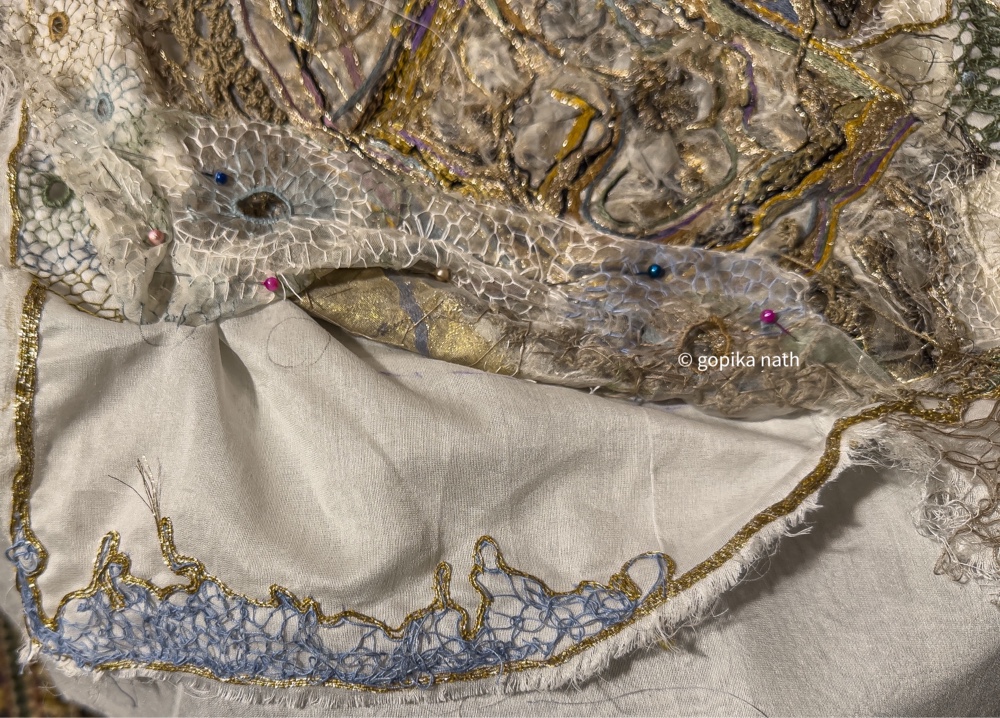
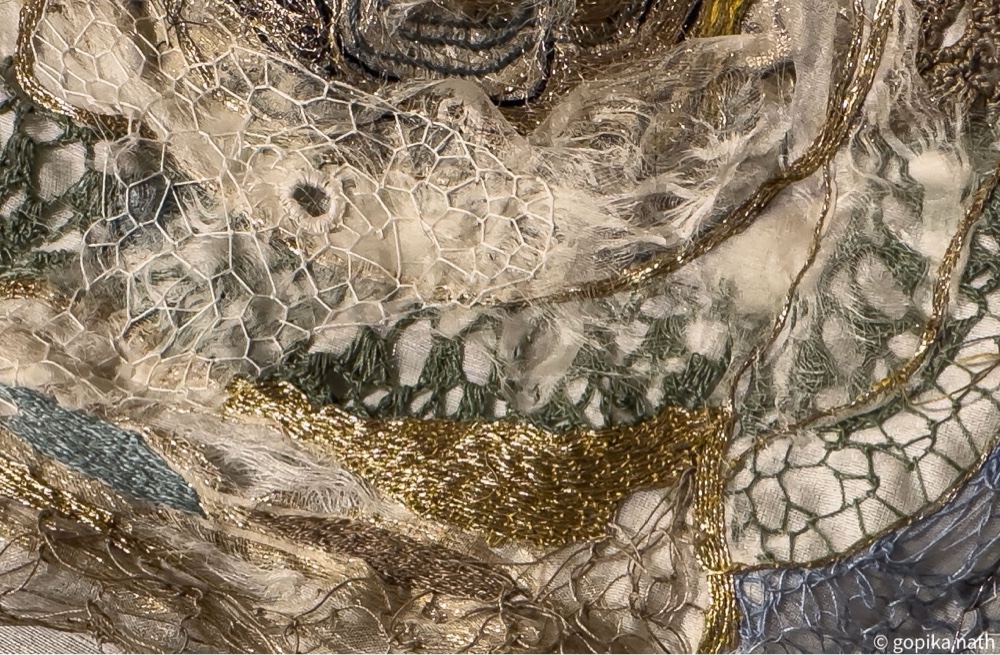
I'm now working on this piece—tentatively called Crab Lace. I've been doing it for a long time and it's taking forever because a lot of tacking work has to be done between the five layers of fabric before I can begin any embroidery. Tacking isn’t something that makes me think too much about what I’m doing. My mind starts replaying all that I have read/heard etc. 

There’s the war in Iran—neither war nor peace, a supposed ceasefire that's not. Glancing at the NYT headlines, disturbed the serenity of the day and what I’d been observing about the weather. Making me think that,  I have the luxury of these gentle moments, even the observations I make about my stitching. Those in war strife zones are striving for basic survival. It seems unfair.

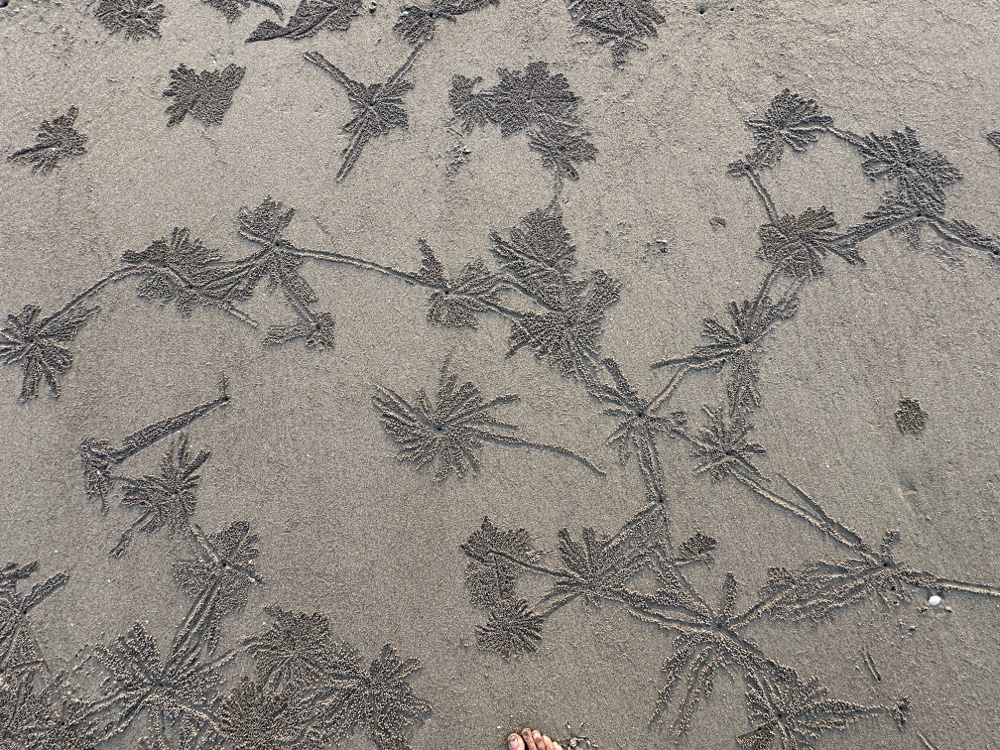
The stitching piece  is inspired by the way the crabs feed off the debris on the beach and in effect clean it for us. Perhaps that’s something we could do for ourselves. Chew on those moments of grief, of pain, of discomfort—digest them.

Now, I have  a knot.  Most uncomfortable. I'm inserting the tip of my needle into the core of the knot, but it is so tight I can't get needle-point into it. If I could, I'd be able to wrestle with it and open it out. It's so tight and so small, I probably need a magnifying glass.

Recently I got news that two of my friends have been diagnosed with cancer. It’s troubling me. My father had cancer and I know what it did to him—to all of us. I know it was decades ago and medicine has made significant advances—but those memories don’t just go away.

I'm holding the thread in my left hand—the burnt hand—it still stings a bit. Between thumb. and index finger, assisted by the second finger, I’ve pulled it taut so that I can try and find the space to inset the needle point to loosen the knot. I'm doing a lot of guesswork because I can’t really see the gap in the threads that have knotted. I have a really fine needle, but maybe I can get a finer one.

Okay, so I've got the finer needle into it. The knot is moving. Now the question is whether I can open it all the way through—unravel the threads to resume stitching.

And I have.
It is so satisfying when you can open a knot.

To me, this  likens  to the wound sitting inside us— things that are knotting in our stomach—the acidity and tension. If you can just release it, it is does indeed lend a sense of satisfaction, doesn’t it?

I like the parallel of the crab digesting its food with us digesting our emotions and cleaning up the environment so that subconscious actions don’t create a stench. Rolling bits of sand in its mouth—then rolling it out into minute balls of sand —moving out of its burrow radially and depositing the feeding residue like sand-lace. It’s a  beautiful image that allows me to think there can be, that there is beauty in dealing with our feelings and emotions. The healer in me wants to believe that we can lessen our body suffering if we pay more attention to what's going on in the mind.

Perhaps I've cultivated that kind of sensitivity. Perhaps that's the kind of person I am. It’s certainly the direction my life has taken. It’s arduous, it tedious—much like the labour of the minuscule sand bubbler crab—especially given its size—its  persistence and ardour are memorable. 

see a lot—both a blessing and a curse. Noticing minute details of life around me. Getting easily stimulated. I can be sitting in my room just drinking water and I will notice the sky. Noting changes in the colour, clouds,  how the shadow travels among the leaves and how delectable that vision is—between filling glasses, between sips. 

And then the mind goes to those who live in war-strife zone. These countries, people living in that region  don't have that luxury. But doesn't that make my capacity  all the more pertinent?

Art is made in all sorts of spaces—in many ways that range from being guttural and spontaneous—responsive in a direct way to subtler visuals. The kind of art that I make is slow and can get quite tedious. The immediacy of expression isn’t possible. Even though the impetus to start something is. But Crab lace—the piece I’m presently working on—it’s more about what the crabs do that inspires me than something I’m feeling aggrieved about.

I’ve been  stitching the layers for months. I’m trying to re-create my own version of the patterns I find on the beach. Evoking the kind of residue that emerges once I’ve been through the emotional vortex—what remains. Sometimes I don't want to come and stitch. It's so tedious. It's not giving me a moment of discovery. It's not challenging me technically. It's not challenging me emotionally. It’s just about tacking and more tacking.

And then I talk myself through it, as I am doing now. I've got the audio on my phone on.  And I'm just talking through the stitching so that the moment is as real as it is.

I am processing like the crabs do.

The zigzag stitches from underneath, which I'm not trying to cover, are a subtle expression of the way the mind does work. So many thoughts, so much that comes up when there is a little space from insta, news, fb and the rest of it. 

I've come to the end of my thread, so I'm cutting the tail after I’ve done  two or three repeated stitches in the same place, and then through those two or three threads, I take the needle and and thread out—hopefully it will not come undone. And quite frankly, the kind of piece I am stitching, if it does come undone, it might very well be more evocative than perfect stitching.

I think of my mother who suffered such a great deal with severe osteoarthritis and Parkinson's. For the last two years of her life, she was fed by a tube. She’d beg us for taste of aam papad, coke, chocolate or tea and mangoes. A lick was all she was allowed. I often wonder if she’d paid greater attention to her emotional wounds that her body wouldn’t have had to take on so much suffering. There’s no scientific proof for this, but I think about it all the time. 

I wake each morning wanting to know what I'm feeling. I journal to understand that feeling. Sometimes I have weird dreams and then I write them out, wondering what my subconscious mind is telling me.  Then I’m distracted by a dark-skinned man climbing up my neighbours coconut tree and I lose the thread. Mind screams overload. Is it because I’ve sensitised myself to the subtler dimensions of being, or is this the way it is with all of us—perhaps not consciously?

The world gets uncomfortable with pain. It wants people to move on. But grief doesn't work like that.

As I sip some elaichi chai, the mug I'm drinking from was painted by my school friend Punchie. She paints these mugs with Hopi style, North American—Indian inspired black-and-white designs. As I savour my tea, I think of her:
She recently lost her mother.

Even though I lost my own mother ten months ago, and we didn't have a particularly close relationship, all kinds of wounds continue to surface. Grieving is something you cannot put a timeline on.

Sometimes the thinking and feelings that come up while stitching gets  so intense that I have to get up after half an hour, or even after ten minutes of stitching. I just need a break from it. From the emotional vortex, from focus on both this and the stitching at hand.

I may put on some TV, but honestly that doesn’t really stop the undertow of thoughts—just helps me keep going. And then later at night, I lie awake with what’s bothering me . 


Thursday, 8 January 2026

Material Memory


The work on my third co-creation piece continues. I have been doing a great deal of couching with 6ply gold thread or Zari. As I was couching around a particularly unregulated space, the process became uncomfortable. Moving along the uneven threads of a knitted piece that I had cut and placed into the work— threads I had earlier couched, or tacked— the surface was uneven. The lines moved up and down, curved inward, then rose again, at one point I was couching a strand of 6ply zari around a single strand of 2/30’s cotton. Needless to say, it was a taxing stitching experience

The intense presence required of me to focus so completely on the thread I was couching with and the six-ply Zari itself—brought several thoughts to mind.

One was how much we take for granted the work we see around us. Zardozi work does not refer to couching at all. It is simply called sui ka kaam. The work is intricate, often impossibly complex, and yet one cannot truly understand what it entails unless engaged in doing it oneself. Even when I am couching the 6ply gold thread in straight lines, a seemingly simple task, I find that my couching stitches are not at regular intervals.

Part of the difficulty is visual. I work with a lot of electric light focussed on the work. The gold of the sari shines back at me. The couching thread itself is dyed yellow. Between the two, visibility is compromised. I am also not bent over an adda like the craftsmen are. I sit back on my sofa, sometimes working at a table, and at this point with the fabric resting on my lap, supported by a cutting mat underneath for stability.

I am acutely aware that I do not work the way traditional craftsmen do. They sit on the floor, cross-legged, bent forward over an adda, the body trained into a posture that brings eye, hand, and cloth into a fixed and intimate relationship. I cannot sit like that. My body does not allow it. I work seated on a couch or a chair, adapting the surface to my lap or a table, stabilising the fabric as best I can. This difference in posture is not incidental. It affects visibility, control, rhythm, and endurance. What the craftsman achieves through a lifelong bodily discipline, I mediate through adjustment and compensation.

What is at work here is physical negotiation. The hand is constantly adjusting to uneven tension, to the glare of gold against yellow thread, to limited visibility. It compensates for posture, and it stabilises the work with whatever is at hand. These are not conceptual decisions. They are moment-to-moment bodily responses. The intelligence involved is motor, accumulated through doing, refined through repetition and resistance.

Much of what happens in this work is decided before it can be named. The hand adjusts, compensates, responds. Thought follows action, not the other way around. The hand carries its own intelligence, shaped by repetition, resistance, and material encounter.

All of this made me acutely aware of the importance of skill, and of how skill is acquired across generations. The level of perfection achieved by traditional craftsmen comes from beginning very young, often at the age of fourteen or even earlier, with nimble fingers trained through repetition. This led me to think about the histories that precede and influence us. How did this gold thread come into being? Who invented it? Who first thought of turning metal into thread?

Historically, gold thread is believed to have originated in China, where thin sheets of gold were beaten into leaf, cut into fine strips, and wrapped around a core of silk. In Chinese practice, paper too was transformed into textile material. What was known as zhi bu—literally paper cloth—referred to paper that was strengthened, coated, sometimes laminated with metal leaf, and then cut into narrow strips to function like thread.

I remember visiting the artisanal district of Nishijin in Kyoto, where I saw this process continued in Japan as Shifu, which uses the same characters and means the same thing: paper cloth. Gold leaf was meticulously laid onto paper, then hung vertically beneath the boards of the atelier to dry so that no dust could settle on it. Once dry, it was cut into extremely fine strips. By the 1980’s, Japan had computerized looms producing elaborate designs for obis and kimonos, yet the gold thread itself—the Shifu—was still inserted by hand. As techniques travelled from China to Japan, pronunciation may have shifted, but the material logic endured: paper becoming textile, metal becoming thread.

Although gold thread is used extensively in India today, it did not originate here. The word Zari itself is Persian, derived from zar, meaning gold. From China, this material knowledge travelled westward along trade routes into Central Asia and Persia, carried not only as finished textiles but as technique. In these regions, where metalworking traditions were already highly developed, gold thread gained technical refinement and symbolic importance, becoming integral to court dress, ceremonial garments, and religious textiles. 

India has always worn gold—often heavily, abundantly, and with deep ritual meaning. Gold jewellery has been central to bodily adornment, temple wealth, marriage, fertility, and lineage. Necklaces, bangles, anklets, waist belts, nose rings—gold sits directly on the body in Indian culture, in intimate contact with skin. In ancient times, there was no cultural hesitation about wearing gold as metal.

What did not emerge in India, however, was the widespread transformation of gold into thread as a dominant textile material. This distinction has less to do with aesthetic preference and more to do with climate, clothing structure, and where status was displayed.

In the Indian subcontinent, the hot and humid climate favoured minimal, draped, breathable garments—saris, dhotis, and uncut lengths of cloth. The body remained the primary site of ornamentation. Gold worn as metal remained visible and effective. Heavy surface embroidery with metal thread would have weighed cloth down and interfered with fluidity and drape. Decoration therefore emerged through weaving, borders, pallavs, dye, and pattern rather than through dense metal-thread embroidery. Today, these factors are overridden by things like air-conditioning and heating of our lived spaces. 

In contrast, in West and Central Asia and the Middle East, layered garments evolved out of environmental and social necessity. Desert regions are marked by extremes of heat and cold, abrasive winds, and dust, and many societies were nomadic or semi-nomadic, constantly moving across terrain. Clothing functioned as protection and portable shelter. Over time, layered robes, coats, and structured garments also became associated with dignity, authority, and public modesty. As the body became increasingly covered, jewellery worn directly on the skin lost its visibility and practical relevance. Status therefore migrated onto the garment itself. For wealth and power to remain legible, gold had to enter cloth. It is in this context that gold thread gained both technical importance and symbolic force, becoming integral to courtly, ceremonial, and religious textiles.

These regions also possessed long-standing metalworking traditions—wire drawing, filigree, armour making—which made the transition from metal to wire to wrapped thread technically continuous. Through trade, migration, and court patronage, this material intelligence travelled into the Indian subcontinent, where gold thread was absorbed, adapted, and eventually refined within local practices, gaining extraordinary prominence in ceremonial embroidery.

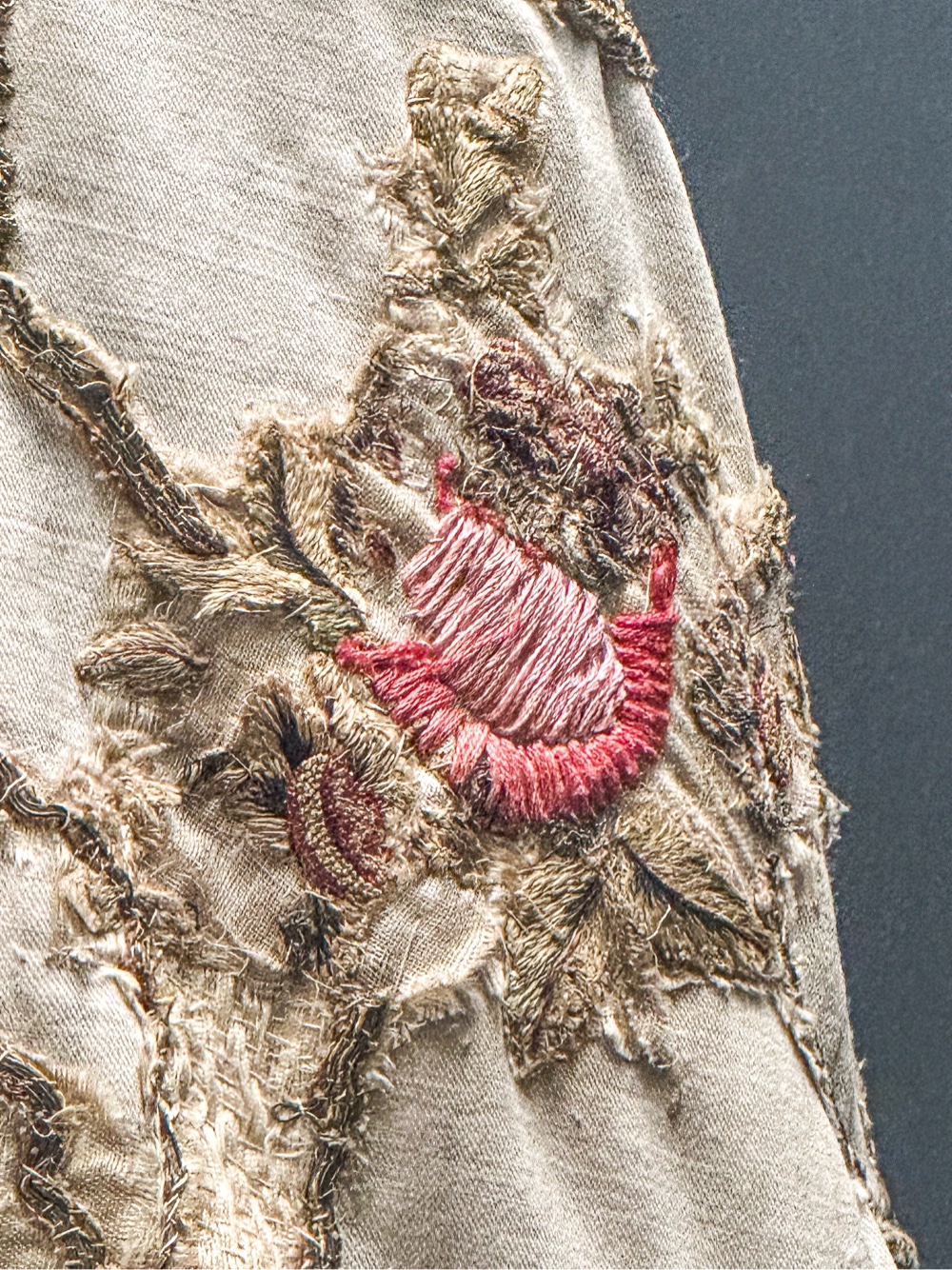
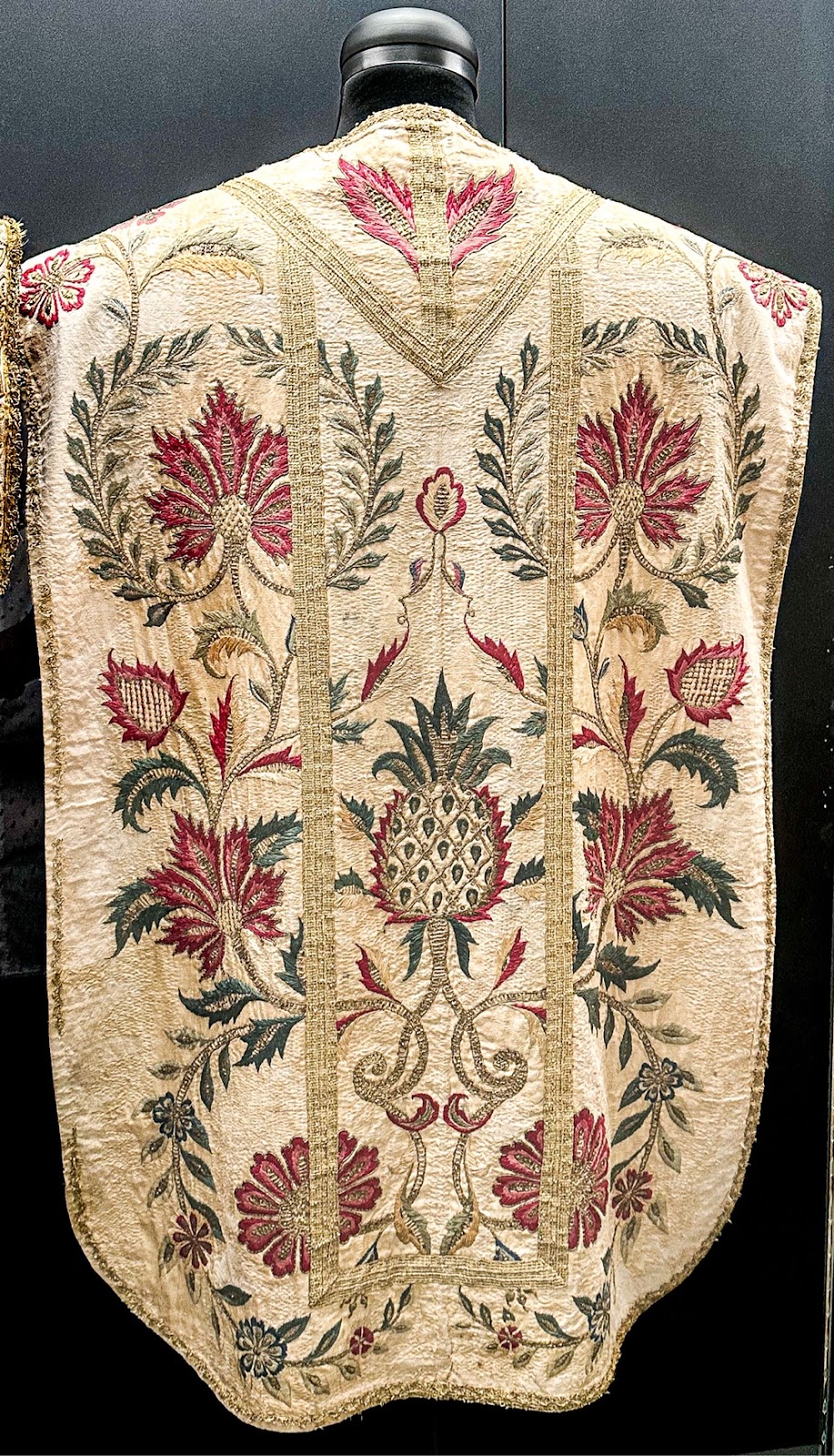
What is interesting is that contemporary Zari behaves very differently from older forms. Today, Zari can pierce fabric, allowing it to be used for stitches such as stem stitch or satin stitch, not only for couching. This is not a very recent development. I have seen ecclesiastical embroideries in the Museum of Christian Art in Goa where Zari is used in satin stitch rather than laid on the surface.

We also have Dabka, the purled gold wire, which is a different material altogether. Today, Dabka is made from copper or aluminium wire coated with a gold-coloured finish. Modern Zari itself is produced through a fascinating industrial process, where a microscopically thin layer of metal is vacuum-deposited onto a polyester film called Mylar. This metallised film is then cut into fine strips and wrapped around a core thread, creating the illusion of metal while remaining light enough to pass through fabric—an extraordinary convergence of ancient visual language and modern material science.

The other moment that struck me came when I turned the fabric over to secure the thread at the back. Looking at the reverse—the unregulated, overlapping stitches in dyed yellow thread that allows me to couch the zari onto the surface without being overtly visible,  something shifted. What surfaced in that moment was the memory of my wedding lehenga—the weight of it, the labour embedded in it, the unseen back of the work. I cannot fathom why the back and not the zari itself brought to mind the peach-saffron lehenga—perhaps the underside was evocative of traditional Zardozi work more than my contemporary rendition. 

It made me think about how history and memory move together, how they converge into what we are doing today, who we are today. And it brought me back, very clearly, to the essence of this piece—what I call co-creation.

Nothing arises in us without history, conditioning, precedent and our own sense of being human.


Sunday, 28 December 2025

The Hand, the Stitch, the History


The Hand Remembers

Thursday 18th December 2025


Today was quite a busy day after about 10 days  have actually managed to do yoga. The viral infection really took the wind out of my sails. Anyway, it's good to be getting back into form slowly. Then there was cooking to be done and I had to drive to Mapusa to get some stuff, bought veggies on the way back. So, by the time it came down to do any stitching it was past 6:00pm. I continued to work a with the split stitch.  I noticed a funny thing today. While I was driving back, planning my stitching sting for the evening.  I thought of how strained my eyes were yesterday. Maybe my eyesight is getting weaker  or the rough texture of torn and shredded white organza was creating problem. It’s hard to tell.

So I thought that I'd do the cheat way you know—of doing split stitch. Make the stitch and then pierce the two twists of the single floss from above. It’s much easier. Only difference is that you get a stem stitch texture at the back. 

I kept trying to do this but my hand was habituated to bringing the needle in the other way and then take it out through the thread make the stitch and then go back halfway and then take it out through the thread and it just insisted on doing that so finally I gave in. And have finished the area I had been trying to complete over the past few days.

Nobody can really identify how the stitch was done but I thought it was uncanny that the hand has such a strong sense of memory of how things should be done

What I was encountering is something the craft theorists call procedural memory — the kind of knowing that lives in the body rather than the mind. Where years of repetition have trained the hand to move in a particular way, and therefore it resisted the shortcut. The hand remembered and insisted on doing the split stitch the right way —no shortcuts!


Split Stitch

28th December 2025


I’ve been thinking about how split stitch came into my stitch vocabulary. It isn’t something I was taught, it is something I was curious to learn and taught myself. The split stitch (a form of back stitch) is one of the basic embroidery stitches, visually resembling a small compact chain stitch, but with a narrower and flatter appearance. It's an easy stitch to work and is especially useful when stitching around tight curves. It is this factor that attracted me and once I had learnt it, I also loved the flat surface it gave. Far cleaner than either satin stitch or stem stitch. It was also more forgiving — I hate using the hoop, and when the fabric is layered like the current piece, it does the job without puckers etc.  The split stitch is also known as the Kensington outline, split back, and opus anglicanum.


Coptic linen panels (belonging to the ancient Christian Church of Egypt) from the 7th and 8th centuries were embroidered in straight, satin and split stitches. The split stitch was extensively used by English embroiderers in opus anglicanum needlework (opus anglicanum - Latin for

‘English work’ refers to English medieval ecclesiastical embroidery, coined in the 13th century to describe the highly-prized and luxurious

embroideries made in England of silk and gold and silver thread, teeming with elaborate imagery.


In some of these embroideries, the entire surface of the cloth is

embroidered with images of saints and prophets worked in stem and split stitches, with the remaining fabric surface covered with couched gold thread.


Opus Anglicanum was done mainly for the purpose of the rich and powerful churches of the medieval ages with expensive materials such as fine silk and gold threads and was labor-intensive as well, making the garments very expensive. So much so, that it went on to become a status symbol for the religious leaders and royalties.


Curiously, when I spent some time at the Museum of Christian Art in Goa, looking at church vestments, I found no trace of split stitch in any of the ecclesiastical garments in their collection. Instead there was greater usage of Persian techniques and Zari with some bold satin stitch.

I’m still researching the influences that led the Franciscan churches in Goa, away from European traditions, to embrace a whole new way of embellishing church vestments.  


Thursday, 18 December 2025

A Parallel Concerto—Mozart, Split Stitch and Zari

16 December 2025


Today I sat with the piece — the third in the Co-creation series — working on it for hours at a stretch. I wanted to fill in the space created by the couched gold thread with a colour that echoed the muddy-coloured crochet I’d  added later. The crochet had made the piece feel bulky, and I wanted the whole to read as a continuum — to draw some of that colour inward, into the inner sanctum, as it were.

I put on some music — an album of Mozart’s violin concertos. I hadn’t really listened to Mozart for a long time. In my thirties I was a devoted listener; I ruined many cassettes playing them endlessly in the car. I was never very fond of his symphonies, but the chamber music, the clarinet concertos, the piano works — those I loved. I even named my black Labrador Mozart.

I wasn’t so familiar with the violin concertos. But as I listened, and by the time I reached the Fourth Concerto in D major, I began to notice a pattern. Mozart would take a melodic line that was  poignant, even melancholic and suddenly, shift it. There was no preamble, no warning. It was as if he was saying: enough. Enough dwelling on pain. Enough dwelling on happiness. Enough dwelling in darkness. This interchange kept occurring, and somehow he even managed to create melancholy within a major key. I don’t know how he did it.

At the same time, I was struggling with my single-strand split stitch. I was working on a fabric base that had been ruptured; the organza threads were everywhere, constantly catching in my needle as I tried to lay the floss against the surface and pick into the twist. I kept struggling to control it.

As I listened to Mozart, it felt almost as if I were stitching with him. There was effort, and then suddenly the stitch would fall into place. I would move forward and it would feel smooth and beautiful. Then the struggle would return. The thread would slip out of the needle. I would lose the needle altogether. It felt like a kind of parallel concerto, if one could call it that. The split stitch became a kind of Mozart stitch — no scope to dwell on any feeling for too long, not an indulgent somatic experience sustained by benign repetition.

At this point I was reminded of a cotton Ikat  weaver I met in Koyyalaguddem in Andhra Pradesh, during one of the projects I did there. Behind his loom was an old black-and-white television. I asked him why it was placed there. He said he liked listening to cricket commentary while he worked. If the television was in front of him, it was distracting. Behind him, he could listen and still weave.

That distinction stayed with me. Many craft processes are repetitive and exacting. The hand already knows what to do. What is required is sustained attention — the ability to remain there long enough for the work to accumulate. Background sound, in such cases, is not inspiration. It is support. It occupies one channel of attention so the rest can remain steady. The stitch proceeds according to its own logic; the listening allows the maker to stay with it. As I did with Mozart—engaged with the music that enabled me to work for 4 hours at a stretch.

As I worked around and within the boundaries created by the couched gold threads, what stirred a deep curiosity in me was my continued use of gold — or rather, zari. Zari comes from a Persian word zar, so it stands to reason that it is not an Indian invention. Historically, it came through Persia and was popularised by the Mughals. Trade moved along the western coast with Surat becoming a centre for Zari production. And,  during periods of instability and invasion in that region,  people migrated— jewellers, metalworkers, weavers — relocated  to regions of greater stability. They were housed and given work by rulers such as the Pallavas, Cholas, and Vijayanagar kingdom.

Within these temple economies— the Cholas and Vijayanagar, gold thread acquired ritual and symbolic associations related to divinity, radiance, and auspiciousness, but it never lost its connection to prestige and excess as employed by the Mughals. Where zari was unapologetically lush and ornate, used in court dress, ceremonial textiles, furnishings, and regalia, a logic closely mirrored by the Catholic Church’s use of gold embroidery to signify divine authority through material splendour. 

Textiles in these religious economies functioned as sacred infrastructure. Gold and silk were not about fashion, but ritual necessity. Gold entered cloth not as ornament, but as an expression of divine light and cosmic order, shaped by temple economies and forms of political theology

 As I reflected on this history, I also reflected on myself. I own jewellery, but I rarely wear it. In Delhi, for a significant occasion, yes. But in daily life, nothing. My mother used to lament that girls cannot be without jewellery on their wrists. But bangles interfered with my work, so I chose not to wear them.


I then thought about how gold entered this piece in the first place. It began with sunlight glinting on the waves. That light created a crack in me — an opening that let something in. Not just visual light, but a philosophical one. It was not an intellectual understanding. It struck the gut, spread through the body, and settled as something unshakeable.

Being drawn to gold outside the body, in a controlled, meditative, material way, I realised that I  may be responding to its older function — divine light, cosmic order, such as is evoked in the Vedas where,  Indra is described as ‘golden hued’ Agni as ‘golden haired’ and the source of life is hiranyagarbha or the golden womb — rather than to its modern role as social ornament.

Standing at the tip of the estuary, on what we call Sandbar Island, this is what I perceived: nothing I do exists without a past. That past is formed by people around me, by their pasts, and by the pasts that shaped them. Everything is layered and co-created as were the images I was recording: sun glinting on water, rippling on sand ripples—a confluence of light, water, earth and wind.

It occurred to me then, within the context of living that whatever one feels or thinks—the authorship is divided. It does not belong to a single person— everything is co-created.

That was a moment of realisation — when understanding moved through the body and settled. I think that is what truly holds the key to this piece.

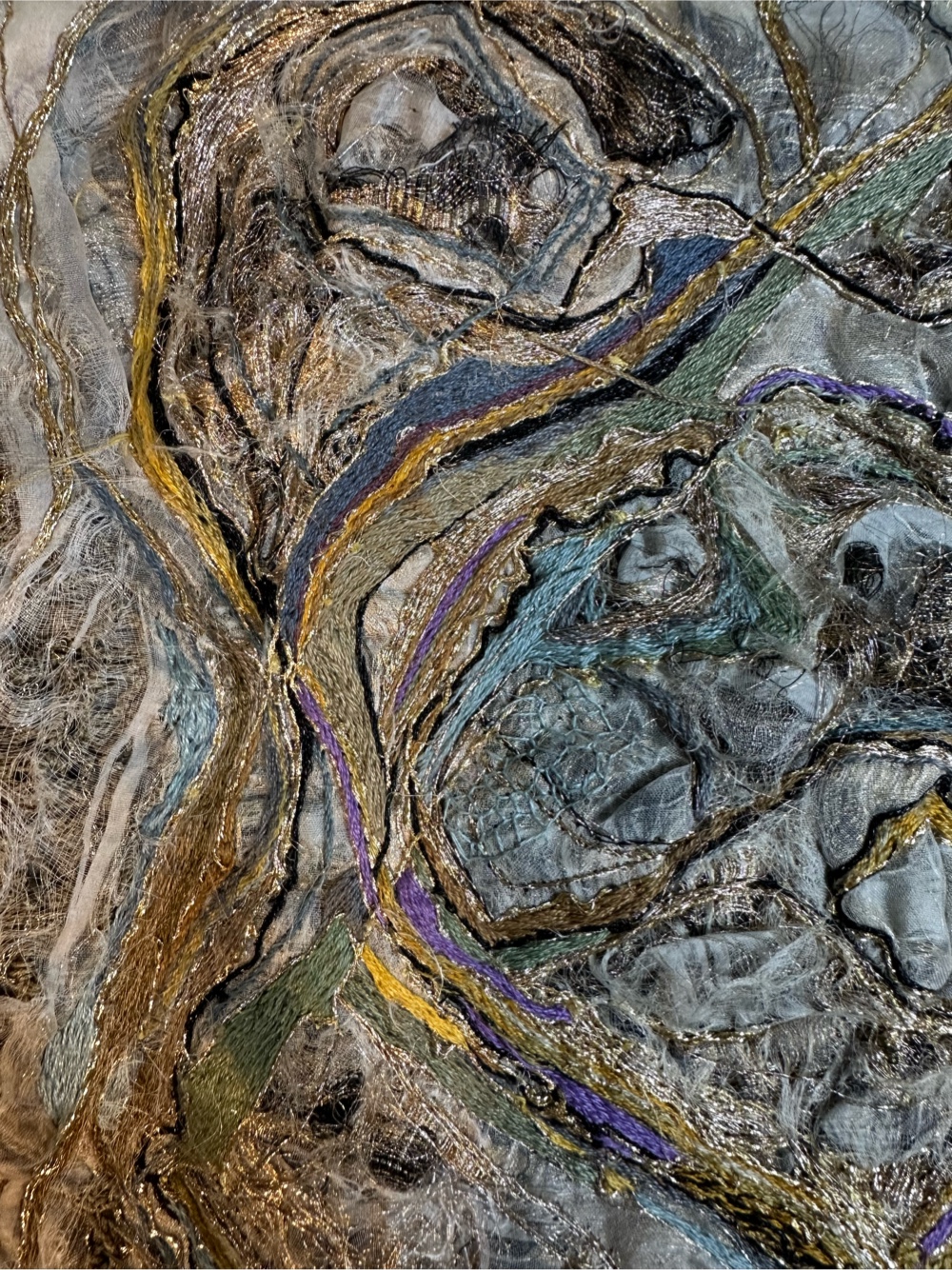
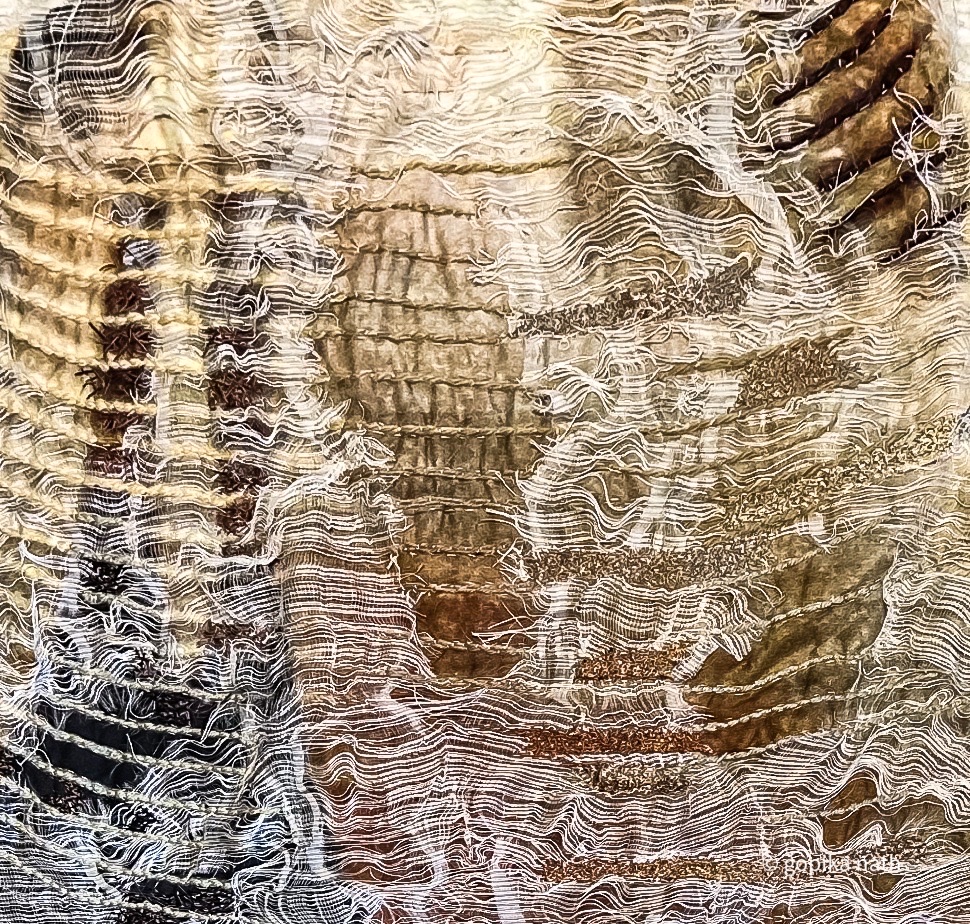
Reflecting that complex layering, the work appears strange — threads removed, delicate and transparent in places, yet dense and impermeable in others. Fabric from layers beneath surfaces through the organza above. Materials at odds with one another, yet organically combined. I am still attempting to create harmony and tonal parity within the composition — a balance that, in life itself, may well be impossible.