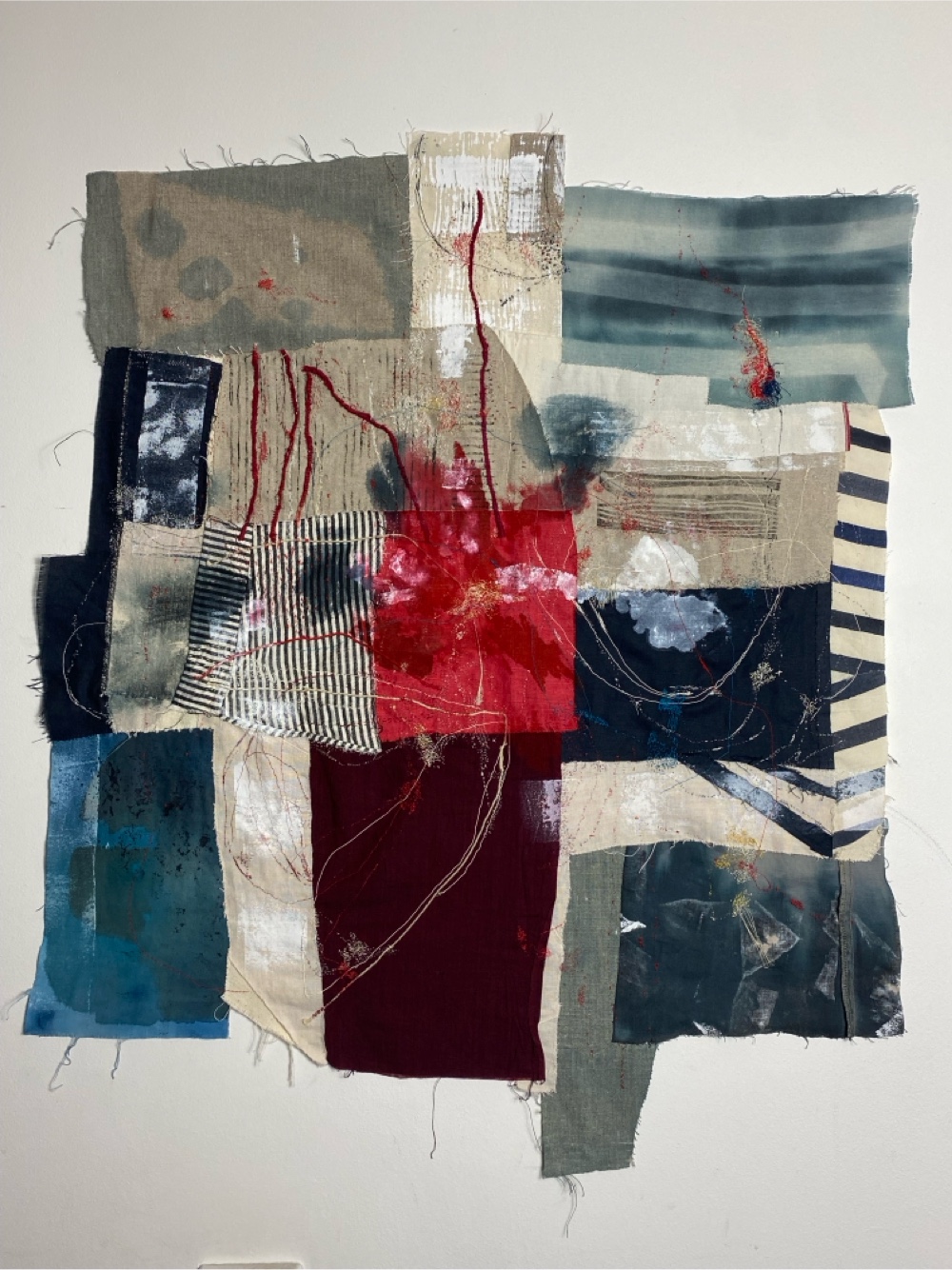
My work was borne of a desire to work with my hands in an almost primal and organic way connecting the emotional and physical me. I am drawn to working with fabrics because the sensory qualities allow me to slow down, contemplate and repair myself. It is literally like putting myself back together and paying attention to the ‘here and now’ and the space I occupy in the world.
Recently, I have been studying art psychotherapy where creativity in a variety of forms is a vehicle for exploring the conscious and unconscious addressing emotional, social and behavioural mental health issues. Of course, my studies have been steeped in theory. I have been reading Shaun McNiff, Joy Schaverien and Stephen. K. Levine about the life and the process of making an image. However, my personal creative journey is evolving in an intensely powerful and, sometimes, painful way where I am finding more clarity and affirmation of my own process of working.
I find there is an internal dialogue happening between thinking and doing that creates a relationship. Working with remnants or offcuts of fabrics, I run them through my fingers tracing by touch to make sense of the shapes and the textures. I am wondering how I want to treat them, will they be printed, stained, ripped? I contemplate how they land in their own space by themselves, but I must also try to give myself permission to weave my own thoughts and emotions into the pieces.
‘Noises in the Quiet’ was made in this way. It began in 2021 as a set of separate, small pieces of linens and cottons of varying weights. Over time, I grew bolder experimenting with each one using a range of techniques such as lino and roller printing, masking off areas, smearing and scraping paints and pouring ink through layers of finer fabrics. The textures and forms that emerged for each small piece became a series of individual ‘noises’ or proclamations of their own identities and, in some cases, the backs of fabrics spoke loudly and took away attention from the front. My quiet stitching responded to the various surfaces in recognition of this. While delicate stitches slipped effortlessly through the ink on softer fabric, much more force was required when stitching on dried paint. The painted string seemed more willing to be guided by my hand but roughly cut red strips of muslin were more anarchic and pursued their own directions. I found myself completely uncertain whether they would have a connection with each other and should I even try to keep them all together. Pushing through such uncertainties over time by repeated revisiting, stitching, unpicking, re-stitching, placing, taking away and re-arranging, the eventual formation of the whole piece of work was a juxtaposition of quiet and noise.
During my process of working, I seem to pass through unnerving states of exposure of myself and confrontations with the work. I feel my fingers and the piece of work communicate deeply with each other - sometimes gently, sometimes aggressively. But, to begin with, I feel vulnerable because I am never sure how the work will develop and I am never sure how much of me I am willing to expose in the piece. I fall deeper into the work until it takes a firm hold to shake me up and push me out into the open.
In another work, made earlier this year, I tried to tackle noticing and confronting my own emotions. I listen to the fabrics unwilling to smooth them out as I let painted threads and strings fall on top of them whatever way they will. My stitches start intensely and chaotically in one place using single and double threads and adding painted yarn. They have the freedom to pass under and over and they often tangle or catch onto other parts of the work. I never untangle threads or strings because, within the vulnerability of making the work, I think strength lies in embracing the imperfections as a natural part of my process of making. I quickly move to work on another part of the piece and as it evolves, we inevitably argue. My stitches become much larger and then smaller again; they look like they are trying to escape from the piece of work itself, trying to outwit me by changing direction and changing size and thickness.
I do not always describe my work as complete, but it ‘arrives’. I usually stare at it for a long while. Has it arrived, have I arrived? I am not always sure. Sometimes I must hide a piece to give it and me some extra space.
There is an empathy for what each other needs but there is also a dynamism in the connection I try to establish between all the elements of the work – the stitches, the fabric, the print or paint, the strings and yarns and the emotional and physical me. We pass through the tussles of the jarring and harmonious feelings and thoughts, through the ruptures and repairs, through the wreckage into a space.
Wherever the piece of work has taken me, I recognise I have been navigating spaces, uncovering hidden boundaries and crossing borders. This journey is very precious.
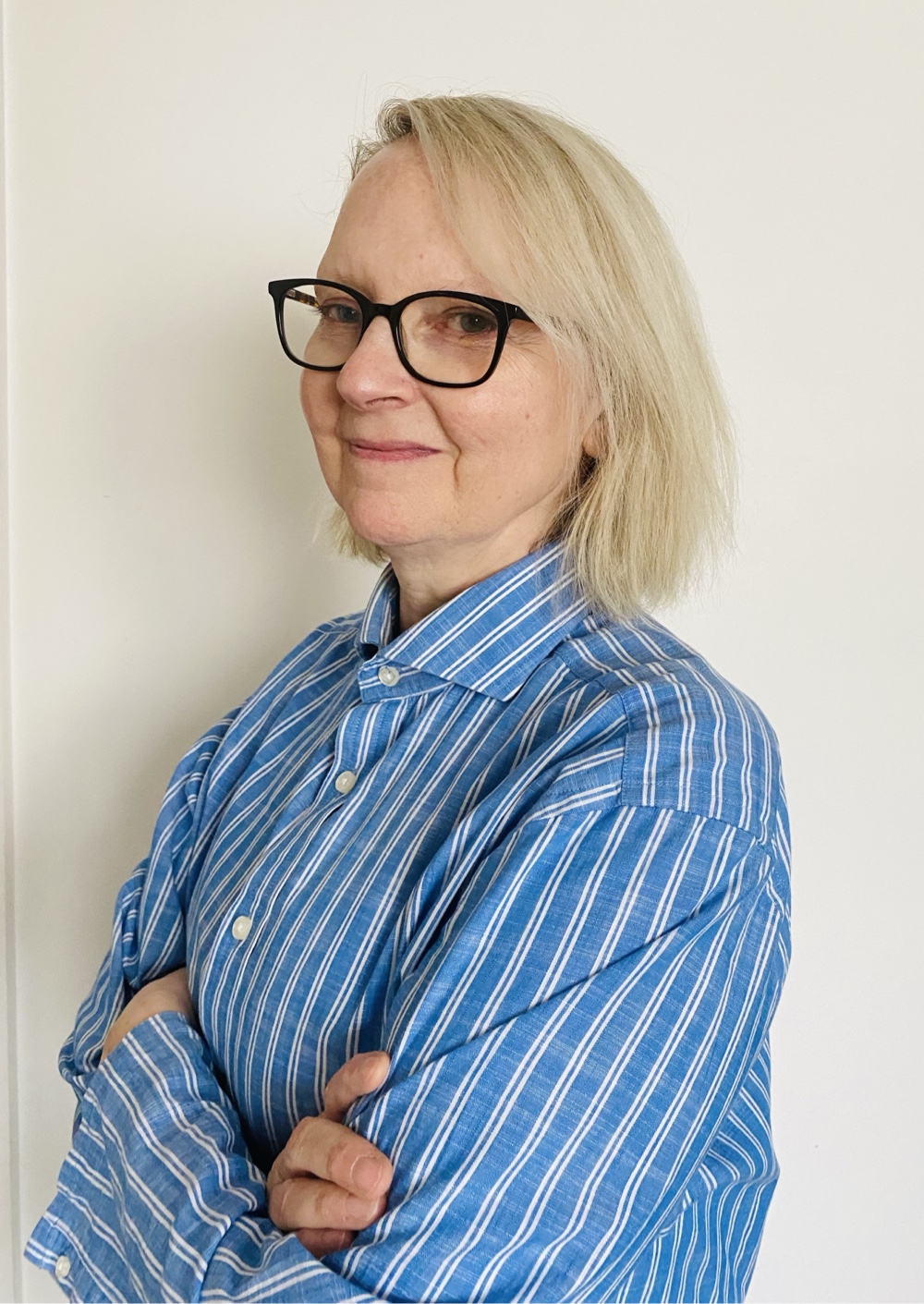 Stephanie Fujii MA (RCA) is a textile artist and teacher based in London, UK. Previous life experiences include working as an illustrator in the 1990’s, travelling, teaching, living in Japan for five years and having a family. She works with textiles and fibres on themes such as physicality, identity, emotions and environments.
