Monday, 16 February 2026

The Knot Of It


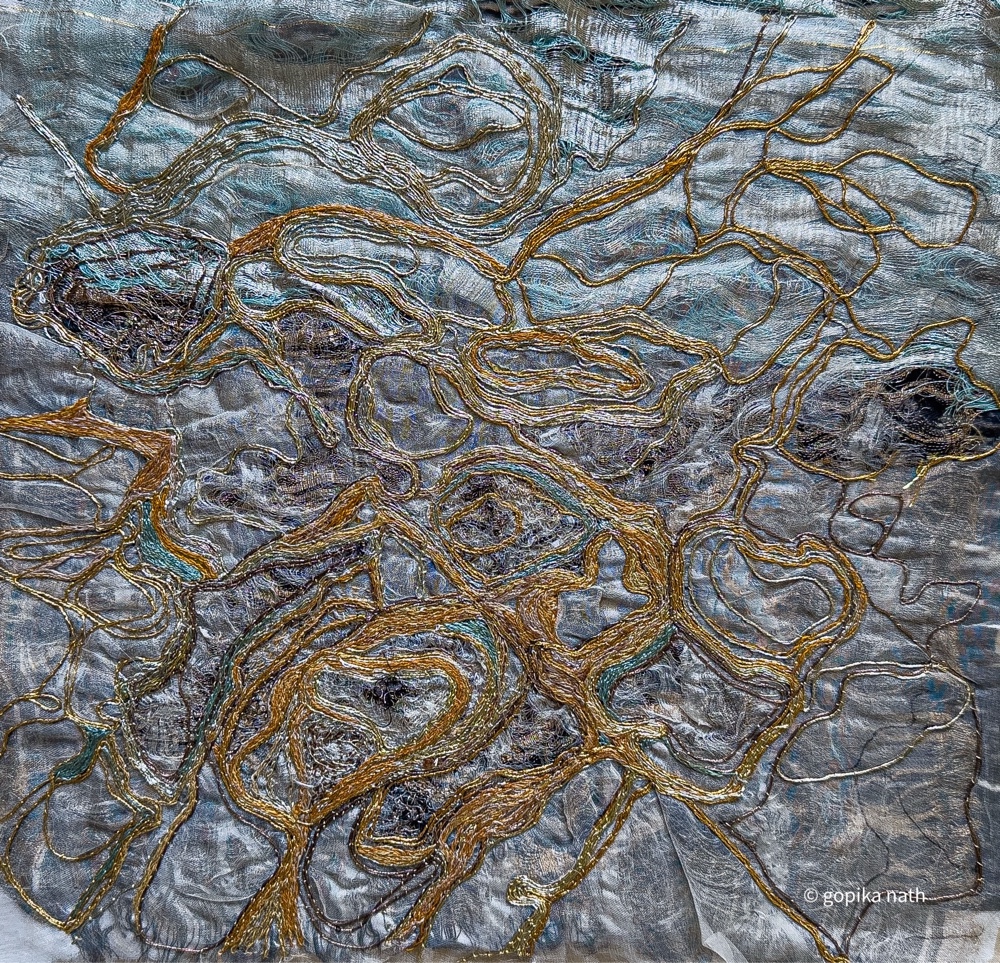
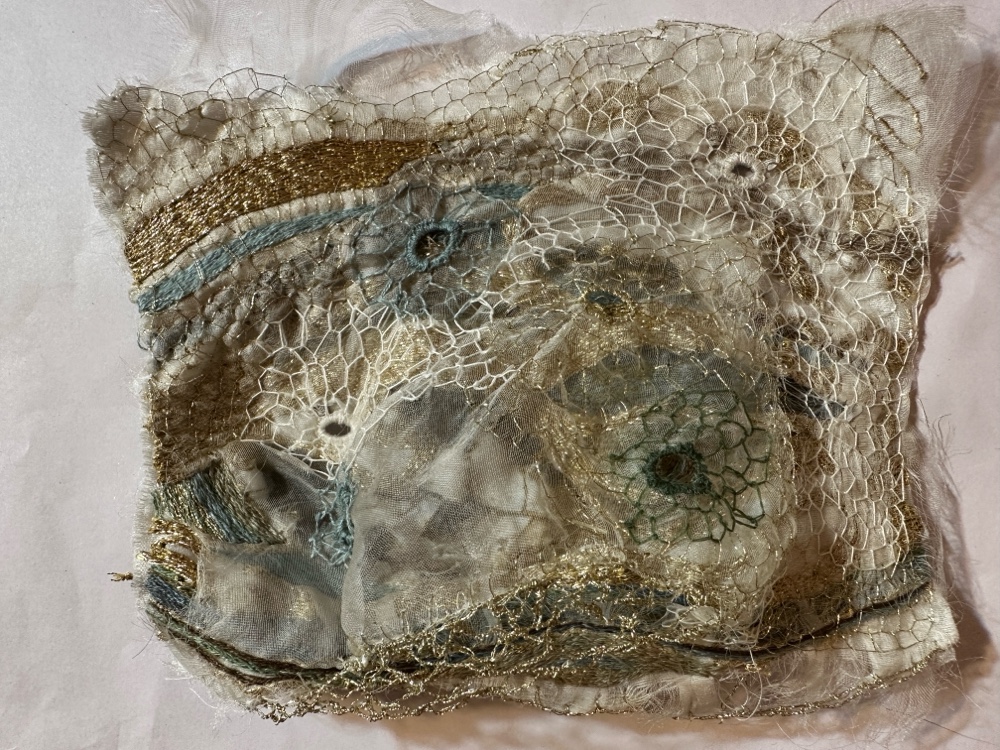
I’ve been working on  Co-Creation III for too long. It started out, with me wanting to create a border — a kind of ‘hashiya’, where the border is separate yet conducts an oblique dialogue with the central image/painting. (The ‘hashiya’ comes from Mughal miniature paintings were artists used the border in dialogue with the main subject.) I decided that I had been working long enough and just had to finish. I know myself: I could keep adding more and more. I just had to stop working on this piece. But, there were couched areas that needed to be completed.

I continued with couching the six-ply zari thread. It has a rhythm to it. You hold the thread to be couched, and you keep the fabric taut, holding the laid thread close. Because I’m couching large, uneven spaces I don’t use a hoop. Both hands work in tandem as if dialoguing with each other. Left  hand thumb and index finger over the thread to be couched, keeping it in place. Other three fingers below the fabric, keeping it close to the laid thread—light pressure from top and bottom. Right hand, holds the needle between thumb and index finger, little finger and side of hand, over the thread— when it’s slack, keeping the tension-mild but keeping thread straight to avoid the knots. I’ve tried using a hoop but it interrupts the rhythm of long laid threads to be couched. Yes, the laid thread may pucker a bit, but that’s okay because the inspiration, for this piece and others in the series,  is sun glinting off ripples of water.

The same week, an incident occurred in my residential complex that left me feeling exposed. It was xenophobic and violent, and  made me feel unsafe and threatened in my own home. I was preoccupied and agitated. I missed a day or two of stitching because I simply couldn’t settle. I’d sit with the piece in front of me, but the very idea of more thinking — more decisions to be made, felt too large a task.

And when I returned to the couching, I noticed knots coming up.

Before stitching, knotting was already a way of making textile. Not as embellishment, but as structure. Nets, cords, bindings, even early fabrics and carrying slings. Whole surfaces could be created  through knotting, loop after loop. In that sense, knotting isn’t secondary to stitch. It’s older than stitch, and it has its own intelligence and lineage.

When I was learning to weave, one also learnt the weaver’s knot. It’s a really elegant knot: left over right, is the primary instruction I remember—to put the thread in the left hand over the thread in the right hand—and the rest is muscle memory—the hand remembers.

Both threads held between thumb and index finger of left hand. Taking the right hand thread over left hand thumb, holding it down with the 2nd finger of left hand, bringing the right hand thread between left thumb and index finger where the two threads are held. Left hand thread then goes into the loop made by the right hand thread over left thumb, while 2nd finger holds the end of the right hand thread and pull. Voila! The perfect knot.

Quite an instruction to remember—I can’t. I wrote this while observing myself create a weaver’s knot. Stopping frequently to annotate. I’m glad the hand remembers and I don’t have to recount the entire process verbally. I think I’d probably confuse more than guide the hand.

The weaver’s knot was invented as a join that’s flat, allowing the knot to move through the heddles of the loom without encumbrance. Once learnt (1982, for me) it’s hard to forget, but learning it in the  first place, is a challenge. My sister is an avid knitter, I’ve tried to teach her, but it still doesn’t form as easily as I can make it. It’s most useful when knitting or crochet and the ball of yarn finishes—to join another seamlessly.

And then there’s the other meaning of knot, the sailing knot, a measure of speed. One nautical mile an hour. Suddenly the word shifts from snag and interruption to movement and distance. Sailors tie knots that must hold in wind and salt and strain. It makes me think that knotting isn’t a mistake at all. Knotting is older than stitching. Rope, nets, rigging, lashings. The forms of making that come before cloth.

But none of this is what I’m meeting here. I’m not doing macramé. I’m not deliberately making a textile through knots, neither am I traversing nautical miles at sea. I’m in the middle of a stitch rhythm, and the thread knots itself anyway. The snag arrives as interruption, not as design.

 It is really annoying. You can’t leave the knots, because they won’t sit under the couching thread. They form a little loop and sit there— an uncomfortable bulge. What’s strange is that the knot doesn’t happen where I can see it form.  It happens in the slack, in the bit of thread behind and under my right hand, in that length that has its own life. I could swear that I don’t leave it too slack, holding it down carefully, but clearly I am not vigilant enough. It is the only way a knot could form.

I follow the rule of thumb — of keeping the thread no longer than the distance from my index finger to my elbow. Still, even when the thread is quite a bit shorter — quite short in fact, I still get the odd knot. The thread forms a loop into itself. Most of the time I can simply put my needle into the loop and holding the threads that precedes the knot, down with my left hand, pull it upwards with the needle(in my right hand)— and it comes undone with a gentle sound that tells me it’s undone. Something like a ‘khitt’ that’s softly whispered.It’s momentary, a small hesitation, the acknowledging ‘khitt’ and I can keep stitching.

But the other day, I struggled and struggled, and it got worse and worse, until I had to do what I absolutely hate: cut the thread. Cutting the thread feels like admitting defeat. Not because it’s a tragedy, but because I was in rhythm. I was in flow. And now I have to stop, stitch in ends, re-thread, restart. It’s like being pushed out of a trance and get down to the nitty-gritty of mundanity.

And because I’m couching gold thread, there’s a glare with the light. The golden thread reflects light back at me. The glare doesn’t allow me to see my stitches clearly. I try and keep the distance of the stitches within a certain perceived gap, and I’m really focused. The rhythm aids my ability to keep that space— it provides a measure. But when I have to stop for the palaver of cutting the thread, re-threading the needle and finding my place back in the work. It interrupts everything.

The knot has a lineage. The problem is that it arrives uninvited.


Just like the xenophobic assault did: interrupting the rhythm and pace of life. A knot that cannot be undone.


Monday, 2 February 2026

What Remains, What Repairs…


“Craft is healing. It helps people feel grounded, purposeful, and whole.”

— Betsy Greer


I spent most of the day stitching.

Yesterday was a long, social day. I’m feeling unsettled. Words cannot quite express my overstimulated mind: teaching a five-week online course, an enriching talk on Hampi, meeting old friends, recriminations, affection, chiding, eating a delicious but heavy meal. Grocery shopping en route to the meetings. Overspending and then returning home to put everything away. Sleep was elusive, as it often is when I’ve done too much.

I need to stitch. I need its somatic, meditative movements. I need thoughts to form, not be dismissed in the way they might be through yoga nidra or meditation.

As the needle enters the cloth and exits again, as the thread tightens and holds, as one action follows another, my day in the world becomes, briefly, coherent.

It’s often said that stitching is healing. But is it? What do we really mean by healing?

We have all seen ruptures of the flesh, wounds that heal. Yet scars remain. The body remembers. Can one truly heal memory, or the recurrence of pain that arises from it?

I have lived with the idea of healing for decades. I am a three-decade-long Reiki practitioner. I practise various modes of energy healing for myself and for others. It is a deeply misunderstood term, and one I have spent years trying to fathom.

Stitching as healing may create a sense of calm, regulation, relief, and an increased ability to cope. These are not trivial states. They matter. They allow one to function, to endure, to remain present. Regulation, not transformation.

This is where the language around healing, including energy healing, needs clarity. Intention alone does not bring about change. Healing practices can support awareness, soften resistance, and create the conditions in which something might shift. But they cannot replace responsibility. They cannot override lived reality. They cannot act in place of recognition or choice. A healing practice may help one cope with exhaustion, grief, or overwhelm, but it cannot decide for us when something continues to tear, when repeated repair is no longer enough, or when it is time to stop and acknowledge the damage.

Healing operates within possibility, not promise. It unfolds only to the extent that a person is able, willing, or ready to respond. Without this participation, healing becomes maintenance, a way of remaining functional within structures that continue unchanged.

Much of what circulates as healing is essentially about making life bearable without altering its underlying structure.

True healing, when it occurs, is rarely gentle. It does not arrive as comfort. It often dismantles rather than restores. In healing parlance, what is latent often rises to the surface when attention is directed inward. This can feel unsettling, even as though something has gone wrong. Old emotions, exhaustion, sadness, or self-dislike may emerge. Physical symptoms too—falls, colds, bouts of flu—are often understood as signals rather than setbacks, pointing toward what needs rest, recognition, or change.

This distinction matters when speaking about stitch and its potential to heal.

When Betsy Greer writes of craft making people feel grounded, purposeful, and whole, these words describe states of coherence and regulation. They do not promise cure or resolution.

Rozsika Parker, in writing  about middle-and upper-class women in Britain in the late eighteenth and nineteenth centuries, especially the Victorian era, spoke of embroidery as a means of psychic survival. She was studying  women who were excluded from paid work and public life, whose labour was confined to the domestic sphere, and for whom embroidery was not freely chosen but prescribed as part of feminine virtue and value. Parker did not frame this as empowerment, self-expression, healing, or liberation. What she described was far more constrained. For many women living with little agency, embroidery provided structure to time, a way to concentrate attention, and a place to contain anxiety, anger, grief, or frustration that could not be spoken. Often unmarried, or trapped in marriages they could not leave, financially dependent yet intellectually capable, socially silent and expected to appear calm, grateful, and composed, these women could not protest their circumstances or even name their dissatisfaction. Embroidery offered a private, repetitive act, somewhere excess emotion could be placed, a way of enduring without collapsing. Not flourishing. Not transformation. But staying intact. Parker’s insistence was a warning against romanticising needlework: not to mistake endurance for freedom, or survival for repair.

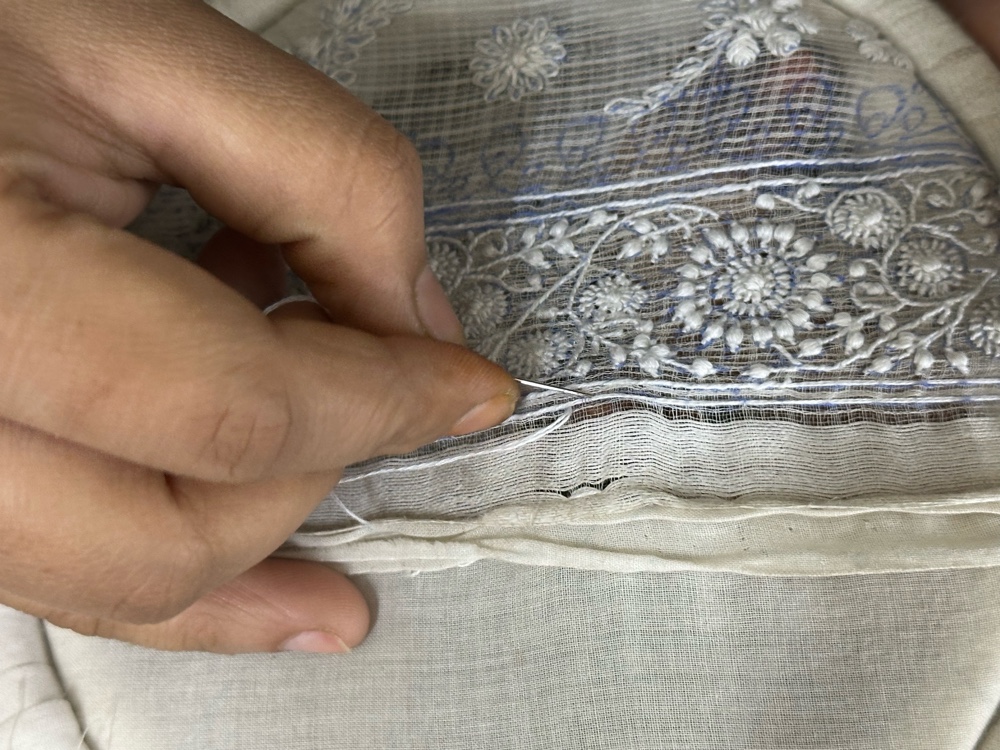
This, reminded me of my visit to Lucknow last April, learning from women engaged in chikankari. Here the context is different, and is not intended as a historical parallel. These were largely Muslim women, many of whom were not permitted to move freely outside the home. They arrived at the atelier covered from head to toe—stepping in wearing burqas, and then, once inside this all-women’s space, unveiled and stitched through the day. The workroom became a contained world — sanctioned, protected, but bounded. Stitch did not alter the structures that governed their lives. It did not offer emancipation. What it offered was time, focus, and a place to speak, share and where attention could rest. Listening to them, and later transcribing those conversations, I was struck by how often stitching appeared not as aspiration or expression, but as continuity — a way of remaining intact within conditions that were unlikely to change.

Repair, in cloth, does not erase damage. It holds a tear. It strengthens an edge. It works with weakness rather than denying it. When I think about repair in this way, it becomes clear that it is not an abstract idea for me, but something I am constantly negotiating through the act of stitching itself. Repair is not something I arrive at conceptually and then apply. It is something that unfolds through attention, constraint, and decision, moment by moment.

I see this most clearly when I think back to how I arrived at the work that day. I was overstimulated, scattered, carrying the residue of too many conversations, obligations, and decisions. Nothing dramatic was wrong, but nothing felt settled either. Stitching did not resolve that state or make it disappear. What it did was hold it. The repetition slowed my breathing. The sequence of actions gave shape to what had been diffuse. The work did not erase the frayed edges of the day, but it strengthened them enough for me to remain present.

I also recognise that the frenzied state was not only about fatigue or overstimulation, but about a lack of clarity. Too many loose threads of thought were creating a sense of chaos. Stitching steadied my breath and slowed the pace enough for those thoughts to come into focus. Once that happened, I could see what needed attention. I made phone calls and  addressed what had been weighing on me instead of carrying it as unnamed anxiety. The stitching did not resolve these issues, but it made it possible to recognise them and act. In that sense, repair was not withdrawal from the world, but a return to it with greater clarity.

Those who have written about craft and making speak of its closeness to lived experience, and of making as a process of correspondence rather than control, where one is in dialogue with material, unspoken perhaps, but real. The material, and how it behaves within the realm of our capacities to interact with it, suggests what we can or cannot do.

As I continue my work on Co-creation III, I am aware of risk at every step. I do not fully control the material. I choose a direction. I commit to a tension, regulate intervals of where the stitch holds the thread, enters the cloth, not always with perfection. Limited by various conditions—eyesight, electric light, glare from shining zari thread and the hued proximity of the thread I couch it with—whatever choices I make within these conditions and my capacity to stitch, skill or lack of it, I live with the consequences. As one does in life.

In this sense, stitch cannot heal the wound. It may effect repairs within the conditions under which the wound can be lived with honestly. Not altering the path, but changing the possibilities of how the path is walked.

And sometimes that is the only kind of healing that is possible.

No miracles. Sometimes not even relief. But an understanding of how the wound, the hurt, even arises.

Within my continued work on Co-creation III, I see this play out repeatedly. A lack of discipline while couching without the fabric stretched on a hoop. The small chaos that emerges when material resists intention. The urge to keep going, to make sense, to hold things together through repetition. Limited by light, eyesight, fatigue, and time, I work within what is possible rather than what is ideal. Each decision holds. Each compromise remains visible.

Stitch does not resolve this.

It asks me to stay with it.

And perhaps that, too, is a form of repair.