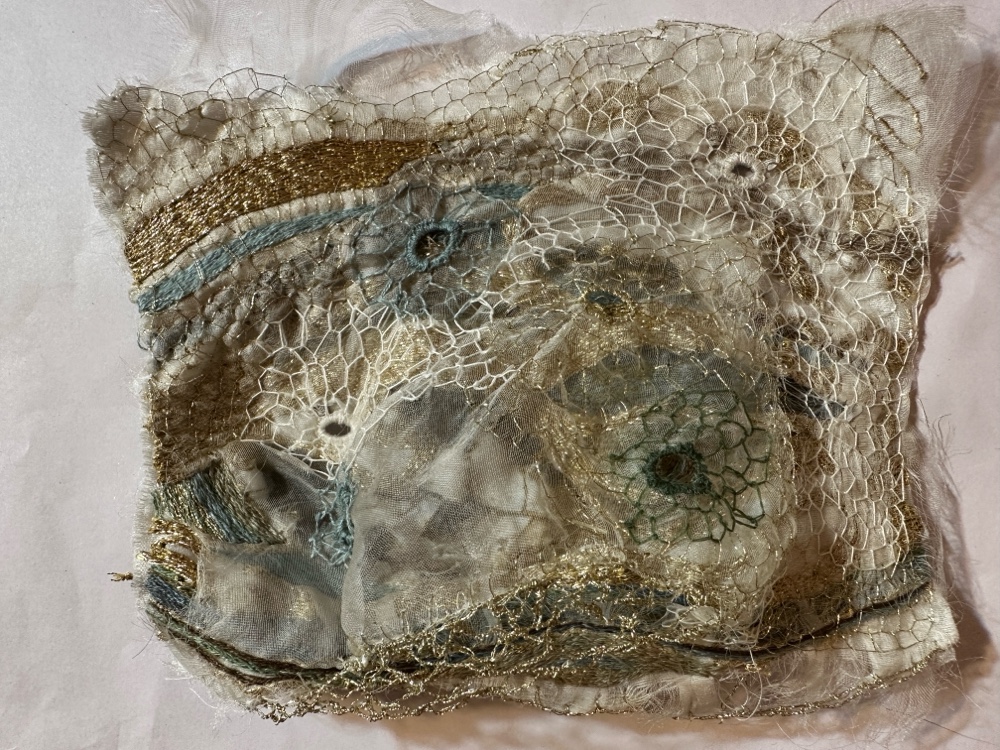
Looking at my work—how I stitch, think while I stitch, through the lens of writers and scholars like Glenn Adamson, Tim Ingold, and David Pye, I have begun to understand more clearly what it means for me to take risks while working, and to notice the decisions I make as I go. This awareness doesn’t give me control in any fixed sense, but it keeps me engaged. It keeps me focused on what I am doing. I may not fully know yet what this attentiveness does for me as an artist, but I do know that it sustains my capacity to stay with the work. Knowledge is power, after all, and knowing what I am doing as I do it seems to strengthen my ability to trust, hold, and remain with my decisions.
Yesterday, while I was stitching, I realised a few things about how I make decisions.
What I put on the fabric to begin with determines the kind of line the stitch will take. In this particular piece, I was working with a fallen, dried leaf that had many, many holes in it. It wasn’t brittle to start with, but as I began manipulating the fabric to stitch around the leaf, it started to crumple. I didn’t want to lose that quality. At the same time, I knew I was already taking a risk by working with something so fragile.
I first tried tacking it down with small bits of Fevicol below and above, hoping that would stabilise it without flattening it completely. That didn’t quite work. Eventually, I realised I had to cover the leaf with fabric while stitching around it. That was another decision, and another risk. Once covered, the leaf would be protected for use, exhibition, and time, but it would also be partially obscured.
When I did that, I saw that the fabric softened the intensity of the leaf that I had initially been drawn to. It pushed it down slightly. I had to accept that loss. And I found myself thinking that this was not really a loss at all. When you look at water flowing over sand ripples, with sunlight glinting on the surface and a leaf lying underneath, nothing is fully visible anyway. The leaf is dried and has no reflective power, so this softening felt appropriate. There is gold all around it, reflecting light, and the translucency of the organza fabric helped tone down the intensity of the gold, even though I quite enjoy it, as it is.
On top of the sheer fabric covering the leaf, I worked a lot of buttonhole stitch. It created a lace-like quality while also holding the fabric down. This wasn’t planned in advance. It came from a previous work where I had liked the effect, and I chose to return to that result here. I had been somewhere before. I remembered what this stitch could do, the kind of structure and openness it creates. At the same time, I have done oodles of this kind of buttonhole stitch, building hexagonal, lace-like forms, so there is also familiarity in the hand. As David Pye puts it, “the workmanship of risk is that in which the quality of the result is not predetermined, but depends on the judgement, dexterity and care which the maker exercises as the work proceeds.” That feels exactly right here. Present decisions are never innocent. They are shaped by past outcomes. The risk I take is always taken with precedent — something I have done before, learned from, and enjoyed the result of.
I have worked with buttonhole stitch in different ways. Sometimes I create a hole right through the fabric, which I’ve done twice in this small piece. At other times, I only create a hole on the surface fabric and then work an intense buttonhole stitch around it to strengthen that opening. From there, I extend it into a kind of hexagonal, lacy structure. I learned this approach in a workshop with the Stitch Club, with Mirjam Gielen.
I also noticed that I was doing split stitch on one side of the leaf, on the organza overlapping it. The fabric doesn’t cover the leaf completely, and it isn’t stitched flat onto it either. It has a slight three-dimensional quality. Because of the buttonhole stitch along the edge, it curls. I can curl it whichever way I want. Sometimes you can see through it, sometimes you can’t. It depends on how you look. When work is exhibited, it’s usually seen straight on, at eye level, and these shifts might not be immediately visible unless you look closely or from underneath. That too is a risk I’m willing to take.
Sometimes, one loses a lot of the stitch quality during exhibition viewing. Particularly the subtle dimensions of stitch which give so much pleasure. In fact, when stitched work or textiles that are exhibited dramatise to stand alongside more visceral media, eclipsing the otherwise delicacy of the medium and its making methodologies, I often cringe. One aspect of working with textiles, for me, is how the meditative dimension of making absorbs the visceral emotive dimensions of the maker, sublimating rather than screaming. I know that stitching for hours together calms the mind, softens the heartbeat, so I do wonder at this.
While stitching this section, I had started with a very light green thread, but I couldn’t find it again later. I didn’t want to open my entire thread stash just to locate that colour. I chose to continue with what was lying nearby. The next green I picked up was much brighter, and I didn’t want it to dominate. So I worked split stitch in lines, leaving spaces in between. Later, I added a very light blue.
Only after doing this did I realise that if I had filled the area with a single green, it wouldn’t have looked as alive as it does now. This decision came partly from laziness, but it turned out to be the right one. I do this often. When a thread runs out, I don’t stop the work. I respond to what is available. The work changes because of that choice.
Louis Pasteur, the French chemist had observed that “Chance only favours the prepared mind,” enabling one to correctly interpret, or integrate unexpected results, with one’s prior knowledge. To my mind, chance is also about taking risks, where as David Pye suggests that the “workmanship of risk” depends on the discretion and dexterity that arise from knowing, enabling the maker to use the risk to their advantage, or not. In relation to this piece, the element of ‘chance’ is working with a dried leaf that might tear or collapse. The chance is covering it with fabric and accepting that something of its intensity will be lost. The chance is running out of a thread and choosing not to stop, but to continue with what is at hand. These are real risks. They only work because the hand is prepared, because it already knows how stitch, colour, and material behave. Without that preparation, the same choices would simply be random and possibly unsuccessful—visually gawky.
I also tend not to work with long lengths of thread. This is something I learned from Tom Lundberg during my Fulbright in 2000, when he was my mentor. Short threads force change. Colours shift more often. There is modulation rather than control. That variation keeps me attentive. It keeps the hand thinking.
I finished this section of the piece with a very fine gold thread that I bought online. It’s good-quality thread. I can’t really do split stitch with it, but I can do stem stitch, which is very close, and that worked well.
What’s amazing me at this point is how looking attentively at how I make, even in a small section as this —which is not quite two inches, I’ve learnt so much — something that reading the craft stalwarts and scholars alone, didn’t do. Quite frankly, the writing confused me, but now, I’m discovering it anew.

I have read Tom Ingold, but not the other two writers you name. I also find such writing difficult to take in, but you have absolutely described my own thinking/responding cycle as I sew. Both considered and impulsive in turn, the work leads itself to becoming made.
ReplyDeleteYes, it’s the density of their words, that made me start observing myself stitch and now I’m hooked. Yes, I had a sense it was you Heidi. Thank you for reading, again, love you for it. 💗
Delete(Heidi, not anonymous!)
ReplyDeleteBlogger/google is making it hard for anyone to comment as themselves. I find the constant sign in’s and that I must agree to cookies to be able to comment or reply as very tedious and oh so not fair
ReplyDeleteReading your post helps me better appreciate the fabric piece; I wouldn't have noticed all the threads, colors, leaf, etc. What really stood out for me was when i realized the 2 layers of creation - first, the intense focus on the process and what you/one discovers about taking risk and experimenting - and secondly, holding the perspective of the viewer, wondering how they will experience the finished work, and how much they think about the process of experimenting, the different thread colors and how the artist intentionally chose to use short threads, etc.
ReplyDeleteI think about this when I'm designing interactive, experiential workshops - smiling to myself about the creative process and effort, while imagining, at the same time, how the participants will respond - and smiling to myself imagining their engagement and joy in response to my creation. :-)
Thank you for your lovely comment. I wish I knew who so was responding to. I am so glad that my writing helped your appreciation of the piece that I’ve created. Thanks again for stopping by. I hope you will continue to read the stitch journal.
Delete