Wednesday, 15 April 2015

Securing Your Boundaries....

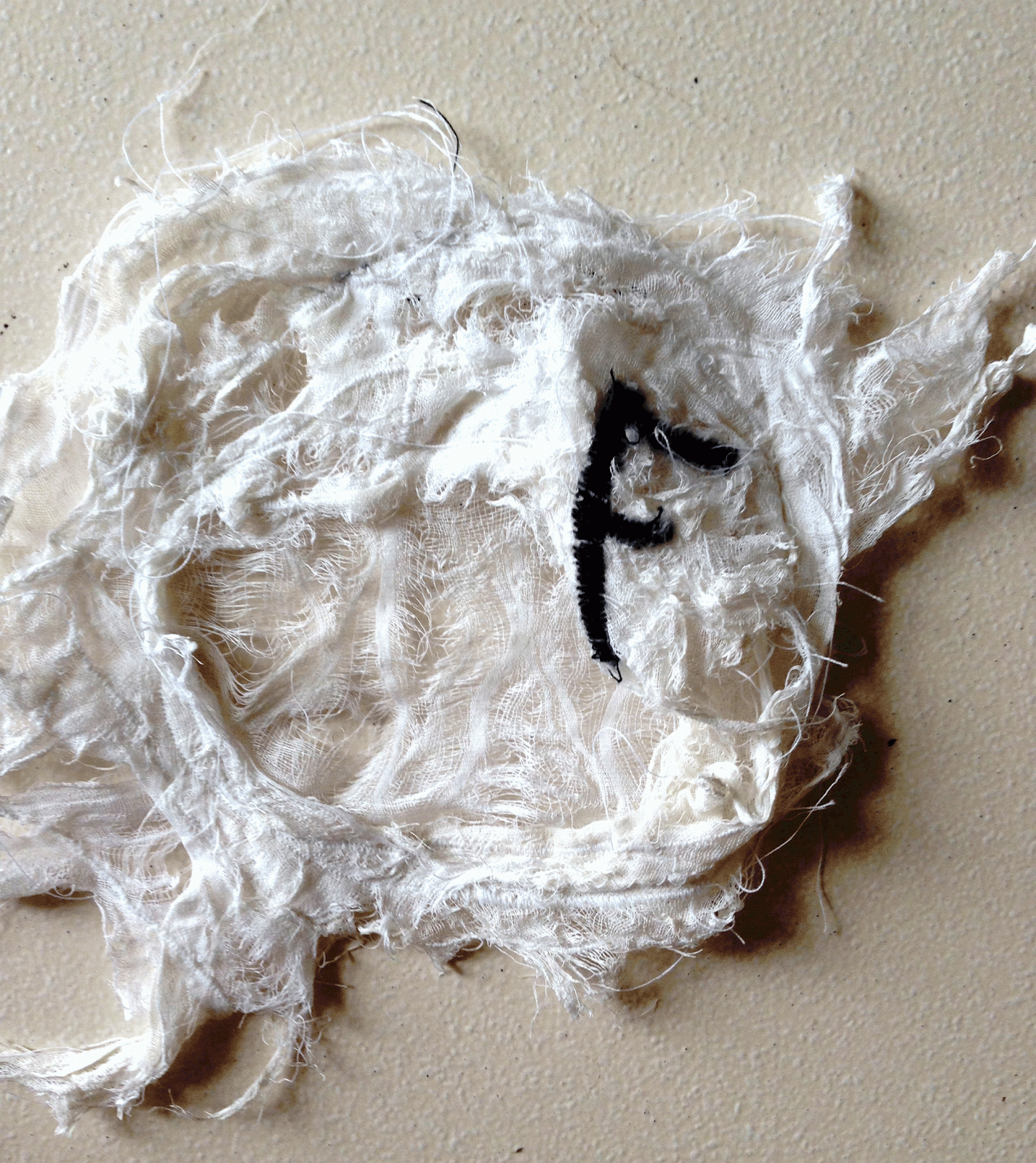
I had been thinking of putting a fine line of Fevicol to bind the edges of the cross- stitch matte.  Despite telling myself each time I picked up the piece to embroider that I must do it at the end of the session, I'd invariably forget. I'd pack everything away carefully without protecting the edges from fraying. And the moment I picked it up the next day, I'd tell myself the exact same thing and forget, each time, in exactly the same way!

Once I had settled down to stitch, it was tedious to get up, put aside the many coloured skeins I had sorted out for the embroidery session – put the needle back into the fabric, go into the next room, hunt for the Fevicol tube and do the needful and then start the ritual of getting started all over again! Not to forget that the viscous solution of Fevicol would need time to dry. And this meant that the precious time I had set aside to sew that evening would be lost. No excuse really. More than laziness, it was the careless chalta hai attitude of “I’ll deal with it when it happens.”

The ritual of reminding myself, doing the embroidery and then putting it away, invariably without doing the needful, had gone on for days now. Predictably, as I was working on the same cross-stitch one evening, the threads at the edge of the matte started fraying. It was the insertion of the needle - a tad too close to the cut edge that was the culprit. But even so, I had known well enough that it would happen one day, but I had been careless nonetheless.

The threads were coming un-done.  This meant that the edge of the work, to which I was giving  finishing touches, would look rather ungainly. I was thinking this, chiding myself for not having put the Fevicol, and hating the idea of the wonky-edged cross-stitch. Almost in the same instant, as if by some ingrained reflex, I then used the very same needle to hold the fraying threads together.


Using the same cross-stitch technique that I was working to embroider the fabric with, using the same needle that had caused a fragile edge to fall apart, made me stop and think. It was a curious fact that I couldn't escape from:  the needle that pierces also repairs and even embellishes.... eventually. And equally curious was the idea that the technique by which I was embellishing the fabric was the same that I had used to repair the edge - doing my jogaad (make-shift repair). It wasn't just a repair of fraying fabric that I'd put into place. The stitch also allowed me to continue with the planned embroidery - as if the fraying hadn't even taken place. At least you couldn't tell unless you scrutinized the edge very closely. Only I knew of the damage.

Well, maybe an expert eye could detect it, but the kind of frayed work I was doing these days, it would pass muster.

I stopped doing the embroidery. I mean this sewing session was laden with meaning, I couldn't continue. I was distracted. I started thinking of the numerous instances when someone or some situation that had hurt me, had also been the catalyst for growth, change and more in the same vein.

It's not easy to deal with this rather paradoxical nature of life and I for one, can never really figure out how to deal with such things. Should I not be wary of the sharpness of the needle? Should one overlook its intrinsically violent nature, to only embrace the beauty that unfolds through its piercing of the fabric? No matter how beautiful the end-result, dealing with an instrument that tenaciously carries its thread in and out of the fabric, generating pain along the way, is a complex affair.

 The needle follows a charted course (sometimes not quite drawn on the fabric but guided by the unfolding design) - unwavering in its stance, oblivious to the silent trauma of the fabric.

If I consider myself the fabric, I know that I cannot forget the pain. And yet we do. That is, until the same sort of thing occurs again. And then it's almost as if a well has been uncorked, where the pain is felt all the more with each recurrence. It makes me wary of those people and circumstances that recur with them. Setting those boundaries can be a difficult thing.

I had known from experience that unless I protected the fragile edges, secured the boundary as it were, the threads would come apart. But I'd continued inserting the needle through those fragile threads for days together - forgetting to put the Fevicol that would bind and protect them. I hadn't taken the precautions - the fabric had to fall apart. It wasn't the fabric that was intrinsically fragile. In an unprotected state, I had carelessly subjected it to repeated piercing by that sharp, pointed needle - causing it to fray.


There was no-one to blame but myself. Again a loaded reminder that if one doesn't take cognisance of those fragile edges of ones being, doing what's needed to keep the equilibrium and set boundaries,  things will inevitably fall apart. Just like the threads of the matte did that night. And these repairs are not always as seamless as my embroidery work......

Thursday, 26 February 2015

Photograph Album


I had started this project of working with stains by photographing the marks in my tea-cup and then getting them digitally printed onto fabric. Suddenly, about a month ago, it struck me that I wanted to work with photos and not have them printed on fabric. I wanted to use photographs from an album and embroider them. I went to the photo album of stains on my computer, edited some images – posterized them and played around on with the little photoshop stuff I had picked up over the years.
 

 There was a sense of urgency to the whole process. I was excited and wanted to see what would emerge, as much as the need to work through  a very stressful phase where I wasn’t getting the usual time to exercise, meditate and write in my journal – dealing with all that came up with the kind of careful scrutiny and analysis I have used to deal with the emotional build-up. I was quite stressed and didn’t have the patience to work with the hand so I used the sewing machine. Actually it was next to impossible to really get much done with hand sewing. Photo paper is thick and the stitches were large and gangly and didn’t really do much to alleviate or express the frazzled state.
 
I hadn’t really used the machine much since my last lesson; the experience of which I shared in a recent post. I didn’t have a clue as to how the machine would respond to photographic paper but some exploration and experimentation revealed that the machine is really quite amenable. If I had any problem it was with the paper, which tore easily. But that was resolved by using fabric beneath and above the paper. Yes, this did sort of create a veil and softened the stains, which made me want to add another element. And that was when I decided to burn the photos.


Armed with candles, some I burned with the fabric already stitched. And some were set alight before I put them under the scrutiny of the needle. As the photos of the stains, that I had recorded some time in 2009, burned, I realised that I was in some sense burning the stains – those marks that symbolized embarrassment, guilt and shame. I felt my frazzled nerves calm down almost as if I was off-loading emotional baggage - catharsis was taking place and without the usual ritual of conversations.


Burning photos, I found, was different to burning ordinary paper.  I didn’t want to really burn them to ashes so I kept a close watch over the photos as they burned and noticed a few things. They burned slowly. And instead of shrivelling up with a bundle of soft and feathery ash beneath them, like regular paper did, the ink smoulders, the paper melts and cracks. The ash is not soft and papery and in some sense purified by the fire, like paper being reduced to ashes – it has a kind of ugly quality.  It is not even ash, the photos crackle into a kind of putrid, thick and almost sticky, black substance. Photographs being burned created the oddest sensation which I encapsulated in a poem.

Flame
Yellow Orange
Ice-blue
within the burning red  

sets ablaze
photos

Ink smoulders
Paper melts
smokes
crackles into putrid ash


After the ritual of burning I sewed into the layers of photo-paper and fabric. It was a very intense process. Controlling the machine - to go round and round the marks, as I do by hand, is easier said than done. Especially with a novice like me trying to do it, but I had such fun. I wasn’t interested in making a piece of work that spoke of fine craftsmanship but wanted to explore the idea of erasing marks in the mind – memories that mark us. Going round and around the marks allows for tracing those marks – like going over the conversations or experience and putting them into perspective.

As I worked with the machine and then the hand - sewing in those odd details that only the hand can do, I realized that the stains or marks of experience that one may try and ‘burn’, are never really erased from memory. They can be buried in time, warped through its seconds and minutes, months and years, but what the mind may feel is forgotten becomes embedded in the body. The body doesn’t forget.
 
Those cells which supposedly renew themselves, they seem to retain the nature of our experiences in a way that our minds seem to have forgotten. I mean, think about it: if we have truly erased, forgiven and forgotten, then what accounts for the countless diseases that abound? 

As a healer I am all too familiar with the idea of stuff being buried under the carpet which shows up as dis-ease and therefore I think it is more about pushing things out of our minds, which often  may seem as if we have forgotten.  It’s worth pondering on why some people are healthier than others – especially those who are more cantankerous, miserable and vocal about their woes.


Memories
sewn as thought 
fade

These marks
buried in time


warped through weft   

the body
doesn't forget

Sunday, 4 January 2015

Are You A Failure......Is Anyone......?

Failing doesn’t make someone a failure, quitting does
                                        – Bob Proctor

'FAILURE' is of those word-stains that I haven’t really wanted to deal with - for the simple reason that I am not sure what this word really means. Of course I know what the dictionary says, but as the above quote implies - simply failing to achieve doesn’t make us failures, only quitting, or terminating the process of trying to achieve does. Then, as long as we keep trying, we are still in the process of achieving and haven’t technically failed. But are there not limits to trying?  Are there also not limits set as to the kind of time one should technically take to achieve something? Aren’t these the parameters that have been dinned into our heads? And more often than not, when one doesn’t achieve something in a designate or reasonably good time, then we consider ourselves failures and give up. Until Lisa Nichols and others like her incite us to keep going with “Quitters don’t win, winners don’t quit”. 

So like I said I don’t really understand how to deal with this word and what it means because where I come from, it has often been said that one should know when to quit....so how does this work?
 
 
But let’s forget for a moment whether we concur on the meaning of ‘Failure’ or if the word should technically even exist in the larger perspective of things and consider instead that often, it’s the mistakes we make that becomes our failures – failure to know better, failure in being able to judge better or do better. Failure seems to dog us, no matter if we give up on something or not, right?

And how many mistakes we do make in a life-time. And then make some more? So, does anyone ever really feel like a winner, all the time? Do you? 
 
I don’t know anyone who really does. Even those who stand up and conduct self-help courses and seminars or webinars as they call them today, or write that pile of books I have on my shelves, have all fallen down and picked themselves up, just like you and I do, every single day.  But the more of these there are around, the more I feel like I am a failure. Sometimes, precisely because I cannot stand up and tell you how to succeed. I don’t have that fool-proof, designed to succeed sure-shot plan.

There have been many times that I have felt like a failure. There have also been those times that I have felt like more like a loser than a winner. Yes, on some days I do feel pretty chuffed with myself – especially when I win ten out of the ten games I am playing on scrabble. But, on most occasions I tend to feel less so, and wonder what have I achieved?
 
However, the other day, I had a small success. I wanted to learn how to use the sewing machine and the class went very well. I actually managed to write out the word FAILURE through the machine and then cut some fabric into little bits and play around with the multiple stitch options. The result was quite familiar. Yes, you read it right. I said familiar because it was almost exactly what I felt within me -a  total lack of order, no control over where I was going –  concentrating so hard on trying to co-ordinate the hand and foot and while it wasn’t quite the same as learning how to drive, it was a challenge.

I have resisted using the sewing machine because I feel good doing
hand-work which slows one down, in tune with the rhythm of the body. However, the past weeks had been rather stressful and the mental strain was just not allowing me to access that natural rhythm of the body easily enough - making me feel even more of a failure. I mean, where was all my training as a yoga practitioner, reiki healer and someone who has done intense meditation for twenty years? What was going on, where was I headed with this screaming inside my head?

One after the other some domestic issue was cropping up  -  tantrums from the help, one maid left, a new one started – totally raw and now I have the pressure of training her to boot.  The fridge was over-cooling and no parts were available – there was a special offer on so I bought a new one. That should have been easy, but the fridge turned out to be, not the one I’d ordered. But I couldn’t have got that one anyway because Samsung had misrepresented the product in their catalogue. I was over-charged and had arguing marathons that fried my brain and am have given up trying to get Samsung to explain the mess-up.  The list continues in this vein – an almost non-ending list that anyone who runs a home must be familiar with. 
 
Anyway, young Advesh from Usha Sewing Machines came to give me a demo and also instruct me, on how to use the sewing machine that I’ve  had with me, for a while now, but never used. I felt like an excited child with her new toy and before I knew it 3 hours had lapsed.  I was simply delighted to have just about learned to thread the needle and move the fabric - to get the needle to go along the lines that I wanted it to – very basic stuff. I was glowing with the praise from my tutor who said that he had never seen anyone manage quite so well, on their first attempt.  How wonderful that sounded to ears that had been on living on battle lines and only heard criticism from within and without, for days together!

I hope that soon I will gain greater control over the process because truthfully, by the time he left, I was nothing short of exhausted. It took every ounce of my concentration to press the pedal and trace the needle over the word ‘Failure’ written in running hand, on the fabric. 
 

Advesh is 24 years old and had come all the way from Faridabad. This is his first job and he’s been doing it for three years. It was very reassuring to have him around every time the thread caught in the needle because of a knot, or when I kept stitching and didn’t even realise the thread had snapped and was no longer in the needle, and a lot more of such glitches that came up. His practiced eye and hand guided me with patience and also watched me with utmost curiosity as I created a blob out of the word ‘Failure’.  I am sure he was cringing. It wasn’t the kind of embroidery he had ever seen, he said, but patiently guided me to do what I wanted.

The  reason that I chosen to learn how to work with the machine was because it occurred to me that in this age, where machines do so much of our work, could I really afford to continue to working with the hand alone? I needed to explore this dimension before I decided it didn’t work. And who knows, it may well turn out to be a useful support tool. 
 
I took great delight in allowing the machine to stitch. It was my first attempt and there was no expectation from myself – I just had to learn.  I was having fun and the machine suited the frazzled state of failure. I found a strange calm descending over me because for a while now, I had felt this intense desire to take some kind of a quantum leap to get past the plethora of thoughts that would run amok in my mind. I really was struggling to organize all aspects of my life – those fundamental things that needed doing from cooking and  more along with my professional work, and then burn them out of the mind by exercising - exhausting myself.

I did find some measure of peace at the end of the day when I was alone, to write or do some creative work. But, I would be so exhausted the next day that waking up was hard, I just didn’t want to. This strategy wasn’t working out well. I needed to figure out another way to express the angst and also find mental clarity and peace. It wasn’t good enough to dull the mind with exercise as it only got more intense the next day. What I needed was something that could adequately express the frazzle.  Working with the hand may eventually calm me down, but truth is that it wasn’t expressing the way I felt and expression of this fraught state of mind is what I sought – it was needed to get the ‘gunge’ out!

The whirring of the machine; the random stitching, making a piece that didn’t take hours but could be accomplished in a short while, made me feel as if I had accomplished something. At the end of three hours, my first three hours of sewing with a machine, I actually had something to show. 
 

It was different, it was a challenge and it also brought into play a whole different work ethic – all of which I managed. That day, I didn’t feel like a failure. I had learned to thread the sewing machine needle and make some marks with thread that expressed, somewhat, the way I felt. In the bigger picture if failure looms large, one needs to be reminded that it is the small things  we do achieve each day that add up to what can be called success.

I don’t think anyone can really be called a failure, even if we do give up. In the process of trying, it’s what we learnt that made us decide to give up, which is integral to the success of our story, is it not?

Friday, 31 October 2014

Sew It On Yourself, She Said.....


I haven’t really been able to focus upon my embroidery for the last few weeks.Working on a project to make 2000 origami butterflies is keeping my fingers really busy. One thing that I have noticed about making the butterflies is that, contrary to my expectations – the logical tedium of making the same thing over and over again; I am really enjoying it. Yes, believe it or not, I didn’t at first either, but it’s so calming to just put my full concentration on matching corners and lines and folding the square pieces of paper to create butterflies.


It’s almost addictive to see how many I can make in day. So yes, I am really enjoying it – call it origami therapy if you will. Whatever it is or isn’t, is so irrelevant because there is a designated purpose in doing [they are needed to decorate a canopy for a friend’s parents’ 60th wedding anniversary lunch], there’s satisfaction in getting it done and, it is creative work to boot. I delight at every butterfly that is made, marvelling at how a square piece of paper can be folded into myriad designs. 

 At this point in time, there is chaos, a total disruption of routine in my home. I have been short staffed and in particular, without a cook for the past 6 -7 weeks. Despite a string of interviews and trials, I haven’t yet found someone suited to my need, who cooks well enough. This has meant that along with making the butterflies, I have also had to get down to the nitty-gritty of cooking everyday food, rather than just those party dishes that I enjoy making.

At this point you are probably wondering what relevance either the origami butterflies or daily cooking chores have anything to do with a sewing journal and you wouldn’t be wrong in thinking upon those lines. Had I been in your shoes, without experiencing unbelievable calm in the midst of chaos and work, such as I have seen in this period of externalizing of energy and conversations - when I am generally an introverted sort of person, finding no scope for deep introspection, I would have thought the same. But it is these things -the origami butterfly making ritual and that of daily cooking that have actually saved the day for me. They have enabled a focus on things that need doing rather than looking towards things that I have wanted to bring into play, thinking and mooning and mulling over things – shall I write this, what shall I do now etc,  as is the norm. And what’s best is that most of this work is not about handling people and their idiosyncrasies but actually being able to put my mind to doing things. I have to confess that even though it has been challenging, for the most part because it’s not the norm, I have no real reason to complain.

 With the onset of Diwali, there has been so much to do. I first started with wanting the kids I teach art, to enjoy the festive season by making their own diyas and rangoli.  This meant shopping around for stuff they could use, painting and decorating pieces that they could work with and be inspired by. This exercise eventually led us to take up a stall at the condominium Diwali mela, with only 5 days notice, where the kids and I invited people to come paint their own diya. The stall was an amazing success. It was possibly the most happening stall in the compound and Mahipal and I didn’t get a chance to go around and see what other vendors had to offer. As one mother put it, our stall was akin to the games stall which the older kids had fun at, and the little ones usually have nowhere to go, so this filled that lacuna. We started at 5.30pm, on the dot, and didn’t wind up till 11pm. I cannot say that we made a ton of money because we didn’t, as our rates were so cheap that we just about broke even, but the turn-out was amazing. And that huge black stain on the red, tentwallah-satin table cloth – with little glimpses of green, yellow, orange and other hues that went into making that extra large spill of dripping paint, was proof enough that the kids had a blast.

Inspired by the origami butterflies, I had decided to make origami boxes for sending out little gifts to my friends, neighbours and family this Diwali, which meant that for three Sundays in a row, I was working. At first the novelty of going back to work with paint and brush, after years, was such an amazing feeling and then making the origami boxes all added up to the idea that I was actually using my creative skills in a way that catered to the functional aspect of the season. And that felt good.

Now this is very significant, because even though I use sewing as self-expression and there is a function to this, in that it allows me to explore deeper ideas than just doing things for the more mundane functions such as I have written above. But, the idea that my work - my creativity, which is the basis of the work I do in the world, that this is mostly used for self expression - as art, has been cause for considerable angst. 
It could be that having trained as a designer, this is sort of in my blood – the idea of form follows function has been ingrained enough to flow through my being, and the evolution from design to art thus fraught with multiple questions? Over the years, I have quelled the discomfort and gone with the flow. But, it felt good making things for my friends. And when they called or wrote sms’s to thank me, noting that they had found the gift beautiful, especially so because they had recognized the labour of love, was gratifying indeed. This personalizing of traditional diwali gifts instead of store bought items was appreciated and it got me thinking.

Painting diyas for the art class also led me to paint a bunch to light and decorate my own home with, this Diwali. Armed with so much stuff, I embarked on a rather ambitious rangoli outside my front door.  I was reeling from the agony of unused muscles and incredibly stiff lower limbs for about three days! But, flushed with the glow of praise and appreciation from so many people, for this effort, re-awakened in me the idea of functionality and art – fulfilling the function of more mundane, everyday aspects of living, where I worked to create with my own hands as opposed to designing and then designating the work to someone else.

All of this was building up into something that hadn’t quite crystallized in my mind and the crowning glory was a chance remark that someone made at a Diwali party, the day before Lakshmi Puja and my elaborate rangoli effort. I was wearing a silk Tanchoi saree [brocade] and getting out of the car, the heel of my sandal, sort of caught at the base of the saree. On hindsight, it must have got stuck in the saree-fall, but without really thinking about what the issue was, I lifted the folds off the shoe. They let go easily enough, and I walked into a beautifully adorned home, met many friends and had engaging and polite conversations. In this bustle of socializing, the saree hem caught again. This time, when I pulled at the folds, the fall must have come undone [the lining at the hem which is about 4 inches wide and runs across the base of the underside of the saree, to enable a better fall of the fabric].  After a while I suddenly felt myself tripping and looked down at the saree to find the fall looping beneath. Philosophically, I thought this was my cue to go home - tripping over my undone saree fall wasn’t a befitting end to such a gay event.
I was seated in one of the bedrooms waiting to use the washroom, before I embarked upon the long haul to Gurgaon, when someone else walked in, and we struck up a conversation. She was a rather elderly lady wearing a traditional Kanjeevaram saree in a colour combination of soft, olivish-lime-green with maroon and gold zari border, such that I haven’t seen around for ages. She had a short bob hair-cut, her hair totally grey. She’d overheard me ask my host’s grand-daughter to find me a safety pin and asked what happened. I narrated by story about the fall coming undone and sighing that now, in the midst of my more-than-hectic schedule,  I had to find someone locally, to put it back on. Very quietly and calmly, as if it was the most normal thing in the world, she said: do it yourself. And I was stunned into silence.

She didn’t know who I was, or that needle and thread was the basis of my work. She didn’t know me at all.  We were total strangers. I sat there stunned. I wasn’t as stunned about the fact that she didn’t know sewing  was  the essence of my work, but that I, whose hands played with needle and thread every day, hadn’t thought of this simple solution – something that should have occurred to me as naturally as she had said it. I mean what was the merit of working with needle and thread to build up these wonderful stories around it, if I couldn’t even think in terms of doing my own repair work?  I was ashamed, I was embarrassed and contrite.

On the hour long drive, back home to Gurgaon, I was deep in thought. I realised that even though I am adept at working with the needle and had used it to make little gift bags for Diwali [for the goodies inside the origami boxes], and more, fact is that I didn’t think of sewing as work I should be doing, beyond the decorative – it never even occurred to me.  And in a sense, this meant that I didn’t really accord the same kind of value that I would like be given to the humble needle and thread - one of the reasons why I even write this journal.

I mean, it was a wake-up call and seriously, even as I write, I am astounded by the kind of cultural moorings - ideas that have taken root in my mind. It made me see that changing one’s thought-patterns wasn’t an easy thing. It took a lot of effort to work around these subconscious ideas that we have imbibed through the environment that we live and grow up in. I hadn’t seen my mother or grandmother sew but I had worked a lifetime with textiles; admired the skill of Indian artisans and was in awe of their ability to do wonders with needle and thread. I had picked up the needle to bring attention and value to this work that I so loved. But, despite two decades of working with needle and thread, I didn’t think of doing my own sewing for things around the house and general repair work in daily living.

 The idea of stitching, back-on, the undone fall on my saree was not something that came naturally to me. That it took a total stranger to remind me, was a wake-up call indeed! Sew it on yourself she said....the words still ringing in my ears, way above the din of the fireworks on Diwali night. 

For those interested in reading the story about the butterfly that enchanted me which was the beginning of the 'Butterfly effect'
http://garammasalachai.blogspot.in/2014/10/butterfly-wings.html


Monday, 25 August 2014

How Selfish Can You Be!


Taking off from my embroidered work on the word ‘Liar’ – the mental stain that emerges on being called a Liar, or is left in the mind when judging someone a Liar - 
Liar,Liar,Liar..... http://gopikanathstitchjournal.blogspot.in/2014/04/liar-liar-liar.html  I have moved onto working with ‘SELFISH’.

I first wrote the letters on paper in a cursive hand, going over and over them, creating a kind of stain. I then drew this mark on a piece of cross-stitch matte.  For some reason, this time I have worked only with cross-stitch.  And, so far, without the muslin which I had earlier torn, burned or shred to express the way I felt.

The writing and over-writing on the word, created a kind of blob.
This then led me to draw the letters which extend above the base line - as loops – such as  the loop of the ‘S’, the ‘l’ and the ‘h’,  in a cursive hand. While outlining this, I started seeing, in my mind’s eye, capital letters rising from behind the cursive hand.  I found that I could only fit in S E L F. Now this gave me food for thought – and I started thinking on the lines of ‘SELF’ as emerging from being selfish.

Cross stitch is a laborious process and very meditative in itself. But, at this point I was rather restive and didn’t quite relish the intense routine of the stitch, which created more contemplation on the inner being than expression of the fraught mind. But, gradually as I worked, I calmed down. Naturally ha! 
 

Many years ago an astrologer advised me that I learn to be more selfish. I found it totally weird but over the years, have often pondered on the idea of being selfish. Conventionally, selfish is not considered a desirable trait, so why was this guy telling me to learn how to be more selfish and basically what did it entail?

I found it very curious the way ‘SELFISH’ was evolving through my embroidery and the meaning that was emerging from this creative representation of the word. It lent an entirely different perspective to:  How selfish can you be!!  - A term, mostly used with derision.
 
 I recollect one of my boarding school reports, where the nuns had noted that I was self-centred and how my mother had chided me for this. Possibly, in her scheme of things, being self-centred meant that I did what I felt in my heart. And this I know, didn’t always meet with her approval.

I was not an overtly rebellious child but driven by ‘feeling’ more than thinking things through, until such a point I felt this had alienated my mother’s love.  She couldn’t understand or discipline me in the way she did my other siblings. Later, ‘doing’ things in a way that catered to a perceived need, to gain her approval, met with disastrous consequences - alienating me from myself.

In this condition, to consider being selfish and doing things that suited me, without caring for the approval of others, perplexed me no end. But through a great deal of self-examining which started about two decades ago, I began to see that there were two kinds of selfishness.

One was being self-centred - rooted in one’s being, listening to the inner guidance. Doing what was needed to do to fulfil one’s life’s purpose – identify it and live. Not through someone else’s dictates or what was perceived as their need - often manipulated by guilt, but through that inner vision that comes forth when one is silent enough to look within and feel. This doesn’t mean a disregard for others in your life and insensitivity towards their feelings or disrespect for them. It just means a healthy respect for you. This state of being will always accommodate those who matter. It means finding that ideal balance between their needs and your own- straddling the most complex of all the paradoxes of life.

The other kind of selfish, is where we are driven by the ego, that i-ness where indignation of the mind comes into play and everything is driven by the way we think that things must be. This other kind of selfishness is what we are usually derisive of. Here people become self-absorbed in a dense and secretive way. They can be insensitive and act almost unconscious of their heart-speak. By extension, they have little respect for others, often without even realising it.

In this state of being, one is running away from that mirror of self, chasing things or ideas regardless of whom or what comes under the callous wheels of this carriage – just to get as far away as possible from that sense of wretchedness that comes from being unable to resolve the inner conflict of mind and spirit or subconscious mind and conscious mind or any other conflict that may be taking place within the human being.

So, when I started looking at the discomfort that I felt in being called selfish and then contrarily also being advised to be more selfish – learn to be so, I felt considerable conflict in my being. At one level it was about being rooted – silent and peaceful with one’s being, working from that heart centre that would guide in mysterious ways towards whatever was right for me. Or, there was the selfishness a lot of us have encountered - where people have no time to listen, focussing upon their own pain, recounting woes and living in a constant state of victimization. I thought I was participating in the former, but was accused of the latter and I couldn’t ever feel at peace because how did one really resolve this issue?         

Through my contemplation on the word, as I embroidered, I was beginning to see that being selfish – no matter which way you look at it, actually roots you in yourself. This, I realised couldn’t be presented through the shredded or pulled fabric – which evokes a fragmented state of being, so I decided to go with the intuitive nudge and work with just the cross-stitch.

I started realising that the word itself is not the problem, it is the association attached to it which creates one. When someone says you are selfish or self-centred, the connotation is a negative one. It deems that you are unwilling to help others when they need. But, truth is that giving to the extent that others often seem to need, especially when they are not rooted in themselves, and therefore in their actual need, can be tough, because it will never be enough.

 Continuing my work on the blob or stain –I outlined the cursive-hand marks in a neutral colour, but, one that had tinges of the colour of a ‘tea stain’ - reflective of a mark or stain in the mind. Then I outlined S E L F [there was no space to include ISH] with a soft pink – the colour of rose quartz, also in some schools of thought, representative of the colour of the heart chakra.  This I suppose could indicate love - in embracing the self. All of this was emerging through that intuitive feeling. I was after all in unchartered territory so that was the only direction I could rely upon.

And then I thought I would have the rising letters of S E L F embroidered in this soft pink hue, but as it rose higher, it would merge with the colour of the fabric.  It would go from soft pink into a kind of off-white – suggesting the emotional and spiritual process of how we rise into the higher self, through selfish beings rooted in the ego self and all that came with it – the stains, the shame, the pain et al.

Gradually as the stains of experience are cleansed through knowing and understanding, the pure self - that spirit of divinity within, emerges and merges with the ether or nothingness - as it is also called. Therefore the colour surrounding the ‘word-stain’ is off-white, reflective of this nothingness.

I don’t know what this piece will end up looking like, and how I will bring in the muslin that I have used with the others, which I probably will because it looks kind of naked without it and very stark too.  But, in this language of fabric, thread, colour and stitch, I was able to find an objective distance.

 I realised that the path of self realisation is through the darkness – the ignorance, the emotion and judgements of the world. And gradually, as one does deal with these experiences and our emotions and attachments thereof, going deeper into the stains, some kind of neutrality emerges – without that harsh, critical and defensive judgement of self and others.
            

Examining the ‘blob’ or ‘word-stain’ through the embroidery process, has enabled me to redefine the meaning of the word, where being selfish - either with or without the ego is really all about a process, and that it cannot be forced upon one. We all begin our journey without knowing much and it is experience and sometimes our own hostile survival instincts that eventually teach us different ways of living.

As the capital S E L F stands erect, high above the muddy, stain-coloured letters below, they stand straight, as if exuding dignity, holding their heads high almost as though the issue is resolved. They seem to say that there is now, no need for shame. It is all part of life, where being selfish will eventually lead you to being self-centred – tuned into your inner being where only SELF matters......or nothing does.


Monday, 23 June 2014

And Wish That I Did Not Feel


 This well is far too deep, deep and black, a watery void.

These dark grey ageing stones are holding onto the surface with bitter ambition, old and darkening, adorned with olive-green mosses. This well was built by my hands, each stone laid down under a waxing moon. I am fated to drown
                                                              beneath its brown shameful waters, waters that flow so deep they touch the very Past, Present, and Future.

I will sink ever further through stagnant tides with my lungs overflowing and my eyes blind, sinking past the places beyond the light of the living world.

I will touch the solid core of the Earth with cold lifeless hands and wish that I did not feel.”


Still Waters [a poem]
Reproduced with the kind permission of Jade Kennedy
www.jadekennedywriter.blogspot.co.uk


The last line of this poem grips me, and knots me up in a bundle of complex emotions which is what the whole idea of ‘feeling’ does to me – of being alive to sensations of pain, of not understanding something and feeling overwhelmed by things – by life as it unfolds.

Why do we feel? Why can't I just be there for someone regardless of my needs and feelings – of unresolved pain, from things in the past, between us? Why must there always be this kashish – this pull, this tension between people and in almost every aspect of living? Why do feelings always seem to get in the way? 

The other day I picked up a piece of six-ply floss that I had earlier removed a two-ply strand, but carelessly left the rest without straightening it out, [as I usually do] thinking that I would be using it soon. But, typically, something had come up and my embroidery and tools hurriedly bundled away. When I came to use it a day or so later, the bunched up strands, of what had been perfectly straight threads, had become knotted.

Just like those unresolved thoughts that one didn’t quite get around to dealing with, because something else came up.

It took time to open the entangled threads and the funny part is that it wasn’t really a knot, but appeared to be one because the threads had become twisted. I pulled a little here, and tugged at the thread a little in the opposite direction. I inserted a needle and made space in the knot so that I could pull the threads out. It took quite a bit of patience and I could feel this irritation welling up inside me. It was my own fault. I had left things carelessly and had no choice but to deal with it, just as the poem says:

“This well was built by my hands, each stone laid down under a waxing moon. I am fated to drown
                                                              beneath its brown shameful waters, waters that flow so deep they touch the very Past, Present, and Future.”


 In its own time – of tackling those uncomfortable twists and turns, the floss was unravelled as if the knot had never been there.  I am always amazed at how this happens. Experience has taught me that I don’t need to cut the thread and throw away almost half the strand but that I can unravel it. And when the knot opens it is such a lovely surprise, always.

It’s almost as if the knot was never quite the struggle it seemed and its funny, but I often get the same sense when there is contention in my mind and I sit and ruminate or fume in isolation but, when I meet the person or people who have been catalysts for creating this, I get this really strange feeling that none of that was ever an issue. And yet, I know it had been sitting there like a leaden weight – a knot, somewhere in my being.

However, it did take time and a lot of patience to unravel the threads, much like those complex issues that keep running through the mind, which if left too long, seem to get into a twist.


In this instance, I took the time needed to open out the entangled thread but, when I need space to deal with the stuff that experience throws my way, I lament at why it needs so much time and I can hear my own voice judging me, as selfish!..... and more such epithets.


Yes, I know it's a conditioned reflex that leans on those voices that taught me to how walk and write and more - that it's a voice of judgement that denies or rejects a need in me in order fulfil that of another, but it's a tough call - this tension within, the conflict between what's right by me and to do right by others that often torments me and I throw up my hands in despair saying why, why do I have to feel!

I wish I didn’t feel so much, when every incident didn’t affect me in so many ways – get me into a twist. It isn’t just a sense of pain that one may feel when life tests you, but also feelings of being alive in the world, alive and awakened to the external stimulus of the world, of people and places  - the pain and pangs of being and also the beauty of nature around me, all of that makes me feel. And sometimes, when there isn’t time to savour a pleasant experience that too can be a problematic feeling.

These things need to be put into perspective. What is the world revealing to me? What is the message from the universe? What did the fallen leaf say? Why did those words, that incident topple my emotional balance? Does the spate of raging summer storms reflect the storms brewing within me? Is there any other way in which I could have handled a particular conversation and changed the outcome of things? 


These are countless questions that I keep asking myself each day, as I pause by the window, as I stand up to stretch my limbs after hours of working, shoulders hunched, on my embroidered pieces or typing on the computer. Or as I brush my hair and go about doing other such mundane functions of living.

At one level life is beautiful because one can feel. I cannot imagine looking at the radiant sunsets, especially in the monsoon season and wishing I didn’t feel. The sense of joy that surges through me when I see those transient colourscapes in the sky, is something that I wouldn’t give up at any cost. But the irony is that life is a paradox and feelings don’t always convey such exultation in being.  Those feelings that drag us down – taking us, reluctantly, deeper into ourselves - into that unseen core our beings, where it seems as if we are alone, at the mercy of “cold life-less hands” that do not have the capacity to hug and hold and provide comfort in being, but dispassionately compel us face ourselves, are the ones that most of us would rather avoid feeling.

 That sense of pain, of rejection, of not quite getting what we wanted in the way that we did - when we feel challenged by the world around us, is what takes us into those dark unknown crevices of our being where we would otherwise not have tread, where the poet says:  “I will sink ever further through stagnant tides with my lungs overflowing and my eyes blind, sinking past the places beyond the light of the living world.”


And paradoxically, it is in those dark, hitherto unknown crevices that lay the secrets to release us from these very moments of darkness that we resist. Secrets that life will reveal, only if we allow ourselves to feel - even as the poet proclaims:  “I will touch the solid core of the Earth with cold lifeless hands and wish that I did not feel.”

When I read this poem by Jade Kennedy, an English poet who lives in Kingston on Hull, [whom I met on a Google+ community] I felt a stab in my gut – of recognition of something I’d felt too, but hadn’t been able to put into words, at least not quite so poetically,

 I empathized with the poet and echoed her sentiments. This poem gave me solace in knowing that someone else felt the same way, which counts for a lot in my book. It  made me realise that the poet in allowing herself to feel the full intensity of being in that given situation which echoed something I too was familiar with, had been able to articulate what many others like me may well feel, but are unable to express  - put into words and find this kind of clarity. But reading the poem lent that clarity and with it a sense of relief too.

It is in sharing that we lend a bit of ourselves to others so that they may find something of themselves in that. And it is only in finding these fragments that we do in effect, experience some sense of wholeness. In a world where the essential spirit of our being is separated by form and identities that question each other, what other way can there be to experience this?

It made me think - If as a creative person, I could enable people around me to find a piece of themselves, this alters my perspective on being an artist and writer. It allows me to feel less selfish and self-indulgent, for needing the time and space to put my life into perspective – deal with my feelings.

 Even as I continue my lament alongside the poet when she says:

“I will touch the solid core of the Earth with cold lifeless hands and wish that I did not feel.”